














Buying a vintage or handcrafted guitar is one of the most rewarding decisions a collector can make, but it is also one of the most unforgiving. A single overlooked crack, a refinished body, or an undocumented repair can quietly erase thousands of dollars in value before you even play the first chord. What exactly should you check before you buy? This checklist walks you through every critical step, from setting up your inspection environment to verifying provenance, so you can approach every purchase with the confidence of a seasoned expert rather than the anxiety of a first-time buyer.
Table of Contents
- Prepare your inspection toolkit and environment
- Inspect construction and materials
- Assess playability, sound, and intonation
- Value factors: originality, wear, and documentation
- What collectors overlook: The hidden costs and rare rewards
- Find your next vintage or handcrafted guitar
- Frequently asked questions
Key Takeaways
| Point | Details |
|---|---|
| Inspection setup matters | The right tools and environment are critical for reliable guitar evaluation. |
| Verify construction details | Rare wood types and original finishes drive both value and sound quality. |
| Playability checks are essential | Precise measurements and tonal tests reveal true instrument quality. |
| Originality impacts value | Unmodified, era-authentic guitars with proper documentation are most collectible. |
| Expert perspective counts | Knowing what veteran collectors value helps avoid costly mistakes and spot hidden gems. |
Prepare your inspection toolkit and environment
Before you touch a single guitar, your setup matters more than most buyers realize. Accurate evaluation depends on stable conditions and the right tools. Walking into a seller’s living room with no equipment and relying purely on instinct is how costly mistakes happen.
Here are the essential tools every serious inspector should bring:
- Straightedge: A precision metal straightedge reveals neck bow, back bow, or hump at the body joint that the naked eye misses.
- Feeler gauge: Used to measure neck relief (the slight curve in the neck) and string action with precision.
- Chromatic tuner: Checks intonation accuracy across all frets, not just open strings.
- Humidity meter (hygrometer): Confirms whether the guitar has been stored in safe conditions, typically 45 to 55% relative humidity.
- Portable LED light: Angles light across the surface to reveal hidden finish flaws, hairline cracks, or repair touch-ups.
Environmental conditions also shape your readings. Ideally, inspect guitars at room temperature between 70 and 75°F with relative humidity in that 45 to 55% range. Wood expands and contracts with humidity shifts, so a neck that looks straight in a dry room may behave differently at home. Always prepare inspection tools and environment before committing to any evaluation.
Pro Tip: Bring a portable LED light with a narrow beam. Hold it at a low angle across the guitar’s top and sides. Finish repairs, filled cracks, and touch-up paint become immediately visible under raking light, even when they are invisible under standard room lighting.
Controlled lighting also matters for color matching. Some refinished guitars look flawless under warm indoor light but reveal obvious color mismatches under daylight-balanced LEDs. Take your time here. A thorough setup saves you from expensive regrets later.
Inspect construction and materials
With your environment ready, shift your focus to the guitar itself. Construction quality and material authenticity are the backbone of any vintage instrument’s value.
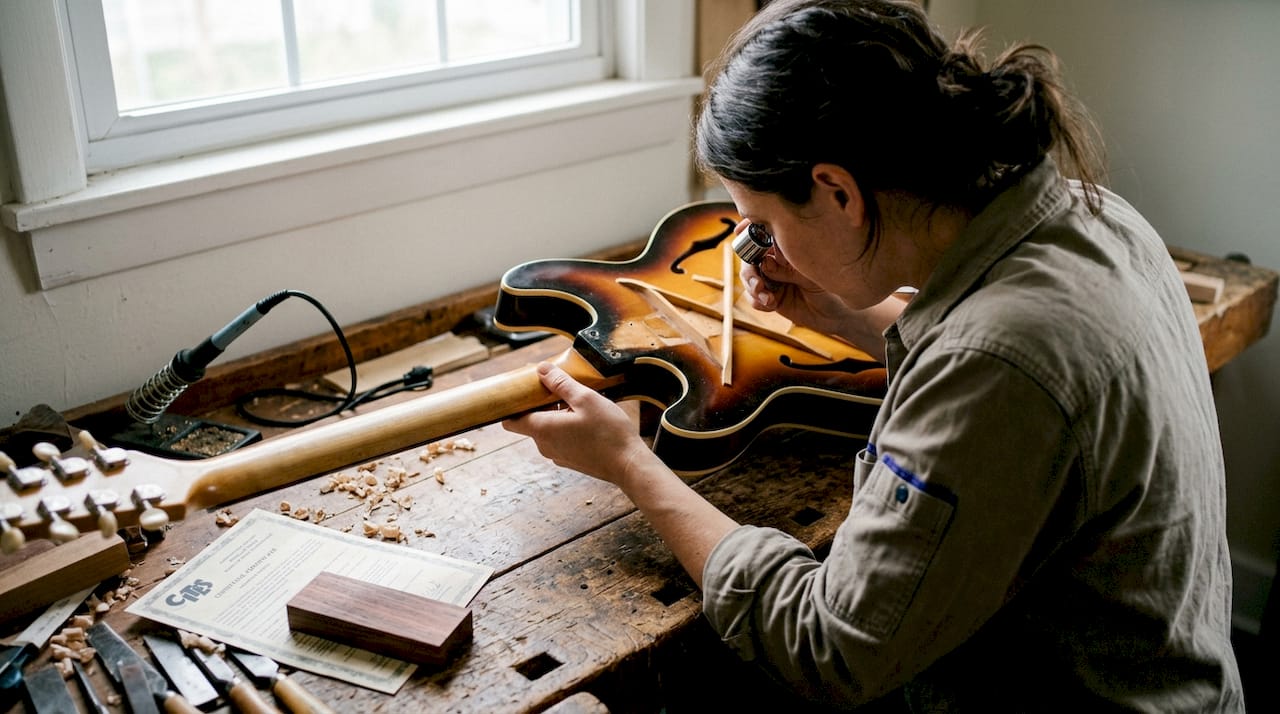
Start with the wood. Wood types and guitar value are deeply connected, and knowing what you are looking at is non-negotiable. Here is a quick reference:
| Wood | Common use | Rarity | Value impact |
|---|---|---|---|
| Brazilian rosewood | Back and sides | Very high | Significant premium |
| Indian rosewood | Back and sides | Moderate | Standard market rate |
| Old-growth Sitka spruce | Tops | High | Strong tonal value |
| Mahogany | Necks, backs | Common | Moderate baseline |
| Ebony | Fretboards | High | Adds collector appeal |
Brazilian rosewood is banned post-1969 under CITES regulations, making it both legally sensitive and highly prized. If a seller claims Brazilian rosewood, verify it with documentation before proceeding.
Next, examine the finish. Vintage guitars were typically finished with nitrocellulose lacquer, which ages in a distinctive way. Over decades, nitro develops fine surface cracks known as “checking.” This is not damage. It is actually a sign of age-appropriate authenticity. Polyurethane finishes, used on most modern instruments, do not check the same way and feel noticeably thicker to the touch.
“Finish checking on a vintage instrument is like reading tree rings. It tells you the guitar has lived through real time, real humidity cycles, and real use. A poly finish that looks perfect on a claimed 1960s guitar should raise immediate questions.”
For a thorough approach to authenticating vintage guitars, cross-reference finish characteristics with known manufacturer specs for the year in question. Use the 7-point checklist for vintage guitars as a structured reference alongside your own visual inspection.
Check for structural issues: top cracks, back seam separations, warped bracing, and loose neck joints. Run your fingers along every seam. Look inside the soundhole with your LED light for brace cracks or old glue repairs.
Pro Tip: Old repairs or modifications often reduce value by up to 50%. A refretted neck, replaced tuners, or a reset neck joint may be functionally sound but will significantly lower collector interest and resale price.
Assess playability, sound, and intonation
Construction tells you what a guitar is. Playability tells you what it does. Both matter, but for players and collectors alike, the way an instrument feels and sounds under your hands is the ultimate test.
Follow these steps in order:
- Check neck relief: Use your feeler gauge between the 7th and 8th fret while fretting the 1st and 14th frets simultaneously. Ideal relief is 0.25 to 0.35mm for most vintage acoustics.
- Measure string action: At the 12th fret, bass strings should sit at approximately 3.2mm and treble strings at 2.8mm. Anything significantly higher suggests neck issues or a rising top.
- Test intonation: Play each string open, then fretted at the 12th fret. The fretted note should match the open harmonic within ±3 cents. Wider deviation signals a setup problem or structural issue.
- Play every fret: Buzz, dead spots, or uneven sustain across the fretboard reveal fret wear, high frets, or neck warping that static inspection misses.
- Listen for tonal character: Strum slowly and listen for clarity, sustain, and dynamic range. A great vintage guitar responds differently at soft and loud volumes.
Here is a quick reference for ideal measurement ranges:
| Measurement | Ideal range | Red flag |
|---|---|---|
| Neck relief | 0.25 to 0.35mm | Over 0.5mm |
| Bass action (12th fret) | 3.2mm | Over 4.0mm |
| Treble action (12th fret) | 2.8mm | Over 3.5mm |
| Intonation variance | Within ±3 cents | Over ±5 cents |
For deeper guidance on testing vintage guitars and used guitar evaluation tips, these resources cover setup standards in detail. Always assess playability and sound as a separate step from visual inspection, because a guitar that looks perfect can still play poorly.
Pro Tip: Use slow, deliberate strumming at low volume to hear subtle tonal character. Many players rush this step. The overtones and harmonic complexity of a quality vintage instrument reveal themselves only when you give them space to breathe.
Value factors: originality, wear, and documentation
Here is where collector instinct and investment logic converge. A guitar can pass every playability test and still be a poor collectible buy if its originality has been compromised.
Key value factors to evaluate:
- All-original hardware: Original tuners, nut, saddle, and bridge pins matter. Replacements, even quality ones, reduce collector value.
- Unaltered electronics (for electrics): Original pickups, pots, and wiring are critical. Replacement pickups on a vintage electric can drop value significantly.
- Era-appropriate play wear: Buckle rash, pick wear, and fret wear that match the guitar’s age tell an authentic story. This kind of honest wear can increase desirability among serious collectors.
- Repairs and modifications: Modifications can reduce collector value by 20 to 50%. A refin (refinish) is often the single most damaging modification to a vintage guitar’s value.
- Documentation: Original case, hang tags, receipts, and previous ownership records all add provenance and buyer confidence.
Verify CITES compliance if the guitar contains restricted materials. Brazilian rosewood requires documentation proving the wood predates the 1969 ban. Without it, the guitar cannot be legally sold across international borders, regardless of its quality.
Use the authentication guide to cross-check serial numbers, headstock decals, and hardware against manufacturer records. The identifying vintage guitars resource provides era-specific details that make authentication far more reliable.
Key stat: Guitars with all-original components and documented provenance consistently command the highest prices at auction, often outperforming cosmetically superior but modified examples by a wide margin.
What collectors overlook: The hidden costs and rare rewards
Most buyers focus on what is wrong with a guitar. The real skill is knowing what is actually wrong versus what only looks wrong, and understanding which imperfections tell a story worth paying for.
Here is the uncomfortable truth: a professionally restored guitar with a clean refin and new hardware often sells for less than a rougher, all-original example with honest wear. Over-restoration destroys the very thing collectors pay for, which is authenticity. A guitar that has been “improved” is no longer a document of its era.
Repairs are not automatically deal-breakers. A well-executed neck reset or crack repair on an otherwise original guitar can be entirely acceptable. The problem arises when repairs are undisclosed, poorly executed, or accompanied by finish work that alters the guitar’s original character.
For quality and value testing, the checklist only takes you so far. Interpreting what you find requires experience and context. Two guitars with identical inspection results can have very different collector trajectories depending on their history and documentation.
Pro Tip: Never assume “mint condition” equals best collectible value. A lightly played 1958 instrument with original finish checking, honest fret wear, and its original case often outvalues a “mint” example that turns out to be a careful refin.
Find your next vintage or handcrafted guitar
You now have a solid framework for evaluating any vintage or handcrafted instrument. Putting that knowledge to work is the next step.

At Vintage Guitar World, every instrument in our shop has been evaluated against exactly these standards. Browse our curated shop for vintage guitars to find instruments with verified provenance and expert documentation. Before you buy, deepen your knowledge with our guitar appraisal guide or explore the full range of vintage guitar types to understand which category fits your goals. Whether you are building a collection or searching for a player-grade classic, we make the process transparent and informed.
Frequently asked questions
What tools are essential for inspecting a vintage guitar?
A straightedge, feeler gauge, tuner, humidity meter, and portable LED light are the core tools for accurate assessment. Without them, critical flaws in neck geometry and finish condition are easy to miss.
How can I tell if a guitar has an original finish?
Look for nitrocellulose checking (fine surface cracks) and compare the finish thickness and aging pattern against era-correct finishes from the manufacturer. Poly finishes look and feel noticeably different from aged nitro.
Does play wear increase or decrease a guitar’s value?
Era-appropriate play wear can increase collector value by confirming authenticity, but repairs and modifications typically reduce collector value by 20 to 50% depending on the extent of the work.
What action height and intonation should collectors check?
Action should measure 3.2mm at the bass strings and 2.8mm at the treble strings at the 12th fret, with intonation variance staying within plus or minus 3 cents for reliable tuning.
Why is Brazilian rosewood important in vintage guitars?
Brazilian rosewood is banned post-1969 under CITES regulations, making it both legally sensitive and a significant value driver. Any guitar claimed to contain it must have proper documentation for legal ownership and resale.