


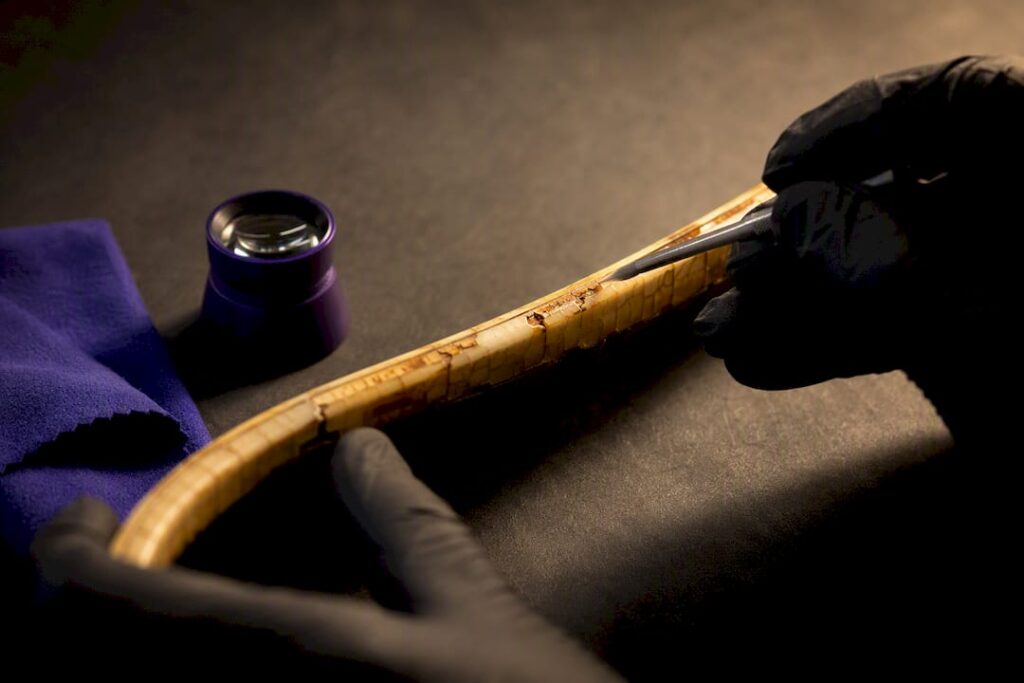

Celluloid rot is the chemical breakdown of the plastic used for binding, pickguards, and knobs on guitars made roughly from the 1920s through the 1960s, and it can release corrosive vapors that damage nearby wood, metal, and glue. Once you spot it, you have three realistic paths: contain and monitor it, replace the affected parts professionally, or accept the patina and leave it alone. The right call depends on the guitar’s rarity, playability, and what you actually plan to do with it, so get a luthier’s eyes on the instrument before anyone touches it with a tool.
TL;DR:
- The variability in celluloid rot depends on manufacturing inconsistencies, making some guitars more prone to damage despite similar age or care.
- Crumbling edges, seams, and a vinegar-like smell indicate active rot that releases corrosive gases capable of damaging metal hardware and adhesives.
- Repair options range from full rebinding, which is costly and invasive, to simple part replacements or leaving the damage untreated if stable.
- DIY fixes are limited to cleaning debris and ventilating the case, with full restoration best left to professionals due to flammability and chemical hazards.
- Proper storage involves regular ventilation, avoiding extreme temperatures, and quarantining affected guitars to slow the rot’s progression.
Table of Contents
- What Causes Zelluloid Rot in Guitars?
- What Are the Visual Signs of Zelluloid Rot?
- Why Does Zelluloid Rot Cause So Much Collateral Damage?
- What Are the Restoration Options for Zelluloid Rot?
- Can You Fix Zelluloid Rot Yourself?
- How Should You Store a Guitar With Zelluloid Rot?
- Should You Keep, Repair, or Sell a Guitar With Zelluloid Rot?
- Publisher Perspective: How Vintage Guitar World Approaches These Cases
- Get a Professional Opinion Before You Touch That Binding
- Sources
- FAQ
What Causes Zelluloid Rot in Guitars?
Celluloid is made from nitrocellulose blended with plasticizers that keep it flexible. Over decades, those plasticizers migrate to the surface and evaporate, and the material left behind shrinks, hardens, and turns brittle. That is the mechanism behind celluloid guitar issues, and it is largely irreversible once it starts.
Manufacturers used celluloid heavily for binding, pickguards, and tuner knobs because it could be dyed and shaped to mimic tortoiseshell or pearl. Not every batch aged the same way. Some guitars from the same era, even the same factory, show dramatic rot on one part while an identical piece on another instrument stays stable for decades, a variability tied to inconsistent manufacturing chemistry rather than how the instrument was cared for, according to Premier Guitar. Refinishing work and certain adhesives can also interact badly with already unstable celluloid, sometimes speeding up the failure instead of slowing it.
What Are the Visual Signs of Zelluloid Rot?
Guitar material degradation from celluloid rarely stays hidden for long once it takes hold. Look for these signs during a close inspection:
- Crumbling or chipped edges along binding strips
- Chalky white or yellow powder collecting in seams
- Shrinking or curling, sometimes called “potato-chipping,” where the plastic pulls away from the wood
- Hairline cracks running parallel to the grain of the binding
- A sharp, acidic, almost vinegar-like smell coming from the case
Check the binding ledges around the body first, then the edges of the pickguard, the bridge pins, tuner buttons, and heel cap. Open the case and look for discoloration on the lining or a dark tarnish forming on nearby metal. Either one is often the first hint that off-gassing has already started, even before the plastic itself looks obviously damaged.
Why Does Zelluloid Rot Cause So Much Collateral Damage?
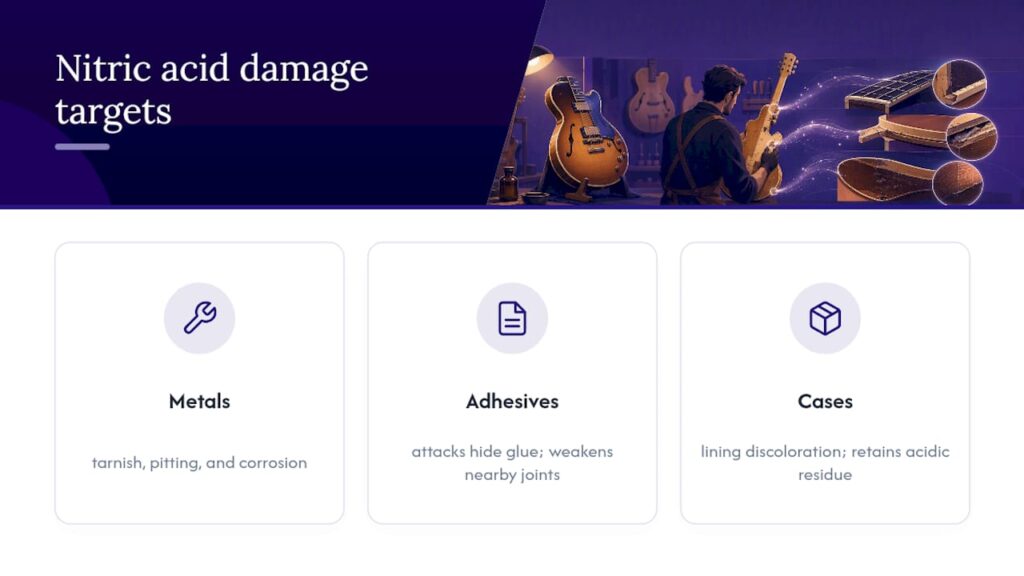
The plastic itself is rarely the biggest problem. As celluloid breaks down, it releases nitric acid gas, and that vapor does far more damage than the crumbling piece it came from. Metal hardware sitting near rotted binding, fret ends, pickup covers, tuner posts, can tarnish, pit, or corrode from the fumes alone, according to Acoustic Guitar.
The same gas attacks protein-based adhesives like hide glue. A binding strip rotting quietly against the rim can weaken the glue joint underneath it, and a luthier evaluating rebinding work needs to test those adjacent joints before opening anything up. Case interiors take a hit too. Linings can discolor and hold onto the acidic residue long after the rotted part is removed, which is one reason repairers sometimes debate whether leaving a guitar in its original case speeds up or slows down the damage. The evidence runs both ways, and nobody has settled it definitively.
What Are the Restoration Options for Zelluloid Rot?
Once you know the extent of the damage, you are choosing between three paths, and each one carries a different cost and risk profile.
- Full rebinding. This is the most invasive option. It is labor-intensive, it risks disturbing the original finish around the edges, and it can run into serious money depending on the instrument. Acoustic Guitar notes that rebinding a finished guitar without a full refinish is difficult to pull off cleanly, and get more than one luthier’s estimate before committing.
- Small-part replacement. Swapping bridge pins or tuner buttons is usually straightforward and low-risk, though it can slightly affect how “original” the instrument looks to a picky buyer.
- Partial or cosmetic stabilization. Tack-gluing loose sections or sealing crumbling edges buys time but is a short-term fix, not a cure.
- Leaving it alone. For some instruments, the rot is stable enough, or the guitar’s value low enough, that doing nothing is the sensible move.
Repair replacement celluloid is not automatically the safer long-term choice, either. Suppliers still sell modern celluloid binding stock in traditional colors, but nothing guarantees that newer material will age any better than what came out of the factory in 1955. Some restoration shops now substitute modern synthetics instead, specifically to sidestep that repeat-failure risk.
Pro Tip: A heavy-handed refinish job to “fix” celluloid rot cosmetically almost always lowers resale value more than the rot itself did. Buyers who collect vintage instruments pay for originality, not a shiny new finish covering up honest wear.
Can You Fix Zelluloid Rot Yourself?
A few safe steps are fine for a hobbyist to handle. Beyond that, you are into specialist territory.
- Gently remove loose debris and crumbled fragments without touching the parts still attached.
- Ventilate the case and, if possible, isolate the guitar from other instruments in storage.
- Replace small, non-structural parts like bridge pins or tuner buttons if you are comfortable doing so, following the kind of guidance in Premier Guitar’s minor repair guide.
- Avoid solvent-based touch-ups, aggressive sanding, or gluing binding back down with whatever adhesive is on hand. Rotted celluloid is also highly flammable and carries a strong odor, so amateur removal is genuinely hazardous, not just risky to the finish.
Leave full rebinding, adhesive testing, and anything involving heat or chemical stripping to a luthier.
How Should You Store a Guitar With Zelluloid Rot?
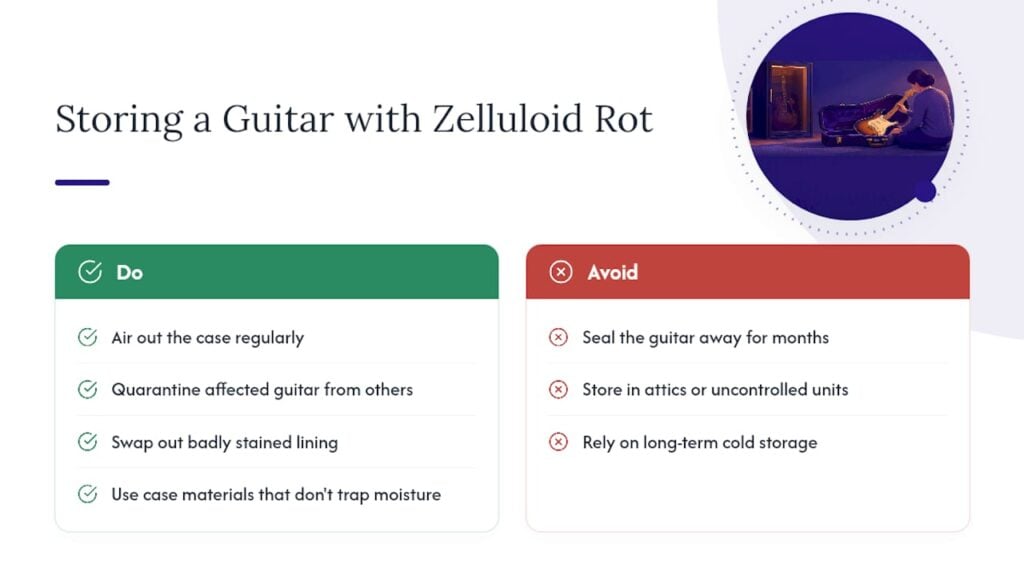
Short-term containment buys you time to make a good decision instead of a rushed one. Air out the case regularly rather than sealing the guitar away for months at a stretch, since trapped gas has nowhere to go but into the wood, metal, and lining around it.
Where possible, quarantine an affected guitar away from other instruments, especially ones stored in the same case compartment or shelf. Swap out badly stained case lining if you can, and lean toward case materials that will not trap moisture. Avoid attics, unclimate-controlled storage units, and anywhere temperatures or humidity swing hard. Long-term cold storage sounds appealing but is impractical for most collectors and does not address the underlying chemistry anyway.
Should You Keep, Repair, or Sell a Guitar With Zelluloid Rot?
Run through a short checklist before deciding anything irreversible:
- How rare is this instrument, and does it have documented provenance?
- Is the rot cosmetic, or is it threatening structural integrity and playability?
- What does a real luthier estimate look like, not a guess?
- What is the realistic resale value before and after repair?
If you intend to keep playing it, prioritize structural fixes and player-friendly repairs over cosmetic perfection. If you are leaning toward selling, know that some collectors specifically want an untouched instrument and will pay for the right to restore it themselves, so selling as-is to the right buyer is a legitimate strategy, not a concession. Full restoration paired with formal certification tends to be worth the expense mainly on instruments where documented authenticity meaningfully moves the price.
Publisher Perspective: How Vintage Guitar World Approaches These Cases
We treat celluloid rot as a diagnostic problem first, not a repair problem. The instinct to grab a tube of glue the moment binding starts crumbling is understandable, but it is usually the wrong instinct. A proper diagnostic, ideally in person, tells you whether you are looking at a cosmetic issue or one that is actively eating into glue joints and hardware.
Our restoration approach favors preserving original finish and provenance whenever the guitar’s history justifies it, and we document that process for buyers through certification rather than treating a repair as invisible. Collectors researching this topic often end up watching restoration walkthroughs before they trust a shop with their own instrument, and that instinct is a good one.
— Vintage
Get a Professional Opinion Before You Touch That Binding
Guessing at a repair timeline or DIY fix for zelluloid rot usually costs more than getting an answer up front. Vintage-guitar-world offers exactly that answer through a few connected services: an in-person testing appointment to see exactly how far the rot has spread, a formal certificate and value assessment so you know what you are actually working with, and, where it makes sense, a full restoration built around preserving the instrument’s original finish rather than papering over it.

If your guitar’s binding is crumbling and you are not sure whether to repair it, sell it, or leave it be, the smartest first move is a diagnostic, not a decision. Book a testing appointment or request a restoration estimate through Vintage Guitar World before any irreversible work happens to your instrument.
Sources
- Ask the Expert: All About Celluloid Rot—and What to Do About It | Acoustic Guitar
- Acoustic soundboard: Your guitar might last forever but will its parts? | Premier Guitar
FAQ
Is Zelluloid Rot Dangerous to Handle?
Rotted celluloid is not dangerous to touch briefly, but it is highly flammable and releases an acidic gas that irritates skin and eyes with prolonged exposure. Handle debris in a ventilated space and avoid open flame or heat near the material, per Acoustic Guitar’s guidance.
Does Zelluloid Rot Always Ruin a Guitar’s Value?
No. Minor rot on small parts like tuner buttons rarely affects value much, while extensive binding loss on a rare instrument can lower it significantly if repaired poorly. A documented, professionally handled restoration through services like Vintage Guitar World’s certification can actually support resale value rather than undermine it.
How Much Does Repairing Zelluloid Rot Cost?
Cost depends heavily on scope. Replacing a bridge pin or knob is inexpensive, while full rebinding on a finished instrument is complex and can be costly, according to Acoustic Guitar. Current restoration pricing details are available through Vintage Guitar World’s restoration page.
Can I Just Leave the Rot Alone?
Yes, and for many guitars that is the right call, especially when the instrument’s value does not justify repair costs. Monitor it for spreading, keep it ventilated and away from other instruments, and revisit the decision if the rot starts affecting playability or nearby hardware.
Will Replacing Celluloid Binding Prevent Future Rot?
Not necessarily. Modern replacement celluloid is sold in period-accurate colors, but there is no guarantee it will age better than the original material, which is why some restoration work now uses modern synthetics instead when long-term stability matters more than historical exactness.