













TL;DR:
- Traditional guitar construction addresses mechanical and acoustic issues through carefully designed bracing and wood architecture, ensuring superior tone and repairability. These methods, proven over centuries, support long-term stability and preserve instrument value by allowing easy restoration using original materials. Despite modern innovations, traditional craftsmanship remains the benchmark for tonal depth, longevity, and collector appeal.
Modern guitar manufacturing can produce instruments faster and cheaper than ever before. Yet the most sought-after guitars in any serious collection are almost always built the way they were built 150 years ago. Understanding why traditional guitar construction holds its ground against technological advancement is not a matter of nostalgia. It is a matter of physics, craftsmanship, and the kind of value that only deepens with time.
Table of Contents
- Key takeaways
- Why traditional guitar construction is rooted in physics
- Structural integrity and long-term durability
- Repairability and what it means for collectors
- Traditional craftsmanship versus modern innovations
- My perspective on tradition and craft
- Discover guitars built the traditional way
- FAQ
Key takeaways
| Point | Details |
|---|---|
| Soundboard drives tone | The guitar top and bracing are the primary acoustic engine, not the wood species alone. |
| Traditional design solves real problems | Classic bracing patterns address mechanical deformation under string tension, making them engineering solutions. |
| Repairability adds collector value | Instruments built with traditional methods can be restored without losing their character or tonal identity. |
| Wood functions as a filter | Architecture and bracing manage energy transfer; tonewoods act as tonal presets, not the sole sound source. |
| Tradition and innovation coexist | Modern techniques offer advantages in specific areas, but traditional hand-built details remain the benchmark for tone and longevity. |
Why traditional guitar construction is rooted in physics
Most conversations about guitar tone drift toward wood selection fairly quickly. Which spruce? Which rosewood? The debate is genuinely interesting, but it misses the bigger picture. Wood species act as acoustic filters, shaping tone the way an equalizer shapes a mix. The architecture of the instrument, specifically the soundboard and its internal bracing, is what actually manages how string energy moves through the body.
This is why the guitar top and bracing are considered the dominant factors in sound production. When a string vibrates, it transfers energy through the saddle and into the soundboard, which then sets the air inside the body in motion. The guitar body functions as a Helmholtz resonator, a hollow chamber where the geometry of the space controls the resonant frequencies you hear. Change the bracing pattern, and you change how that energy is distributed across the plate.
Traditional luthiers understood this intuitively long before acoustic science gave it a name. Antonio de Torres Jurado, working in Spain during the 19th century, developed the fan bracing pattern that remains the standard for classical guitars today. Hermann Hauser refined it further in the 20th century. These patterns were not arbitrary. They were refined through decades of listening, adjusting, and rebuilding until the soundboard responded with the richest, most balanced tone possible. You can read a thorough breakdown of how these decisions shape sound in this guide on classical guitar bracing.
“The architecture manages the energy transfer. Wood species are physical EQ presets, not the primary tone source.” This framing, drawn from engineering analysis of guitar acoustics, reorients the entire tonewood debate toward what actually matters in traditional construction.
The implication for collectors and players is significant. Two guitars made from the same spruce and rosewood can sound completely different if their bracing patterns differ. The features of classic guitar design are not decorative decisions. They are acoustic decisions that have stood up to more than a century of scrutiny.
Structural integrity and long-term durability
One of the most underappreciated aspects of traditional construction is how it handles the relentless mechanical stress a guitar endures over its lifetime. A set of strings exerts somewhere between 150 and 200 pounds of tension on the top. Over years, this creates a set of predictable deformation patterns. Bridge rotation and soundboard bellying are among the most common issues, and traditional bracing designs were developed specifically to address them.
Understanding why traditional guitar construction handles these forces so well requires looking at the bracing as a compromise, not a perfect solution. Traditional builders discovered that the same stiffness that resists deformation also reduces the top’s ability to vibrate freely. So every bracing decision involves a trade-off. More support equals less responsiveness. Less support equals more resonance but greater long-term risk.
Here is how master luthiers working in traditional methods address this balance:
- Graduated top thickness. The soundboard is thinner near the treble side and thicker near the bass side, tuning the plate’s flexibility before a single brace is glued.
- Scalloped bracing. Removing mass from the center of each brace while keeping the ends anchored maintains structural integrity without over-stiffening the plate.
- Precise brace height and width ratios. Small changes in cross-section dramatically affect stiffness, and experienced luthiers tap-tune each plate to confirm the response before closing the body.
- Tight grain selection for the top. Straight, close-grained spruce or cedar transmits vibration more evenly, reducing the chance of uneven deformation over time.
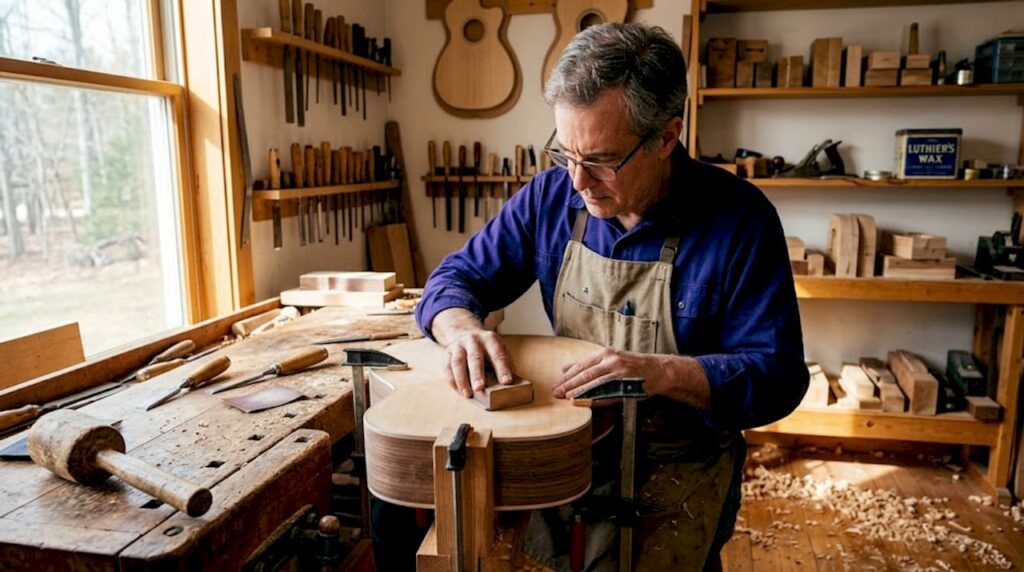
Precise hand-finishing and assembly by skilled builders contribute directly to an instrument’s long-term stability. A poorly fitted brace joint creates a weak point. A perfectly fitted one, glued under proper clamping pressure, becomes structurally indistinguishable from the wood around it.
Pro Tip: If you are evaluating a vintage guitar for purchase, check the bridge plate area from inside the body with a mirror and flashlight. Any separation or cracking around the brace ends nearest the bridge is a warning sign of long-term stress accumulation that will need professional attention.
Seasonal changes in humidity also affect how a guitar behaves. Traditional construction, using solid tonewoods that move with the environment, requires maintenance but rewards it. An instrument properly cared for settles into itself over decades, and its tone actually improves as the wood responds to years of vibration.

Repairability and what it means for collectors
Here is where the benefits of traditional guitar building become most concrete for anyone thinking about long-term ownership. A guitar built with traditional joinery, animal hide glue, and solid tonewoods can be taken apart and put back together without destroying what makes it valuable. That is not a small thing.
Hide glue, the standard adhesive in traditional lutherie, bonds strongly under normal conditions but releases cleanly with controlled heat and moisture. This means a luthier can remove a top, re-brace it, reset a neck angle, or replace a damaged bridge without leaving the instrument a patchwork of compromised surfaces. The guitar comes out of the repair sounding like itself, not like a repaired version of itself.
The sustainability angle matters here too. Restoring a vintage guitar preserves rare or protected tonewoods that could never be legally sourced today. Brazilian rosewood, Madagascan rosewood, and old-growth Sitka spruce exist in finished instruments that are still playable and repairable. Replacing those instruments with new builds would require either inferior substitutes or illegal sourcing.
The benefits of repairability extend directly into collector value:
- Historical integrity stays intact. A properly restored guitar retains its original materials, construction details, and acoustic character.
- Investment value holds or grows. Instruments that can be maintained indefinitely do not face the same obsolescence risk as those that cannot be repaired.
- Cultural legacy is preserved. A 1950s classical guitar by a recognized maker carries the history of the musician who played it and the luthier who built it. That story survives as long as the instrument does.
For a deeper look at how restoration preserves both the instrument and its value, the guitar restoration guide at Vintage-guitar-world covers the process in practical detail. The advantages of guitar restoration for collectors is another resource worth spending time with if you are weighing purchase decisions.
Traditional craftsmanship versus modern innovations
Modern guitar building has produced some genuinely interesting advances. Carbon fiber lattice bracing, first developed for classical guitars in the 1970s by Greg Smallman, produces instruments with extraordinary projection and very low mass. Double-top construction, using two thin sheets of wood with a Nomex honeycomb core, allows for extreme top responsiveness. These are legitimate engineering achievements.
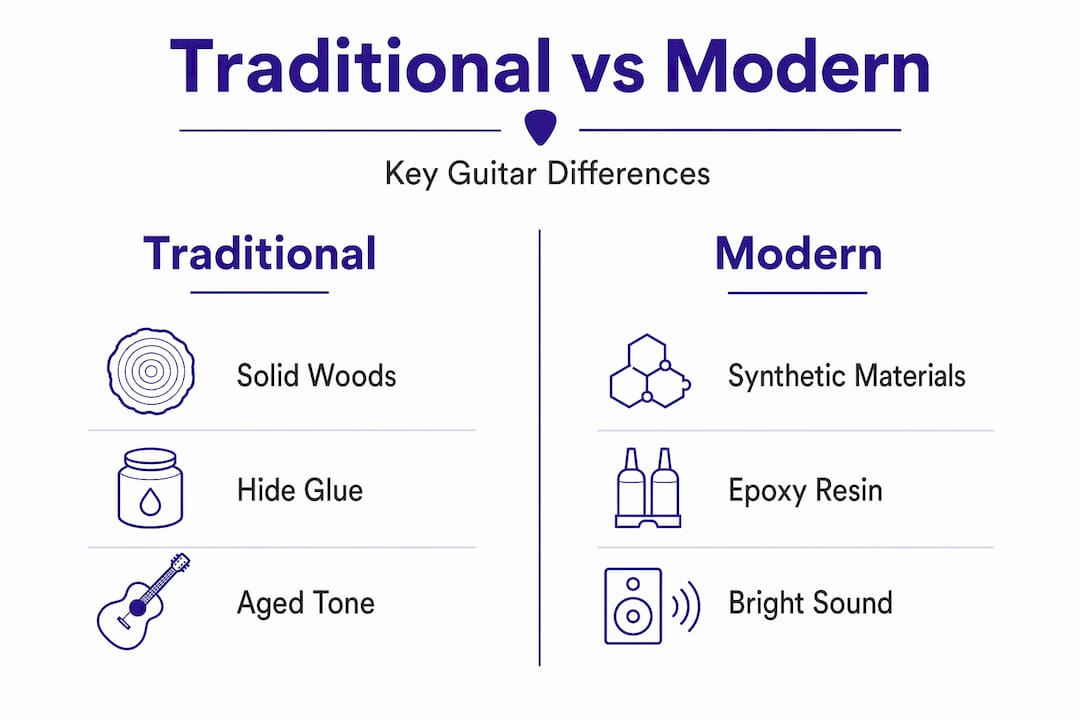
Here is how traditional and modern approaches compare across the factors that matter most to musicians and collectors:
| Feature | Traditional construction | Modern innovations |
|---|---|---|
| Tonal character | Warm, complex, naturally aged resonance | Often brighter, more immediate projection |
| Repairability | High. Designed for disassembly and restoration | Often difficult. Synthetic adhesives and composites complicate repair |
| Collector value | Strong. Heritage and provenance drive market prices | Lower. Less historical significance and harder to verify authenticity |
| Longevity | Proven over centuries with proper care | Long-term performance not yet fully established |
| Environmental stability | Solid wood requires humidity control but rewards maintenance | Some modern materials more dimensionally stable but less tonally alive |
Traditional bracing patterns from Torres and Hauser still guide best-practice classical guitar building even as modern luthiers experiment with carbon fiber and composite materials. That is a meaningful statement. The engineering has been tested across hundreds of thousands of instruments over more than a century, and it has held up.
What modern approaches often lack is the tonal complexity that develops over time in a solid wood instrument. The benefits of traditional guitar building are not just about sound on day one. They are about the way an instrument evolves across decades of play, becoming more responsive and more personal as the wood relaxes.
The importance of guitar construction, traditional or otherwise, always comes back to this question: what do you want this instrument to be in 20 years? Structured sides using multi-ply construction do offer genuine stiffness and damping advantages in modern builds. But a traditionally built instrument with properly maintained solid sides carries a tonal richness that laminated construction rarely matches over time.
My perspective on tradition and craft
I have spent years handling, evaluating, and listening to instruments that span more than a century of guitar making. What I keep coming back to is this: the so-called compromises in traditional construction are not failures. They are solutions to real physical problems that engineers and luthiers solved without computer modeling or composite materials.
What I have found is that people who dismiss traditional construction as nostalgia have usually not played a well-maintained 60-year-old instrument back to back with its modern equivalent. The difference is not subtle. Traditional guitars carry a depth of tone that takes decades to develop, and that cannot be engineered around.
The part collectors often overlook is the intangible dimension. Traditional guitar craftsmanship encodes the knowledge of the maker into the instrument. The tap-tuned plates, the hand-fitted braces, the carefully graduated tops. These are decisions that live inside the guitar permanently. No spec sheet captures them, and no factory process replicates them.
My caution is against treating tradition as a fixed target. The great luthiers of the past were not trying to preserve a style. They were solving problems with the best tools and knowledge available to them. Honoring that tradition means continuing to think carefully about craft, not just copying what worked before.
— Vintage
Discover guitars built the traditional way

If this deep dive into traditional craftsmanship has you thinking about which instruments actually embody these principles, Vintage-guitar-world has curated a selection built precisely for that kind of discernment. The collection covers classical, flamenco, and acoustic instruments with documented provenance and expert evaluation on every piece.
For collectors starting their research, the guide to vintage guitar types and history covers the full spectrum of what makes an instrument worth owning for the long term. If handcrafted instruments are your focus, the resource on why handcrafted guitars excel explains exactly what separates a hand-built instrument from a production piece in terms you can actually hear. Every instrument on the platform comes with testing appointments and valuation support, so you are never buying blind.
FAQ
Why does traditional guitar construction still matter today?
Traditional construction solves real acoustic and mechanical problems that modern methods have not fully replaced. The soundboard and bracing designs developed over centuries produce tonal complexity and repairability that factory-built instruments rarely match.
How do guitar materials affect sound in traditional builds?
Wood acts as an acoustic filter, shaping tonal color while the bracing architecture controls how string energy moves through the body. Material choice matters, but structural design drives the overall acoustic result.
What makes traditional guitars more valuable to collectors?
Traditional construction supports long-term restoration using original materials and methods, preserving historical integrity and provenance. Repairability and authenticity are the two factors most consistently linked to sustained collector value.
Can modern guitar innovations replace traditional methods?
Modern techniques like carbon fiber bracing offer specific advantages in projection and mass reduction, but they have not replicated the tonal depth that develops in traditionally built solid wood instruments over decades. Most serious collectors and players treat them as complementary approaches rather than replacements.
What is the biggest structural advantage of classic guitar design?
The scalloped bracing and graduated top thickness used in traditional builds create a balance between structural support and acoustic responsiveness, addressing long-term deformation under string tension without over-stiffening the soundboard.