













Guitars use different bridges because no single design can serve every playing style, tonal goal, or instrument construction equally well. The bridge is the mechanical heart of a guitar’s setup: it anchors the strings, sets the intonation, controls string height (action), and transmits string vibration into the body. Change the bridge design, and you change how the guitar feels under your hands, how it stays in tune, and how it sounds. That’s not marketing. It’s physics and ergonomics working together.
Here’s what a guitar bridge actually does, and why those functions demand different solutions:
- Anchors the strings at the correct tension and spacing for the scale length
- Sets intonation by positioning each string’s speaking length precisely
- Controls action by determining how high the strings sit above the fretboard
- Transfers vibration from the strings into the soundboard or body
- Enables (or prevents) pitch modulation depending on whether the design is fixed or floating
Different players need different things from each of those functions. A fingerstyle acoustic player needs maximum resonance transfer and stable tuning. A shred guitarist needs aggressive pitch manipulation without going out of tune. A jazz player on an archtop needs a floating setup that doesn’t require drilling into the body. One bridge cannot do all of that. That’s why guitar bridge design has evolved into a wide family of distinct types, each built around a specific set of priorities.
Table of Contents
- What are the main types of guitar bridges?
- How does bridge design affect tone, sustain, and feel?
- How do bridges control intonation, action, and tuning stability?
- “Tremolo” vs. “vibrato”: what’s the actual difference?
- Common myths about guitar bridges and materials
- Advantages and disadvantages of each bridge type
- How bridge placement and design shape playability
- Maintenance and adjustment for different bridge types
- Key Takeaways
What are the main types of guitar bridges?
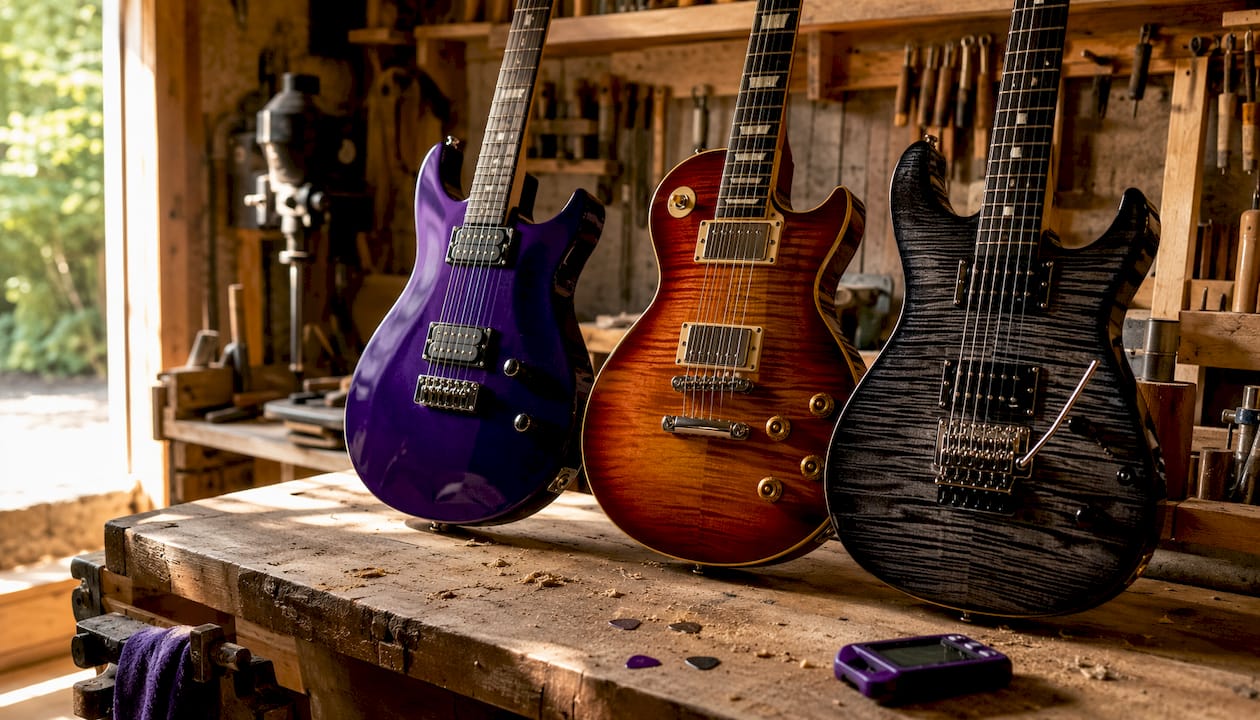
Guitar bridges split into two fundamental families: fixed and tremolo. Within each, there are several distinct designs, each with its own mechanical logic and tonal character.
Fixed bridges
Fixed bridges don’t move. They bolt or glue directly to the guitar body, which maximizes contact between the bridge and the wood. That contact is the reason fixed-bridge guitars are generally associated with stronger sustain and more direct string-to-body vibration transfer.
Wraparound
The wraparound is the oldest modern electric bridge design. Strings wrap over the top of a single bar, which also serves as the saddle. It’s simple, reliable, and easy to restring. The trade-off is limited intonation adjustment: you get two posts to work with, not six individual saddles. Some newer wraparound designs add compensated saddles to address this, but the basic version is a compromise on precision.
- Simple restringing
- Reliable tuning stability
- Limited intonation flexibility
- Cannot convert to tremolo without major modification
Tune-O-Matic (TOM)
Developed for Gibson in 1954, the Tune-O-Matic added individual saddles to the fixed-bridge concept, letting players adjust each string’s intonation independently. A separate stop-bar tailpiece anchors the strings and creates a break angle over the saddles, which contributes to sustain. The Nashville-style TOM offers even more intonation range. It’s one of the most widely used electric bridge designs for good reason: it’s precise, stable, and easy to set up.
- Individual saddle intonation adjustment
- Excellent tuning stability
- Requires a separate tailpiece
- Not compatible with arch-top bodies without modification
Hardtail
The hardtail bolts directly to the body, with strings either passing through the body or anchoring at the bridge plate. Six individual saddles give you full intonation and action control per string. Telecasters and many S-type guitars use hardtail configurations. With locking tuners, a hardtail guitar rarely needs retuning. The only thing it won’t do is give you a whammy bar.
- Maximum tuning stability
- Full per-string intonation and action control
- No tremolo capability
- Excellent for players who prioritize simplicity and reliability
Tremolo bridges
Tremolo bridges float above or within the body, connected to a spring system that allows the bridge to pivot. Pressing or pulling the arm changes string tension, producing pitch modulation. (More on the terminology confusion around “tremolo” vs. “vibrato” in a later section.)
Floating tremolo (synchronized tremolo)
Fender’s synchronized tremolo, introduced on the Stratocaster in the mid-1950s, remains one of the most influential bridge designs ever made. The bridge plate floats on a fulcrum, balanced against springs in a rear cavity. You get six saddles for intonation and action, plus the arm for pitch effects. Setup requires balancing string tension against spring tension, which takes patience, especially when changing string gauges.
- Smooth vibrato effects
- Full intonation and action adjustability
- Tuning stability is good but not as solid as a fixed bridge
- Setup complexity increases with floating position
Locking tremolo (Floyd Rose style)
The Floyd Rose, invented in 1976, added a locking nut and locking saddle clamps to the floating tremolo concept. The result: you can dive-bomb strings to slack and return to perfect pitch. Locking tremolo bridges provide greater tuning stability for aggressive vibrato techniques, but they require more complex setup and longer string changes. Breaking a string mid-set also kills the spring balance, making the guitar unplayable until restrung.
- Extreme pitch range with tuning stability
- Locking nut and saddle clamps prevent slippage
- Complex setup; string changes take significantly longer
- Incompatible with many guitar bodies without routing
Roller tremolo (Bigsby style)
The Bigsby is a spring-loaded arm attached to a roller bar. Strings wrap around the roller; pressing the arm moves the bar, stretching and releasing the strings. The effect is subtle and warm, which is exactly why it suits jazz, rockabilly, and vintage country. Bigsby-style tremolos can be fitted to archtop and hollow-body guitars without routing, which is a major practical advantage. Tuning stability is the weak point: locking tuners and a roller saddle are almost mandatory additions.
- Subtle, musical vibrato character
- Compatible with archtop and hollow-body guitars
- Tuning stability requires supplemental hardware
- Limited pitch range compared to Floyd Rose
How does bridge design affect tone, sustain, and feel?
The bridge is where string energy enters the guitar body. How efficiently that energy transfers, and what happens to it once it does, shapes the instrument’s tonal character more than most players realize.
On acoustic guitars, the bridge is a glued wooden piece, typically rosewood or ebony, sitting directly on the soundboard. Its job is to maximize resonance transfer into the top. A heavier bridge damps the top’s movement; a lighter one lets it vibrate more freely. That’s why classical guitar luthiers obsess over bridge mass and wing geometry. The saddle material matters too: bone transmits vibration more efficiently than plastic, which is why bone saddles are the standard upgrade on any serious acoustic.
On electric guitars, the relationship is different. The body’s contribution to amplified tone is debated, but the bridge’s contact area with the body does affect resonance. Fixed bridges bolt directly to the wood, creating a firm coupling. Floating tremolo bridges rest on pivot points, reducing that contact. As Wikipedia’s bridge article) notes, non-tremolo bridges are generally thought to provide better transfer of string vibration into the body because of their direct contact, and guitars with this type of bridge have different characteristics than those with tremolos.
Bridge mass and saddle design also shape tonal brightness. Heavier brass saddles tend to produce a warmer, fuller sound. Lighter steel saddles lean brighter and more articulate. The break angle of the strings over the saddle affects how much downward pressure the strings exert, which influences sustain: a steeper break angle generally means more sustain.
Key tonal factors tied to bridge design:
- Contact area with body: More contact generally means more resonance transfer and sustain
- Bridge mass: Heavier bridges tend toward warmth; lighter ones toward brightness
- Saddle material: Bone, brass, steel, and synthetic each transmit vibration differently
- Break angle: Steeper angles increase downward pressure and sustain
- Spring resonance: In tremolo systems, the springs themselves vibrate and contribute to the guitar’s overall resonance
Pro Tip: Swap your acoustic’s plastic saddle for bone before spending money on any other upgrade. It’s the single highest-return modification for tone and sustain on most production guitars, and it costs less than a set of strings.
How do bridges control intonation, action, and tuning stability?
Intonation is the accuracy of pitch across the fretboard. A string that plays in tune open but goes sharp at the 12th fret has an intonation problem, and the bridge is where you fix it. Each saddle can be moved forward or backward to adjust the string’s speaking length. Move it back and the string gets longer, lowering the pitch at the 12th fret. Move it forward and it sharpens. Guitar bridges function as critical interfaces for intonation and action, with individual saddle adjustments enabling correct pitch and string height.
Action adjustment works similarly. Raising or lowering the saddle height changes how far the strings sit from the fretboard. Too high and the guitar is hard to play; too low and the strings buzz against the frets. On a TOM bridge, you raise or lower the entire bridge via the post screws. On a hardtail or Floyd Rose, you adjust each saddle individually.
Tuning stability is where bridge design creates the sharpest trade-offs. Fixed bridges limit longitudinal string movement, so strings stay put when you bend or play hard. Floating tremolo systems are balanced against springs, and that balance is sensitive. Change string gauge, and the whole system needs recalibration. The floating tremolo’s balancing act between string tension and springs can be challenging for beginners, unlike fixed bridges which offer more stability.
| Bridge Type | Intonation Control | Action Control | Tuning Stability |
|---|---|---|---|
| Wraparound | Limited (2 posts) | Limited (post height) | High |
| Tune-O-Matic | Per-string saddle | Bridge post height | High |
| Hardtail | Per-string saddle | Per-saddle height | Very High |
| Floating Tremolo | Per-string saddle | Per-saddle height | Moderate |
| Locking Tremolo | Per-string saddle | Per-saddle height | High (with locking nut) |
| Bigsby Roller | Roller position | Roller height | Low to Moderate |
Key mechanical components that determine these outcomes:
- Individual saddles: Allow per-string intonation and action adjustment
- Bridge posts or mounting screws: Set overall bridge height and angle
- Spring system (tremolo only): Counterbalances string tension; must be recalibrated when string gauge changes
- Locking nut (locking tremolo): Clamps strings at the headstock, eliminating tuning slippage from the nut
- Scale length matching: Bridges are not universal and must match the guitar’s scale length, neck angle, and body shape; mismatched bridges cause intonation and playability problems
“Tremolo” vs. “vibrato”: what’s the actual difference?
This is one of the most persistent mix-ups in guitar terminology, and it goes back to one man’s naming decision in the 1950s.
In musical terms, tremolo is a rapid fluctuation in volume. Vibrato is a fluctuation in pitch. They are not the same effect. A tremolo pedal makes notes pulse louder and quieter. A vibrato arm on a guitar raises and lowers the pitch of the strings.
As Orpheo at Seymour Duncan clarifies: bridges commonly called “tremolos” are actually vibrato systems affecting pitch, not volume. Leo Fender’s amplifier and guitar labeling historically mixed the terms “tremolo” and “vibrato,” causing the persistent terminology confusion players still deal with today. Fender’s amplifiers had a tremolo (volume modulation) circuit, and he labeled the pitch-modulating bridge on the Stratocaster a “tremolo” as well, swapping the terms. The name stuck, and the entire industry followed.
The practical consequence is that when a guitarist says “tremolo arm” or “whammy bar,” they mean a device that produces vibrato, not tremolo. The Bigsby, the Stratocaster synchronized tremolo, and the Floyd Rose are all vibrato systems. Understanding this distinction helps you evaluate what a bridge actually does rather than what it’s called. A vibrato bridge changes pitch; a tremolo effect pedal changes volume. If you want pitch modulation from your bridge, you want what the industry calls a tremolo bridge.
The Fender Stratocaster’s “synchronized tremolo” introduced in 1954 was the design that cemented this naming convention. Fender also labeled the volume-modulating circuit in his amplifiers as “vibrato” and the pitch-modulating bridge as “tremolo,” which was precisely backwards. Decades later, the confusion is baked into the language of guitar culture, and there’s no realistic path to correcting it. Knowing the distinction makes you a more informed player, even if you keep using the common terms.
Common myths about guitar bridges and materials
Myth 1: Bridge material is the primary driver of tone.
This one shows up constantly in online forums. The truth is more nuanced. As expert Juha Ruokangas emphasizes, myths about bridge tone often overlook that geometry and setup affect tone more significantly than bridge material or model. The mechanical function of anchoring strings, defining intonation, and managing tension is primary; tonal differences mostly depend on interaction with the guitar body and installation. A perfectly installed brass saddle on a poorly set-up guitar will sound worse than a bone saddle on a well-set-up one. Setup quality and bridge geometry carry more weight than the material itself.
Myth 2: Any bridge can be swapped onto any guitar.
Bridges are not universal and must match the guitar’s scale length, neck angle, and body shape. Retrofitting a floating tremolo onto a fixed-bridge body requires major routing and adjustments, and it’s often impractical. The neck angle and bridge height must align perfectly for proper intonation and string action. Modifying a guitar to fit a different bridge type often requires extensive structural changes that can compromise the instrument’s integrity.
Myth 3: Floating bridges always sound worse than fixed ones.
Fixed bridges do transfer vibration more directly into the body. But “better” depends entirely on what you’re after. Some players feel that the vibration of the springs in a tremolo system affects resonance in a way that improves the guitar’s sound. That’s subjective, and it’s a legitimate perspective. The tonal difference between a fixed and floating bridge is real, but neither is objectively superior.
Myth 4: Replacing a bridge is always a simple upgrade.
On a vintage instrument, this is genuinely risky. Replacing original bridges on vintage guitars affects provenance and market value and should be done only by certified luthiers to maintain authenticity. Original bridge hardware contributes to an instrument’s historical value and tonal character. If you’re considering a bridge swap on a collectible guitar, consult an expert first.
Myth 5: The “best” bridge type exists.
No bridge design is perfect. Every design involves trade-offs between tuning stability, expressive range, setup complexity, and tonal character. The right bridge is the one that fits your playing style, your guitar’s construction, and your sonic goals.
Advantages and disadvantages of each bridge type
Understanding the trade-offs is the fastest way to figure out which bridge type actually suits you.
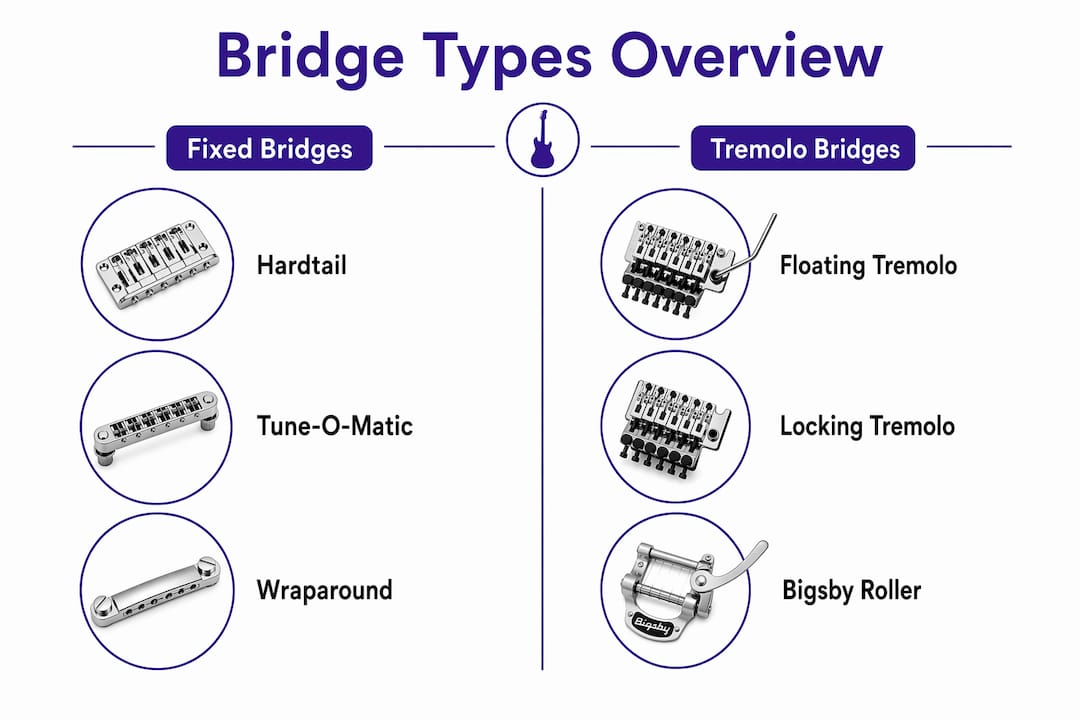
Wraparound: Dead simple to restring and reliable in tuning. The limitation is intonation: with only two adjustment posts, getting precise intonation across all six strings is difficult, especially on guitars with longer scale lengths. It’s a great beginner bridge, but players who tune to alternate tunings frequently will feel the constraint.
Tune-O-Matic: The gold standard for fixed-bridge precision. Per-string intonation, solid tuning stability, and a break angle that supports sustain. The stop-bar tailpiece can be adjusted for break angle, which gives you some tonal flexibility. The downside is that it requires a specific neck angle and body geometry, so it’s not a universal fit.

Hardtail: The most stable and maintenance-free option. String changes are fast, intonation is precise, and there are no springs to recalibrate. If you never need a whammy bar, a hardtail is hard to argue against. The trade-off is purely expressive: you give up pitch modulation entirely.
Floating tremolo: Versatile and expressive, with the full range of intonation and action adjustment. The Stratocaster’s synchronized tremolo has been the template for decades because it works well for most players who want some vibrato capability without the complexity of a locking system. Tuning stability is the weak point, particularly with aggressive use or without locking tuners.
Locking tremolo: Maximum expressive range with surprisingly good tuning stability, thanks to the locking nut and saddle clamps. The cost is setup complexity and string change time. When a string breaks live, the show stops. It’s the right tool for players who use the arm constantly and need the guitar to return to pitch reliably.
Bigsby roller tremolo: The most character-rich option. Its subtle, warm vibrato is genuinely musical in a way that a Floyd Rose isn’t. It fits guitars that other tremolo systems can’t touch. The tuning stability issues are real, but manageable with the right supporting hardware. For vintage and hollow-body players, it’s often the only practical tremolo option.
How bridge placement and design shape playability
Where a bridge sits on the guitar body, and how it’s shaped, affects playability in ways that go beyond tone and tuning. These are the physical details that determine how comfortable the instrument is to play for hours.
Picking hand comfort varies significantly across bridge designs. Ashtray-style Telecaster bridges, with their enclosed metal cover, can dig into the side of the picking hand during extended playing. Hardtail bridges with a flat, low profile are generally more comfortable for palm muting. Floating tremolo bridges tend to have flatter surfaces that suit the picking hand well, though aggressive palm muting on a floating system risks pushing the bridge and pulling notes sharp.
String spacing is set by the saddle positions on the bridge. If you’re switching bridges, matching the string spacing to your existing nut and neck width is non-negotiable. A bridge with wider string spacing on a narrow neck makes accurate picking harder; a narrower spacing on a wide neck feels cramped.
Bridge height and neck angle work together to determine action. A bridge that sits too high relative to the neck angle forces the saddles down to their lowest position, leaving no room for adjustment. This is why retrofitting a floating tremolo onto a fixed-bridge body is often impractical: the neck angle and bridge height must align perfectly for proper intonation and string action, and most fixed-bridge guitars aren’t built with the geometry a floating system requires.
Break angle affects both tone and feel. A steeper break angle over the saddle increases downward string pressure, which can make the guitar feel slightly stiffer under the fingers. A shallower angle feels looser. On a TOM bridge, adjusting the stop-bar height changes the break angle and subtly shifts both sustain and feel. It’s a small adjustment with a noticeable effect.
The guitar setup process integrates all of these variables. Bridge type sets the range of what’s adjustable; a proper setup dials in the specifics within that range.
Maintenance and adjustment for different bridge types
Different bridge designs demand very different levels of ongoing attention. Knowing what your bridge requires keeps the guitar playing well and prevents small issues from becoming expensive repairs.
Fixed bridges (hardtail, TOM, wraparound) are the lowest-maintenance option. Saddle screws can loosen over time, particularly on TOM bridges where the saddles sit in slots. Check them periodically and apply a small amount of thread-locking compound if a saddle keeps shifting. On wraparound bridges, the post threads can wear; replacing worn posts is straightforward and inexpensive. String changes are fast, and there’s no spring system to recalibrate.
Floating tremolo bridges need more attention. The spring tension in the rear cavity must balance the string tension at the bridge. Change string gauge, and you need to adjust the spring claw screws to restore the balance. A floating tremolo that’s out of balance will sit at an angle, pulling the guitar sharp or flat when you use the arm. Keeping the pivot points clean and lightly lubricated prevents binding. The saddle contact points benefit from occasional lubrication with graphite or a dedicated lubricant to reduce friction and improve return-to-pitch accuracy.
Locking tremolo systems are the most demanding. A double-locking tremolo system requires balancing string tension and spring force; even small setup changes cause significant recalibration needs for tuning stability. String changes involve unlocking the nut, cutting ball ends, threading strings through locking saddles, stretching them, setting the spring balance, and re-locking. Budget 30–45 minutes for a full string change if you’re not practiced. The fine-tuners at the bridge handle small pitch corrections without unlocking the nut, which helps between full restrings.
Bigsby and roller tremolos need the roller bar and pivot points kept clean. The strings can wear grooves into the roller over time, which affects return-to-pitch consistency. Replacing the roller bar is a simple fix. Adding a roller saddle under the strings reduces friction significantly and is the single most effective tuning stability improvement for a Bigsby-equipped guitar.
For vintage instruments, any bridge adjustment or replacement deserves careful thought. Original bridge hardware contributes to an instrument’s historical value and tonal character, and replacing it affects both provenance and market value. If you’re working on a collectible guitar, consult a certified luthier before touching the bridge. At Vintage-guitar-world, every instrument in the collection is evaluated with this in mind: original hardware is documented, and any restoration work is performed with authenticity as the guiding principle. Collectors looking to understand how bridge originality affects vintage guitar value will find that the bridge is often one of the first things an appraiser examines.

Vintage-guitar-world carries a curated selection of vintage and handcrafted guitars, each with documented hardware history and expert evaluation. Whether you’re looking for a pre-war acoustic with its original rosewood saddle intact or a vintage electric with matching-numbers hardware, the collection is worth exploring.
Key Takeaways
Different guitar bridges exist because no single design can simultaneously maximize tuning stability, expressive pitch range, resonance transfer, and setup simplicity.
| Point | Details |
|---|---|
| Bridge function is multifaceted | Every bridge anchors strings, sets intonation, controls action, and transfers vibration into the body. |
| Fixed bridges prioritize stability | Hardtail and TOM designs offer maximum tuning stability and direct body contact for sustain. |
| Floating bridges trade stability for expression | Tremolo systems enable pitch modulation but require spring balancing and more maintenance. |
| Material matters less than setup | Geometry, installation quality, and setup affect tone more than bridge material alone, per Juha Ruokangas. |
| Vintage bridge originality has real value | Replacing original hardware on a collectible guitar affects both provenance and market value. |