













TL;DR:
- Guitar model heritage influences an instrument’s value, sound, and cultural meaning through production history, provenance, and craftsmanship. verified provenance, original parts, and the era of manufacture are essential for authenticating and valuing vintage guitars. Modern reissues cannot fully replicate the tonal qualities of apex-era instruments due to unique materials and construction techniques.
Guitar model heritage is the defining factor that shapes an instrument’s historical importance, collectible value, and unique tonal identity. Understanding why guitar model heritage matters separates informed collectors from buyers who overpay for the wrong instrument or undersell a genuine treasure. Heritage spans three interconnected pillars: manufacturing history, provenance, and craftsmanship era. Each pillar directly affects what a guitar is worth, how it sounds, and what it means culturally. Vintage-guitar-world evaluates every instrument against these standards before listing it, which is why collectors trust the platform’s guitar heritage expertise when making serious acquisition decisions.
Why does guitar model heritage matter for value and authenticity?
Guitar model heritage, known in collector circles as “model lineage,” is the documented record of how a specific guitar design evolved through production changes, ownership, and cultural use. Vintage guitars remain benchmarks for quality because their value combines heritage, rarity, and sound qualities that modern production often cannot replicate. That combination is not accidental. It is the direct result of specific decisions made during specific production windows.
Production windows as collector benchmarks
Production windows are the single most important benchmark in guitar model comparisons. A guitar built during a manufacturer’s peak engineering period carries measurably different collector appeal than the same model built five years earlier or later. The Gibson ES-175 humbucker transition between 1957 and 1960 is one of the clearest examples in electric guitar history. Instruments from that specific window command premiums because the pickup change altered the tonal character in ways players and collectors still prize today.
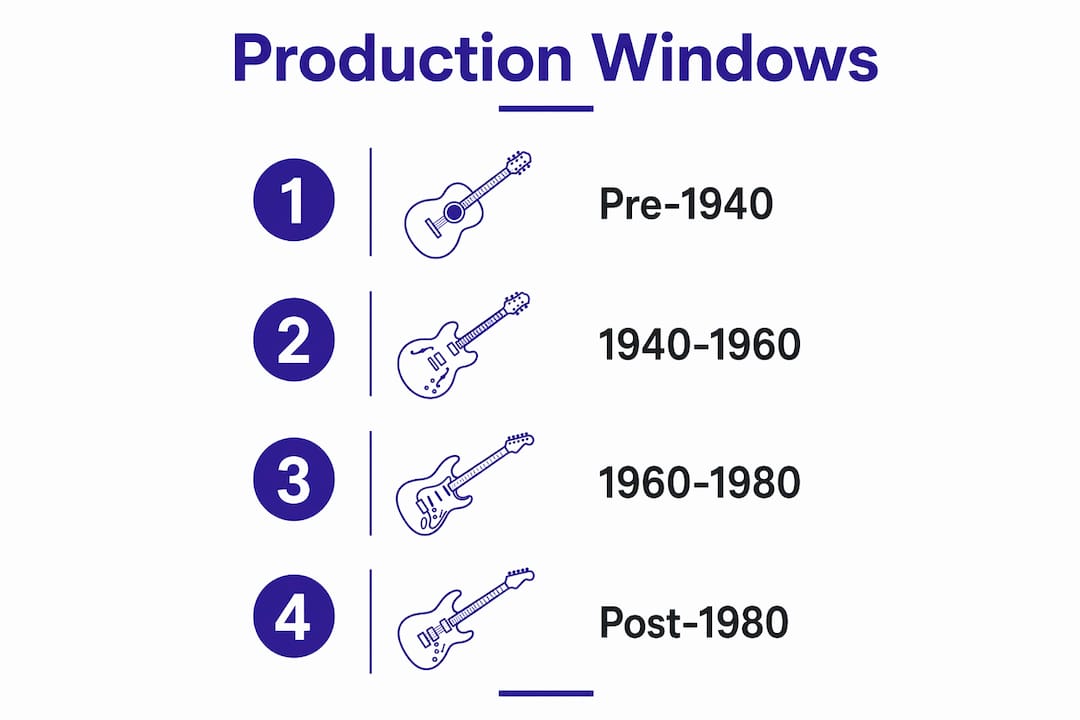
Continuous production models with subtle engineering changes create what collectors call “specimens.” These are guitars where a specific year or factory run defines the instrument’s desirability. The Gibson ES-335 follows the same pattern, with specific pickup transitions separating standard examples from collector-grade pieces. Knowing these windows is not trivia. It is the foundation of accurate guitar valuation.
Key production factors that define collector value include:
- Pickup type and transition year: Humbucker vs. P-90 installations mark clear value boundaries on many Gibson models.
- Body construction method: Laminate vs. carved solid tops represent different eras and price tiers.
- Hardware originality: Factory-correct tuners, bridges, and tailpieces confirm an unmodified example.
- Finish type and color: Sunburst, natural, and custom colors from specific decades carry distinct premiums.
- Country and factory of origin: Pre-import models from specific American factories often outvalue later production.
Pro Tip: Cross-reference a guitar’s serial number against published factory ledgers for its model. Serial number databases for Gibson, Martin, and Fender are publicly available and will confirm whether a guitar falls inside a prized production window.
What role does provenance and ownership history play in guitar heritage?
Provenance is the verified record of who owned a guitar, where it was used, and how it was maintained. The provenance guitar market has experienced exponential growth between 2016 and 2026. That growth reflects a broader shift: collectors now treat documented ownership history as a core value driver, not a bonus feature.
Instruments with verified ties to iconic artists command significant premiums. A guitar played on a landmark recording or used during a historic concert tour carries cultural weight that no reissue can replicate. The artist association premium is real and measurable in auction results. Understanding guitar provenance is now a baseline skill for any serious collector.
Collectors can verify provenance through these steps:
- Obtain original purchase receipts or factory order forms. These documents confirm the original buyer and sale date.
- Request letters of authenticity from recognized experts. Third-party authentication from a credentialed luthier or auction house specialist carries legal and market weight.
- Review photographic evidence. Concert photos, album liner notes, and press images showing the specific instrument in use are powerful provenance anchors.
- Check auction and insurance records. Previous auction listings and insurance appraisals create a paper trail that supports market value claims.
- Consult instrument-specific registries. Some models and makers maintain official registries that log serial numbers and ownership transfers.
Pro Tip: Always ask for documentation before purchasing a guitar with claimed artist provenance. Verbal history is not provenance. A signed letter from the artist or their estate, combined with photographic evidence, is the minimum standard for a legitimate provenance claim.
How do craftsmanship and manufacturing era shape a guitar’s musical identity?
Specimen guitars represent craftsmanship peaks that modern manufacturing has not fully replicated. That claim is not nostalgia. It reflects real differences in materials, construction methods, and quality control standards that defined specific manufacturing eras.
The apex era advantage
Certain decades produced guitars with tonal qualities that players describe as irreplaceable. Pre-war acoustic guitars built with Adirondack spruce tops and hide glue construction produce a projection and warmth that modern builders actively study but rarely match. The reason is material scarcity combined with hand-fitting techniques that were standard practice then but are cost-prohibitive now.
The Gibson L-5, in continuous production since 1923, illustrates this clearly. Its carved top and bracing processes mirror cello construction, and the tap-tuning of individual wood pieces creates acoustic projection that mass production cannot duplicate. Each piece of wood was selected and shaped by hand to resonate at a specific frequency. That process produces a guitar with a tonal identity tied directly to its era of manufacture.
Modern reissues use CNC routing and standardized wood grading. The result is consistent but not identical to hand-fitted originals. The craftsmanship differences between era-specific originals and modern recreations show up most clearly in dynamic response and sustain.
| Era | Key construction feature | Tonal character |
|---|---|---|
| Pre-1940 acoustics | Hand-carved Adirondack spruce tops, hide glue | Rich projection, complex overtones |
| 1950s electrics | Hand-wound pickups, nitrocellulose lacquer | Warm, dynamic, responsive to touch |
| 1960s archtops | Carved maple tops, long-tenon neck joints | Balanced midrange, strong sustain |
| Post-1980 production | CNC routing, polyurethane finish | Consistent but tonally compressed |
Pro Tip: When evaluating a vintage guitar’s tonal identity, play it unplugged first. A well-made acoustic-electric from a peak era will resonate strongly even without amplification. Weak unplugged response often signals a laminate body or a compromised top.
How does guitar heritage affect purchase and preservation decisions?
Heritage information directly changes how collectors should price, buy, and maintain instruments. A guitar with strong model lineage and verified provenance is not just worth more. It requires a different approach to ownership.
Pricing decisions start with understanding the effects of guitar model lineage on market comparables. Two guitars with identical model names can differ in value by thousands of dollars based solely on production year and originality. Collectors who ignore lineage overpay for late-production examples and miss undervalued early specimens.
Preservation decisions follow the same logic. Parts swapping and unauthorized modifications reduce collector value significantly. A common issue with early ES-175 examples involves original parts being swapped onto other models, leaving the donor guitar with replacement components that undermine its authenticity. Identifying unauthorized parts swapping requires expert inspection and knowledge of original factory specifications.
Key preservation principles for heritage instruments include:
- Never replace original hardware without documenting the change. Keep all original parts, even if they are non-functional, as they support future restoration.
- Use period-correct materials for any repairs. Hide glue on pre-war acoustics, nitrocellulose lacquer on 1950s electrics. Modern substitutes alter the instrument’s character and reduce its heritage value.
- Store instruments at stable humidity levels. Vintage tonewoods are more sensitive to humidity swings than modern kiln-dried alternatives. A stable environment between 45 and 55 percent relative humidity protects the wood.
- Commission expert valuations before selling. A professional guitar valuation accounts for heritage factors that general appraisers miss.
- Document every service and repair. A maintenance log adds to provenance and protects the instrument’s market position.
Musicians who collect vintage guitars for playing use, not just display, face an additional consideration. Experts emphasize playing specimen guitars as working tools to preserve their tonal character. A guitar that sits unplayed loses the subtle wood conditioning that comes from regular vibration. Heritage and playability are not in conflict. They reinforce each other.
Key Takeaways
Guitar model heritage is the primary driver of an instrument’s value, tonal identity, and long-term collectibility, making it the first factor any serious collector must evaluate before buying or selling.
| Point | Details |
|---|---|
| Production windows define value | Specific manufacturing years, like the Gibson ES-175 humbucker transition, set clear collector benchmarks. |
| Provenance multiplies market worth | Verified artist ties and documented ownership history command measurable premiums at auction. |
| Craftsmanship era shapes tone | Hand-fitted construction from apex eras produces tonal qualities that modern production has not replicated. |
| Originality protects investment | Parts swapping and undocumented modifications reduce collector value and complicate future authentication. |
| Documentation is non-negotiable | Serial number records, repair logs, and letters of authenticity are the foundation of a guitar’s heritage claim. |
What I’ve learned from years of working with heritage instruments
The most common mistake I see collectors make is treating heritage as a price tag rather than a story. They look up a production year, find a high auction comparable, and assume their guitar is worth the same. Heritage does not work that way. Two guitars from the same year and model can tell completely different stories depending on their originality, provenance, and condition.
The second misconception is that modern reissues are “close enough.” They are not, and the difference is not about brand loyalty or nostalgia. A 1959 archtop built with hand-selected tonewoods and hide glue construction has a physical relationship between its components that a CNC-routed reissue simply does not share. That relationship shows up in how the instrument responds to a player’s touch. Collectors who have played both know immediately.
What I find most rewarding about working in this space is watching a collector’s understanding shift from “what is this worth?” to “what is this?” The value follows naturally from the second question. When you understand a guitar’s production history, its provenance, and the craftsmanship era it represents, the price becomes obvious. The research is the work. The valuation is the result.
My practical advice: never buy a heritage guitar without at least one expert inspection. Serial numbers can be faked, parts can be swapped, and a convincing story is not the same as verified documentation. The instruments that hold their value over decades are the ones where every claim is backed by evidence.
— Vintage
Heritage guitars at Vintage-guitar-world
Vintage-guitar-world curates every instrument in its collection against the same heritage standards described in this article. Each guitar is evaluated for production authenticity, provenance documentation, and era-specific craftsmanship before it is listed.

Collectors looking for a starting point can explore the full vintage guitar types guide, which covers features, history, and investment potential across acoustic, electric, archtop, and classical categories. For collectors weighing original instruments against modern alternatives, the vintage vs. reissue comparison provides a direct, evidence-based breakdown. Every listing on Vintage-guitar-world includes the heritage context you need to buy with confidence.
FAQ
What is guitar model heritage?
Guitar model heritage is the documented record of a model’s production history, craftsmanship evolution, and cultural significance. It directly determines an instrument’s collector value and tonal identity.
How does production year affect a guitar’s value?
Specific production windows, such as the Gibson ES-175 humbucker transition between 1957 and 1960, define collector benchmarks. Guitars from peak engineering periods command premiums over the same model built outside those windows.
What counts as valid guitar provenance?
Valid provenance requires documented evidence: original purchase receipts, letters of authenticity from credentialed experts, photographic records showing the instrument in use, and prior auction or insurance records.
Does parts swapping affect a vintage guitar’s value?
Parts swapping significantly reduces collector value. Replacing original hardware with non-factory components undermines authenticity and complicates future authentication, even if the replacement parts are period-correct.
Why can’t modern guitars replicate vintage tonal qualities?
Apex-era guitars used hand-selected tonewoods, hand-wound pickups, and construction methods like tap-tuning that are cost-prohibitive in modern production. The Gibson L-5’s cello-style carved top is one example of a technique that mass manufacturing has not fully reproduced.