












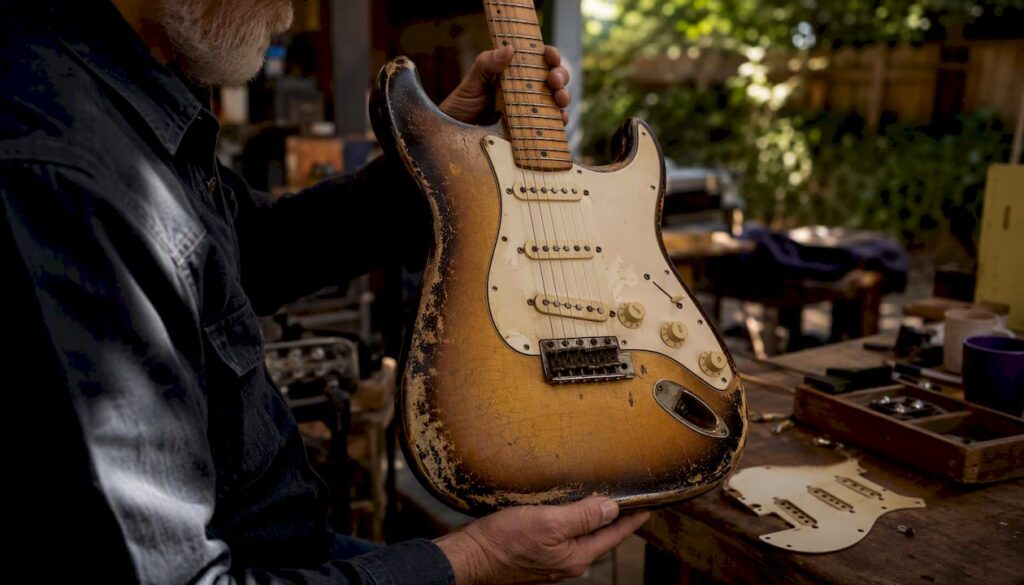

Original finish aging — patina, lacquer checking, honest player wear — generally preserves or increases a vintage guitar’s collector value. A professional refinish, by contrast, almost always reduces it, often by 40%–60% compared to an original-finish example. That’s the core verdict. The exceptions matter, though:
- Original patina and checking: typically neutral to positive for collector value on nitrocellulose-finished instruments like a 1950s Gibson Les Paul or early Fender Stratocaster.
- Structural finish failure, flaking, or bare-wood exposure: reduces value even when the damage is original.
- Water or chemical damage: lowers value regardless of origin.
- Non-original refinishes: the single biggest value killer in the vintage market.
Vintage-guitar-world applies these distinctions in every valuation it conducts.
Key Takeaways
Original finish aging is the single most important condition factor in vintage guitar valuation: it either confirms authenticity and commands a premium, or its absence (through refinishing) triggers a significant market discount.
| Point | Details |
|---|---|
| Original patina adds value | Authentic checking, wear, and patina signal provenance and keep a guitar in the collector-grade category. |
| Refinishing is costly | Professional refinishes typically reduce collector value by 40%–60% compared to original-finish examples. |
| Not all aging is equal | Structural failure, flaking, and water damage lower value even when original; light checking is often neutral or positive. |
| Document before you sell | High-resolution photos of cavities, hardware, and wear areas are the foundation of any credible appraisal or listing. |
| Vintage-guitar-world | Offers appraisal, certification, and testing appointments to verify finish originality and support accurate pricing. |
Table of Contents
- Why finish aging impacts value: the core mechanics
- Why original patina often makes a guitar worth more
- When finish aging or damage actually lowers value
- How experts detect a refinish
- How finish condition typically shifts the price
- Documenting, disclosing, and getting a professional valuation
- Quick inspection checklist for buyers and collectors
- Vintage-guitar-world’s approach to finish aging in valuations
- Vintage-guitar-world’s appraisal and certification services
- Sources
Why finish aging impacts value: the core mechanics
Finish aging affects tone and perceived value simultaneously, which is why collectors and players care about it so deeply. The finish type determines how aging shows up visually and acoustically.
What different aging signs look like:
- Patina: a warm, amber-to-honey discoloration of clear lacquer or binding; signals decades of oxidation and is widely considered authentic.
- Lacquer checking: a network of fine cracks in the finish caused by thermal cycling; common and expected on nitrocellulose-finished guitars from the 1950s–1970s.
- Wear-through: finish worn to bare wood at contact points (forearm, belly, back of neck); considered honest player wear when consistent with the guitar’s age.
- Sun-fade: color shift from UV exposure, most visible on sunburst tops; can be a provenance signal.
- Discoloration/oxidation: yellowing or darkening of clear coats; normal on older instruments.
- Edge wear: finish chipping at body edges; expected on heavily played examples.
Nitrocellulose vs. polyurethane/polyester: Nitrocellulose lacquer thins and checks over decades, allowing the wood to breathe and resonate more freely. Polyurethane and polyester finishes, standard on most post-1970s production guitars, stay thick and hard, resist checking, and can slightly dampen resonance. Collectors recognize nitro aging patterns immediately; a poly-finished guitar that shows checking is a red flag, not a sign of age.
Quick identification checks: look inside control cavities for consistent finish color and thickness; check hardware for matching patina; inspect pickguard edges for overspray; examine screw heads for undisturbed finish.
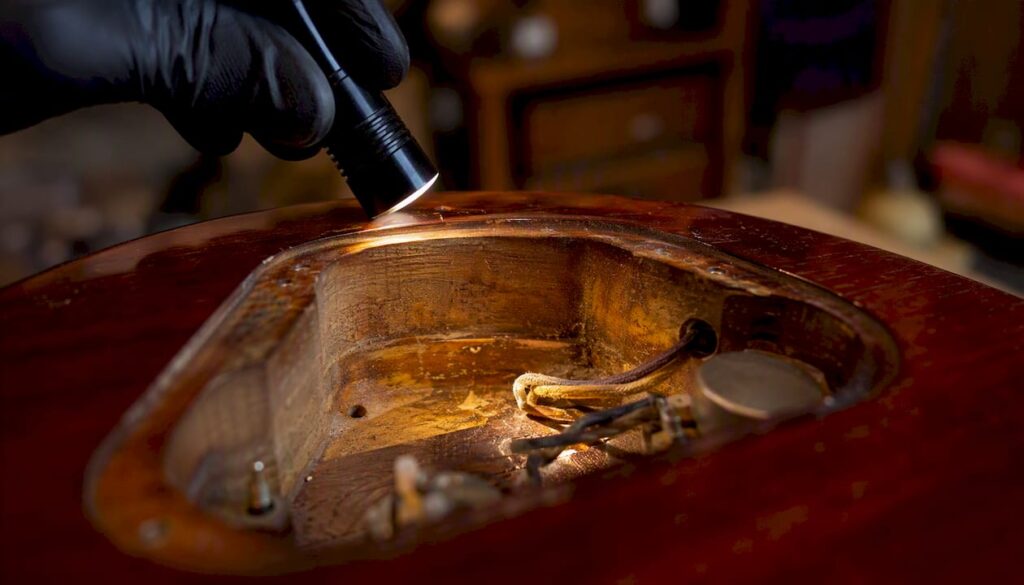
On a Gibson Les Paul or Fender Stratocaster, finish-age patterns are among the first things an experienced appraiser examines. These are the two most scrutinized models in the vintage market, and their finish histories are extensively documented.
Why original patina often makes a guitar worth more
Original patina is a provenance document you can see. It tells a buyer the guitar left the factory with this finish, was played by real hands, and survived decades without someone stripping and recoating it.
Here’s why that matters to the market:
- Authenticity signal: nitrocellulose checking and amber patina are difficult to fake convincingly; they confirm the finish is factory-original.
- Tonal association: aging wood and thinning nitro are linked to the open, resonant tone collectors associate with pre-CBS Fenders and early Gibson Les Pauls.
- Scarcity: truly untouched examples grow rarer every year; the market rewards them accordingly.
- Collector demand: serious buyers actively seek guitars with original finishes, even heavily worn ones, over cleaner refinished examples.
Forum consensus among experienced dealers confirms that light to moderate lacquer checking is often neutral or even desirable. Checking alone rarely drives a price down; it’s the type and severity of finish change that determines direction.
Pro Tip: When photographing a guitar for sale or appraisal, shoot the control cavity interior, the neck pocket, and close-ups of hardware threads. These images prove finish continuity and patina consistency far more convincingly than body shots alone.
When finish aging or damage actually lowers value
Not all aging is equal. Structural finish failure is a different category from honest patina, and buyers who conflate the two make expensive mistakes.
Conditions that reduce value:
- Finish flaking off in sheets (not checking — actual delamination)
- Bare wood exposed at the neck joint or headstock
- Water damage: white haze, raised grain, or bubbling under the finish
- Chemical damage: solvent clouding, crazing from cleaning products
- Non-period repairs: mismatched lacquer color, overspray on hardware, filler visible under raking light
- Heavy gouges that compromise wood integrity
Collectors and dealers consistently report that non-original repairs and finish replacements reduce value more than honest wear. The logic is straightforward: a guitar with original finish damage is still original; a guitar with a new finish is not.
The community advice from luthiers and experienced players is consistent: live with checking rather than refinish. A refinish that repeats checking in a few years is worse than the original checking ever was, and it permanently removes the guitar from the collector-grade category.
How experts detect a refinish
The most reliable sequence an appraiser uses:
- Control cavity interior: original finishes coat cavities consistently; a refinish often shows a sharp demarcation line or different color inside vs. outside.
- Neck pocket: look for finish buildup or a clean edge that suggests masking.
- Hardware threads: original screws show patina under the head; a refinish often leaves fresh lacquer in the threads.
- UV light inspection: overspray fluoresces differently from original lacquer; a UV lamp reveals refinish boundaries invisible in normal light.
- Pickguard edges: original finish runs under the pickguard; a refinish typically stops at the edge.
- Lacquer thickness: original nitro thins with age; a refinish adds thickness, detectable at cavity edges.
Pro Tip: A $20 UV flashlight is one of the most cost-effective tools a buyer can carry to a guitar show. Shine it across the body at a low angle and check the cavity edges. Overspray glows.
| Inspection point | What original looks like | Refinish red flag |
|---|---|---|
| Control cavity | Consistent aged finish, same color as exterior | Sharp demarcation, fresh-looking interior |
| Hardware threads | Patina under screw heads | Clean lacquer in threads |
| UV inspection | Uniform fluorescence | Bright patches or hard boundary lines |
| Pickguard edge | Finish runs underneath | Finish stops at edge, clean line |
| Lacquer thickness | Thin, especially at edges | Noticeably thick at cavity openings |
Guitar certification and testing appointments exist precisely because these checks require trained eyes and proper equipment. When the stakes are high, booking a specialist is the right call.
How finish condition typically shifts the price
Rarity, maker, year, and originality combine with finish condition to set the final price. Finish condition modifies that baseline in predictable directions.
A refinished example of a high-demand model routinely trades at a 40%–60% discount to an original-finish counterpart. That gap is not uniform — it widens for rarer models and narrows for player-grade buyers who care more about playability than provenance.
Factors that modify the finish-condition impact:
- Model desirability: the more collectible the model, the larger the refinish penalty.
- Buyer profile: a collector pays a premium for originality; a working player may not.
- Quality of the refinish: a period-correct nitro refinish by a respected luthier loses less value than a thick poly spray job.
- Provenance documentation: a guitar with original receipts, photos, or a known ownership history recovers some value even with finish issues.
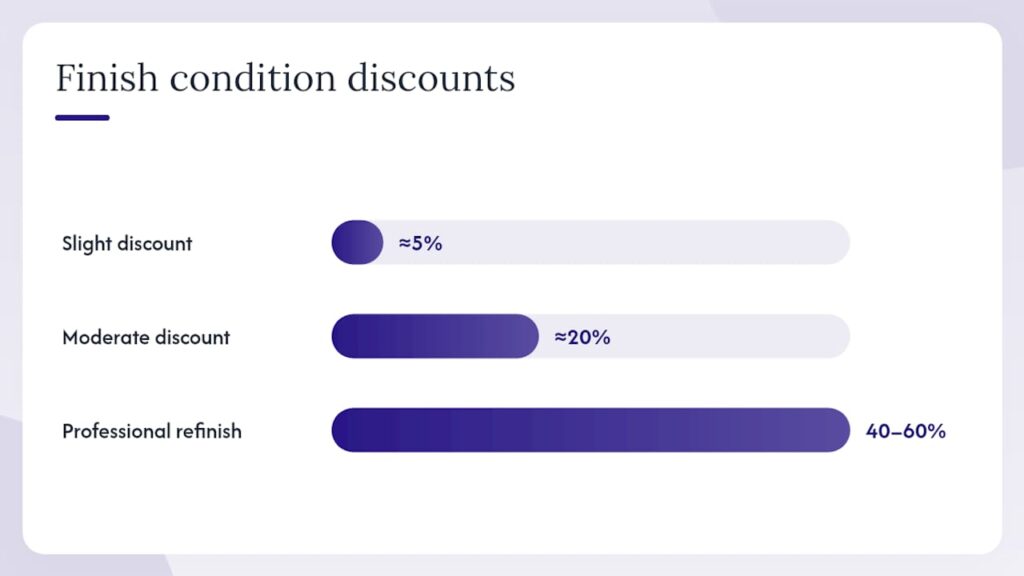
| Finish condition | Typical price impact vs. original baseline |
|---|---|
| Original finish, light checking | Neutral to slight premium |
| Original finish, heavy checking | Slight discount (about 5%) |
| Original finish, heavy wear-through | Moderate discount (around 20%) |
| Professional refinish | Significant discount (40%–60%) |
Documenting, disclosing, and getting a professional valuation
Thorough documentation protects both sides of a transaction. Sellers who disclose finish condition accurately avoid disputes; buyers who request documentation make better decisions.
- Photograph everything: body front and back, headstock, neck joint, control cavity interior, hardware close-ups, and any wear or damage areas. High resolution matters.
- Record the serial number and cross-reference it with known production records for the model.
- Gather provenance documents: original receipts, previous appraisals, photographs of the guitar in earlier ownership.
- Write condition notes: describe finish type, checking presence, wear locations, any known repairs, and whether the finish appears original.
- Book a testing appointment for any instrument where originality is uncertain or the asking price is significant.
- Commission a formal appraisal when selling, insuring, or buying a high-value example. Appraisal fees vary; for collector-grade instruments, the cost is typically recovered many times over in negotiating accuracy.
Pro Tip: In a listing, phrase finish condition specifically: “original nitrocellulose finish with light checking consistent with age, no repairs or refinishing” outperforms vague terms like “good condition” and reduces buyer questions by giving them the exact language appraisers use.
Photographic documentation and condition notes are the foundation of any credible appraisal or sale.
Quick inspection checklist for buyers and collectors
Carry this to shows, shops, or when reviewing online listings:
- [ ] Identify finish type: nitrocellulose, polyurethane, or polyester
- [ ] Check for lacquer checking: fine network of cracks (expected on old nitro) vs. flaking or delamination (red flag)
- [ ] Locate wear-through spots: consistent with age and playing position, or random?
- [ ] Inspect control cavity interior: finish color and texture consistent with exterior?
- [ ] Check neck pocket for masking lines or finish buildup
- [ ] Examine hardware threads for patina under screw heads
- [ ] Look for overspray on pickup covers, tuner buttons, or bridge saddles
- [ ] Use UV light if available: check for fluorescence anomalies
- [ ] Photograph serial number, cavity interior, and all wear areas before purchase
- [ ] Note any repairs, cracks, or structural finish failure
Pro Tip: Always document serial numbers on-site. Cross-referencing a serial number with published production records takes minutes and can confirm or contradict a seller’s dating claim before money changes hands.
Vintage-guitar-world’s approach to finish aging in valuations
At Vintage-guitar-world, original finish condition is the first thing evaluated on any instrument that comes through for appraisal or sale. An original nitro finish with honest checking and player wear is treated as a positive attribute, not a flaw to discount. A refinish, regardless of quality, is disclosed clearly and priced accordingly.
When originality is uncertain, Vintage-guitar-world recommends a formal testing appointment before purchase or listing. Certification is offered for instruments that pass a full originality and condition review, giving buyers documented confidence and sellers a credible basis for asking price. For instruments with finish damage, responsible restoration referrals are available — but the default recommendation is always to preserve original material when structurally sound.
That approach reflects a simple conviction: a buyer who knows exactly what they’re getting makes a better decision, and a seller who discloses accurately closes faster.
Vintage-guitar-world’s appraisal and certification services
Knowing what finish aging does to value is one thing. Getting a documented, defensible answer for a specific instrument is another.

Vintage-guitar-world offers guitar appraisal and valuation for collectors and buyers who need a professional opinion on finish originality and condition. The service covers finish-type identification, originality verification, condition grading, and a written report you can use in a sale or insurance filing. For instruments that pass a full review, guitar certification provides documented proof of originality that supports higher asking prices and faster sales. In-person testing appointments let you play and inspect an instrument before committing. Browse the vintage guitar inventory or contact Vintage-guitar-world directly to schedule an appraisal or testing session.
Sources
- The Vintage Advantage: Why Original Guitars Hold the Magic, the Value, and the Stories Reissues Can’t Touch | Equipboard
- How Much Does CHecking Devalue A Guitar ? | TheGearPage