













TL;DR:
- Pre-owned guitars develop unique physical and tonal characteristics through years of real use.
- Wear, aging, and documented history add aesthetic and collectible value beyond just sound.
- Proper evaluation focuses on neck stability, fret wear, electronics, finish authenticity, and provenance.
Many players assume that a guitar fresh from the factory is the pinnacle of what an instrument can be. That assumption is worth questioning. Experienced collectors and working musicians often seek out pre-owned guitars precisely because they offer something a brand-new instrument simply cannot: a combination of physical transformation, matured tone, and documented history that accumulates only through years of real use. This guide breaks down exactly what makes pre-owned guitars different, why those differences matter, and how you can evaluate them with confidence.
Table of Contents
- The physical transformation: How age and play shape the guitar
- The sonic signature: Break-in effects and matured tone
- Aesthetic and historical value: More than just looks
- Evaluating pre-owned guitars: What collectors and enthusiasts should check
- Why the magic of pre-owned guitars is more than nostalgia
- Explore and invest in unique pre-owned guitars
- Frequently asked questions
Key Takeaways
| Point | Details |
|---|---|
| Break-in changes matter | Years of play naturally enhance the tone, feel, and character of pre-owned guitars. |
| Environmental impact | Humidity and temperature shifts can alter a guitar’s neck, setup, and longevity over time. |
| Collector appeal | Playwear, history, and provenance can boost value, often outweighing cosmetic flaws. |
| Careful evaluation required | Knowing how to inspect and interpret signs of age helps you make the best buying choices. |
| Every guitar is unique | No two pre-owned instruments age the same, making each one a potential treasure. |
The physical transformation: How age and play shape the guitar
Time and use leave marks on every guitar, and those marks are far more meaningful than most beginners realize. The frets on a well-played instrument develop subtle wear patterns that actually conform to a player’s touch. The fingerboard oils up from years of skin contact, becoming smoother and more responsive. The finish, whether nitrocellulose lacquer or polyester, reacts differently to decades of temperature swings and handling, sometimes checking (developing fine cracks in the finish) in ways that collectors recognize as proof of genuine age.
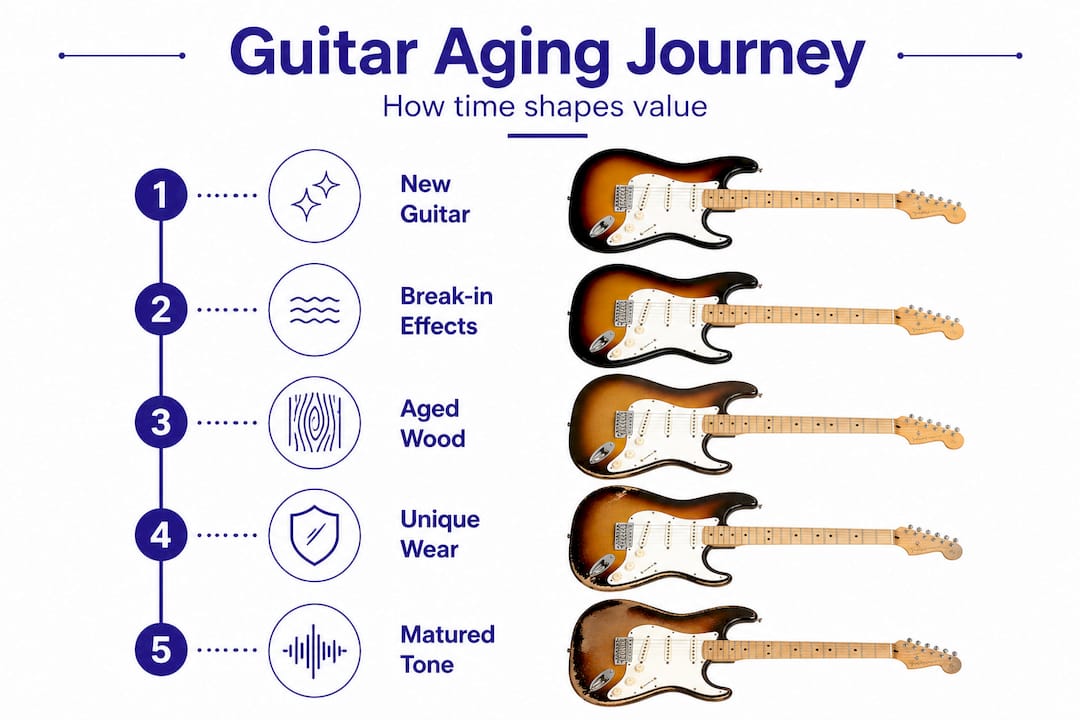
String tension is one of the most powerful forces acting on a guitar over its lifetime. A standard set of steel strings exerts roughly 150 to 200 pounds of pull on the neck and top. Over years, this tension combined with humidity fluctuations causes the neck to shift. Neck relief and straightness differ in pre-owned guitars due to string tension, humidity fluctuations (ideal 45 to 55% RH), and temperature changes, potentially causing warps, twists, or bows that affect action and buzzing. This is not automatically a problem. A skilled luthier can often correct these shifts, and a guitar that has been properly maintained through these stresses is a proven survivor.
Proper guitar storage and protection plays a huge role in how a pre-owned guitar ages. Instruments stored in stable environments tend to show structural integrity even after decades. Those stored in attics, garages, or other uncontrolled spaces often show more dramatic changes. The impact of tremolo systems on neck and body stress is another factor worth noting, since guitars with floating tremolos experience different tension dynamics than fixed-bridge instruments, which can affect how the top and neck age over time.
| Feature | New guitar | Pre-owned guitar |
|---|---|---|
| Fret condition | Pristine, sharp edges | Worn smooth, player-ready |
| Finish | Thick, uniform | Checking, worn spots, patina |
| Neck relief | Factory set | Shaped by real-world use |
| Structural integrity | Untested | Proven over time |
| Fingerboard feel | Stiff, dry | Conditioned, smooth |
“Maintaining a relative humidity of 45 to 55 percent is the single most important factor in preserving the structural integrity of any guitar over its lifetime.”
Pro Tip: When evaluating a pre-owned guitar, sight down the neck from the headstock toward the body. A slight forward bow (concave relief) is normal and playable. A back bow or twist is a more serious concern and should be assessed by a qualified luthier before purchase.
The sonic signature: Break-in effects and matured tone
These physical changes have an impact beyond just appearance and feel. They also transform the guitar’s sound in ways that many players describe as impossible to replicate with a new instrument, no matter how expensive.
The concept of “break-in” refers to the process by which a guitar’s components settle through repeated vibration. Pre-owned guitars exhibit break-in effects where played-in components like frets and wood settle, providing a smoother feel and matured tone versus stiff new guitars. Think of it like a new pair of leather boots versus a pair broken in over years of wear. The structure is the same, but the response is completely different.
Wood aging is the core of this transformation. As wood dries and its cellular structure changes over decades, it becomes lighter relative to its stiffness. This ratio, known as the stiffness-to-weight ratio, is one of the key factors in acoustic resonance. A guitar top that has been vibrating for 30 years has literally been exercised into a more efficient sound-producing machine. This is part of why old guitars sound better in terms of projection, sustain, and harmonic richness.
There is also a common misconception worth addressing: many people assume that a pre-owned guitar will sound worse because it is “used up.” In reality, the opposite is often true for well-maintained instruments. The tonal qualities that collectors and experienced players seek are a direct result of use, not despite it. Understanding why old guitars sound different helps you appreciate that this is a feature, not a flaw.
Sonic qualities enthusiasts seek in pre-owned guitars:
- Warmer low-end response with less harshness in the high frequencies
- Increased sustain as wood resonates more freely
- Faster attack and more dynamic sensitivity to picking pressure
- A “bloomed” midrange that sits well in a mix without EQ
- Reduced stiffness in the top, allowing it to respond to lighter touch
- Harmonic complexity that new guitars often lack in the first few years
| Sonic quality | New guitar | Pre-owned guitar |
|---|---|---|
| Treble response | Bright, sometimes harsh | Smooth, refined |
| Sustain | Moderate | Often extended |
| Dynamic range | Consistent, less sensitive | Highly responsive to touch |
| Midrange character | Flat, even | Rich, complex |
| Overall warmth | Limited | Pronounced |
Aesthetic and historical value: More than just looks
Moving beyond tone and playability, there is also an aesthetic and historical appeal to these instruments that drives serious collector interest and, in many cases, significant market value.
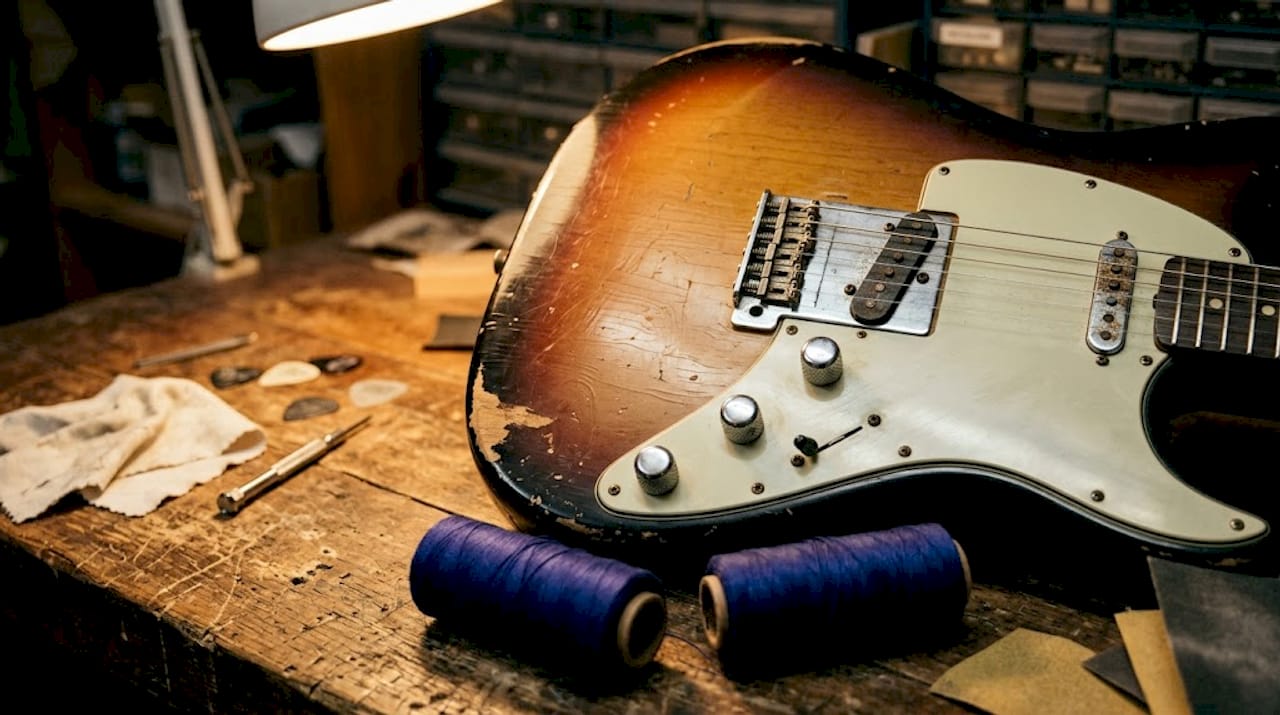
Pre-owned guitars accumulate what collectors call “honest wear.” This includes finish checking, belt buckle rash on the back, pick wear on the top, and small dents or dings from years of real use. Each mark is a physical record of the guitar’s life. According to the broader collector community, authentic wear and history in played-in components adds a dimension of character that pristine instruments simply do not have. This is why the difference between vintage and new guitars is not just technical but deeply personal and cultural.
Historical provenance takes this further. A guitar owned or played by a notable musician, used on a famous recording, or documented at a significant performance can command prices far beyond its intrinsic material value. A 1950s Gibson Les Paul with solid documentation of its ownership history is worth dramatically more than an identical guitar with no paper trail. Even without celebrity ownership, a guitar with a clear, documented history of careful use and maintenance carries more confidence for buyers than one with gaps in its story.
Visual attributes collectors look for in pre-owned guitars:
- Finish checking consistent with the era of manufacture
- Fret wear patterns that match the claimed age and use
- Original hardware showing appropriate oxidation
- Neck joint integrity with no signs of amateur repair
- Tuning machine wear that matches the rest of the instrument
- Original case or period-correct accessories
Pro Tip: Learning to distinguish honest playwear from artificial “relicing” (factory or custom aging applied to new guitars) is a critical skill. Genuine wear tends to be random and concentrated in areas of actual contact, like the forearm rest area on the top and the back of the neck. Reliced guitars often show wear in patterns that are too uniform or in places that don’t align with how the instrument would actually be played. Examining the wear under good lighting and comparing it to known examples of the era is the best approach. Understanding why we love vintage guitars often comes down to this authenticity.
Evaluating pre-owned guitars: What collectors and enthusiasts should check
Understanding these differences is important, but knowing how to evaluate them when buying or collecting is even more crucial. A systematic approach protects you from costly surprises and helps you identify genuine value.
-
Check neck straightness first. Sight down both the bass and treble sides of the neck from the headstock. Look for any twist, back bow, or excessive forward bow. Mild forward relief is acceptable and adjustable. Twists are more serious. As noted, neck warps and bows result from string tension and humidity fluctuations over time, so always factor in where the guitar was stored.
-
Inspect fret wear carefully. Run your fingertip along each fret. Flat spots, divots under the main playing positions, and sharp fret ends that have crept past the fingerboard edge all indicate significant wear. Fret leveling or replacement is a real cost to factor into your offer price.
-
Test every electronic component. For electric guitars, plug in and test every pickup, every switch position, every pot (potentiometer, the knobs controlling volume and tone). Crackly pots are cheap to fix. Faulty pickups or wiring issues can be more involved. Original electronics in good working condition add value.
-
Examine the finish for repairs. Look under good lighting for touch-up paint, overspray, or refinishing. A guitar that has been refinished loses a significant portion of its collector value, even if the work is excellent. Original finish, even heavily worn, is almost always preferable in the vintage market.
-
Ask about maintenance and environmental history. Where was the guitar stored? Has it ever had a neck reset, fret job, or bridge repair? Has it been in a flood, fire, or extreme climate? Good sellers will have answers. Gaps in the story are a red flag. Proper protect and store your guitar practices in the guitar’s past are a strong positive signal.
-
Check all structural joints. Look at the neck joint, the bridge plate from inside the body if possible, and the bracing visible through the soundhole. Any signs of lifting, cracking, or poor repair work should be evaluated by a luthier before you commit.
Pro Tip: Minor flaws in a genuinely vintage guitar often add value rather than subtract from it. A small ding on a 1959 Les Paul is proof of age. The same ding on a 2015 guitar is just damage. Context is everything. Train your eye to read wear as a narrative, not just a defect list.
Why the magic of pre-owned guitars is more than nostalgia
Here is something that gets lost in most conversations about vintage and pre-owned guitars: the real value is not simply age. Age is just the container. What fills that container is use, care, and history, and those three things together create something that cannot be manufactured or rushed.
We have handled instruments at Vintage Guitar World that were 40 years old but had barely been played, stored in controlled conditions their whole lives. They were beautiful, structurally sound, and worth good money. But they did not have the same energy as a guitar that had been gigged weekly for 20 years, loved, maintained, and passed between players who each left a small piece of their story in the wood. That lived-in quality is not nostalgia. It is a real, measurable difference in how the instrument responds.
Conventional wisdom in the guitar world tends to fixate on condition ratings, originality percentages, and comparable sales data. Those metrics matter for investment purposes. But real collectors know that why vintage guitars matter goes deeper than a grading scale. A guitar with honest wear and a proven track record of being played well is, in many ways, a more trustworthy instrument than one that has sat untouched in a case for decades.
The uncomfortable truth is that pristine does not always mean best. A guitar that has never been played has never proven itself. It has never been tested under string tension across seasons, never had its neck relief checked and adjusted, never demonstrated that its bracing can handle decades of vibration. The played-in guitar has done all of that and is still standing. That is not a flaw. That is a credential.
We encourage you to look beyond the surface when you assess any pre-owned guitar. Ask not just “what is wrong with it” but “what has it been through, and how did it come out?” The answers will tell you far more about the instrument’s real value than any condition grade.
Explore and invest in unique pre-owned guitars
Ready to put this knowledge into practice? Vintage Guitar World offers a curated selection of pre-owned, vintage, and handcrafted guitars, each evaluated by experts who understand exactly what we have covered in this article.

Start by exploring our detailed guide to types of vintage guitars, which covers the features, history, and investment potential of the most sought-after instruments on the market. If you are ready to assess a specific instrument, our guitar appraisal expert guide walks you through the professional valuation process step by step. Whether you are building a collection or searching for your next playing guitar, our team is here to help you find an instrument with real history and real value.
Frequently asked questions
Why do some pre-owned guitars sound better than new ones?
Over time, the wood and components in a guitar settle and vibrate more freely, producing a matured tone. Break-in effects in played-in guitars result in smoother feel and richer sound that new instruments simply have not had time to develop.
Is it risky to buy a pre-owned guitar?
There are risks, but a thorough inspection and understanding of the guitar’s history reduce them significantly. Neck warps and structural issues from humidity fluctuations are the most common concerns, and a qualified luthier can assess these before you buy.
What should I check first when evaluating a pre-owned guitar?
Start with the neck. Neck relief changes caused by string tension and environmental exposure affect playability more than almost any other factor, and they are the first thing any experienced evaluator examines.
Do visible wear and scratches lower a guitar’s value?
Not always. Honest, authentic wear on a vintage instrument can actually increase collector value because it confirms genuine age and use. Played-in character is something serious collectors actively seek out, not something they discount.