














TL;DR:
- A proper guitar setup involves precise adjustments to neck relief, action, nut height, intonation, and pickup height to optimize playability and tone.
- Following the correct order—relief, then action, nut, and finally intonation—ensures each adjustment complements the others and achieves the desired feel.
Most guitarists assume their instrument plays as well as it possibly can right out of the box. That assumption costs them more in frustration and missed potential than almost anything else. The guitar setup process, known in lutherie as a “professional setup” or “action job,” is a series of precise mechanical adjustments that optimize how your guitar plays, sounds, and stays in tune. It covers neck relief, action, nut height, intonation, and pickup height. Whether you own a $200 starter or a $5,000 vintage instrument, a proper setup is what separates a guitar you tolerate from one you love.
Table of Contents
- Key Takeaways
- What the guitar setup process actually involves
- The correct order for setting up a guitar
- How setup differs by guitar type
- Signs your guitar needs a setup
- My honest take on guitar setups
- Explore quality guitars that are already set up right
- FAQ
Key Takeaways
| Point | Details |
|---|---|
| Setup is a system, not a single fix | Multiple interconnected adjustments must be done in the correct order to get good results. |
| Order of operations matters | Start with neck relief, then action, then nut height, and finish with intonation last. |
| Acoustic and electric setups differ | Acoustic adjustments are often permanent (sanding, filing), while electric changes are largely reversible. |
| Signs you need a setup | Fret buzz, stiff strings, tuning drift, and notes that go sharp above the 12th fret all signal it’s time. |
| Regular maintenance extends playability | Cleaning, lubrication, and fresh strings between professional setups keep your guitar performing at its best. |
What the guitar setup process actually involves
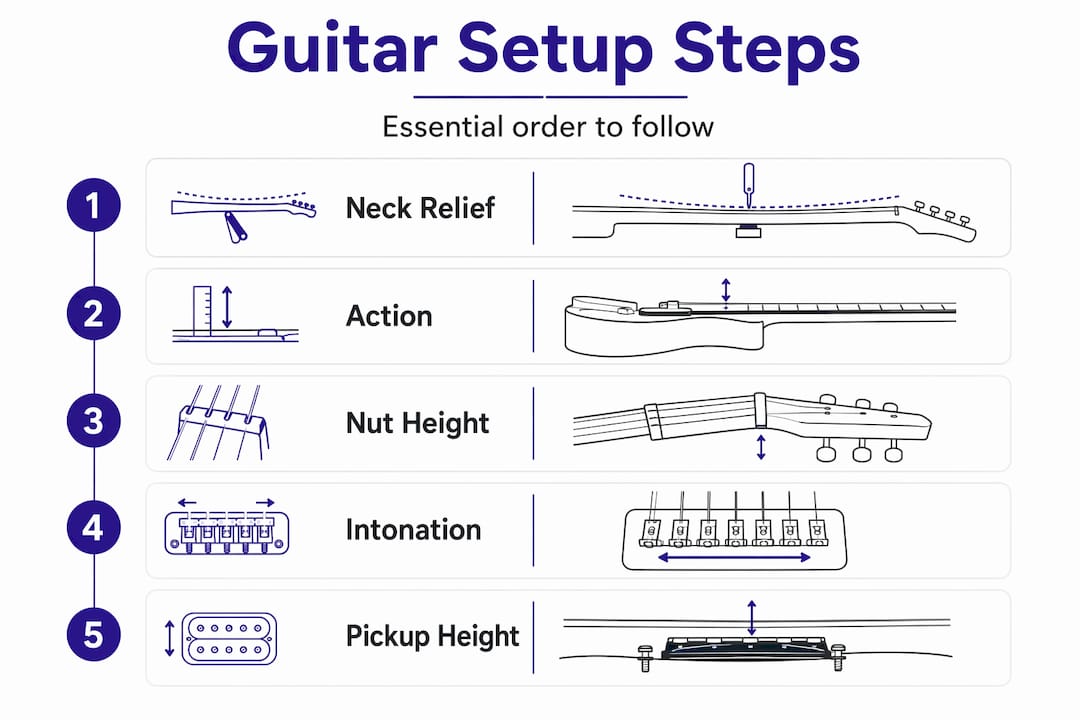
A setup is not just tuning your strings or wiping down the body. It is a holistic mechanical process that covers every variable affecting how the instrument feels and sounds under your hands. Here are the five core components:
-
Neck relief: The slight forward bow in the neck, controlled by the truss rod, creates clearance between the strings and frets in the middle of the neck. Too much bow causes high action in the middle positions. Too little causes fret buzz. Getting this right first is non-negotiable.
-
String action height: Action refers to the distance between the strings and the fret tops at the bridge or saddle. High action makes the guitar physically harder to play and pulls notes sharp when you fret them. Low action creates buzz. Your ideal action depends on your playing style, string gauge, and personal preference.
-
Nut height and slot depth: The nut controls string height at the first fret. Worn or improperly cut nut slots cause open string buzz, stiff tuning peg feel, and can mask other problems in the setup. This is one of the most underestimated adjustments on any guitar.
-
Intonation: Even if your open strings are perfectly tuned, saddle position affects pitch accuracy across the entire fretboard. If your guitar sounds great at the first fret but goes noticeably sharp at the 12th, the intonation is off.
-
Pickup height (electric guitars): Measured with the string depressed at the last fret, typical targets are around 6/64" on the bass side and 4/64" on the treble side. Pickups that are too close to the strings create magnetic pull that warps sustain and muddies your tone.
Pro Tip: If your guitar sounds slightly “warbly” on sustained notes even with fresh strings, check pickup height before blaming the instrument itself. Magnetic interference from a pickup sitting too high is a surprisingly common culprit.
The correct order for setting up a guitar
The sequence you follow matters as much as the adjustments themselves. Relief, action, and nut height are interdependent, and adjusting them out of order produces results that cancel each other out. Here is the correct sequence:
-
Start with fresh strings. Install a new set and stretch them thoroughly before doing anything else. Any measurement you take on old or unstretched strings will be inaccurate.
-
Tune to pitch and check neck relief. With the guitar tuned, check the bow in the neck using a straightedge or by fretting the 1st and 14th frets simultaneously and measuring the gap at the 7th or 8th fret. Adjust the truss rod in small increments and let the neck settle before rechecking.
-
Set bridge and saddle action. Once relief is dialed in, adjust the saddles (electric) or sand the saddle (acoustic) to reach your target action height at the 12th fret. A common starting point is 4/64" on the treble side and 6/64" on the bass side for most electric guitars.
-
Isolate and adjust nut height. Place a capo on the first fret, which removes the nut from the equation entirely. This lets you confirm your action measurements are coming from the bridge and not the nut. Then remove the capo and check open string feel. If open strings buzz but fretted notes don’t, your nut slots are too low. If open strings feel stiff to fret, the slots need deepening.
-
Set pickup height (electric only). Do this after all mechanical adjustments. Fret the last fret on each string and measure the gap between the string and the pole piece. Adjust per pickup until you get balanced output across strings.
-
Finish with intonation. Compare the open string pitch to the fretted 12th fret harmonic. If the fretted note is sharp, move the saddle back. If it is flat, move it forward. This step depends entirely on everything above being correct first.
Pro Tip: Always make truss rod adjustments in quarter turns, then wait at least 10 to 15 minutes before measuring again. Wood moves slowly, and impatience is how necks get over-adjusted.
How setup differs by guitar type

Not every guitar gets the same treatment. The core principles stay the same, but the tools, techniques, and permanence of adjustments vary significantly.
| Guitar type | Action adjustment method | Nut/saddle modification | Reversible? |
|---|---|---|---|
| Electric | Screw or hex key at saddle | Minor filing, usually minimal | Mostly yes |
| Acoustic | Saddle sanding or filing | Slot filing, sometimes permanent | Often no |
| Bass | Screw adjustment, wider tolerances | Slot filing for gauge | Mostly yes |
| Classical | Saddle shaping, precise height work | Nut shaping, nylon string spacing | Partially |
For acoustic guitars, lowering action often means physically removing material from the saddle. That wood does not go back. This is why it is worth knowing your acoustic guitar’s specific needs before making any cuts. Getting a second opinion or taking measurements from a known-good instrument of the same type is smart practice.
Electric guitars are more forgiving. Most saddle adjustments are reversible, and pickup height is just a screwdriver away. That said, electrics introduce the pickup height variable that acoustics skip entirely, which adds a layer of nuance that many players overlook.
Classical guitars live in their own category. Nylon strings exert far less tension than steel strings, so the neck responds differently and action tolerances are wider by design. Saddle shaping on a classical guitar is a craft-level skill, and getting it wrong affects both tone and playability in ways that are harder to diagnose than on a steel-string guitar.
Signs your guitar needs a setup
Your guitar will tell you when it needs attention. You just have to know how to listen. The most common warning signs are:
- Fret buzz on specific notes or across entire positions, which often points to low action or uneven neck relief
- Strings that feel unusually stiff or hard to press down, especially at lower frets where nut height is the likely cause
- Tuning instability, buzzing, and poor intonation that persists even after changing strings
- Notes that are in tune at open position but go sharp as you move up the neck, a classic sign of intonation problems
- A guitar that plays fine in one season but buzzes or feels tight in another, usually caused by humidity and temperature affecting neck relief
For most players, a professional setup once or twice a year is a solid baseline. If you change string gauges, move between climates, or play heavily, you may need adjustments more often. Between professional visits, basic guitar care and protection goes a long way: keep the fretboard conditioned, wipe strings down after playing, and store the guitar in a stable humidity environment.
Pro Tip: A basic professional setup costs between $40 and $150 depending on the guitar type and scope of work. That investment typically transforms how a guitar feels and plays far more than a new pedal or accessory would.
A setup is also not a repair. It does not fix cracked frets, a broken nut, or a warped neck beyond its adjustment range. But it can prevent those repairs from becoming necessary by catching the early signs before they compound into bigger problems.
My honest take on guitar setups
I’ve seen players spend thousands on a new guitar and then wonder why it doesn’t feel right. Nine times out of ten, the setup is the answer. And I’ve noticed that even intermediate players who understand setups conceptually tend to make the same mistake: they start with intonation.
It feels logical. You want your guitar in tune, so you fix the intonation first. But intonation depends on action, and action depends on neck relief. If you set intonation on a neck that still needs truss rod work, you will undo that intonation the moment you touch the truss rod. I’ve had to explain this to players who’ve spent an hour at the bridge only to start over completely.
The other thing I’ve learned is that “setup” is personal. Two guitarists playing the same model can want completely different action heights and neck feels. A heavy-picking slide player needs higher action. A fingerstyle player often wants it as low as possible without buzz. There is no universal correct measurement, only a correct process that gets you to your personal ideal.
What I find genuinely satisfying about setup work is what it teaches you about your instrument. When you understand what each adjustment does and how they interact, you stop treating your guitar like a black box. You start to hear and feel why it sounds the way it does. That knowledge stays with you across every guitar you ever play.
— Vintage
Explore quality guitars that are already set up right

At Vintage-guitar-world, every instrument that goes through our doors gets a thorough evaluation before it reaches a buyer. We know from experience that a well-setup guitar changes how you connect with music, which is why playability is one of the first things we assess on every piece in our collection. If you are curious about which vintage instruments hold up best and why, our guide to types of vintage guitars covers the features, history, and collector value of the most important models. For those interested in older acoustic instruments specifically, our acoustic guitar restoration guide walks through what a proper setup and restoration looks like on instruments with real history. Whether you are shopping or simply learning, we are here to help you make informed decisions.
FAQ
What does a guitar setup include?
A guitar setup includes neck relief adjustment, action setting, nut height, intonation, and pickup height for electric guitars. It also typically covers new strings, hardware tightening, and fretboard cleaning.
How often should you get a guitar setup?
Most players benefit from a professional setup once or twice per year. More frequent adjustments may be needed if you change string gauges, switch tunings, or live in a climate with significant seasonal humidity swings.
Can I set up my guitar at home?
Yes, with the right tools and patience, most setup steps are manageable at home. Starting with neck relief and action is the safest entry point. Nut slot filing and saddle work on acoustics carry more risk and are best left to a professional until you have experience.
Why does intonation have to be adjusted last?
Intonation depends on correct action and relief being set first. If you adjust saddle position before those variables are locked in, any subsequent change to relief or action will throw your intonation off again.
Does an acoustic guitar setup differ from an electric?
Yes. Acoustic setups often require permanent modifications like sanding the saddle or filing nut slots, whereas most electric guitar adjustments are reversible using hardware screws and Allen keys.