













TL;DR:
- Scalloped bracing enhances a guitar’s bass and sustain by carving the underside of soundboard braces into a scooped profile. It produces a warmer, rounder tone suited for rhythm and fingerstyle players but can pose structural risks for long-term stability. Verification of brace profiles requires inspection because “scalloped” specs vary significantly in depth and placement, influencing the instrument’s sound.
Scalloped bracing is a construction technique where the underside of a guitar’s soundboard braces are carved into a scooped, concave profile, reducing mass and increasing local flexibility across the top. The result is a more resonant, bass-forward tone with stronger fundamental frequencies and longer sustain — balanced against some loss in structural stiffness and a potential long-term risk of top deformation.
The core effects in brief:
- Warmer, fuller tone: scalloped braces increase low-end fundamental energy and sustain compared with straight braces
- Rounder attack: the initial note onset is slightly softer, with more bloom than snap
- Structural trade-off: less mass means a more flexible top, which can develop a “belly” behind the bridge under long-term string tension
- Variable in practice: two guitars both labeled “scalloped” can sound and feel quite different depending on how deeply and where the braces were carved
C. F. Martin and the Martin D-28 appear constantly in these conversations because Martin’s pre-war and vintage instruments used scalloped X-bracing as a defining feature of their sound. They are useful reference points, not the only examples.
Table of Contents
- What is scalloped bracing, and which braces does it affect?
- How luthiers actually shape scalloped braces
- How scalloped bracing changes what you actually hear
- Who benefits from scalloped bracing, and who should think twice?
- Structural risks and long-term stability
- Scalloped vs. tapered vs. straight bracing: how do they compare?
- How to tell if a guitar actually has scalloped bracing
- Common myths about scalloped bracing
- A brief history and why Martin keeps coming up
- What luthiers and acoustic research actually say
- Key Takeaways
- Vintage-guitar-world’s perspective on buying scalloped instruments
- Useful sources
What is scalloped bracing, and which braces does it affect?
The braces in question sit on the underside of the soundboard, the thin spruce or cedar top that does most of the acoustic work. In a steel-string acoustic, the primary candidates are the two legs of the X-brace, which cross just below the soundhole, along with the main transverse braces that run across the lower bout.
A scalloped brace has a scooped center between two raised peaks. Picture a shallow valley between two hills. The peaks remain near full height; the center is carved away. That geometry does two things at once: it removes mass from the middle of the brace span, and it concentrates stiffness at the peak locations. A straight (non-scalloped) brace has uniform height along its full length and distributes stiffness evenly.
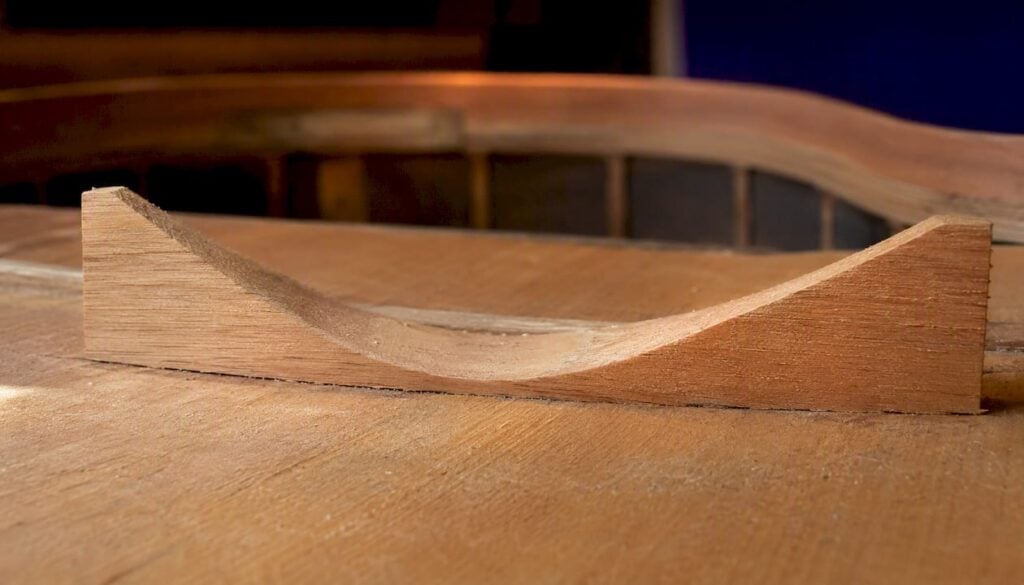
The acoustic rationale is about local stiffness control and mode-shaping. By placing peaks at specific positions along the brace, a luthier can stiffen the top at locations that correspond to important resonant modes while leaving the center freer to vibrate. The result is not simply “less wood = more vibration.” It is a deliberate tuning of which parts of the top move and how much.
Scalloping depth varies considerably:
- Shallow cosmetic scallop: minimal mass removal, mostly aesthetic, modest tonal effect
- Standard scallop: a clear scooped center, the most common interpretation on production specs
- Deep or aggressive scallop: significant material removed, pronounced tonal shift, greater structural risk
Pro Tip: When reading a spec sheet, “scalloped bracing” tells you the profile type but nothing about depth or peak placement. Ask the seller or builder for internal photos or a luthier’s notes on voicing depth before drawing tonal conclusions.
How luthiers actually shape scalloped braces
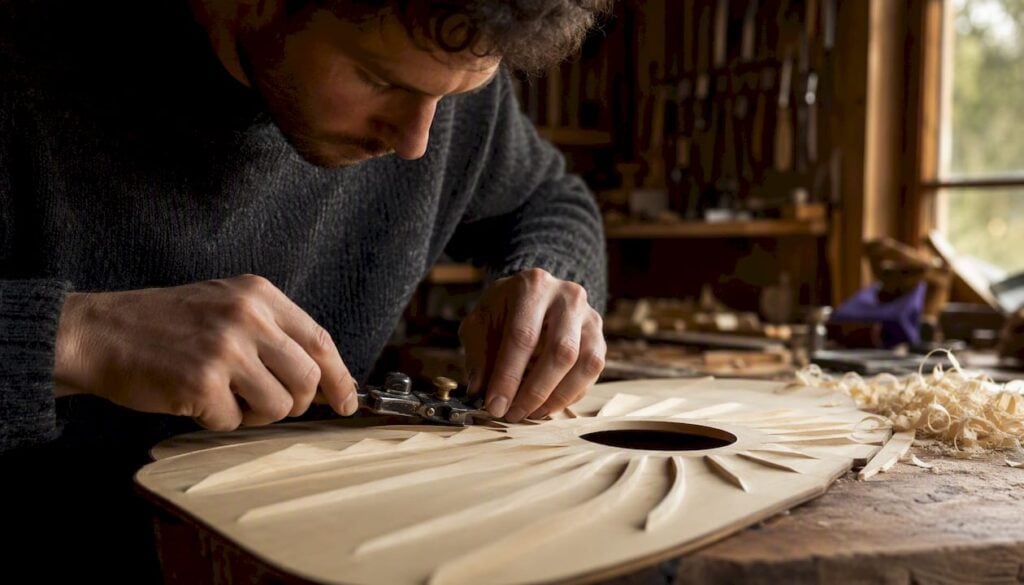
The physical process is iterative and largely done by hand. A luthier starts with a brace blank, typically quartersawn Sitka spruce or Adirondack spruce, already fitted and glued to the top. Shaping tools include a hand plane, a spoke shave, a card scraper, and sandpaper. Some production shops use a light router pass to rough in the profile before hand-finishing.
The peaks are typically positioned at roughly one-quarter and three-quarter points along the brace’s length. Engineering analysis confirms that peak placement at those locations targets specific modeshapes of the soundboard, allowing the maker to influence particular resonant frequencies rather than simply reducing overall mass. Two braces with identical peak heights but different peak spacing will produce measurably different results.
Common profile variations:
- Symmetrical scallop: peaks at equal distances from each end, the most predictable and widely used
- Asymmetrical scallop: peaks offset toward one end, used to bias stiffness toward the treble or bass side
- Partial scallop: only one section of the brace is carved, leaving the rest straight
Voicing is not a one-pass operation. A skilled luthier taps the top, listens to the fundamental and overtone response, removes a little more material, and repeats. Two guitars built from the same plan and the same wood can end up sounding different because the maker stopped carving at a different point. That is not a flaw in the process; it is the nature of acoustic voicing.
Pro Tip: If you are buying a used or vintage instrument, ask whether the seller has internal photos of the brace profile. A quick look through the soundhole with a mirror and flashlight can also reveal whether the braces have a visible scoop or appear flat and uniform.
How scalloped bracing changes what you actually hear
The tonal shift is real and consistent enough that experienced players can often identify it by ear. Scalloped bracing shifts the top toward stronger low fundamentals and longer sustain, while tapered bracing moves flexibility to the perimeter, producing a brighter, quicker-sounding top with faster note separation.
What that means in practice:
- Bass and low mids: fuller, rounder, with more body behind each note
- High mids and treble: smoother and less forward; the guitar does not cut as sharply
- Attack: slightly slower initial onset, more of a bloom than a snap
- Sustain: notes ring longer and blend into one another more readily
- Note separation: reduced compared with straight or tapered bracing; fast runs can sound slightly smeared
Player reports consistently describe a rounder low end and more sustain with scalloped braces, alongside less per-note clarity for fast passages. That trade-off is not a defect. It is a design choice that suits some playing contexts and not others.
Projection is a separate question. A scalloped top often sounds fuller in a room, but raw volume and projection depend on body shape, top thickness, and string choice as much as brace profile. Attributing loudness solely to scalloping oversimplifies the physics.
Who benefits from scalloped bracing, and who should think twice?
Luthiers like Bryan Galloup frame scalloped versus tapered decisions as a question of intended role: rhythm warmth versus articulated lead response. That framing is useful because it cuts through the “scalloped is better” marketing noise.
Scalloped bracing tends to suit:
- Singer-songwriters and rhythm players who want a warm, full-bodied accompaniment sound
- Fingerstyle players prioritizing a singing low end and smooth sustain over crisp attack
- Studio recording contexts where warmth and body are valued over cutting clarity
- Players who use lighter picking dynamics and let the guitar do the work
Scalloped bracing tends to work against:
- Fast flatpickers who need clean note separation at speed
- Percussive or hybrid-picking styles that rely on a sharp, defined attack
- Live settings where the guitar needs to cut through a dense mix
- Players who favor a bright, forward tone with quick response
When auditioning instruments, play your actual repertoire rather than a generic test riff. A guitar with scalloped bracing can feel almost effortlessly resonant on slow chord work and noticeably muddy on a fast bluegrass run. Neither impression is wrong; they are both accurate descriptions of the same instrument.
Structural risks and long-term stability
The flexibility that makes scalloped bracing tonally appealing is the same property that creates structural risk. Collectors and restorers flag scalloped tops as a factor to inspect carefully for long-term structural integrity, because decades of reduced top stiffness under constant string tension can increase the likelihood of belly formation and more invasive future repairs.
Common failure modes to watch for:
- Top belly: the area behind the bridge rises as the top deforms under string pull
- Bridge creep: the bridge tilts forward, changing action and intonation
- Humidity sensitivity: a more flexible top reacts more dramatically to seasonal moisture changes
- Brace separation: scalloped braces have less gluing surface at the center, making delamination more likely after years of movement
Inspection checklist before buying a vintage or used instrument with scalloped bracing:
- Sight down the top from the endpin: any rise behind the bridge is a warning sign
- Check the bridge angle: it should sit flat, not tipped toward the soundhole
- Look through the soundhole with a flashlight for clean glue lines and intact brace profiles
- Ask about the instrument’s humidity history and storage conditions
- Request documentation of any prior top work, neck resets, or bridge reglues
Repairs on a scalloped top can be more involved than on a stiffer straight-braced instrument. A neck reset or bridge reglue on a guitar with significant belly deformation may require partial top removal, which is expensive. The acoustic guitar restoration process for instruments with structural issues is worth understanding before you commit to a purchase.
Pro Tip: Before buying any vintage acoustic with scalloped bracing, ask specifically: “Has this guitar been stored at consistent humidity?” and “Has the top ever been removed or the bridge reglued?” Honest answers to those two questions tell you more than a visual inspection alone.
Scalloped vs. tapered vs. straight bracing: how do they compare?
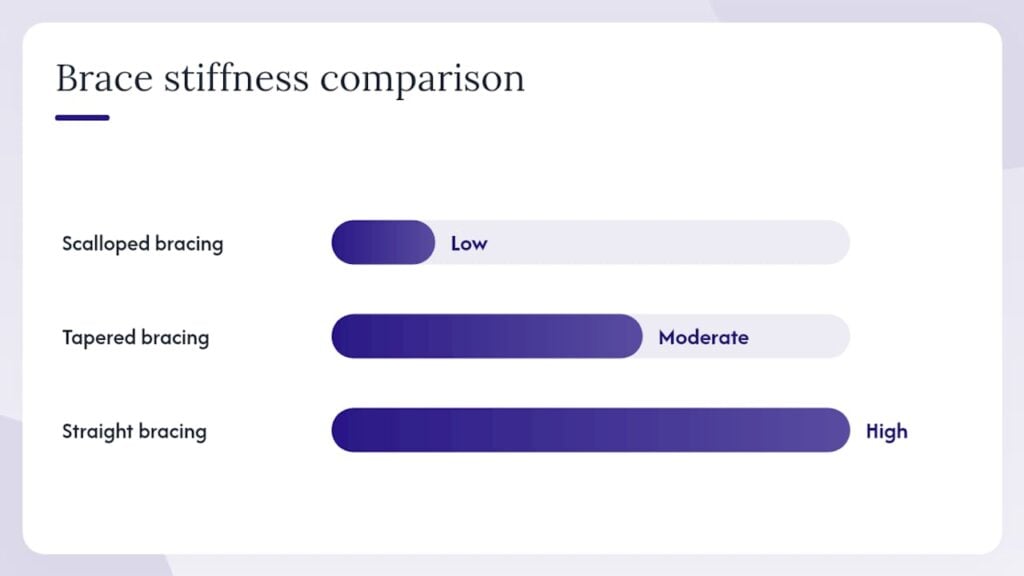
| Dimension | Scalloped bracing | Tapered bracing | Straight bracing |
|---|---|---|---|
| Tonal character | Warm, bass-forward, full low mids | Bright, clear, forward mids and treble | Balanced, neutral, even across registers |
| Attack and note separation | Slower attack, notes bloom and blend | Fast attack, clean note separation | Moderate attack, good clarity |
| Sustain and projection | Long sustain, full-sounding in a room | Shorter sustain, projects with clarity | Moderate sustain, consistent projection |
| Structural stiffness | Lower stiffness, higher deformation risk | Moderate stiffness, perimeter flexibility | Higher stiffness, more stable long-term |
| Best for | Rhythm, fingerstyle, singer-songwriter | Lead, flatpicking, articulate styles | Versatile all-around playing |
A few points the table cannot capture:
- Tapered braces direct flexibility to the perimeter, so the outer edges of the top contribute more to vibration response, which is why they tend to sound quicker and brighter
- Straight bracing is not inherently inferior; many players prefer its predictability and stability
- The whole build matters: top wood species, thickness, body shape, and scale length all interact with brace profile; bracing is one influential variable, not the whole story
How to tell if a guitar actually has scalloped bracing
Spec sheets are a starting point, not a verdict. “Scalloped” on a spec sheet covers a wide range of actual brace profiles, and two guitars labeled identically can feel and respond very differently depending on how deeply and where the carving was done.
Practical checks:
- Read the spec sheet carefully: look for language like “scalloped X-bracing” or “hand-scalloped braces”; vague terms like “voiced top” or “custom bracing” need follow-up questions
- Request internal photos: a photo through the soundhole showing the X-brace crossing and the lower transverse braces will reveal whether a scoop is visible
- Tap-tone test: tap the top lightly near the bridge and listen; a scalloped top typically produces a lower, more resonant fundamental with longer decay
- Top flexibility: with the strings slack, very gentle fingertip pressure on the top near the bridge can reveal relative stiffness; a scalloped top feels slightly more yielding
- Play slow, then fast: strong low-end bloom on slow chords and slight smearing on fast runs is a consistent auditory signature
- Ask for a luthier inspection: for any significant purchase, a qualified luthier can confirm brace profile, check for belly formation, and assess structural condition
Pro Tip: During an in-person audition, play a single bass note and let it ring fully. A scalloped top will sustain noticeably longer and feel fuller in the low register. Then play a fast chromatic run on the treble strings. If the notes blur together more than you expect, that is the scalloping at work, not a setup problem.
Common myths about scalloped bracing
Myth: Scalloped bracing is always better.
It is a tonal choice with real trade-offs. Players who need fast articulation and structural durability often prefer tapered or straight bracing. “Better” depends entirely on what you play and how you play it.
Myth: All scalloped specs are equivalent.
Depth and peak placement vary widely across makers and even across production runs from the same brand. A shallow cosmetic scallop and an aggressively voiced deep scallop both qualify as “scalloped” on a spec sheet. The actual sound difference between them can be substantial.
Myth: Scalloped bracing always makes a guitar louder.
Projection is multi-factorial. Body depth, top thickness, bracing pattern geometry, and string choice all contribute. A scalloped top may sound fuller in certain frequency ranges without being objectively louder in a measured sense.
How to read spec sheets skeptically:
Treat “scalloped bracing” as a category label, not a performance guarantee. Ask for specifics: brace wood species, approximate scallop depth, peak placement, and whether the voicing was done by hand or machine. Sellers who can answer those questions in detail are usually selling instruments worth the asking price.
A brief history and why Martin keeps coming up
Scalloped X-bracing was standard practice among American steel-string guitar makers through the pre-war era. C. F. Martin used scalloped bracing on its instruments through 1944, after which the company shifted to non-scalloped (straight) bracing, partly in response to the heavier string gauges that became common in the postwar period. That shift is why pre-war Martins became so prized: the combination of Adirondack spruce tops, hide glue construction, and scalloped bracing produced a tonal character that players and collectors have chased ever since.
The Martin D-28 appears in these discussions because it is one of the most documented examples of the transition. Pre-war D-28s with scalloped bracing are reference instruments for the warm, open sound associated with the technique. Martin later reintroduced scalloped bracing on certain models to address player demand for that vintage tonal character.
Key historical points:
- Pre-war scalloped bracing is associated with Adirondack spruce and lighter string gauges, a combination that amplifies the tonal benefits
- The postwar shift to straight bracing was partly structural: heavier strings put more stress on a flexible top
- Modern makers vary widely in their approach; notable luthiers throughout history have each developed their own voicing philosophies around brace profiles
- “Vintage scalloped” on a modern reissue spec sheet is a shorthand that requires verification against the actual brace geometry
What luthiers and acoustic research actually say
The engineering and workshop consensus aligns closely. Research comparing scalloped and rectangular brace profiles demonstrates that scalloped shapes significantly affect specific modeshapes when peaks align with mode maxima. This is the mechanical explanation for why scalloping changes tone in predictable ways: it is not random mass removal, but targeted stiffness control.
Luthier practice reflects the same principle. Bryan Galloup and other makers treat scalloping as one voicing tool among many, chosen when the intended tonal balance calls for rhythm warmth over articulated lead response. No serious luthier treats it as a universal quality upgrade.
Practical guidance from workshop experience:
- Audition the instrument in the context you will actually use it; a guitar that sounds magnificent solo may disappear in a band mix
- Verify brace profile through internal photos or luthier inspection, not spec sheet language alone
- For vintage purchases, factor in the structural implications: a scalloped top that has been well maintained is a joy; one that has been stored in a dry attic for decades may need significant work before it plays reliably
Research note: Engineering models show that scalloped brace peaks placed at modal maxima can significantly affect specific resonant frequencies of the soundboard, confirming that peak placement is as important as scallop depth in determining tonal outcome.
Key Takeaways
Scalloped bracing is a deliberate voicing choice that trades structural stiffness for tonal warmth, stronger bass fundamentals, and longer sustain — making it ideal for some players and a poor fit for others.
| Point | Details |
|---|---|
| Core tonal effect | Scalloped bracing increases low-end fundamental energy and sustain compared with straight braces. |
| Play-style fit | Best for rhythm, fingerstyle, and singer-songwriter contexts; less suited to fast flatpicking or percussive styles. |
| Structural risk | Reduced top stiffness raises the long-term risk of belly formation and more invasive repairs. |
| Spec sheet caution | “Scalloped” covers a wide range of actual profiles; depth and peak placement vary materially across instruments. |
| Inspection step | Request internal photos or a luthier inspection before purchasing any vintage acoustic with scalloped bracing. |
Vintage-guitar-world’s perspective on buying scalloped instruments

Scalloped bracing is one of the most misunderstood features in vintage guitar buying, and the misunderstanding almost always runs in the same direction: players assume it is a quality marker rather than a tonal choice. The instruments that command serious collector interest are not valuable because they have scalloped braces. They are valuable because the whole build, including the brace profile, the top wood, the construction era, and the maintenance history, came together correctly.
At Vintage-guitar-world, every instrument we handle goes through a documented evaluation that includes construction verification. When a listing notes scalloped bracing, that reflects an actual inspection of the brace profile, not a restatement of the original spec sheet. For buyers who want to go further, we offer testing appointments so you can play the instrument before committing, along with valuation and certification services that document construction details and structural condition.
If you are considering a vintage acoustic guitar with scalloped bracing, the practical next steps are straightforward: book a test, ask for the inspection documentation, and confirm the humidity history. A guitar that has been properly maintained over decades with scalloped bracing is a genuinely exceptional instrument. One that has not is an expensive restoration project. Knowing which you are looking at before you buy is exactly what the evaluation process is for.
Useful sources
These are the research and workshop sources that informed this article, organized by type:
Engineering and acoustic research:
Luthier and maker-level practical writing:
- Guitar bracing basics (Acoustic Guitar magazine) — accessible technical overview of brace types and their tonal consequences
- The science of acoustic guitar bracing patterns (Premier Guitar) — comparison of scalloped, tapered, and straight bracing with tonal descriptions
Collector and restoration guidance:
- Martin guitar soundboard bracing (One Man’s Guitar) — detailed look at how spec-sheet language around scalloping can be misleading and what to verify
Player forums: