












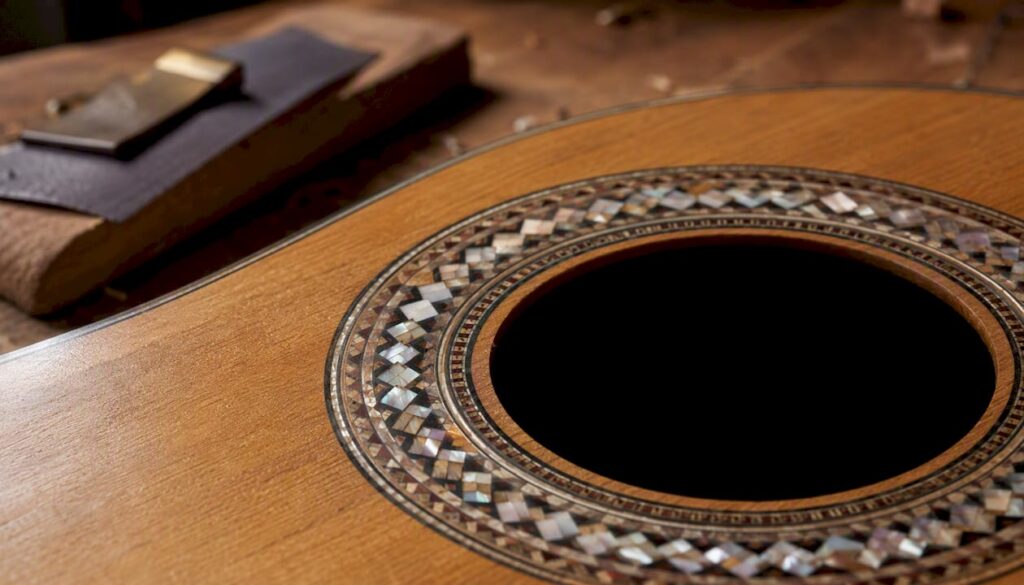

A rosette design is the decorative, often inlaid ring that encircles the soundhole on an acoustic or classical guitar, serving both an ornamental purpose and a structural one. At Vintage-guitar-world, it’s one of the first details examined when evaluating any instrument for the collection. Beyond aesthetics, the rosette reinforces the soundboard edge against cracking, and on historic instruments, it functions as a maker’s signature. C.F. Martin & Co. built one of the most recognized ring-style rosettes in steel-string history, and that single detail still tells collectors something about provenance before they play a single note.
Key Takeaways
A guitar rosette is a structural and decorative inlay that encircles the soundhole, and its originality, materials, and craftsmanship are among the most reliable indicators of an instrument’s provenance and collector value.
| Point | Details |
|---|---|
| Rosette definition | An inlaid ring around the soundhole that reinforces the top edge and signals maker identity. |
| Originality drives value | An unaltered, well-executed rosette confirms the instrument’s provenance and raises collector value. |
| Inspect before buying | Check tile depth, glue lines, pattern continuity, and material consistency under raking light. |
| Call a luthier early | Loose tiles or cracks near the soundhole need professional attention before they worsen. |
| Conservation over replacement | Preserving original rosette material protects both the instrument’s history and its market value. |
Table of Contents
- What is rosette design, and where did it come from?
- Materials and construction methods luthiers use
- Common rosette styles every collector should recognize
- How rosettes affect tone and collector value
- How to inspect a rosette when buying a guitar
- Caring for your guitar’s rosette
- Rosette examples from Vintage-guitar-world’s collection
- Why rosette detail matters more than most buyers realize
- Sources
What is rosette design, and where did it come from?
The word “rosette” comes from the French for “little rose,” and the name fits: early lutes carried elaborately carved wooden roses in their soundholes, intricate enough to look like lacework. According to Wikipedia’s entry on the rosette in music, these carved roses evolved over centuries into the inlaid ring designs found on modern guitars.
The shift happened gradually. Renaissance and Baroque luthiers carved their roses directly from the soundboard, sometimes in multiple stacked layers. By the 19th century, as guitar construction moved toward thinner, more resonant tops, carving gave way to inlaid rings. The carved rose became impractical on a top tuned for vibration.
Regional craft traditions shaped what replaced it. Classical Guitar Magazine’s history of guitar rosettes traces the influence of Mudejar geometric patterns, the intricate Islamic-influenced tilework of Andalusia, and the marquetry traditions of Tunbridge Ware on 19th-century English and Spanish guitar decoration. Those geometric tile patterns are exactly what you see in a classical mosaic rosette today. Simple ring rosettes became common as carved examples declined; later, inlaid central mosaics resurged with pearl and intarsia techniques, giving luthiers a new vocabulary for maker identity.
Materials and construction methods luthiers use
The material choices for a rosette range from humble to extraordinary. Typical options include dyed wood veneers, ebony, rosewood, abalone, and mother-of-pearl shell. Lower-cost or repaired instruments sometimes used plastic binding strips or printed paper overlays, which matter a great deal during inspection.

The mosaic rosette is the most technically demanding construction. Jonathan Sevy’s detailed notes on mosaic rosette construction describe the process clearly: a luthier builds a “tile log” by stacking and gluing columns of veneer into a repeating geometric pattern, then tapers the log so that when it’s sliced crosswise, each tile slice forms a slight wedge. Those wedges are arranged in a circle, and the taper is what prevents the ring from spiraling. The tiles are then glued into a routed channel in the soundboard, surrounded by purfling strips.
| Material | Visual character | Structural role |
|---|---|---|
| Dyed wood veneer | Geometric color patterns | Lightweight, traditional |
| Abalone / mother-of-pearl | Iridescent shimmer | Decorative, no structural benefit |
| Ebony / rosewood | Dark, refined banding | Adds local stiffness at edge |
| Plastic binding | Uniform, flat color | Minimal; common in repairs |
A custom mosaic rosette typically takes a skilled luthier several hours to days depending on tile complexity. Repair or replacement of a damaged rosette on an existing instrument runs from a modest workshop fee for simple ring work up to a premium rate for full mosaic restoration.
Pro Tip: StewMac’s no-fail rosette fitting method recommends routing the channel in shallow increments with a jig and index pins rather than a single deep pass. This prevents tear-out at the tile edges and produces a flush, gap-free fit.
Common rosette styles every collector should recognize
Style tells you a lot about a guitar’s origin and era. A few categories come up repeatedly when evaluating instruments.
- Classical mosaic rosette: Geometric tile patterns in dyed veneers, often with concentric purfling borders. This is the dominant style on Spanish and classical guitars and the most labor-intensive to produce authentically.
- Concentric ring rosette: Simple bands of contrasting wood or binding material. Clean, understated, and common on steel-string folk guitars. The Martin ring, C.F. Martin & Co.’s signature banding arrangement, is the most recognized example in the steel-string tradition and remains a provenance cue on pre-war instruments.
- Flamenco rosette: Often simpler than classical mosaic work, sometimes featuring a single tile row or a minimal geometric border. Flamenco guitars traditionally prioritize tap tone and weight over ornament.
- Mother-of-pearl / intarsia inlay: Found on high-end and custom instruments. Abalone or shell is cut and fitted piece by piece, producing a shimmering, three-dimensional effect that no printed overlay can replicate.
Authentic mosaic rosettes show tile edges under raking light: you can see the individual wedge-shaped pieces and the thin glue lines between them. A printed or laser-cut overlay looks flat, with no depth variation across the pattern.
The signature elements of Spanish guitars offer a useful reference for identifying regional rosette traditions and linking them to specific maker schools.
How rosettes affect tone and collector value
The direct acoustic effect of a rosette is minimal. Gecko Guitars’ explanation of rosette purpose notes that the rosette’s original function was protective: reinforcing the soundboard edge around the soundhole, which is a structurally vulnerable area prone to cracking. Modern humidity control and construction techniques reduce that risk, but the rosette still provides local stiffness. Hard materials like ebony binding can marginally affect vibration at the soundhole edge, though the effect is small compared to top thickness or bracing.
For collectors, the rosette’s value lies elsewhere. Originality matters most. An original, well-executed mosaic rosette on a vintage instrument signals that the top has not been refinished or heavily repaired, and that the maker’s hand is still present. A replaced or poorly matched rosette raises questions about what else may have been altered.
Value indicators to look for:
- Pattern complexity and precision of tile joints
- Maker-specific designs or materials (shell, rare veneers)
- Matching purfling style consistent with the instrument’s period
- Evidence of professional restoration with documented provenance
- Provenance records or certification confirming originality
The role of guitar aesthetics in identity and design covers how ornamental details like rosettes contribute to an instrument’s overall collector profile.
How to inspect a rosette when buying a guitar
A thorough rosette inspection takes about five minutes and can save you from a costly mistake.
- Examine under raking light. Hold the guitar so light crosses the soundhole at a low angle. Authentic mosaic tiles cast micro-shadows at their edges; printed overlays look uniformly flat.
- Check pattern continuity. The tile pattern should run continuously around the ring. Look for the join point, which is typically hidden under the fingerboard extension. An abrupt pattern break elsewhere suggests a repair or replacement.
- Inspect glue lines. Thin, consistent glue lines indicate professional work. Thick, uneven lines or squeeze-out inconsistent with the instrument’s age suggest a later repair.
- Look at banding alignment. Purfling strips bordering the rosette should be parallel and even. Wavy or misaligned banding is a sign of amateur work.
- Check finish leveling. The rosette surface should be flush with the soundboard. A raised or sunken ring means the inlay was not properly sanded or the top has moved since installation.
- Compare materials to the instrument’s period. Plastic binding on a guitar claimed to be pre-1950 is a red flag. Shell inlay on a budget instrument warrants scrutiny.
Ask the seller directly:
- Was the rosette original to the instrument, or has it been replaced or restored?
- Is there documentation of any repair work?
- Can you provide a provenance note or certification?
Red flags:
- Mismatched tile color or pattern compared to period examples
- Visible glue squeeze-out around the ring perimeter
- A printed paper or plastic overlay rather than inlaid material
- Pattern break at an unexpected location on the ring
Pro Tip: Use the guitar appraisal checklist from Vintage-guitar-world as a structured reference when evaluating any vintage instrument, rosette included.
Caring for your guitar’s rosette
Rosettes are durable when treated sensibly, but the soundhole area is one of the most vulnerable zones on any guitar.
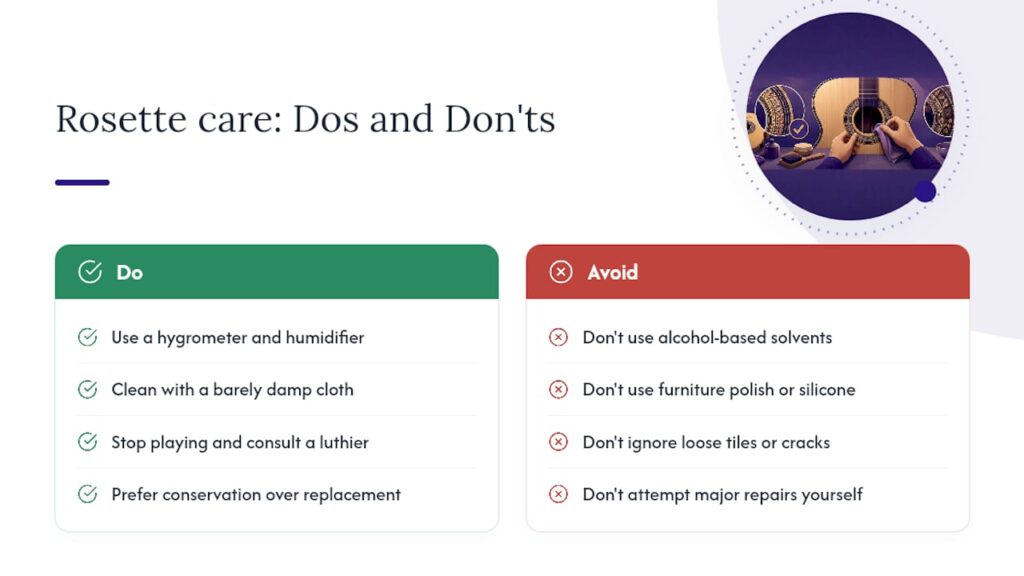
Dry conditions cause the soundboard to shrink, which can pull tile joints apart or crack the wood immediately adjacent to the rosette. A simple hygrometer and a case humidifier are the most cost-effective protection available.
For cleaning, a barely damp cloth is enough. Avoid alcohol-based solvents near the rosette; they can lift the finish, dissolve old hide glue, and cause veneer tiles to shift. Never use furniture polish or silicone-based products around the soundhole.
If you notice a loose tile, a hairline crack radiating from the soundhole, or visible separation between the rosette and the soundboard, stop playing the instrument and consult a luthier. These are not cosmetic issues. A loose tile can catch a fingernail and pull an entire section of the mosaic free. Structural separation at the soundhole edge can propagate into the top.
Pro Tip: For collectors in Germany, seek a luthier certified through the Bundesinnungsverband des Deutschen Musikinstrumentenmacher-Handwerks (the German musical instrument makers’ guild). Certified restorers follow documented conservation standards, which matters for maintaining provenance records on valuable instruments.
Conservation is almost always preferable to replacement. Replacing an original rosette, even with a high-quality reproduction, reduces collector value. A professional restorer can re-glue loose tiles, stabilize cracks, and refinish the area without disturbing the original material.
Rosette examples from Vintage-guitar-world’s collection
Vintage-guitar-world’s inventory regularly includes instruments where the rosette is a primary identification and valuation point. Close-up photography of each instrument captures:
- Tile edge definition and mosaic pattern geometry on classical guitars
- Purfling banding width and material contrast on flamenco instruments
- Join point location and pattern continuity under the fingerboard extension
- Shell or abalone iridescence on premium handcrafted examples
Provenance notes in the Vintage-guitar-world catalog record the rosette’s material, construction type, and any documented restoration, giving buyers a written reference that travels with the instrument.
Pro Tip: Request a guitar testing appointment to examine rosette details in person before purchasing. High-resolution photography is useful, but raking-light inspection in person reveals tile depth and glue line quality that images can miss.

Vintage-guitar-world offers curated vintage and handcrafted guitars with full provenance documentation, expert evaluation, and in-person testing appointments in Germany. Every instrument in the collection is assessed for rosette originality as part of the standard certification process.
Why rosette detail matters more than most buyers realize
Most buyers glance at a rosette and move on. That’s a mistake. The rosette is one of the few areas of a guitar where the maker’s hand is fully visible without disassembly. Bracing is hidden. Neck joints are covered. But the rosette sits right there, open to inspection, and it tells you whether the person who built this instrument cared about precision at the millimeter scale.
At Vintage-guitar-world, the rosette evaluation is part of every instrument assessment. A guitar with an original, well-preserved mosaic rosette and a clean provenance record is a different object from one with a replaced ring and no documentation, even when they play identically. For collectors, that difference compounds over time. Instruments with intact original details hold their value and their story in a way that restored or altered examples simply don’t.
The services available through Vintage-guitar-world, including testing appointments, valuation, certification, and restoration referrals to qualified luthiers in Germany, exist precisely because these details matter and because getting them right requires more than a photograph.
Sources
- Rosette (music) – Wikipedia
- L’Art de la Rose: A Whirlwind History of Guitar Rosettes | Classical Guitar
- Mosaic Rosette Construction | Jonathan Sevy
- No-fail method for making custom guitar soundhole rosettes – StewMac
- Why Do Guitars Have Rosettes? What Its Purpose? – Gecko Guitars