












TL;DR:
- Golpe is a deliberate percussive tap on a flamenco guitar’s golpeador that enhances rhythmic accents within complex cycles. Mastering coordination and timing requires focused practice, as it plays a vital role in shaping flamenco’s emotional and rhythmic expression. Using a proper flamenco guitar with a golpeador is essential for effective technique and sound quality.
If you’ve ever watched a flamenco guitarist and wondered what that sharp percussive tap was hitting the guitar face mid-phrase, you’ve just witnessed the golpe. Understanding what is flamenco golpe technique goes well beyond identifying a simple knock on the wood. It’s a deliberate, rhythmically precise movement that adds a percussive layer to the melody, marks accents within flamenco’s complex rhythmic cycles, and gives the music that raw, driving energy no other genre quite replicates. This guide breaks down how it works, why it matters, and exactly how you can start developing it in your own playing.
Table of Contents
- Key takeaways
- What is flamenco golpe technique: definition and anatomy
- Rhythmic context of golpe in flamenco music
- How to perform the golpe: step-by-step
- Equipment essentials for golpe technique
- Applying golpe for musical expression
- My honest take on learning the golpe
- Ready to find the right flamenco guitar for your practice?
- FAQ
Key takeaways
| Point | Details |
|---|---|
| Golpe is more than a tap | It’s a coordinated percussive finger strike that reinforces rhythmic accents within flamenco’s complex cycles. |
| Finger coordination is everything | The striking finger and strumming finger move in opposite directions simultaneously, making coordination the core challenge. |
| The golpeador is non-negotiable | A protective tap plate on your guitar body prevents serious surface damage during consistent golpe practice. |
| Rhythmic context shapes the golpe | Golpe patterns differ across palos like Soleá, Bulerías, and Alegrías, so musical context drives your execution. |
| Equipment affects sound and durability | A proper flamenco guitar with the right build and golpeador directly impacts your tone and how long your instrument lasts. |
What is flamenco golpe technique: definition and anatomy
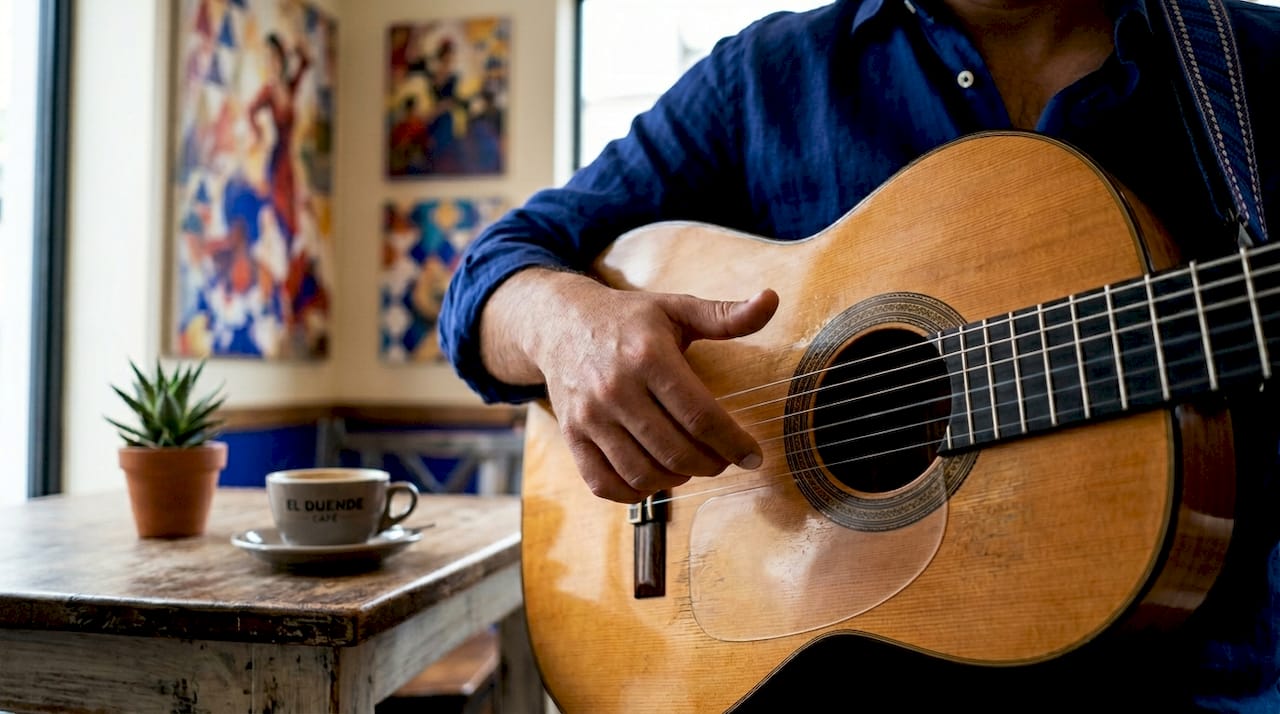
At its core, the flamenco golpe is a finger tap on the golpeador (the protective tap plate on the guitar’s body) performed simultaneously with or alongside a strumming movement. The word golpe means “hit” or “blow” in Spanish. That name is telling. This isn’t an accidental brush or a soft grace note. It’s a deliberate, controlled strike.
The technique is typically executed with the middle finger (dedo medio) or the ring finger (dedo anular) of the right hand. What makes golpe technically demanding is that the fingers move in opposite directions) during execution. One finger taps downward onto the guitar body while another performs a downstroke across the strings. Coordinating those two motions at precisely the same moment, with the right force and timing, is where most players get stuck.
There are two main types of golpe you’ll encounter in practice:
- Golpe with a downstroke: The ring or middle finger strikes the tap plate at the exact moment a downstroke crosses the strings. This reinforces the beat with both a melodic and percussive hit at once.
- Golpe on a rest: Sometimes the golpe fires without any accompanying strum, acting purely as a percussive ghost beat. This is common in falsetas and solo passages where the guitarist punctuates silence.
- Golpe with rasgueado: The tap is layered underneath a fan strum, adding texture and rhythmic punch to an already dense sound.
The striking surface matters too. Most golpes land on the golpeador below the soundhole, though some players tap near the bridge plate or upper bout depending on style and desired sound. Each position produces a slightly different tone — sharper near the bridge, woodier near the waist.
Pro Tip: Practice the tapping motion alone, without any strumming, until your ring or middle finger develops an instinctive, snappy rebound. A limp follow-through will deaden the sound. You want a quick tap and immediate release, almost like touching a hot surface.
Rhythmic context of golpe in flamenco music
Flamenco is built around rhythmic cycles called compás. These cycles are not just time signatures. They carry emotional weight, cultural identity, and structural logic that govern everything a guitarist, singer, or dancer does. The golpe is one of the primary tools a guitarist uses to articulate those cycles with physical, audible impact.
The 12-beat rhythms of Soleá, Alegrías, and Bulerías are the most common homes for golpe. In Soleá, golpe typically lands on beats 3, 6, 8, 10, and 12, reinforcing the asymmetric accent pattern that gives the palo its brooding, serious weight. In Bulerías, golpe appears more rapidly and expressively, matching the frantic, joyful energy of that style. In Alegrías, the golpe carries a lighter, more celebratory feel to match the palo’s character.
What sets golpe apart from other flamenco techniques is its dual role. The table below shows how it compares with the other core right-hand techniques:
| Technique | Primary function | Sound character | Rhythmic role |
|---|---|---|---|
| Golpe | Percussive accent on body | Sharp, woody knock | Marks accents and weak beats |
| Rasgueado | Fan strum across strings | Full, dense chord wash | Drives rhythmic momentum |
| Picado | Single-note melodic runs | Bright, articulate tone | Melodic line and speed passages |
| Tremolo | Repeated single note | Flowing, sustained melody | Melodic expression and dynamics |
Notice that golpe doesn’t compete with these techniques. It works in tandem with rasgueado) to create flamenco’s layered rhythmic texture. A guitarist who uses golpe well doesn’t just keep time. They signal to the dancer, communicate with the singer, and shape the emotional arc of the whole performance. That’s a significant musical responsibility sitting in one tapping finger.
How to perform the golpe: step-by-step
Learning how to perform golpe correctly from the beginning saves you from building habits that become very hard to undo. Work through these steps slowly and with focus before you push for speed.
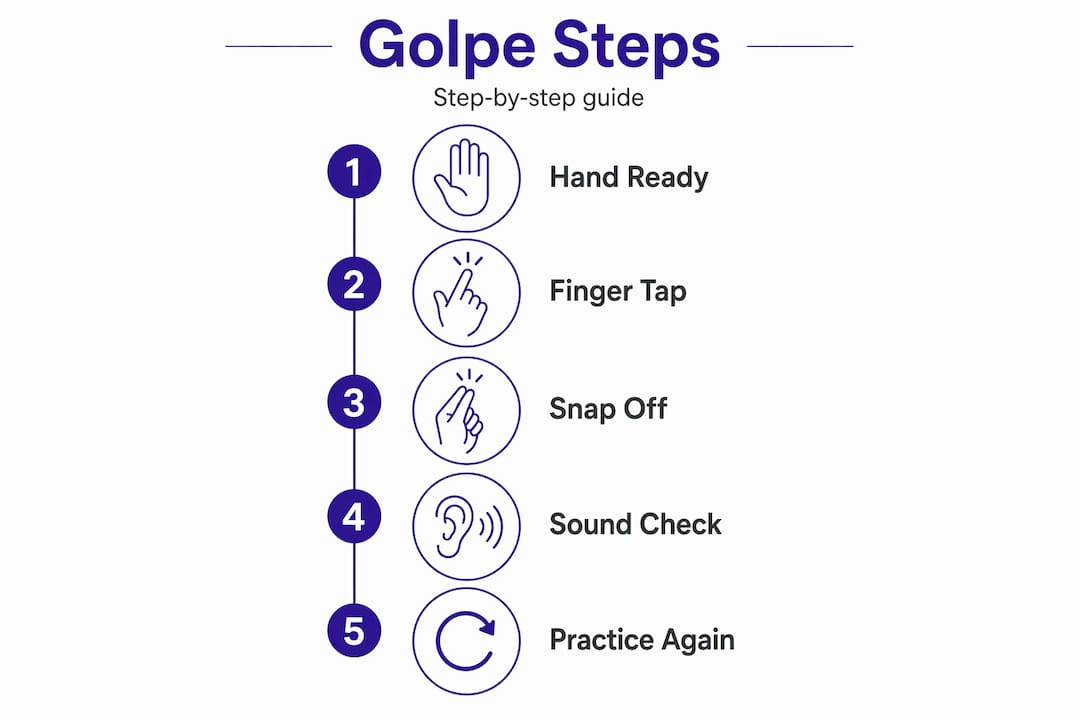
- Position your right hand. Rest your right hand lightly over the golpeador with your fingers slightly curved. Your ring finger should hover naturally above the tap plate without tension. Relax your wrist.
- Isolate the tapping motion. Without touching the strings, practice snapping your ring finger down onto the golpeador and rebounding immediately. The sound should be a clean, sharp click. A dull thud means your finger is staying on the surface too long.
- Add a simple downstroke. Play a single downstroke on one or more strings with your index finger while your ring finger taps the plate at the same time. Start slowly. The two movements should land as one combined sound.
- Practice the separation. Exercises that separate then combine) golpe and strumming are the fastest way to develop coordination. Do ten taps alone, ten strums alone, then ten combined. Repeat until the combined motion feels natural.
- Introduce it within a rhythmic cycle. Choose a slow Soleá compás and mark beats 3 and 8 with a golpe plus downstroke. Use a metronome. Resist the urge to rush.
- Vary your dynamics. Once the basic timing locks in, start experimenting with softer and harder taps. A lighter golpe whispers. A firm one demands attention. Both have their place.
- Build to full integration. Combine golpe with rasgueado runs, then with melodic picado lines. Work on one pairing at a time rather than throwing everything together at once.
Common beginner mistakes to watch for: pressing the finger into the golpeador instead of snapping off it, tensing the wrist before the strike, and letting the ring finger drag across the surface instead of landing cleanly. If your taps sound inconsistent, slow down and examine your rebound.
Pro Tip: Record yourself with a simple phone camera and watch your right hand back. What feels correct in the moment often looks very different on video. Most students discover their tapping finger stays on the surface far too long, killing the sound.
Equipment essentials for golpe technique
Your guitar matters here more than many players realize. Performing golpe on the wrong instrument doesn’t just sound bad. It causes lasting damage to your guitar.
The golpeador is the protective plate on flamenco guitars designed specifically for this technique. Typically made from clear or lightly tinted plastic, it covers the area below the soundhole where tapping occurs most frequently. Modern golpeadores protect all primary striking areas so the cedar or spruce soundboard beneath is never touched directly by your fingernail.
Here’s what to know before you start practicing golpe on any instrument:
- Flamenco vs. classical guitar: A flamenco guitar’s lighter construction and lower action make golpe easier to execute and more resonant. Classical guitars have thicker tops and lack golpeadores, making them unsuitable for regular golpe practice.
- Golpeador placement: On flamenco guitars, golpeadores are positioned to cover the most common tapping zones. Single-plate models protect below the soundhole. Extended models also cover the upper bout for players with a higher tapping position.
- Material makes a difference: Thicker plastic golpeadores absorb impact and produce a slightly duller tap sound. Thinner ones resonate more with the top and give a brighter knock.
- Retrofitting a classical guitar: You can apply adhesive golpeadores to classical or non-flamenco guitars if needed. However, playing without a golpeador will cause visible wood damage quickly, even after a short period of regular practice.
If you’re serious about developing this technique, reviewing our flamenco guitar guide will walk you through the full range of differences between flamenco and classical instruments and help you identify the right build for your needs.
Applying golpe for musical expression
Knowing the mechanics is only half the story. Knowing when and how much to use golpe is what separates technically correct playing from genuinely compelling flamenco performance.
Varying golpe pressure and timing is the fastest way to unlock emotional depth. A soft golpe on a quiet falseta passage creates tension. A hard golpe cracking down right before a rasgueado burst releases it. That tension and release is the emotional architecture of flamenco.
A few principles worth internalizing:
- Golpe communicates with the dancer. In a live performance setting, the guitarist’s golpe often signals rhythmic cues to the bailaor or bailaora. Placing it cleanly on the right beat isn’t just musical courtesy. It’s functional communication.
- Less is often more. Overusing golpe flattens its impact. Reserve your strongest taps for structural moments in the compás where the accent needs maximum weight.
- Placement on the body creates tonal variety. Tapping near the bridge produces a higher, drier click. Moving your tap point toward the soundhole creates a rounder, more resonant knock. Use both deliberately rather than defaulting to one spot.
- Combine with rasgueado for maximum drive. The fusion of a rasgueado fan strum with a simultaneous golpe is one of the most recognizable and exciting sounds in all of flamenco guitar.
Working through established pieces in Soleá or Bulerías and analyzing exactly where master players place their golpes is one of the most practical ways to develop your own musical instincts for this technique. Listen before you play.
My honest take on learning the golpe
I’ve seen players spend months drilling rasgueado and tremolo while completely ignoring golpe until late in their studies. That’s a mistake. In my experience, the golpe reveals something important about your overall right-hand coordination that no other technique exposes quite as clearly.
When I first worked seriously with golpe, I thought I had decent timing. The golpe corrected me. That split-second coordination between the tapping finger and the strumming finger showed me exactly where my timing was sloppy in ways that a metronome alone never would.
What I’ve found is that golpe rewards patience more than almost any other flamenco technique. The mechanical motion is learnable in a few weeks. But the musical intelligence to know when to land it hard, when to whisper it, and when to leave it out entirely takes real time with the music. If you’re starting to learn flamenco guitar, treat the golpe as a listening exercise, not just a hand exercise.
The most surprising thing I discovered through consistent practice was how much the golpe changed the way I heard flamenco as a listener. Once you understand it mechanically, you start catching it everywhere in recordings. That kind of active listening accelerates your whole development, not just the golpe itself.
— Vintage
Ready to find the right flamenco guitar for your practice?
The golpe sounds its best on an instrument built for it. A proper flamenco guitar with a quality golpeador, responsive cedar or spruce top, and low action transforms this technique from a mechanical exercise into a genuinely musical experience.
At Vintage-guitar-world, we carry a curated selection of flamenco, classical, and vintage guitars across a wide range of styles and price points, each evaluated for playability and craftsmanship. Whether you’re looking for your first proper flamenco instrument or a professional-grade guitar capable of recording-quality golpe response, our collection gives you real options backed by expert knowledge. Explore what we have available and find an instrument that matches where your playing is headed.
FAQ
What is golpe in flamenco guitar?
Golpe is a percussive tap performed with the ring or middle finger of the right hand on the golpeador (tap plate) of a flamenco guitar. It accentuates rhythmic beats within flamenco’s compás cycles and is performed simultaneously with strumming or as a standalone percussive strike.
What finger do you use for golpe?
The ring finger is the most commonly used finger for golpe, though some players also use the middle finger depending on the technique and style. The key is that it taps the golpeador cleanly while another finger handles the strumming motion.
Do you need a special guitar to practice golpe?
Yes, a flamenco guitar with a golpeador (protective tap plate) is strongly recommended. Playing golpe on a guitar without this protection will damage the soundboard surface over time, as the repeated finger taps wear through the wood finish quickly.
How does golpe differ from rasgueado?
Rasgueado is a fan strum technique across the strings that generates full chord textures and rhythmic drive. Golpe is a percussive body tap that adds a physical knock to the rhythm. Both techniques often work together in the same passage to create flamenco’s layered sound.
How long does it take to learn golpe?
Basic golpe coordination can be developed within several weeks of focused daily practice. Musical integration within flamenco compás patterns takes considerably longer, as it requires internalizing the rhythmic structure of each palo and knowing when and how hard to apply the tap expressively.