












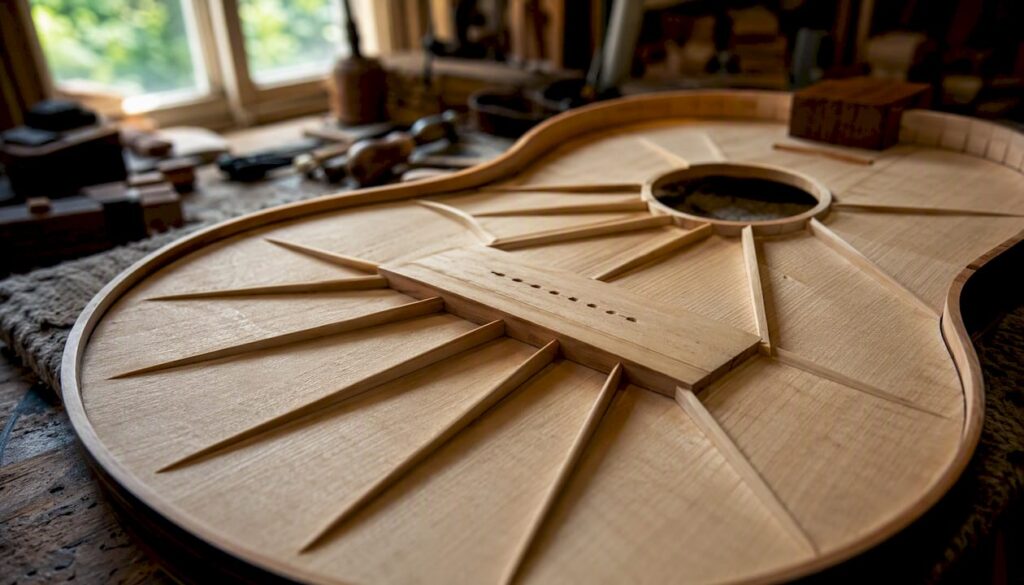

Fan bracing is a set of wooden struts arranged in a radiating, fan-like pattern on the underside of a guitar’s soundboard. Those struts do two things at once: they hold the top together under string tension, and they shape how the wood vibrates, which determines much of the guitar’s tonal character. If you’ve ever looked through a classical guitar’s soundhole and seen thin wooden ribs fanning outward beneath the bridge area, you’ve seen fan bracing in action.
Its two core roles, in brief:
- Structural support: The braces distribute the pull of the strings across the top, preventing the bridge from slowly lifting or the wood from warping over time.
- Tonal shaping: Their placement, thickness, and orientation control how freely different parts of the soundboard flex, directly affecting warmth, bass response, and dynamic range.
Fan bracing is the standard internal architecture for classical and flamenco guitars (nylon-string instruments). It is not the default system for steel-string acoustics, which require heavier cross-bracing to handle the higher tension those strings generate.
A labeled interior diagram showing the fan struts clustered beneath the saddle area and radiating toward the lower bout is the fastest way to orient yourself to the layout. Look for one before reading further — it will make every section below click into place.
Key Takeaways
Fan bracing is the defining internal architecture of the classical guitar, and understanding it helps players, collectors, and buyers make better decisions at every stage.
| Point | Details |
|---|---|
| Core definition | Fan bracing is a set of wooden struts radiating under the soundboard, providing structural support and shaping tonal response. |
| Main tonal effects | Produces warmer tone, stronger bass response, and broader dynamic range compared with ladder-braced tops. |
| Identification tip | Look through the soundhole with a light; fan struts radiate from a cluster near the bridge toward the lower bout. |
| When to choose fan bracing | Prefer it for classical and flamenco playing; consider lattice or double-top only if maximum projection is the primary goal. |
| Vintage-guitar-world | Offers testing appointments, appraisal, and curated fan-braced classical and flamenco instruments with documented provenance. |
Table of Contents
- What is fan bracing and how does it control vibration?
- How Antonio de Torres shaped the modern classical guitar
- What does a typical fan-bracing pattern look like?
- How does fan bracing affect tone and playability?
- How does fan bracing compare with other bracing systems?
- How to identify fan bracing inside a guitar
- What a vintage dealer looks for in a fan-braced instrument
- Why fan bracing still matters in 2026
- Hands-on evaluation and curated fan-braced instruments at Vintage-guitar-world
- Sources
What is fan bracing and how does it control vibration?
Fan braces run mostly along the wood grain of the soundboard rather than perpendicular to it. That orientation is deliberate. Running with the grain lets the top flex longitudinally, which amplifies the low-frequency modes responsible for warmth and bass. Perpendicular bracing stiffens the top against that flex, which is exactly what you want for steel strings but not for nylon.
The spacing of the struts near the bridge matters enormously. Clustered tightly beneath the saddle, they stiffen the area that takes the most mechanical stress from string tension. As the struts radiate outward toward the lower bout, they thin and spread, allowing the outer regions of the top to vibrate more freely. That gradient of stiffness is what creates the nodal patterns responsible for a classical guitar’s characteristic tonal bloom.
Fan bracing’s dual purpose is to stiffen and support the soundboard against string tension while shaping the guitar’s tonal responsiveness. Because the braces carry structural load, builders can thin the top itself, sometimes to a very thin dimension in the lower bout, which would be impossible without the internal skeleton. Thinner tops vibrate more freely, which is a direct contributor to the instrument’s sensitivity and dynamic range.
Luthiers treat each brace as a tuning variable. Changing strut count, thickness, and scalloping produces material differences in sustain, balance, and responsiveness. Scalloping, the practice of carving shallow curves along the length of a brace to reduce its mass at the midpoint while keeping the feet stiff, is one of the most common adjustments. A scalloped brace is lighter and more flexible at its center, which tends to open up the midrange and improve touch sensitivity.

Traditional fan bracing is not suited to steel strings. High steel-string tension risks structural failure on a fan-braced top without reinforcement, which is why steel-string builders moved to X-bracing and similar cross-pattern systems.
Pro Tip: In a shop, lightly press the top just behind the bridge with one finger while the guitar is unstrung. A fan-braced classical top should feel noticeably flexible compared with a steel-string acoustic. If it feels rigid, the bracing may be unusually heavy or the top unusually thick.
How Antonio de Torres shaped the modern classical guitar
Torres’ 19th-century refinements made fan bracing the standard for modern classical guitars. Before him, the instrument was smaller, quieter, and often braced with simple ladder patterns (parallel struts running across the grain) that limited bass response and dynamic range.
The key developments in brief:
- Pre-Torres era: Builders used ladder bracing or rudimentary proto-fan patterns with three to five struts. Bodies were smaller, tops were thicker, and bass was weak.
- Torres’ 1840s innovations: He enlarged the body, thinned the soundboard, and developed more effective fan patterns, often experimenting with seven struts plus secondary braces. His designs allowed builders to address the weak bass of romantic-era guitars by increasing body size and reducing top mass.
- Tonal consequence: Torres’ refinements enabled thinner soundboards and larger bodies with stronger bass and a wider dynamic range than anything ladder-braced instruments could produce.
- 19th–20th century evolution: Builders across Spain, Germany, and France adopted and adapted Torres’ patterns. Francisco Tárrega, the guitarist who defined the classical repertoire of the late 19th century, performed on Torres instruments, which helped cement the design’s authority.
Torres didn’t just improve a construction detail. He changed what the guitar could do musically, and the fan-bracing system he refined is still the foundation of virtually every serious classical instrument built today. For a deeper look at his legacy, the profile of Antonio de Torres at Vintage-guitar-world covers his design philosophy in detail.
What does a typical fan-bracing pattern look like?
The standard layout places several fan struts clustered tightly beneath the saddle area, then radiating outward and downward toward the lower bout. A transverse brace (sometimes called the bridge plate or harmonic bar) runs across the top just above the fan cluster, anchoring the pattern and helping distribute bridge load laterally.
Common components:
- Primary fan struts: Usually 5–7, though some builders use as few as 3 or as many as 9 depending on tonal goals.
- Transverse brace: Sits above the fan cluster; provides lateral stiffness and anchors the fan’s upper ends.
- Secondary small braces: Diagonal or “belly bars” sometimes appear at the edges of the fan to control top flex near the waist.
- Scalloping: Most quality instruments show carved relief along the brace length, reducing mass without sacrificing foot adhesion.
Brace wood is almost always a light, stiff spruce variant, with Engelmann spruce, Sitka spruce, and European spruce all appearing in quality instruments. Some builders use cedar for the top itself but still prefer spruce for the braces, since spruce’s stiffness-to-weight ratio is hard to match. Braces are typically glued with hide glue, which is reversible and allows future repairs without damaging the top.
The number of struts is a genuine tonal variable, not just a stylistic choice:
| Number of fan struts | Typical tonal tendency |
|---|---|
| 5 struts | Brighter, clearer articulation; faster attack |
| 7 struts | Warmer, richer bass; more complex overtones |
| 9 struts | Maximum structural support; sometimes denser, less open sound |
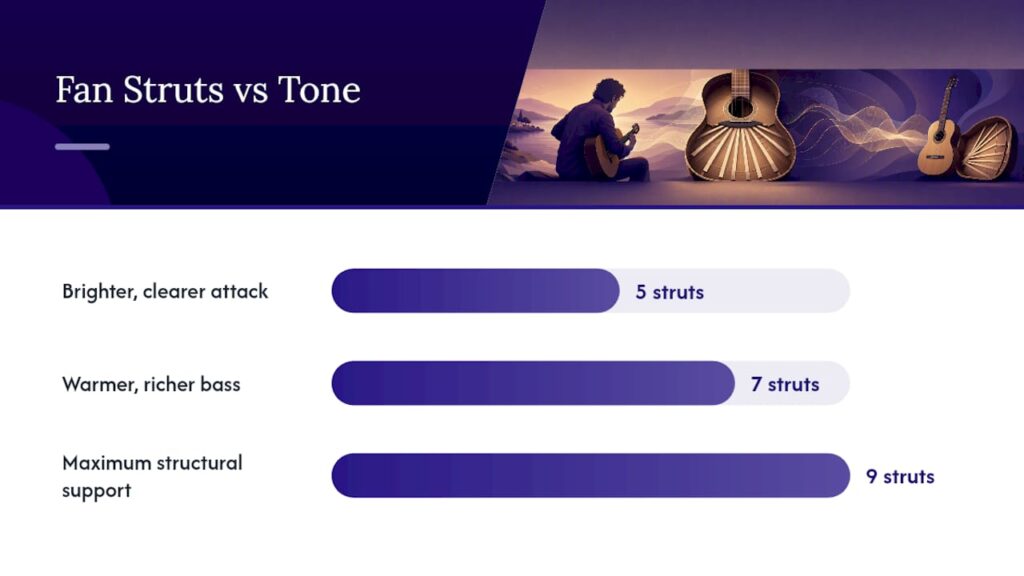
These tendencies are guidelines, not rules. A lightly scalloped 7-strut pattern can sound brighter than a heavy, unscalloped 5-strut layout. The fan-bracing standard for classical guitars has countless localized modifications, and the interaction between top thickness, brace dimensions, and wood density makes every instrument its own case.
When inspecting a guitar, look through the soundhole with a small flashlight. The fan struts should be clearly visible, running from a tight cluster near the bridge plate outward toward the sides. Scalloping marks, if present, appear as subtle concave curves along the brace length.
How does fan bracing affect tone and playability?
Fan bracing generally produces a warmer, earthier sound with stronger bass response and a broader dynamic range than ladder-braced tops. For players, that translates to an instrument that rewards nuanced right-hand technique: play softly and it whispers; dig in and it opens up without breaking apart.
Specific tonal attributes the fan pattern influences:
- Warmth: The along-grain brace orientation encourages low-frequency resonance, giving the tone body and depth.
- Bass response: Struts radiating toward the lower bout amplify the bass register, which is why classical guitars project so differently from steel-string acoustics.
- Sustain: A well-tuned fan pattern lets notes ring and bloom; too much stiffness cuts sustain short.
- Projection: Fan-braced tops project well in intimate settings but can struggle to fill large halls without amplification, a known tradeoff.
- Touch sensitivity: Thinner, scalloped braces make the top more responsive to dynamics, which is central to classical technique.
Classical and flamenco guitars use fan bracing differently. A classical instrument typically prioritizes sustain, warmth, and tonal complexity. Flamenco guitars often favor a stiffer top with less sustain and a faster, percussive attack, achieved through slightly heavier or less scalloped bracing, a thinner body, and sometimes a cypress back and sides. The result is a drier, more immediate sound suited to rhythmic playing and the golpe (finger tap) technique.
Builders manipulate these qualities deliberately. Thinner braces and deeper scalloping open the sound and increase touch sensitivity. More struts add warmth and bass at the cost of some clarity. Fewer struts brighten the response and sharpen articulation. For a technical breakdown of how these choices interact, the classical guitar bracing and tone article at Vintage-guitar-world goes into the specifics.
Pro Tip: When testing a guitar in a shop, play a single bass note on the open E or A string and let it decay fully. A well-tuned fan-braced top produces a note that blooms slightly after the attack before settling into a long, even sustain. A top that’s too stiff cuts the bloom short; one that’s too flexible sounds tubby and unfocused.
How does fan bracing compare with other bracing systems?
Luthiers routinely vary fan bracing, and some combine it with other concepts entirely. Builders vary brace count and shaping to tune tone, treating the pattern as a starting point rather than a fixed specification.
Key bracing systems and how they differ in practice:
- Fan bracing: The classical standard. Works with nylon-string tension, produces warm bass and dynamic sensitivity. Countless regional and builder-specific variants exist.
- X-bracing: Two primary braces crossing beneath the soundhole, developed for steel-string acoustics. Handles higher tension, produces a brighter, more focused tone with stronger midrange. Not suited to classical playing styles.
- Lattice bracing: A grid pattern of carbon fiber or thin wood strips covering the entire top. Produces exceptional volume and projection, often used in concert-level instruments. Less traditional in feel and tonal color; repairs are more complex.
- Double-top construction: Two thin wood layers with a Nomex honeycomb core. Extremely light and responsive, favored by some modern concert builders. Produces a different tonal character than traditional fan bracing, with more even string-to-string balance.
Fan bracing works well for nylon-string classical instruments, and steel-string guitars are rarely built with it because the tension differential is simply too large. Converting a fan-braced top to steel strings without reinforcement risks collapse. X-bracing handles that tension by crossing the braces directly beneath the bridge, distributing load in two directions simultaneously.
Lattice and double-top systems are modern alternatives for players who need maximum projection, often for recording or large-venue performance. They are not better or worse than fan bracing in any absolute sense; they serve different tonal and performance goals. Many instruments labeled “hybrid” combine elements from two or more systems in builder-specific ways. Evaluate those by sound and build quality rather than the label.
How to identify fan bracing inside a guitar
The quickest check: look through the soundhole. Fan bracing is visible as a set of thin wooden ribs radiating from a cluster near the bridge toward the lower bout. You don’t need special tools for a basic visual inspection.
Step-by-step shop inspection:
- Visual check through the soundhole: Use a small flashlight or your phone’s light. Tilt the guitar so light falls on the interior lower bout. You should see the fan struts clearly, along with the transverse brace running across the top above them.
- Count the struts: Note how many primary fan struts are present and whether they are evenly spaced. Unusual spacing or asymmetry may indicate a repair or a non-standard pattern.
- Check for scalloping: Look for the subtle concave curves along the brace length. Their presence usually indicates a quality build; their absence on an otherwise fine instrument may suggest heavy bracing.
- Inspect glue seams: Look at the brace feet where they meet the top. Clean, tight glue lines are normal. Gaps, lifting, or discoloration suggest a loose brace, which affects tone and structural integrity.
- Check the bridge plate: The transverse brace above the fan cluster should be intact and firmly glued. A cracked or lifted bridge plate is a significant repair issue.
- Tap test: Tap the top lightly with a knuckle in the lower bout, away from the bridge. A healthy fan-braced top produces a clear, resonant tap tone. A dull thud can indicate a loose brace or a very thick top.
Red flags to watch for:
- Cracks running parallel to the grain near brace feet (stress fractures from loose braces)
- Evidence of heavy repairs: mismatched wood patches, excess glue residue, or replaced braces that don’t match the original wood grain
- Unusual reinforcement added across the fan pattern (sometimes indicates a previous structural failure)
- A bridge plate that shows cracking or has been replaced with a non-original material
Normal variation includes scalloping marks, minor glue traces at brace feet, and slight asymmetry in strut placement, all of which are common in handmade instruments and don’t affect value or playability.
Pro Tip: Press the top gently with your thumb just behind the bridge while the guitar is unstrung. A properly fan-braced classical top flexes noticeably. If it feels like pressing on a table, the bracing is unusually heavy or the top is thick. If it flexes too easily, the bracing may be compromised.
What a vintage dealer looks for in a fan-braced instrument
Structural soundness comes first, tonal character second, and provenance third. That priority order reflects a practical reality: a guitar with compromised bracing can’t be accurately assessed for tone, and a guitar without documented history is harder to value accurately.
The dealer checklist for a fan-braced instrument:
- Originality of braces: Are the fan struts original to the instrument, or have any been replaced? Replacement braces, even well-executed ones, alter the tonal identity and reduce collector value.
- Evidence of sympathetic repairs: Repairs done with period-appropriate materials and techniques (hide glue, matching spruce) are acceptable. Epoxy fills, modern adhesives, or structural reinforcements that weren’t part of the original design are red flags.
- Top thickness: Measured with a dial gauge through the soundhole, top thickness affects both tone and structural risk. Unusually thin tops may have been sanded down; unusually thick ones may have been replaced.
- Bridge plate condition: The transverse brace takes significant stress. Cracks, lifting, or replacement here affect both structural integrity and tonal character.
- Documented maker signs: Original scalloping marks, consistent wood grain in the braces, and original glue seam patterns all contribute to authenticity. Original brace geometry is a large part of an instrument’s historical tonal identity, and collectors pay accordingly.
For sellers preparing an instrument for appraisal: photograph the interior bracing through the soundhole with good lighting, note any repairs or replaced parts in writing, and have a professional setup or appraisal completed before listing. Instruments with documented, original bracing and clean repair histories consistently achieve stronger valuations. The guitar appraisal checklist at Vintage-guitar-world walks through the full evaluation process step by step.
Why fan bracing still matters in 2026
Fan bracing remains central to the classical guitar not because builders lack alternatives, but because its tonal qualities are genuinely difficult to replicate with other systems. Lattice and double-top instruments can project more volume, but they often sacrifice the tonal complexity and touch sensitivity that define the classical guitar’s expressive range. For players who work in the nuanced dynamic world of classical or flamenco repertoire, that tradeoff is rarely worth it.
The tradition also matters practically. Fan-braced instruments are repairable with standard luthier tools and materials. A loose brace can be re-glued; a cracked top can be cleated. Lattice and double-top instruments require specialized knowledge and materials for even minor repairs, which limits the pool of qualified luthiers and raises long-term maintenance costs.
For collectors, original fan bracing is part of an instrument’s historical identity. A Torres-pattern guitar with original bracing intact is a different object, historically and tonally, from the same guitar re-braced with modern materials. That distinction drives real valuation differences.
When should a player or collector consider a modern alternative? If the primary goal is maximum projection for large-venue or recording use, a lattice or double-top instrument may genuinely serve better. For everything else, including studio work, chamber performance, teaching, and collecting, a well-made fan-braced instrument remains the standard against which alternatives are measured.
Hands-on evaluation and curated fan-braced instruments at Vintage-guitar-world
Finding a fan-braced classical or flamenco guitar you can trust requires more than reading specs online. The difference between a well-tuned fan pattern and a mediocre one is audible in seconds when you play the instrument, and visible in minutes when you inspect it properly.

Vintage-guitar-world offers guitar testing appointments so you can evaluate instruments in person before committing, along with professional appraisal and certification services for buyers and sellers. The curated selection covers classical and flamenco guitars across a range of periods and makers, each with documented provenance and expert evaluation. Restoration and setup services are also available for instruments that need attention before they’re playable at their best. To book a testing appointment or request an appraisal, visit the Vintage-guitar-world shop and use the contact or booking options listed there.
Sources
The references below are selected for technical accuracy and depth. Each covers a different angle of fan bracing, from construction mechanics to historical context.
- Bracing Styles for Classical Guitars | This is Classical Guitar
- Introduction to Classical Guitar Bracing » Good Music Academy
- Guitar bracing — Wikipedia
- Frets
- Understanding Acoustic Guitar Bracing Systems – Guitar Space
Readers purchasing or appraising instruments in Germany should verify maker specifications, local restoration standards, and current valuation practices with a qualified German luthier or through Vintage-guitar-world’s appraisal service, since regional workshop traditions and material availability can affect both repair approaches and market pricing.