














TL;DR:
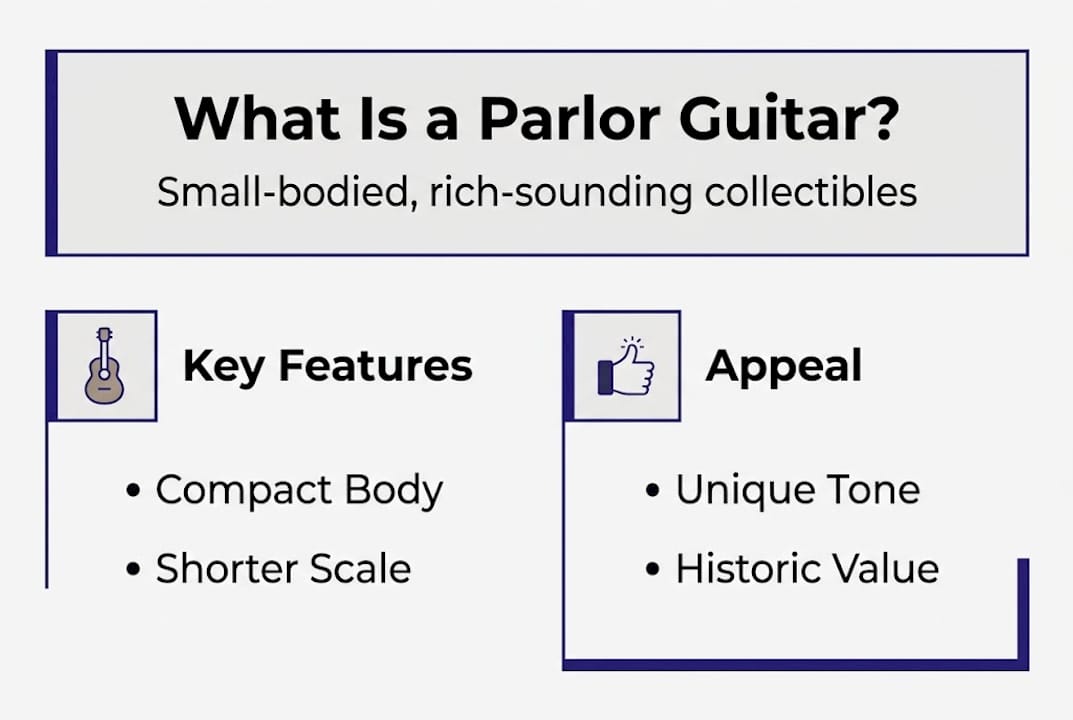
- Parlor guitars are small-bodied instruments with focused midrange and intimate sound.
- Originally popular in Victorian homes, they have gained recent popularity among players and collectors.
- They offer unique tonal qualities, historical value, and playability advantages, especially for fingerstyle and blues.
Parlor guitars are having a genuine moment. Once tucked away as relics of Victorian living rooms, these compact instruments are drawing serious attention from fingerpickers, folk musicians, blues players, and veteran collectors. Yet the misconception persists that they are simply “small guitars” without the depth or seriousness of a full-size dreadnought. That thinking is wrong, and increasingly, the broader guitar community knows it. This guide breaks down exactly what a parlor guitar is, where it came from, how it sounds, and what to look for if you want to add one to your collection.
Table of Contents
- Defining the parlor guitar: What makes it unique?
- From Victorian parlors to modern stages: A brief history
- Sound and playability: Why players and collectors love parlors
- Buying and collecting: Tips for choosing quality parlor guitars
- A collector’s perspective: What most miss about parlor guitars
- Discover your next vintage guitar
- Frequently asked questions
Key Takeaways
| Point | Details |
|---|---|
| Compact design | Parlor guitars are known for their small bodies and comfortable playability. |
| Rich history | They originated in 19th-century America and have a fascinating lineage tied to home music making. |
| Unique tonal character | Their sound emphasizes midrange clarity and is ideal for fingerstyle and blues. |
| Collectibility | Well-preserved vintage parlors are highly valued for craftsmanship and historic appeal. |
Defining the parlor guitar: What makes it unique?
A parlor guitar is, at its core, a small-bodied acoustic guitar. As defined by guitar historians, it is typically smaller than Martin’s Size 0 or concert guitar, with a narrow waist and compact dimensions. But that plain description barely scratches the surface of what makes these instruments so distinctive.
The body dimensions tell part of the story. A typical parlor guitar measures:
| Measurement | Typical Range |
|---|---|
| Body length | 18 to 19.75 inches |
| Lower bout width | 13 to 14.25 inches |
| Body depth | 3.75 to 4.4 inches |
| Scale length | 24 to 24.9 inches |
Compare that to a dreadnought, which runs a lower bout of around 15.6 inches and a scale length closer to 25.4 inches. The difference is immediately felt the moment you pick one up.
The narrow waist is more than an aesthetic feature. It shapes the guitar’s tonal response by limiting the internal air volume, which tightens the bass frequencies and pushes the midrange forward. This is why parlors sound focused and immediate rather than boomy. They also sit more comfortably on the knee for players who spend long hours in a seated position.
Here is a quick comparison across common acoustic guitar types:
- Parlor: Compact, narrow waist, focused midrange, intimate projection
- Concert (Size 0/00): Slightly wider body, balanced tone, versatile
- Auditorium (Size 000/OM): Fuller bass, more volume, popular for singer-songwriters
- Dreadnought: Large body, strong bass, designed for strumming and projection
- Jumbo: Maximum volume and bass, favored for country and rock
The history of parlor guitars shows that these instruments were purpose-built for intimate domestic music making, not performance halls. That intentional design still defines them today.
Pro Tip: If you have smaller hands or find full-size acoustics physically fatiguing, a parlor guitar is not a compromise. Its shorter scale length and narrower body can genuinely improve your playing comfort and precision.
From Victorian parlors to modern stages: A brief history
Understanding where parlor guitars came from helps explain why they still matter. Their timeline stretches from the gaslit rooms of 19th-century homes to the stages and studios of the 21st century.
According to acoustic guitar research, parlor guitars originated in the late 1800s in the United States, were popularized by Martin with X-bracing innovations for steel strings, peaked in popularity from the late 19th to mid-20th century, and experienced a renaissance in the 2000s driven by portability and tone.
| Era | Key Developments |
|---|---|
| Victorian (1870s to 1900s) | Gut-string parlors for home entertainment; parlor music culture at its peak |
| Pre-war (1900s to 1930s) | Steel strings adopted; Martin X-bracing; blues and folk players adopt parlors |
| Post-war (1940s to 1980s) | Dreadnoughts dominate; parlors largely fade from mainstream production |
| Modern revival (2000s to present) | Boutique makers, vintage collectors, and touring artists rediscover the format |
Martin’s contribution cannot be overstated. Their development of X-bracing, a structural pattern of internal wooden supports, made it possible for smaller guitar bodies to handle the higher tension of steel strings without collapsing. This turned the parlor from a delicate gut-string instrument into something with real sonic character and durability.
The numbered moments that drove the modern revival are worth noting:
- Renewed interest in roots music and acoustic blues in the early 2000s
- Growth of fingerstyle guitar as a genre and social media community
- Practical appeal for touring musicians needing a light, travel-friendly instrument
- Collector demand for pre-war American instruments as authentic historical artifacts
- Boutique luthiers offering premium handbuilt parlors as alternatives to mass production
“The parlor guitar is not a lesser instrument. It is a different instrument, one that rewards players who listen more carefully and play more thoughtfully.”
Today, exploring types of vintage guitars reveals just how much variety exists within the parlor category alone, spanning different eras, makers, and tonal profiles.
Sound and playability: Why players and collectors love parlors
Playing a parlor guitar for the first time can catch even experienced players off guard. The instrument responds differently from what most modern guitarists are trained to expect.

The tonal character is the most striking feature. Parlors deliver a responsive, articulate midrange focus with clarity in the trebles, but limited bass and volume compared to larger-bodied guitars. They excel in fingerstyle, folk, and blues, and are less suited for heavy strumming without amplification.
Here is what that means in practice:
- Quick attack: Notes bloom fast, making every fingerpicked note distinct
- Pronounced mids: Cuts through a mix in recording and small-room settings
- Sparkling trebles: Ideal for melodic runs and intricate fingerpicking patterns
- Reduced bass: A feature, not a flaw, for players who want clarity over boom
- Lower volume ceiling: Best for intimate settings, recording, or small venues
The scale length plays a major role in playability. At 24 to 24.9 inches, the shorter string length reduces overall tension. Less tension means bends require less effort, chord grips are slightly less demanding, and players with smaller hands can navigate the neck more easily.
Statistic to note: A guitar with a 24-inch scale can have up to 10 to 15 percent less string tension than a standard 25.4-inch scale at the same pitch and string gauge. That difference is physically felt, especially during longer playing sessions.
The choice of tonewoods and sound quality matters significantly in parlors because the small body amplifies the character of each wood more directly. Spruce tops add brightness, cedar softens the attack, and rosewood back and sides add warmth and sustain.
Pro Tip: Parlors shine brightest in solo acoustic settings, home recording, and folk or blues jams. Before committing, consider testing playability in person if possible, since the response of a parlor is something you feel as much as hear.
Buying and collecting: Tips for choosing quality parlor guitars
Whether you are after a pre-war American gem or a modern handbuilt instrument, knowing what to look for separates a great acquisition from an expensive mistake.
As instrument experts note, vintage parlors offer historical character but may need a professional setup for comfortable playability. Modern examples use tonewoods like cedar and rosewood with all-solid construction for quality craftsmanship.
Here is a numbered checklist for evaluating any parlor guitar:
- Structural integrity: Check for cracks, splits, or separation along the top, back, and sides
- Neck angle and action: High action can signal a warped neck or sunken top, both expensive repairs
- Originality: Original tuning machines, nut, saddle, and bridge add collector value
- Repair history: Look for signs of prior repairs; clean repairs are acceptable, poor ones reduce value
- Tonewood quality: Solid tops and back/sides outperform laminate for both tone and long-term value
- Playability after setup: Even a well-preserved vintage instrument may need a fresh nut, saddle, or fret level
When examining condition, watch for these specific warning signs:
- Bellying behind the bridge (top bowing upward under string pressure)
- Finish checking (hairline cracks in old lacquer) versus structural cracks
- Replaced or mismatched parts that affect originality
- Evidence of amateur repairs, including misaligned braces or uneven glue joints
Sourcing matters enormously. Reputable dealers who specialize in vintage instruments perform authentication, provide provenance documentation, and often offer condition guarantees. Before buying, use a vintage guitar buying checklist to make sure you have covered every critical point.
Also factor in ongoing maintenance. Older instruments need humidity control, periodic fret leveling, and careful storage. Good care tips for vintage guitars can mean the difference between an instrument that holds its value and one that deteriorates.
Pro Tip: Avoid parlors with replaced tops or backs unless the price reflects it dramatically. The structural wood IS the instrument. A replaced top changes the entire sonic and historical identity of the piece.
A collector’s perspective: What most miss about parlor guitars
Here is something we have observed consistently: buyers who approach parlor guitars looking for a “small version” of something bigger will always be disappointed. That framing misses the point entirely.
Parlor guitars were never designed to compete with dreadnoughts on volume or bass. They were designed to create intimacy. When you sit with a well-made parlor, you feel the instrument respond directly to your touch in a way that larger-bodied guitars simply cannot replicate. Every nuance of your right-hand technique becomes audible.
For collectors, the real appeal runs even deeper. These instruments carry visible evidence of handwork, from the way braces were carved and fitted to the figuring of aged tonewoods. A pre-war American parlor is not just an old guitar. It is documentation of craft practices that no longer exist at scale. This is exactly why old guitars sound better than most modern mass-produced alternatives: aged tonewoods, hand-fit joinery, and decades of natural resonance buildup.
Do not let small size fool you into thinking these are entry-level instruments. The finest examples demand serious prices and reward serious attention.
Discover your next vintage guitar
If this exploration of parlor guitars has sparked your curiosity, you are in the right place to take the next step. At Vintage Guitar World, we specialize in exactly the kind of instruments this article describes: rare, authentic, and carefully evaluated.

Browse our guides on explore vintage guitar types to understand what else the vintage market offers beyond parlors. If craftsmanship is your focus, our feature on handcrafted guitars goes deep on what separates boutique builds from factory production. And when you are ready to shop, the full Vintage Guitar World collection is curated with collectors and serious players in mind. Every listing includes condition notes, provenance details, and expert evaluation.
Frequently asked questions
What does ‘parlor’ mean in parlor guitar?
‘Parlor’ refers to the small domestic room where these compact guitars were originally played in the 19th-century homes. The name stuck even as the instruments moved beyond those intimate settings.
What genres are parlor guitars best for?
They excel in fingerstyle, folk, blues, and similar styles that benefit from clarity and subtle dynamics. As noted in acoustic research, parlors excel in fingerstyle and blues but are less suited for heavy strumming without amplification.
Are vintage parlor guitars a good investment?
Well-preserved and original examples are prized by collectors for their history, sound, and craftsmanship. Buyers guide data confirms that vintage parlors are valued for quality craftsmanship and historical character, making them strong candidates for long-term appreciation.
How do parlor guitars compare to dreadnoughts?
Parlor guitars are smaller, more focused in tone, and easier to handle for extended sessions. Scale length data shows parlors measure 24 to 24.9 inches versus a dreadnought’s 25.4 inches, which affects both tension and tonal character significantly.