












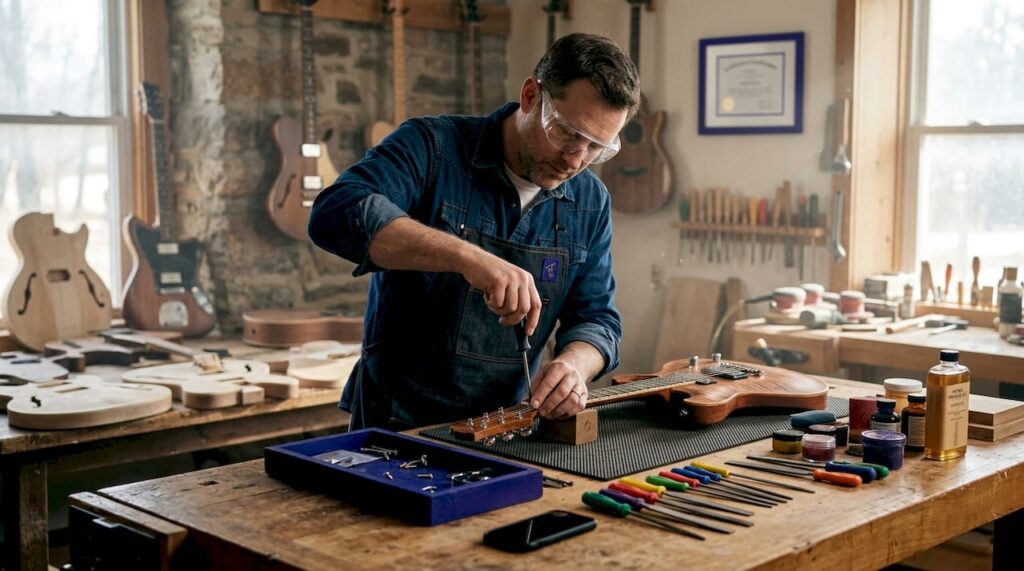

TL;DR:
- A custom shop guitar is a high-end instrument produced by a major brand’s dedicated division, offering bespoke specifications and superior craftsmanship. These guitars are assembled by master builders who maintain full responsibility for each instrument, ensuring greater stability, playability, and resale value. Unlike boutique or production models, custom shop guitars prioritize process and customization over volume and cost efficiency.
Most players assume a custom shop guitar is just a fancier factory model with a higher price tag. That assumption costs collectors real money and leads musicians to the wrong instrument. What defines custom shop guitars goes far deeper than premium tonewoods or a certificate of authenticity. In the industry, the term refers specifically to a dedicated high-end division within a major brand, where master builders apply a fundamentally different production process, offer genuinely bespoke specifications, and deliver instruments that production lines simply cannot replicate. This guide breaks down exactly what separates a true custom shop guitar from everything else on the market.
Key Takeaways
| Point | Details |
|---|---|
| Custom shop is a specific category | Major brands like Fender, Gibson, and PRS operate dedicated divisions distinct from standard production. |
| Masterbuilt process drives consistency | Single-craftsman ownership of assembly and setup reduces variability and improves tuning stability. |
| Bespoke specs set them apart | Players can specify neck profile, pickups, hardware, and finishes unavailable in any production run. |
| Price reflects process, not just parts | Custom shop pricing ($3,500 to over $7,000) reflects labor intensity and craftsmanship, not just materials. |
| Resale value follows brand recognition | Custom shop guitars from major brands hold value better than boutique instruments in most collector markets. |
What defines custom shop guitars: brand divisions vs. production models
The phrase “custom shop guitar” gets used loosely, but the industry recognizes a specific meaning. A custom shop guitar comes from the dedicated high-end division that major manufacturers operate separately from their standard production facilities. Fender Custom Shop, Gibson Custom, and PRS Private Stock are the clearest examples. These are not marketing labels applied to upgraded production models. They are separate operations staffed by experienced master builders who work to different standards and answer to different production priorities.
Custom shop pricing typically starts around $3,500 and can climb well past $7,000 depending on specifications and build tier. That price range reflects something beyond premium tonewoods or upgraded hardware. It reflects a fundamentally different production philosophy. Production guitars are built for repeatability and volume. Custom shop instruments are built for specificity and quality, even when that requires slowing down.
Here is how the three main categories compare:
| Category | Builder type | Price range | Customization | Resale strength |
|---|---|---|---|---|
| Custom shop | Major brand division | $3,500 to $7,000+ | High, within brand constraints | Strong |
| Boutique builder | Independent luthier | $1,200 to $3,500 | Very high, direct builder access | Moderate |
| Production model | Factory floor | $500 to $2,500 | Low, limited spec options | Variable |
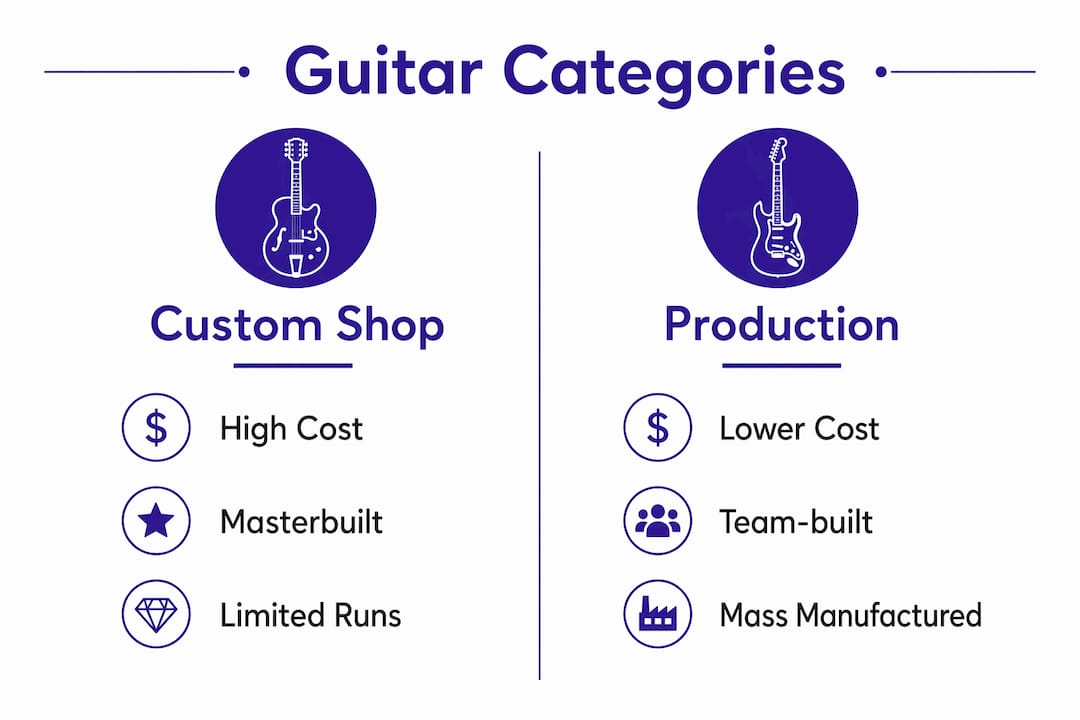
The distinction matters because the custom shop guitar qualities you are paying for are procedural, not just cosmetic. You are not buying a production guitar with fancier parts. You are buying a guitar built to a different standard by people who treat the instrument as a project rather than a unit.
The craftsmanship process that sets them apart
This is where custom shop guitar craftsmanship separates itself from everything else, including many boutique builders. The difference is not just who builds the guitar. It is how responsibility for that guitar is structured throughout the build.
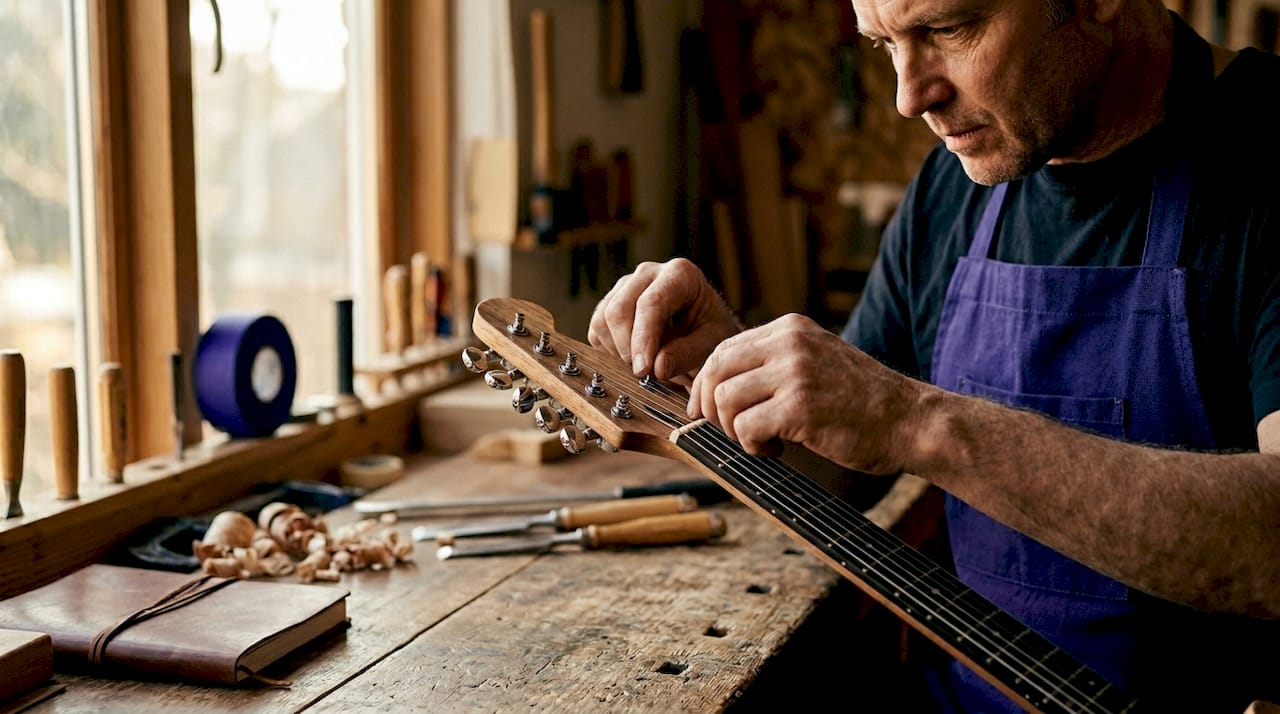
In Fender’s Custom Shop, the Masterbuilt tier assigns a single craftsman full ownership of the assembly and setup process. Masterbuilt guitars are assembled and set up by the same builder, which eliminates the handoff problems that plague production workflows. When one person installs the neck, cuts the nut, sets the action, and does the final setup, nothing gets lost between steps. That person knows exactly what decisions were made at each stage and can compensate accordingly.
The practical benefits show up in the finished instrument. Expert setup by the same builder leads to measurably better tuning stability and playability. It is not a subtle difference. Players who have owned both production and Masterbuilt instruments consistently describe the Masterbuilt as more “settled,” meaning it holds tuning more reliably and responds more consistently across the neck.
The finishing details compound this effect. Meticulous part preparation, including careful filing, burr removal, and precise alignment of saddles, nut slots, and frets, directly affects how the guitar plays and how reliably it stays in tune. These are steps that get compressed or skipped entirely in high-volume production.
Key craftsmanship distinctions in custom shop production:
- Masterbuilt vs. team-built tiers: Masterbuilt assigns one builder to the complete instrument. Team-built guitars are still custom shop quality but involve collaborative assembly across specialists.
- Setup by the assembler: The person who cuts the nut and sets the action knows exactly how the neck was shimmed, what the truss rod tension is, and how the frets were leveled. Production setup technicians often receive instruments blind.
- Finishing quality: Custom shop lacquer work, binding, and aging processes involve hand-applied stages that cannot be automated without losing the result.
- Part fit and preparation: Saddle slots, tuner holes, and pickup routing receive individual attention rather than machine tolerance assumptions.
Pro Tip: When evaluating a custom shop guitar, ask specifically whether it is Masterbuilt or team-built. Both are excellent, but the Masterbuilt tier offers a documentable provenance that matters significantly for resale and collector value.
Unique features and customization options
Beyond the process, custom shop guitar features include a level of specification control that production models cannot offer. This is what the term “bespoke” actually means in practice. You are not choosing from a color chart. You are specifying an instrument built around your preferences, your playing style, and your tonal goals.
The range of customization available through major brand custom shops includes:
- Neck profile and dimensions: Customers can specify depth, width at the nut, and taper. Players with smaller hands or specific technique requirements can dial in something that would never appear in a production catalog.
- Pickup specifications: Custom shop orders can include proprietary or period-correct pickups wound to specific output levels, using materials not found in standard models.
- Hardware choices: Aged hardware, non-standard tuner configurations, and historically accurate parts are available in ways that production guitars simply cannot accommodate.
- Exclusive finishes: Relic aging processes create instruments with unique, unrepeatable wear patterns. Vintage-correct color options, custom paint, and non-catalog finishes are standard territory for custom shop orders.
- Artist signature and limited run models: Custom shops produce the instruments behind most artist signature lines, which means those guitars carry the same build standards as fully bespoke orders.
Custom shops have evolved well beyond their original role as vintage recreation departments. The modern custom shop produces instruments that honor brand legacy while accommodating genuinely original player specifications. That balance requires skill. Builders navigate modifications carefully, keeping enough of the original design to preserve what makes those models work tonally and structurally, without refusing to innovate when a customer’s needs demand it.
Custom shop vs. boutique vs. production: how to decide
Understanding the benefits of custom guitars means knowing which type of custom guitar actually fits your situation. The answer depends on more than budget.
| Factor | Custom shop | Boutique builder | Production |
|---|---|---|---|
| Resale value | Strong, brand-supported | Moderate, builder-dependent | Lower, model-dependent |
| Build time | Weeks to months | Months, sometimes longer | Immediate availability |
| Direct builder access | Limited | High | None |
| Brand recognition | Maximum | Niche | Maximum |
| Customization depth | High, within brand framework | Very high, open scope | Minimal |
Boutique builders typically price between $1,200 and $3,500 and offer a direct relationship with the person building your guitar. That personal connection has real value. You can have detailed conversations about your technique, your tonal preferences, and your physical needs. The limitation is that boutique instruments carry narrower market recognition, which affects both community credibility and resale prices.
Partscasters occupy a separate category entirely. Quality in partscasters depends almost entirely on the assembler’s skill and intent, not the origin of the parts. A well-assembled partscaster can outplay a production guitar. It will rarely outplay a Masterbuilt custom shop instrument in consistency and finish quality.
Pro Tip: If resale value matters to you, major brand custom shop guitars hold their value more predictably than boutique instruments. If personal builder relationship and maximum spec freedom matter more, a boutique builder may serve you better despite the trade-off in resale liquidity.
The decision also hinges on what coherent design intent means for your goals. A guitar is a system. The neck joint, body resonance, pickup height, and nut slot depth interact with each other. Custom shop builders understand these interactions at a level that protects the integrity of the final instrument regardless of how unusual the specifications become.
How to choose a custom shop guitar
Knowing how to choose custom guitars means knowing what to examine before you commit. Here is a practical sequence:
- Confirm build tier: Ask for documentation confirming Masterbuilt vs. team-built status. This affects both playability expectations and resale positioning.
- Examine the setup quality: Check nut slot depth, string action at the 12th fret, and fret ends. These are the clearest indicators of whether the finishing process was done carefully. Learn more about what to look for in a handmade guitar guide.
- Test tuning stability under playing conditions: Bend strings aggressively, use the vibrato arm if there is one, and retune while playing. A properly set-up custom shop guitar should stabilize quickly.
- Evaluate spec relevance to your playing: A custom shop guitar built around vintage specs is not automatically better for modern players. Check whether the neck profile, fret size, and pickup voice match your actual technique.
- Research the specific model’s resale history: Custom shop guitars from major brands have trackable resale histories. Knowing what a specific configuration typically sells for protects your investment. Consult resources like guitar appraisal guides for valuation context.
- Check maintenance access: Major brand custom shops provide service support that boutique builders often cannot. If your guitar needs warranty work or specialist setup down the road, brand support matters.
My take on what truly makes these instruments special
I have spent years handling custom shop instruments alongside boutique builds and production models, and the thing that consistently surprises people is where the real value lives. It is not the tonewoods. It is not the pickups. It is the fact that someone who knew what they were doing made every decision about that guitar with a clear goal in mind, and then they set it up themselves.
What I find most telling is how custom shop guitars feel when you first pick them up cold, without warming up or adjusting anything. A well-built Masterbuilt guitar feels settled in a way that is hard to articulate but immediately recognizable. The nut is cut right. The action is where it should be. The frets are level without being dead. That is not luck. That is the result of process ownership by master builders who do not hand the instrument off between critical steps.
The counterintuitive lesson I keep coming back to is that brand heritage is actually a technical advantage, not just a marketing one. When you order from a brand like Fender Custom Shop or Gibson Custom, you are accessing decades of accumulated understanding about how those specific designs behave under modification. They know where the tolerance limits are. They know what you can change without destabilizing what makes the model work. A builder without that accumulated context, regardless of how skilled, is working with less information.
The emotional value of a custom shop guitar is real, but it follows from the technical reality rather than preceding it. When the instrument plays this well and holds up this consistently, it becomes something you form a different relationship with.
— Vintage
Explore custom and vintage guitars at Vintage-guitar-world

At Vintage-guitar-world, we have built our catalog around instruments where craftsmanship is the point. Whether you are drawn to custom shop guitars for their playability, their collectible provenance, or both, our curated selection spans handcrafted and vintage instruments that meet the same standard of intentional, skilled construction. Browse our types of vintage guitars to understand which configurations hold the most collector value. Our team provides expert evaluation, certification, and guidance so you can invest with confidence in instruments that will reward you for years.
FAQ
What defines a custom shop guitar vs. a standard model?
A custom shop guitar comes from a major brand’s dedicated high-end division, built by master craftsmen to bespoke specifications with premium materials and individualized setup. Standard production models are built for volume and repeatability, not individual specification.
What is the difference between Masterbuilt and team-built custom shop guitars?
Masterbuilt guitars are assembled and set up entirely by one craftsman, which reduces setup variability and improves tuning stability. Team-built guitars divide production across specialists and are still custom shop quality but with less single-builder ownership.
Why do custom shop guitars cost so much more than production models?
The price premium reflects the labor intensity of individualized builds, the skill level of master builders, premium materials, and meticulous finishing processes that cannot be automated without sacrificing quality.
Are custom shop guitars good investments for collectors?
Yes, custom shop guitars from major brands hold resale value more predictably than boutique instruments due to strong brand recognition and documented build provenance. Limited runs and Masterbuilt examples tend to appreciate over time.
How is a custom shop guitar different from a boutique guitar?
Custom shop guitars come from major brand divisions with strong resale recognition, while boutique guitars are built by independent luthiers at generally lower price points with more direct builder access but narrower market recognition.