




A Stratocaster with a spaghetti logo, a plain chrome neck plate with a centered serial, and a small headstock built between 1954 and 1964 is almost certainly pre-CBS. If those features mix with later hardware or a different logo style, you are likely looking at a 1964 to 1965 transition guitar, and you need to confirm the neck-heel date and component stamps before trusting any single visual clue.
TL;DR:
- Treat an L prefix serial as a broad clue because Fender used those plates from late 1962 through 1965, and serial ranges overlap across years.
- Use the pre CBS label only when at least three independent clues, including the logo, serial placement, and neck heel date, agree.
- A small headstock, outlined logo, and double line Kluson tuners can mark a 1964 or 1965 transition guitar rather than a clear pre CBS model.
- Before paying, request clear photos of the headstock, neck plate, and control cavity; stop if the seller will not provide access to the neck pocket.
Table of Contents
- Quick ID at a glance: the 30 and 5-second checks
- Logo and headstock evolution from spaghetti to CBS
- Serial numbers and neck plate dating
- Neck-heel dates and component dating
- Finish, pickguard, and hardware tells
- The 1964-1965 transition and why it complicates ID
- A step-by-step authentication checklist for buyers and sellers
- How experts verify provenance on high-value instruments
- How we approach pre-CBS authentication
- Get a certified pre-CBS Strat or a professional valuation
- FAQ
- Sources
Quick ID at a glance: the 30 and 5-second checks
Before you pull out a flashlight or a mirror, a few seconds of looking tells you most of what you need to know. Start with the headstock: a thin, script “spaghetti” logo almost always points to a pre-1965 instrument, while a bold block logo signals the CBS era that followed.
Check the neck plate next. Pre-CBS plates are plain chrome with a serial number stamped in the center, not off to one side. Look at the pickguard. An eleven-screw, mint green or white three-layer guard is typical of the late 1950s through early 1960s, while later guards could have a different screw pattern. Peek at the pickup bottoms through the control cavity if you can; gray-bottom pickups are common on earlier instruments, while black-bottom pickups appear more often as the 1960s wore on.
- Quick checks: logo style, serial placement on the neck plate, pickguard screw count, and visible pickup bottom color.
- Further checks: the penciled or stamped date at the neck heel, the depth and finish of the neck plate stamp, and any obvious mismatch between parts, such as a replacement pickguard or a tuner set that does not match the rest of the hardware.
- Weak evidence on its own: the decal alone, since logos get replaced or redone, and the pickguard alone, since these are the most commonly swapped parts on any Stratocaster.
Pro Tip: Always photograph the headstock, neck plate, and open control cavity before you negotiate. Those three images alone let a specialist flag most red flags without ever touching the guitar.
Logo and headstock evolution from spaghetti to CBS
The logo on a Stratocaster headstock is often the first thing a buyer notices, and it tracks the guitar’s era closely enough to be a genuine starting point, as long as you treat it as a clue rather than a verdict.
The spaghetti logo, a thin gold script set directly on the headstock finish, was used from the Stratocaster’s 1954 introduction through most of 1964. It sits on a small headstock with no visible transition hardware. Late in 1964, Fender introduced a transition logo with a thin black or gold outline, a detail that Fender’s own history of the 1965 Stratocaster flags as the start of a genuinely confusing identification window. That transition logo, combined with a still-small headstock, is the signature of a late-1964 to 1965 guitar and is exactly why collectors treat 1965 as its own category rather than clean pre-CBS or clean CBS.
By late 1965, Fender had enlarged the headstock and moved to a bigger, bolder block logo, a change that visually separates most post-1965 guitars from everything that came before.
- Spaghetti logo: thin gold script, small headstock, used from 1954 into 1964.
- Transition logo: outlined gold or black lettering on a still-small headstock, concentrated in late 1964 and 1965.
- CBS-era logo: larger block lettering paired with the enlarged headstock introduced after 1965.
- Red flags for replaced decals: uneven gold tone, decal edges that sit slightly proud of the finish, or a logo style that does not match the guitar’s claimed serial-number era.
Serial numbers and neck plate dating
Serial numbers are the most quoted piece of evidence in any pre-CBS conversation, and also the most overrated when used alone. From mid-1954 onward, Fender stamped serials into the chrome neck plate on the back of the body, and the pre-CBS serial number dating guide at Owning a Fender lays out why 1954 through 1964 forms the core pre-CBS production window, with those early plate-mounted numbers sitting roughly in the 0001 to 100,000 range as the decade progressed.
Things get messier starting in late 1962. Fender began using an “L” prefix on serials, and that same source notes these L-series numbers run through 1965, meaning a guitar stamped L10000 could plausibly date from 1963, 1964, or even 1965 depending on how quickly that batch of plates moved through the factory. Serial ranges from different years genuinely overlap, since Fender did not stamp plates in strict chronological order and sometimes used old stock.
A handful of very early 1954 instruments carry serials on the bridge plate rather than the neck plate, a quirk worth knowing if you come across an exceptionally early Strat with a serial in an unexpected location.
- Approximate ranges: single and low double-digit serials with no letter prefix generally point to 1954, while numbers climbing toward five digits track through the late 1950s and into 1962.
- L-prefix serials: introduced in late 1962, used through 1965, and therefore unable by themselves to distinguish a 1963 guitar from a 1965 one.
- Location quirks: most plates sit on the neck plate, but a small number of the earliest 1954 examples carry the serial on the bridge plate instead.
- Why serials alone fall short: overlapping ranges, reused old stock, and the simple fact that a neck plate can be swapped between bodies over 60-plus years of ownership.
Because of that overlap, a serial number should always function as a starting hypothesis, never as a standalone verdict. The Guitar makes the same point from the buyer’s side: serials need corroboration from the neck heel and the electronics before you treat a date as settled.
Neck-heel dates and component dating
Pull the neck off, or look through the neck pocket with a mirror and flashlight, and you will often find a penciled or inked date written by the worker who shaped or finished that neck. Fender’s own support documentation on dating American-made instruments confirms these dates were typically written or stamped on the butt end of the neck heel, usually as a month and year, sometimes with a model or neck-width code alongside it.
That date tells you when the neck was made, not necessarily when the finished guitar left the factory, since Fender built up stock of necks and bodies separately and paired them later. A neck dated several months before the body’s finish date is normal, not suspicious.
Inside the control cavity, potentiometers and pickups carry their own clues. Pots are usually stamped with a manufacturer code and a date in week-and-year format, and pickup bottoms often show a consistent color that shifted gradually over the decade. The Guitar.com buying guide notes that authenticators routinely check neck-heel dates, pot codes, pickup bottoms, and solder joints together, precisely because any single stamp can mislead on its own. Components were bought in bulk and sat in bins before assembly, so a pot date can predate or postdate the guitar’s actual build by months.
- Neck-heel dates: look for penciled or stamped month and year at the heel, visible by removing the neck or using a mirror through the pocket.
- Pot and capacitor codes: a date stamp in week and year format narrows the window, but reflects when the part was made, not when it was installed.
- Pickup bottoms: color and winding details shift gradually across the decade and support a date range rather than pinpointing one.
- Mismatched dates: a 1963-dated neck on a guitar with 1967-coded pots usually means a part has been swapped, not that the dating method is wrong.
Finish, pickguard, and hardware tells
Original finish and hardware carry some of the most reliable physical evidence, because they are harder to fake convincingly than a decal or a serial stamp. Pickguards from the late 1950s through the early 1960s were commonly a three-layer celluloid material in a mint green or off-white tone, mounted with eleven screws, a detail echoed in a museum record of a 1965 Stratocaster that describes a cream three-layer ABS guard as part of that transitional guitar’s original spec.
Nitrocellulose lacquer, used throughout the pre-CBS years, ages in a distinctive way. According to Vintage Guitar magazine’s account of the Strat in transition, the lacquer’s chemistry shifted across these years, and the resulting checking patterns and yellowing differ enough by year that experienced examiners use ultraviolet light and magnification to tell a genuine 60-year-old finish from a modern respray or an artificially relic’d one.
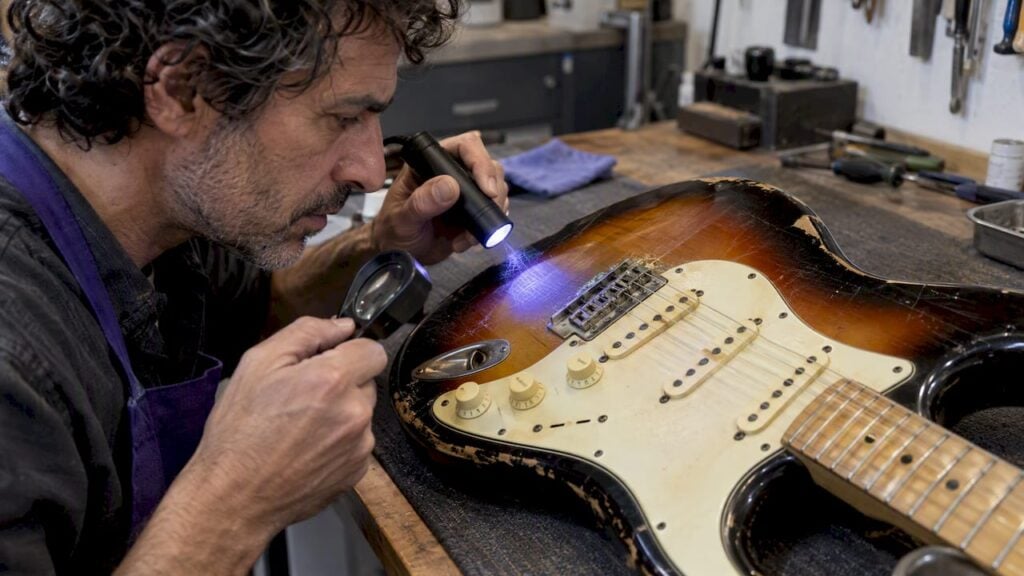
A nitrocellulose finish that has aged naturally over 60-plus years shows checking and yellowing patterns that are difficult to fake convincingly, which is exactly why specialists reach for UV light rather than the naked eye.
Beyond the finish itself, factory assembly left small marks worth hunting for: nail or pin holes near the neck pocket or body edges, used to hang bodies during spraying, and a consistent contour and routing pattern inside the control cavity.
- Pickguard: three-layer celluloid, mint green or cream tone, eleven screws in the late 1950s and early 1960s pattern.
- Finish aging: nitrocellulose lacquer develops fine checking and gradual yellowing that tracks naturally with decades of age.
- Factory marks: small nail or spacer holes near the body edge or neck pocket from the original finishing process.
- Repairs to flag: overspray that blurs checking lines, replacement screws that do not match the original pattern, or a pickguard color that looks too uniform for its claimed age.
The 1964-1965 transition and why it complicates ID
A transition Stratocaster is exactly what the name suggests: a guitar built while Fender was swapping component suppliers and design details but had not yet rolled out the larger headstock, and Fender’s own retrospective on the 1965 Stratocaster treats this short window as uniquely complex to date with confidence.
On a transition instrument, you can find a small headstock paired with the outlined transition logo, double-line Kluson tuners instead of the earlier single-line style, and a cream or white pickguard material that differs from the mint green common a few years earlier. That exact mix, including the transitional decal and double-line tuners, shows up on the documented 1965 Stratocaster held by a museum collection, which is a useful reference point for what a genuine transition guitar actually looks like in hand.
- Small headstock paired with the outlined transition logo rather than the plain spaghetti script.
- Double-line Kluson tuners replacing the earlier single-line tuner stamp.
- A pickguard material or color that reads slightly different from classic late-1950s mint green.
- Hardware or neck-plate details that sit right at the edge of CBS-era specifications without fully matching them.
As a practical rule, treat a guitar as confidently pre-CBS only when at least three independent signals agree: the logo, the serial and neck-plate placement, and the neck-heel date. When only one or two line up and the rest are ambiguous, call it a transition instrument until a hands-on inspection says otherwise.
A step-by-step authentication checklist for buyers and sellers
Work through verification in order, from the cheapest checks to the ones that require real expertise, and stop the moment something does not add up.
- Photograph the headstock, the neck plate, and the pickguard straight on, in good light, before you negotiate on price.
- Check the serial number on the neck plate and compare it against the neck-heel date once you can access the neck pocket.
- Inspect the potentiometers, pickups, and solder joints inside the control cavity for consistent codes and original-looking workmanship.
- Evaluate the finish for natural checking, yellowing, and any factory nail holes near the body edges or neck pocket.
- Ask the seller for provenance: prior ownership history, past repair receipts, or any existing valuation documents.
Keep every photo and document you collect, even the ones that seem redundant, since a specialist evaluator will often want to cross-reference several angles at once. Stop the transaction if the seller cannot produce the neck pocket for inspection, if the serial and neck-heel date are years apart with no explanation, or if the logo shows signs of being reapplied.
Pro Tip: When a guitar clears steps one through four but the price is high enough to matter, a paid valuation or certification is cheap insurance against an expensive mistake.
Our guide to checking the authenticity of a vintage guitar walks through this same sequence in more depth, and our piece on avoiding scams when buying a guitar covers the documentation red flags that should stop a sale outright.
How experts verify provenance on high-value instruments
Professional evaluators go a step further than a visual checklist: they look for corroboration across the entire instrument, confirming that the neck, body, and electronics all point to the same era rather than just one or two of them. That often means examining finish under ultraviolet light to catch a respray that looks convincing in daylight, and comparing component codes against known production patterns rather than taking any single stamp at face value.
Provenance matters just as much as the hardware itself. A documented ownership history or a prior valuation carries real weight on a high-value pre-CBS instrument, since it closes gaps that physical inspection alone cannot.
- Cross-checking neck, body, and electronics dates for internal consistency rather than relying on one component.
- Using magnification and UV light to spot modern finish work disguised as natural aging.
- Weighing documented ownership history and past appraisals alongside the physical evidence.
Our own guide to authenticating vintage guitars for collectors outlines how these checks fit together, and it is the same framework our valuation and certification services draw on.
How we approach pre-CBS authentication
We specialize in vintage and handcrafted guitars, and pre-CBS Stratocasters are exactly the kind of instrument where photos only get you partway to certainty. A remote opinion can flag obvious issues, but a neck-heel date, a pot code, or a finish detail often needs a hands-on look before you commit real money. When the stakes are high enough, book a professional inspection rather than relying on listing photos alone.
— Vintage
Get a certified pre-CBS Strat or a professional valuation
We offer exactly what this kind of purchase calls for: Zertifikate und Wertgutachten for instruments you already own or are considering, Exklusive Anspieltermine so you can play a guitar hands-on before buying, and Verkauf in Kommission if you would rather consign a vintage instrument than sell it privately. Our curated Vintage Gitarren listings are vetted before they ever reach the shop floor.

| Service | What it covers |
|---|---|
| Zertifikate und Wertgutachten | Documented valuation and certification for an instrument you own or plan to buy |
| Exklusive Anspieltermine | A hands-on appointment to play and inspect a guitar before purchase |
| Verkauf in Kommission | Consignment sale support for owners looking to sell a vintage instrument |
| Vintage Gitarren | A curated catalog of vetted vintage guitars, including Stratocasters |
- Request a valuation or certification before you finalize a private purchase.
- Book a viewing appointment to inspect a candidate guitar in person.
- Browse our Vintage Gitarren listings for already-vetted instruments.
Reach out through our site to schedule an appraisal or arrange a viewing.
FAQ
What years count as pre-CBS Stratocasters?
Pre-CBS generally refers to Stratocasters built from the model’s 1954 introduction through 1964, before CBS completed its acquisition of Fender. The Owning a Fender serial guide treats 1954 through 1964 as the core pre-CBS production window, with 1965 standing apart as a transition year.
Is a 1965 Stratocaster pre-CBS or CBS?
A 1965 Stratocaster usually falls into a transition category rather than a clean pre-CBS or CBS classification. Fender’s own account of the 1965 Stratocaster describes this year as mixing small-headstock features with hardware changes that came to define the CBS era.
Can I rely on the serial number alone to date a Strat?
No, serial numbers overlap across years, especially once the L-prefix series started in late 1962 and ran through 1965. Corroborate any serial with the neck-heel date and component codes, as outlined in the serial number dating guide, before drawing a conclusion.
Where do I find the neck-heel date on a Stratocaster?
The date is typically penciled or stamped on the butt end of the neck heel, visible once the neck is removed or viewed through the neck pocket with a mirror. Fender’s support documentation notes this reflects when the neck was made, not necessarily the guitar’s final assembly date.
What should I check before paying for a professional authentication?
Gather clear photos of the headstock, neck plate, pickguard, and control cavity, along with any ownership history or past repair records. If the physical checklist clears but the price is significant, our valuation and certification services can confirm what a photo alone cannot.
Sources
- Pre-CBS Fender Serial Numbers: 1954–1964 Dating Guide
- Guitar
- The Strat in Transition – Vintage Guitar® magazine