














TL;DR:
- Vintage guitar inlays serve as an essential marker of craftsmanship, history, and authenticity, reflecting material use and installation quality. Recognized in specific shapes like dots, blocks, and trapezoids, they reveal details about a guitar’s era, maker, and value, especially when original and properly aged. Expert assessment involves examining material aging, craftsmanship nuances, and signs of restoration, which significantly influence the collector’s true valuation.
Walk into any serious collector’s space and you’ll notice that the first thing experienced eyes land on isn’t the finish or the hardware. It’s the inlays. Those small, precisely fitted pieces of shell, plastic, or stone embedded into a guitar’s fretboard, headstock, or body carry far more information than most players realize. Inlays are timestamp, signature, and craftsmanship test rolled into one. For collectors who know how to read them, they unlock the story behind the instrument: who made it, when, and whether it’s been tampered with since.
Table of Contents
- What are vintage guitar inlays?
- Classic materials and why they matter
- The craft: How vintage guitar inlays are made
- Inlays and guitar value: What collectors should look for
- What most collectors overlook about vintage inlays
- Find and restore true vintage inlay artistry
- Frequently asked questions
Key Takeaways
| Point | Details |
|---|---|
| Inlays reveal authenticity | Original vintage inlays help indicate a guitar’s age, maker, and authenticity to collectors. |
| Material matters | Genuine shell and early plastics not only add beauty but can substantially impact collector value. |
| Craftsmanship counts | Proper inlay work requires skilled cutting, fitting, and finishing—visible in flush fit and even luster. |
| Restoration needs care | Restoring inlays with the right methods and materials preserves originality and value. |
What are vintage guitar inlays?
Now that you appreciate the deeper value of inlays, let’s look at what they are and why they matter for vintage guitar enthusiasts.
At their most basic, inlays are decorative or functional inserts set into routed pockets in a guitar’s fretboard, headstock, or body. Their original purpose was practical: position markers helped players navigate the fretboard quickly, especially in low-light performance settings. Over time, inlays evolved into one of the clearest expressions of a builder’s identity and a guitar’s market tier.
The history of decorative inlays on guitars stretches back centuries, but the golden era most collectors focus on runs roughly from the 1930s through the 1970s. During that period, major American manufacturers used inlay design as a direct signal of a model’s prestige. The most recognized inlay motifs collectors encounter include:
- Dots: Standard on student and mid-range instruments; circular and economical to cut
- Blocks: Larger rectangular pieces common on archtop and jazz guitars; associated with higher-end models
- Trapezoids: Signature shapes used on certain iconic archtop lines, immediately recognizable to trained eyes
- Snowflake and crown motifs: Found on high-end acoustic and hollow-body electrics, often hand-fitted
- Custom art inlays: Elaborate pictorial work seen on presentation-grade or custom shop instruments
The materials used in these inlays are just as telling as their shape. Natural shell (mother-of-pearl and abalone) and synthetic pearloid/other plastics each have their own visual signature and aging patterns, making material identification a key skill for any serious collector.
What makes vintage inlays collectible isn’t just rarity. It’s the combination of period-correct material, specific construction technique, and the way those elements hold up across decades. A guitar with its original shell inlays intact, properly fitted and aged, carries authenticity that no reproduction can fully replicate.
Classic materials and why they matter
Once you know what inlays are, the next step is understanding why the material matters for both value and authenticity.
Mother-of-pearl and abalone are classic inlay choices, while pearloid offers its own distinct history. Each material ages differently, catches light differently, and tells a different story to a trained eye.
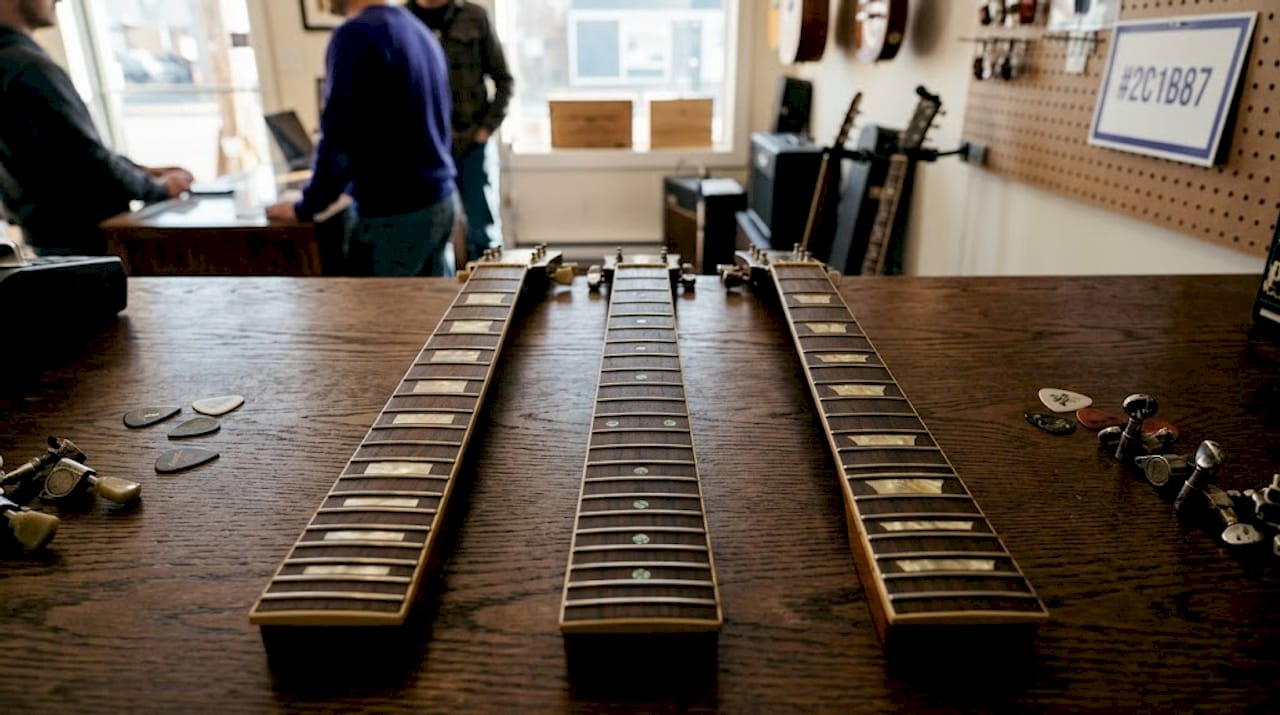
Mother-of-pearl (MOP) comes from the inner lining of mollusk shells. It has a creamy, soft iridescence that tends toward white or pale cream with gentle color shift. On pre-war and early postwar guitars, MOP inlays often show a warm yellowing that you simply cannot fake with modern materials. Abalone is more visually aggressive. Its iridescence runs across a broader color spectrum, often showing vivid greens, blues, and reds depending on the viewing angle. Abalone was used on premium instruments and custom work, partly because it’s harder to work with and partly because its dramatic shimmer signals luxury. Pearloid is a celluloid or plastic material engineered to mimic shell. It has a flatter, more uniform shimmer and doesn’t yellow in the same organic way as natural shell. Its aging patterns are quite different, which makes it easier to spot during inspection.
| Material | Origin | Appearance | Rarity | Age signs |
|---|---|---|---|---|
| Mother-of-pearl | Mollusk shell lining | Soft, creamy iridescence | Moderate | Yellowing, micro-cracks |
| Abalone | Abalone sea snail shell | Bold, multi-spectrum shimmer | Higher | Edge darkening, fine fractures |
| Pearloid | Celluloid or synthetic plastic | Uniform, flat shimmer | Common | Shrinkage, discoloration |
Original, aged shell pieces command significantly higher prices in the collector market for a simple reason: they cannot be perfectly reproduced. The organic variation in each piece of shell, its specific reaction to decades of humidity and temperature, and the subtle imperfections of hand-fitting all combine to create something unique.
Pro Tip: To spot reproduction inlays, hold the guitar at a low angle under a single strong light source. Original vintage shell pieces show irregular color variation across their surface. Reproduction pearloid tends to reflect light more uniformly. Look closely at the edges of each inlay piece as well; original shell often shows hairline cracks along the grain, while plastic reproductions crack differently or not at all.
When authenticating genuine inlays, understanding material behavior over time is your single most powerful tool. No reference book substitutes for hands-on familiarity with how aged shell looks and feels compared to modern replacements.
The craft: How vintage guitar inlays are made
Understanding the material is only half the story; next, uncover the skill required to install and finish inlays on prized vintage guitars.
The inlay installation process requires a level of patience and precision that separates master luthiers from competent woodworkers. Here’s how it breaks down at a level that helps you assess quality when inspecting a vintage instrument:
- Design and template creation: The luthier draws or traces the inlay shape and creates a precise template for routing.
- Material cutting: Shell or plastic blanks are cut to shape using a fine jeweler’s saw or rotary tool. Even minor deviations at this stage produce visible gaps later.
- Cavity routing: A matching pocket is routed into the fretboard. The depth must match the inlay thickness precisely. Going too deep produces a sunk appearance; too shallow means the piece sits proud.
- Test fitting: The inlay is dry-fitted to check for gaps. On hand-crafted vintage instruments, this is done by eye and feel, producing the subtle irregularities that collectors now prize.
- Gluing: The piece is set with adhesive (historically often hide glue or early synthetic adhesives), and the cavity is fitted and glued flush.
- Sanding and leveling: The inlay is sanded flush with the surrounding fretboard surface. This is where skill shows most clearly.
- Finishing: Final polishing ensures the inlay integrates seamlessly with the fretboard material.
“The difference between a great inlay and a mediocre one lives almost entirely in steps three and six. You can cut a perfect shape and still ruin it in the routing or the sanding. Vintage luthiers who got this right every time were genuinely rare.” This is why original factory inlay work from premier makers in their prime years commands such collector respect.
Brittle shell materials like pearl and abalone can crack or appear visually off if the cavity depth and finishing aren’t handled precisely, which is exactly why skilled vintage craftsmanship is so meaningful. A guitar craftsmanship guide can help you understand how this level of precision fits into the broader story of instrument building.
Signs of excellent vintage inlay work include tight cavity fit with no visible glue seepage, flush surface integration with the fretboard, and consistent depth across all positions. Signs of poor or replacement work include visible gaps at inlay edges, a slightly raised or sunken surface, mismatched color between adjacent inlay pieces, and modern tool marks inconsistent with the guitar’s stated era.
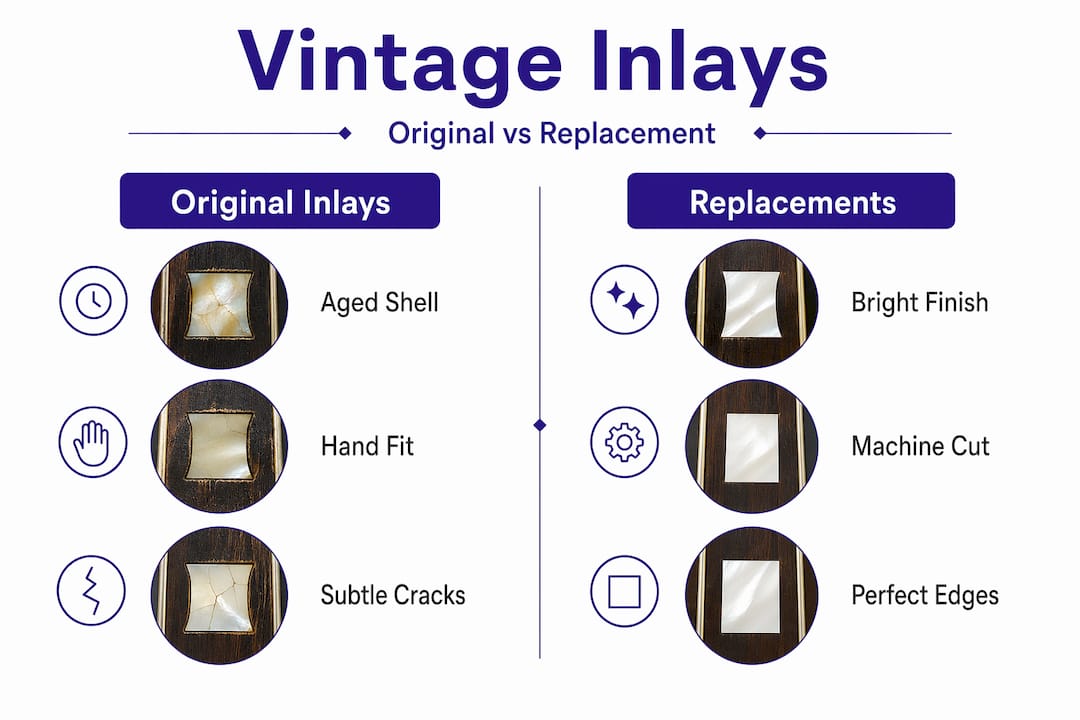
Pro Tip: Original hand-fitted inlay work often shows subtle asymmetry when examined closely. On a genuine vintage guitar, individual inlay pieces at the same fret position may differ very slightly in their exact outline. Machine-cut replacements are perfectly uniform, which is actually a red flag on an instrument claimed to be pre-1970.
Inlays and guitar value: What collectors should look for
Having explored how inlays are made, let’s tie those details to real collector value and how experts assess originality and worth.
Mother-of-pearl and abalone inlays are known for their iridescence and the careful process required to maintain their appearance, which is exactly why original examples matter so much to the collector market. When you pick up a vintage guitar for evaluation, the inlays are among the first things to assess systematically.
Factors that increase collector value:
- All original inlays present and unrepaired
- Period-correct material matching the guitar’s production era
- Signature shapes associated with specific sought-after models
- Visible aging consistent with the guitar’s age (yellowing, surface patina)
- Tight cavity fit with no visible restoration work
Factors that decrease collector value:
- Replaced inlays, even with high-quality materials
- Inlays from a different era than the guitar’s body and neck
- Repair attempts that altered surrounding fretboard wood
- Modern adhesives visible under UV light
- Shape inconsistencies suggesting non-factory installation
| Feature | Original vintage inlays | Modern replacements |
|---|---|---|
| Surface finish | Aged patina, slight yellowing | Bright, uniform sheen |
| Edge fit | Hand-fitted, subtle variation | Machine-cut, uniform edges |
| Cavity seams | Tight, minimal adhesive | May show filler or gaps |
| Material aging | Organic cracks, color shift | Plastic yellowing or none |
| Market value impact | Maximum originality premium | Reduced by 15 to 40% typically |
When you authenticate vintage guitars as a collector, inlays function as one of the most tamper-evident features on the instrument. Replacing inlays requires significant work and almost always leaves traces. Understanding the role of craftsmanship in valuation helps you make informed decisions rather than relying solely on paperwork or provenance claims.
A practical checklist for inspecting inlays on a potential acquisition should include: examining each piece under magnification for original tool marks, checking surface level consistency across all inlay positions, comparing material aging to the fretboard and finish age, verifying shape consistency with documented examples from the claimed production year, and using UV light to detect modern adhesives that glow differently than period-correct glues.
What most collectors overlook about vintage inlays
Collectors have plenty of checklists, but the truth is, there’s more to inlays than meets the casual eye. And in our experience examining hundreds of vintage instruments, the gap between what most buyers check and what actually matters is surprisingly wide.
The most common mistake is letting surface gloss drive the assessment. A guitar with clean, bright-looking inlays actually raises more questions for us than one showing honest wear. A skilled restorer can repolish shell to a near-original sheen, but they can’t replicate the specific micro-aging patterns that accumulate over fifty years of temperature cycling. Surface gloss tells you almost nothing. What lies beneath it tells you everything.
Here’s the counterintuitive part that experienced collectors eventually learn: cracks in the inlay material can actually confirm authenticity. Brittle shell inlays that have genuinely aged over decades develop hairline fractures along their natural grain. These cracks follow patterns dictated by the material’s organic structure. Reproduction inlays or modern replacements crack differently when they crack at all, or they show no cracking because they simply haven’t had the time. Seeing a crack and writing off a guitar is a beginner’s mistake.
Machine-cut replacement inlays are another area where conventional wisdom fails buyers. Many collectors check shape and material but miss the telltale uniformity of machine work. Original factory inlays from the 1950s and 1960s were cut and fitted by hand in most cases. Slight variations in outline, tiny asymmetries in the cavity edge, and subtle differences between individual pieces at different fret positions are normal and expected on genuine vintage instruments. When every single inlay on a claimed 1958 guitar is geometrically perfect to the same tolerances, that’s a problem, not a feature.
The real information lives under magnification. Original sanding marks, the specific pattern of scratch lines from hand-leveling, and the precise relationship between the inlay edge and the surrounding wood are all visible with a loupe or jeweler’s glass. We recommend that any serious collector add a 10x loupe to their inspection toolkit when identifying rare guitars. It changes what you see completely.
The broader lesson here is that authenticity in vintage inlays is a conversation between material, time, and human hands. Checklists capture some of that story. Deep familiarity with original examples captures the rest.
Find and restore true vintage inlay artistry
Inspired to dig deeper or add to your vintage collection? Here’s where you can keep learning and take action.
At Vintage Guitar World, we evaluate every instrument in our catalog with exactly the kind of scrutiny this article describes. Our team examines inlay material, cavity fit, aging patterns, and restoration history before any guitar reaches the listing stage.

Whether you’re building a collection around a specific era, chasing a particular inlay style, or trying to understand what you already own, our resources are built for collectors who take the details seriously. Browse our breakdown of types of vintage guitars to connect inlay styles with specific models and eras, or explore our acoustic guitar restoration guide for practical guidance on preserving original inlays during restoration work. When you’re ready to explore what’s currently available, the Vintage Guitar World shop brings together rare, certified, and expertly evaluated instruments where the inlays are always part of the story we tell.
Frequently asked questions
How can I tell if a vintage guitar’s inlays are original?
Original vintage inlays show subtle signs of age including yellowed shell, organic micro-cracks, and hand-fitting irregularities visible under magnification. Brittle shell materials like pearl and abalone develop specific crack patterns over decades that reproductions cannot replicate convincingly.
What are the most valuable materials for vintage inlays?
Mother-of-pearl and abalone are the most valued inlay materials for collectors due to their iridescence, organic aging characteristics, and direct association with high-end vintage production. Both materials command a premium when original and intact.
Do inlays affect the sound of a vintage guitar?
Inlays are primarily decorative and don’t meaningfully affect tone on a properly built instrument. However, poorly executed inlay work that compromises fretboard integrity can create uneven string action and affect playability.
Can you restore damaged vintage inlays without losing value?
Restoration is possible without significant value loss when a skilled luthier uses period-correct materials and techniques. The standard process of routing, fitting, gluing, and leveling flush preserves structural integrity and, when done well, maintains collector appeal.