














TL;DR:
- Creative vintage guitar displays balance aesthetic appeal, physical protection, and space efficiency to showcase instruments as art. Wall mounts, curio cabinets, racks, shadow boxes, and artistic shelving each serve different collection needs, emphasizing preservation and visual storytelling. Proper installation, finish-safe materials, and warm LED lighting are essential for safeguarding and highlighting valuable guitars long-term.
Vintage guitar display ideas are creative and protective methods for showcasing instruments in ways that highlight their beauty, preserve their value, and integrate them into your living or studio space as genuine art. The best approaches balance three priorities: aesthetic impact, physical protection, and space efficiency. Whether you own a 1959 Gibson Les Paul, a pre-war Martin 000-28, or a rare Torres classical guitar, how you display it shapes both its long-term condition and the story it tells every time someone walks into the room. Wall mounts, curio cabinets, shadow boxes, and creative shelving each offer distinct advantages that collectors should understand before committing to any single approach.
1. Vintage guitar display ideas: wall mounts
Wall mounts are the most space-efficient display method available to collectors. Switching from floor stands to wall mounts reclaims 6 to 10 square feet per instrument, which matters enormously in a studio or dedicated music room. That recovered floor space also eliminates the tip-over risk that destroys headstocks and cracks bodies on valuable vintage pieces.
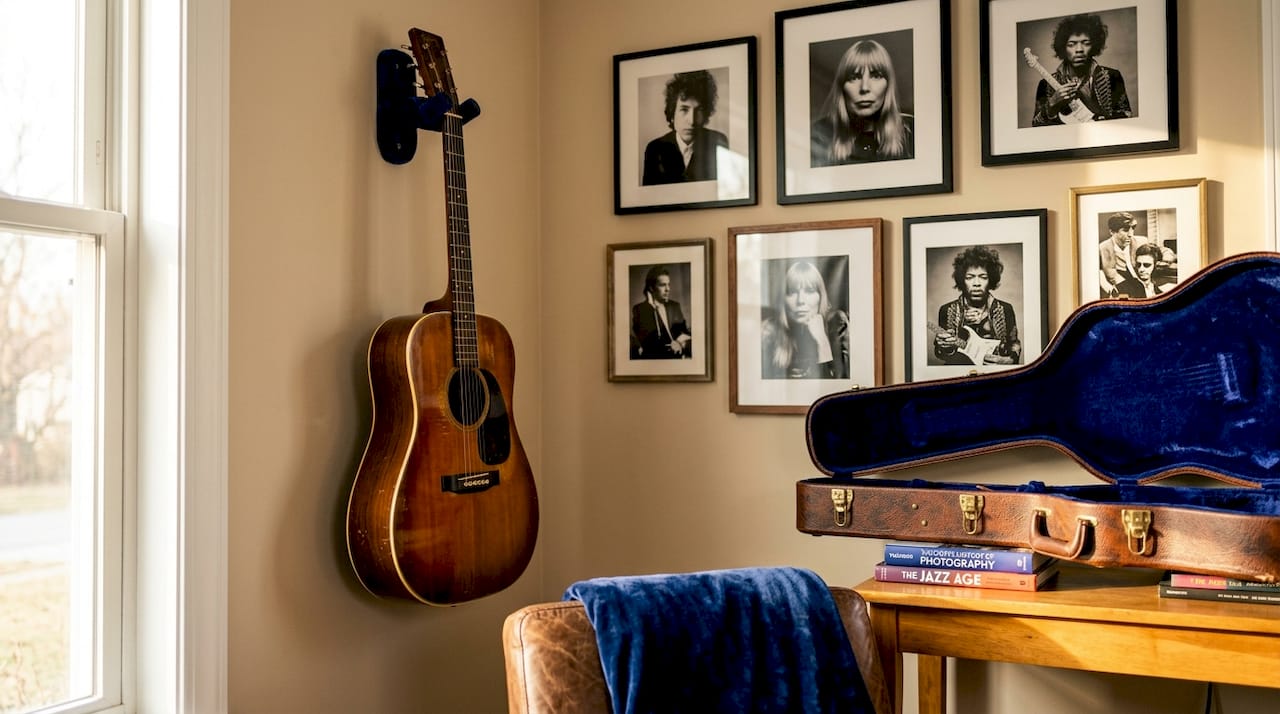
The visual impact is equally significant. A row of well-spaced guitars mounted at consistent heights reads like a curated gallery wall rather than a storage solution. Brands like Hercules Stands and String Swing produce wall mount hardware specifically designed for vintage instruments, with padded yokes that cradle the headstock without stress.
Pro Tip: Always mount into wall studs. Drywall anchors loosen over time from vibration and accidental contact, and a falling vintage guitar is a catastrophic loss. Use a stud finder before drilling.
2. Curio cabinets for museum-quality protection
Curio cabinets offer a controlled environment that protects against dust, humidity fluctuations, and accidental contact while providing a gallery-style presentation. For collectors with rare or autographed instruments, this is the display method closest to professional museum practice. Glass panels create a visual boundary that signals “this is a serious collection” without hiding the instrument.
The humidity control advantage is real and measurable. Vintage guitars with nitrocellulose finishes and hide glue construction are sensitive to rapid moisture changes. A sealed or semi-sealed cabinet with a small silica gel pack or a Boveda humidity control packet maintains a stable 45 to 50 percent relative humidity, which is the accepted preservation standard for wooden instruments.
Curio cabinets also work well for guitars that are too valuable or fragile to play regularly. A Torres, a Hauser, or a signed vintage Stratocaster belongs behind glass. The cabinet becomes the centerpiece of the room rather than just storage.
3. Guitar display racks and multi-instrument stands
Racks and multi-instrument stands offer flexibility that wall mounts cannot match. If your collection rotates, if you play multiple guitars regularly, or if you are still building your display setup, a quality rack from brands like Gator Frameworks or Ultimate Support lets you reconfigure without drilling new holes.
The trade-off is floor space and visual density. A rack holding five guitars occupies roughly the same footprint as a single floor stand but creates a visually busy cluster. For collectors who prioritize access over aesthetics, this is an acceptable compromise. For those building a gallery-style room, racks work best in a dedicated corner or alcove rather than as a centerpiece.
Guitar display rack ideas work particularly well in recording studios where instruments need to be grabbed quickly during sessions. The functional and aesthetic goals align naturally in that context.
4. Shadow boxes for rare and autographed instruments
Shadow boxes represent the highest protection level available outside a professional museum case. A shadow box mounts the guitar inside a deep frame with a sealed front panel, protecting it from dust, UV light, and physical contact while displaying it as a framed art piece. This approach is ideal for a guitar that will never be played again, such as a signed concert instrument or a historically significant piece.
The installation requires more planning than a standard wall mount. The shadow box itself must be anchored into studs given the combined weight of the frame and instrument. Custom shadow boxes from woodworkers or specialty framing shops can be built to match your room’s existing decor, using materials like reclaimed wood, brushed brass hardware, or velvet backing in colors that complement the guitar’s finish.
For collectors who want to learn more about identifying rare guitars before committing them to permanent display, understanding what makes a piece historically significant informs how prominently it should be featured.
5. Creative guitar shelving and artistic mounts
Creative guitar shelving treats the instrument as a sculptural object integrated into the room’s design language. This means using floating shelves, angled brackets, or custom-fabricated mounts that position the guitar at a deliberate angle rather than simply hanging it straight. A guitar displayed at a 15-degree tilt on a dark walnut shelf against a white wall reads as intentional art, not incidental storage.
Themed backdrops and vintage-style materials like brass hooks, leather straps, and reclaimed wood shelving reinforce the vintage aesthetic of the instruments themselves. A 1960s Telecaster displayed on a shelf made from reclaimed barn wood with aged brass hardware creates a cohesive visual narrative. The display material tells the same story as the guitar.
This approach works best for collectors with a clear interior design direction. If your space is mid-century modern, industrial, or rustic, your display hardware should speak that same language.
6. How to install and arrange guitars safely
Safe installation starts with hardware selection and mount height. Experts recommend positioning the guitar headstock between 1,300 and 1,500 mm above the finished floor for daily-use instruments. This height places the guitar within comfortable ergonomic reach without requiring you to stretch or crouch, and it positions the instrument at natural eye level for visual impact.
Follow these installation steps for a secure, professional result:
- Locate wall studs using a reliable stud finder and mark their centers clearly.
- Select mount hardware with a backplate large enough to span two stud centers where possible.
- Pre-drill pilot holes to prevent stud splitting, especially in older homes with dry lumber.
- Use silicone-free neoprene or cork liners on all contact points to protect nitrocellulose lacquer finishes from chemical reactions.
- Torque screws to firm resistance without over-tightening, which can crack the stud or strip the hole.
- Test each mount with a weight equivalent to your heaviest guitar before hanging any instrument.
For multi-guitar arrangements, stagger instrument heights within a 100 to 150 mm band and maintain 450 to 600 mm spacing center-to-center. This spacing prevents the necks and bodies from overlapping visually and physically, and it creates a rhythmic pattern that reads as a deliberate composition rather than a crowded wall.
Pro Tip: Photograph your planned layout on paper or use a room planning app like Roomstyler before drilling. Moving a mount leaves visible holes in your wall and potentially damages the stud.
7. Lighting your vintage guitar display
Lighting is the single most underestimated element in any guitar display setup. Use 3,000 to 3,500K LEDs to enhance wood tones without emitting UV radiation that accelerates finish aging. This warm color temperature makes sunburst finishes glow and brings out the grain in spruce and mahogany tops in a way that cool white light never achieves.
Target 300 to 500 lux on the guitar face using a 30-degree beam angle aimed slightly off-axis to minimize glare on glossy vintage lacquer. Track lighting systems from brands like WAC Lighting or Kichler allow you to direct individual heads precisely at each instrument. For dramatic accent lighting on a single showcase piece, a recessed adjustable downlight positioned 18 to 24 inches from the wall creates a spotlight effect without harsh shadows.
Avoid any light source that generates significant heat, including older halogen and incandescent bulbs. Heat accelerates wood movement and finish checking on vintage instruments. LED technology eliminates this risk entirely while consuming a fraction of the energy.
8. Styling and thematic ideas for vintage guitar decor
A cohesive display strategy transforms a collection into a personal gallery. Combining guitars with guitar-themed artwork and memorabilia creates a unified wall that communicates your musical identity. Concert posters, vintage sheet music in matching frames, and signed photographs placed between instruments fill the negative space without competing with the guitars themselves.
Consider these design principles when building your display:
- Unified color palette: Choose frame colors and mount hardware that share a finish. Mixing brushed nickel, brass, and matte black in the same display reads as unplanned.
- Staggered sightlines: Plan your layout so the viewer’s eye moves naturally across the wall rather than jumping between disconnected clusters.
- Seasonal rotation: Swap instruments in and out of the primary display to keep the room fresh and to give stored guitars regular visual attention.
- Scale contrast: Pair a full-size dreadnought with a parlor guitar or a ukulele to create visual variety without breaking the thematic unity.
| Display style | Best for | Material palette |
|---|---|---|
| Industrial | Electric guitars, studio spaces | Raw steel, black powder coat, concrete |
| Rustic vintage | Acoustic, classical, flamenco | Reclaimed wood, leather, aged brass |
| Mid-century modern | Mixed collections, living rooms | Walnut, brushed gold, warm white walls |
| Minimalist gallery | Single showcase pieces | White walls, chrome, invisible mounts |
9. Comparing display options by protection, cost, and space
Choosing the right display method depends on what you prioritize most. This comparison covers the five primary options across the criteria that matter to serious collectors.
| Method | Protection level | Space efficiency | Approximate cost | Best use case |
|---|---|---|---|---|
| Wall mounts | Medium | High | $20 to $80 per mount | Daily-use guitars, multi-guitar walls |
| Curio cabinets | High | Medium | $200 to $1,500+ | Rare or fragile instruments |
| Shadow boxes | Very high | Low | $150 to $600+ | Autographed or retired pieces |
| Racks and stands | Low | Low | $50 to $200 | Rotating collections, studios |
| Creative shelving | Medium | Medium | $100 to $500+ | Design-forward spaces |
Wall mounts win on space efficiency and daily accessibility. Curio cabinets win on protection and presentation formality. Shadow boxes are the right choice when a guitar’s display value permanently exceeds its playing value. Racks serve function over form. Creative shelving serves collectors who treat their instruments as design objects first. For deeper context on showcasing collectible guitars, the method you choose should reflect both the instrument’s value and your room’s purpose.
Key takeaways
The most effective vintage guitar display combines stud-mounted hardware, UV-safe LED lighting, and finish-safe contact materials to protect value while creating a gallery-quality presentation.
| Point | Details |
|---|---|
| Mount into studs only | Drywall anchors loosen over time and risk catastrophic instrument damage. |
| Use finish-safe liners | Silicone-free neoprene or cork prevents chemical damage to nitrocellulose lacquer. |
| Target 1,300 to 1,500 mm height | This range balances ergonomic daily access with strong visual presentation. |
| Choose 3,000 to 3,500K LEDs | Warm LEDs enhance wood tones without UV radiation that ages vintage finishes. |
| Match display style to room design | Hardware materials and backdrops should reinforce the guitar’s era and aesthetic. |
What I’ve learned from years of watching collectors get this wrong
Most collectors spend months researching which guitar to buy and about fifteen minutes thinking about how to display it. That imbalance shows. I have seen a genuinely rare 1950s archtop hanging from a drywall anchor on a foam pad that was slowly dissolving the finish. The guitar was worth more than the car in the driveway. The mount cost eight dollars.
The finish protection issue is the one that surprises people most. Nitrocellulose lacquer, which covers the majority of pre-1970s American guitars, reacts chemically with certain foam and rubber compounds. Standard foam padding sold at hardware stores often contains plasticizers that soften and discolor nitro finishes over months of contact. This is not a theoretical risk. It is a documented, irreversible problem that reduces both the aesthetic and monetary value of an instrument.
Lighting is the second area where I see consistent mistakes. Collectors invest in beautiful guitars and then display them under cool white LEDs that make a warm sunburst finish look flat and gray. The difference between a 2,700K warm white and a 5,000K cool white on a vintage cherry sunburst is the difference between a gallery and a storage room.
The deeper point is that your display is an extension of your collection. A well-chosen vintage guitar deserves a display that communicates its history and craftsmanship. When you get the mount, the lighting, and the spacing right, the guitar does the rest of the work. You stop seeing a wall of instruments and start seeing individual stories.
— Vintage
Explore vintage guitars and display-ready instruments at Vintage Guitar World
Vintage Guitar World curates rare, restored, and certified vintage guitars across classical, flamenco, acoustic, and electric categories. Every instrument in the collection has been evaluated for playability, finish condition, and historical authenticity, which means you know exactly what you are displaying before it goes on your wall.

Whether you are building your first display wall or adding a centerpiece to an established collection, the right instrument makes every display decision easier. Browse the full range of vintage guitar types and histories to find instruments worth showcasing, or explore why collectors love vintage guitars for deeper context on what makes these pieces worth displaying in the first place. For collectors weighing acquisition decisions, the vintage vs. reissue comparison is required reading before any purchase.
FAQ
What is the safest way to hang a vintage guitar on a wall?
Mount into wall studs using hardware with a backplate that spans two stud centers, and use silicone-free neoprene or cork contact liners to protect nitrocellulose finishes. Drywall anchors alone are not reliable for instruments weighing more than a few pounds.
What height should I hang a guitar on the wall?
Position the headstock between 1,300 and 1,500 mm above the finished floor for daily-use instruments. This height sits within the ergonomic reach zone and places the guitar at natural eye level for visual impact.
How do I protect a vintage guitar’s finish in a display?
Avoid contact with silicone-based foam or standard rubber padding, which can chemically react with nitrocellulose lacquer and cause permanent softening or discoloration. Use medical-grade neoprene or cork at all contact points.
What lighting is best for displaying vintage guitars?
Use 3,000 to 3,500K LED fixtures targeting 300 to 500 lux on the guitar face with a 30-degree beam angle aimed slightly off-axis. This color temperature enhances wood tones and avoids the UV radiation that accelerates finish aging.
How much space should I leave between guitars on a display wall?
Maintain 450 to 600 mm center-to-center spacing between instruments and stagger heights within a 100 to 150 mm band. This spacing prevents physical overlap, creates visual rhythm, and keeps the display from looking cluttered.