













TL;DR:
- Trustworthy vintage guitar dealers rely on detailed authentication processes and proven provenance documentation.
- Grading distinguishes collector’s grade from player’s grade, affecting value and originality.
- Modern dealers use advanced tools and teamwork to detect sophisticated fakes and verify authenticity.
Buying a vintage guitar sounds simple until you’re holding a 1959 Les Paul that may or may not be exactly what the seller claims. Every detail matters: the serial number, the finish, the hardware, the case. One wrong move and you’re out thousands of dollars on an instrument that’s worth a fraction of what you paid. Provenance is crucial and can make or break a guitar’s value. That’s precisely where vintage guitar dealers step in, not as middlemen, but as expert guides who separate authentic treasure from costly mistakes. This article breaks down exactly how they do it.
Table of Contents
- How vintage guitar dealers shaped the market
- Authentication and provenance: Identifying true vintage value
- The nuances of grading and value: Collector’s grade vs. player’s grade
- Modern tools and collaboration: How dealers stay ahead of fakes
- What most collectors get wrong about vintage dealers
- Find your next collectible with Vintage Guitar World
- Frequently asked questions
Key Takeaways
| Point | Details |
|---|---|
| Expert dealers matter | Reputable dealers are vital for authenticating and valuing vintage guitars safely. |
| Provenance impacts price | A clear ownership history can boost a guitar’s value by up to 50 percent. |
| Grading affects investment | Collector-grade instruments typically hold more value than player-grade or modified models. |
| Verification is evolving | Modern dealers use technology, team reviews, and networks to spot fakes effectively. |
How vintage guitar dealers shaped the market
The vintage guitar market didn’t organize itself. It was built, carefully and methodically, by a handful of dedicated dealers who understood that knowledge was the real product they were selling.
In the early decades of serious guitar collecting, the market was fragmented and unreliable. Instruments changed hands at swap meets, through classified ads, and between players who had little understanding of what made one guitar worth ten times another. Then came dealers who changed everything.
Pioneers like Norman Harris and George Gruhn established what a reliable vintage guitar business could look like: deep expertise, thorough documentation, and a reputation built on honest dealing. Gruhn Guitars in Nashville became a landmark not just as a store, but as a resource. George Gruhn co-authored reference books that became industry bibles for collectors worldwide. That kind of contribution set the standard every serious dealer is still measured against today.
“A dealer’s reputation is ultimately their most valuable asset. In a market built on trust, one bad transaction can unravel years of credibility.”
Here’s a quick comparison of what separates respected vintage dealers from casual resellers:
| Factor | Reputable vintage dealer | Casual reseller |
|---|---|---|
| Authentication process | Structured, multi-point inspection | Visual check only |
| Provenance documentation | Required and verified | Optional or absent |
| Grading transparency | Clearly communicated grade | Vague or absent |
| Warranty or return policy | Standard practice | Rare or non-existent |
| Market pricing knowledge | Deep, current, and documented | Inconsistent |
What made these early dealers so influential wasn’t just inventory. It was the networks they built with manufacturers, collectors, and historians. They knew which factories used which parts in which years. They recognized the subtle differences between a genuine pre-CBS Fender and a convincing replica. That institutional knowledge, accumulated over decades, is something no online listing can replicate on its own.
The dealer’s role also stabilized prices. When trustworthy experts publicly valued instruments based on consistent criteria, it gave the entire market a reference point. Collectors could buy with greater confidence. Sellers understood what fair market value looked like. That foundation still supports the vintage guitar world today.
Authentication and provenance: Identifying true vintage value
Once you understand how important the dealer’s reputation is, it’s vital to grasp their central role in authenticating value. Authentication isn’t a single test. It’s a layered process that examines an instrument from multiple angles.
Provenance verification involves records and paperwork, and the absence of solid documentation directly reduces a guitar’s value and buyer confidence. A guitar with a clear ownership trail, original receipts, period photographs, or factory paperwork commands a premium. One with a murky history raises red flags, even if it looks perfect.
Experienced dealers examine far more than the obvious. They check for:
- Serial number consistency with manufacturer records for the claimed year
- Hardware originality, including tuning machines, pickups, and bridge components
- Finish integrity, looking for signs of refinishing under ultraviolet light
- Neck joint and body routing, which can reveal hidden modifications
- Case and accessories, since original cases and paperwork add significant authenticity weight
Pro Tip: Always ask a dealer for a written condition report before purchasing. Any reputable seller will provide one without hesitation. If they resist, walk away.
Understanding guitar provenance explained in detail will sharpen your instincts before you even speak with a dealer. And for a deeper framework, a thorough guitar provenance guide can show you exactly what documentation to request and how to evaluate it.
Common pitfalls include trusting seller descriptions at face value, skipping independent verification, and ignoring minor cosmetic details that experienced eyes would flag immediately. A small crack in the wrong place or a replaced tuner button can tell a whole story about how a guitar was stored, repaired, or altered over its lifetime.
The dealers who do this well have spent years handling thousands of instruments. That tactile, visual experience is genuinely irreplaceable. They feel the weight of a guitar, hear how it resonates unplugged, and notice when something is slightly off before they’ve even picked up a magnifying glass.
The nuances of grading and value: Collector’s grade vs. player’s grade
Understanding authenticity leads naturally to grading, where vintage dealers also make their expertise clear. Grading is the system dealers use to communicate an instrument’s condition and originality, and it directly shapes what you’ll pay and what you’ll get.
Collector’s grade instruments are those that retain their original components, finish, and hardware with minimal wear. These guitars are prized for their historical integrity. A 1960 Stratocaster with all original parts, original case, and unmodified electronics is a collector’s grade instrument regardless of whether it plays perfectly. The value is tied to what it is, not just how it sounds.
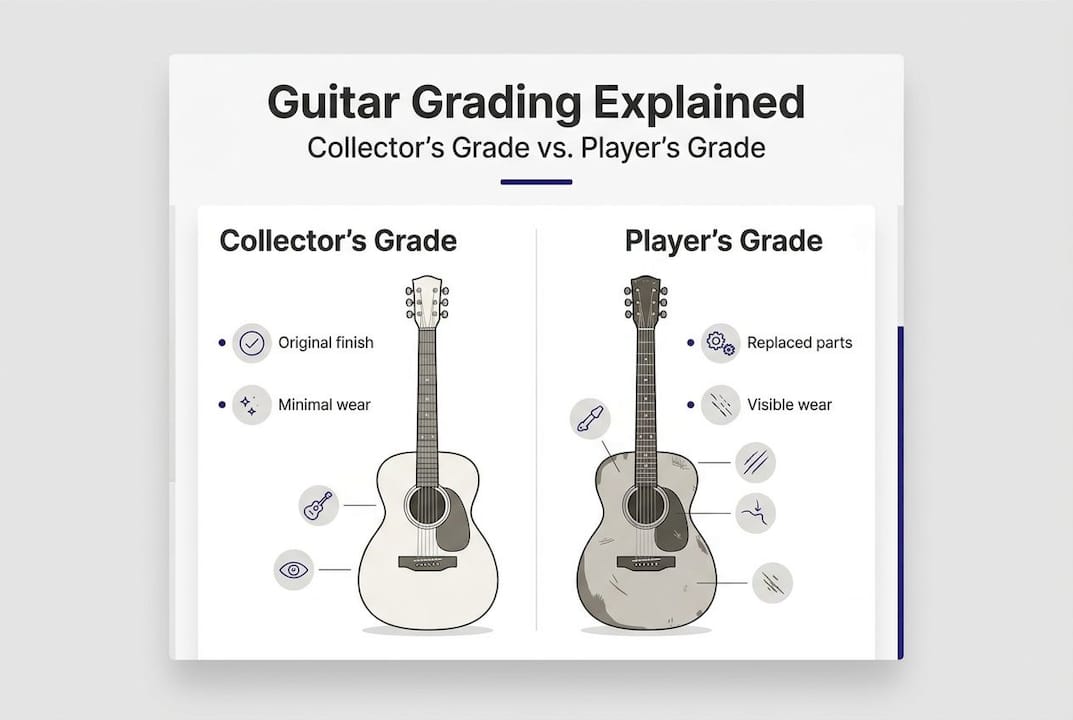
Player’s grade instruments have modifications: replaced pickups, refrets, refinishes, or other alterations that make them excellent playing tools but reduce their collector appeal. A refinished guitar, even a beautifully done one, can lose 30 to 50 percent of its value compared to a matching original-finish example.
Here’s a practical framework dealers use:
- Establish originality first. Every component is checked against factory specifications for that model year.
- Document all deviations. Even a replaced screw matters in collector-grade assessment.
- Grade the finish. Checking for touch-ups, overspray, or full refinishes under UV light.
- Assess playability separately. A guitar can be collector-grade and still need a setup.
- Price against comparable sales. Recent auction results and dealer transactions anchor the final figure.
Fakes, refinishes, and grade distinctions affect value significantly, and transitional models (guitars made during manufacturer changeovers) require particular expert handling because their specifications can vary unexpectedly.
Pro Tip: When considering a transitional model, look for a dealer who can cite specific production records, not just general knowledge. The details matter enormously at this level.
For collectors building a serious portfolio, understanding authenticating vintage guitars in depth will save you from expensive grading mistakes early in your collecting journey.
Modern tools and collaboration: How dealers stay ahead of fakes
Grading isn’t static, so how do modern dealers keep up with evolving threats and new verification technologies? The answer is that the best ones never stop learning, and they never work alone.
Counterfeiting has become increasingly sophisticated. High-quality replicas of classic Gibsons and Fenders now circulate with aged finishes, period-correct hardware, and convincing serial numbers. The threat is real, and it’s growing. Dealers who rely solely on visual inspection are increasingly vulnerable.
The best dealers today employ multiple layers of defense:
- Team-based inspections, where multiple experts examine the same instrument independently
- Ultraviolet light analysis to detect refinishes, repairs, and replaced components
- Digital documentation systems that cross-reference serial numbers against manufacturer records
- Community reporting networks where dealers share information about known fakes circulating in the market
- Third-party verification platforms that provide independent authentication certificates
“No single expert, no matter how experienced, catches everything. The most reliable authentication is a collaborative process.”
Authentication is evolving: even expert dealers now rely on teamwork and advanced tools like Vintage Verified to stay current. Services like these create digital fingerprints for instruments, making future transactions more transparent and traceable.
For collectors who want to protect themselves, understanding checking authenticity guide steps in detail is a strong first defense. And broader collecting tips for avoiding fakes can help you build healthy skepticism into every potential purchase.
Absolute certainty is rare in this field. But a dealer with solid processes, a collaborative approach, and access to modern tools reduces your risk dramatically compared to navigating the market on your own.
What most collectors get wrong about vintage dealers
Here’s a perspective that might challenge your assumptions: most collectors undervalue dealers until something goes wrong.
It’s easy to think that online research, forum opinions, and YouTube teardowns give you enough knowledge to buy confidently without professional guidance. And for basic, lower-value instruments, maybe that’s true. But the moment you’re considering a four or five-figure purchase, the calculus changes completely.
The uncomfortable reality is that experienced fakers know exactly what forum-educated buyers look for. They replicate the obvious details while hiding the subtle tells that only hands-on experts catch. We’ve seen collectors spend years building knowledge from screens, then lose thousands on a transaction they were certain they understood.
Another misconception is that dealers are primarily motivated to sell at any price. Reputable dealers are motivated by repeat business and referrals. A bad sale destroys relationships. That incentive structure actually works in your favor.
The pursuit of originality also means knowing when to walk away, a lesson that costs most collectors at least once before it sticks. A trusted dealer who has seen authenticating vintage guitars processes go wrong can save you from that expensive education.
Find your next collectible with Vintage Guitar World
If this deep look into the dealer’s world has sharpened your appetite for collecting, the smartest next step is connecting with resources that match your level of seriousness.

At Vintage Guitar World, we’ve built a platform specifically for collectors who care about authenticity, history, and quality. Explore our guides on vintage guitar types and history to understand what different eras and models actually represent as investments. Discover why collectors love vintage guitars and what drives passionate collectors to seek out specific instruments. When you’re ready to buy, our expert guitar valuation advice gives you the grounding to negotiate with confidence and recognize real value.
Frequently asked questions
How do vintage guitar dealers verify a guitar’s authenticity?
Dealers check provenance records, examine hardware and finish integrity, cross-reference serial numbers with manufacturer data, and often conduct multi-expert team inspections to confirm authenticity before any sale.
What makes a dealer trustworthy in the vintage guitar world?
Transparency in authentication processes, documented market expertise, and a reputation built on consistent, honest transactions are the clearest markers of a dealer you can rely on.
Why is provenance important for collectible guitars?
A verifiable ownership history directly increases value and buyer confidence; provenance boosts value because it removes uncertainty about an instrument’s origins, past repairs, and authenticity.
Can dealers spot fakes if authentication is so nuanced?
Expert dealers use advanced tools, team reviews, and community networks to catch most fakes, though authentication isn’t foolproof and absolute certainty remains rare even among the most experienced professionals.