













TL;DR:
- Proper humidity and storage are essential to prevent cracks and finish damage in vintage guitars.
- Routine cleaning, inspection, and professional servicing help maintain both value and sound quality.
- Preserving originality and avoiding cosmetic over-restoration are key to long-term guitar value.
A vintage guitar is not just an instrument. It is a piece of living history, and its value, both financial and musical, can be wiped out by a single season of neglect. Collectors who treat their instruments with the same rigor they apply to buying them are the ones who watch their guitars appreciate over decades. Those who do not often discover cracked tops, warped necks, and ruined finishes that no amount of money can fully reverse. This guide walks you through everything you need to know: setting up your space, building a care routine, storing safely, knowing when to call a professional, and dodging the mistakes that quietly destroy value.
Table of Contents
- Preparing your space and gathering essentials
- Routine maintenance to preserve value and sound
- Safe handling and storage for long-term protection
- Restoration and professional servicing: When and how
- Avoiding mistakes: Common pitfalls for vintage guitar owners
- What most collectors get wrong about vintage guitar care
- Find, restore, and protect your next vintage guitar
- Frequently asked questions
Key Takeaways
| Point | Details |
|---|---|
| Control climate | Keep humidity and temperature steady to prevent cracks and warping. |
| Use proper tools | Only use dedicated guitar care products to avoid damaging finishes. |
| Document maintenance | Record every service or repair to protect and possibly enhance resale value. |
| Originality matters | Retain all original parts and hardware for the highest collectibles value. |
| Seek expert help | Don’t hesitate to consult professionals for repairs beyond your expertise. |
Preparing your space and gathering essentials
Before you touch a vintage guitar with a cloth or a tool, the environment around it needs to be right. Wood is a living material. It expands and contracts with every shift in humidity and temperature, and vintage instruments are especially sensitive because their wood has already spent decades adapting to conditions. Proper humidity and temperature control is essential for preserving vintage guitar wood and finish, and getting this wrong is the fastest route to irreversible damage.
The target humidity range for vintage guitars is 40 to 50 percent. Below 40 percent, wood dries and shrinks, which leads to cracks and sharp fret ends poking out from the fingerboard edges. Above 60 percent, wood swells, glue joints weaken, and tops can belly. Temperature should stay between 65 and 75 degrees Fahrenheit, away from heating vents, air conditioners, and windows. Direct sunlight is particularly destructive, fading finishes and creating localized heat that stresses the wood unevenly.
Here are the core tools every vintage guitar owner should have on hand:
- Soft microfiber cloths for daily wiping without scratching
- A quality hygrometer to monitor room humidity in real time
- In-case humidifiers such as Boveda or Oasis packs
- Instrument-grade polish formulated for nitrocellulose or lacquer finishes
- Soft-bristle brushes for cleaning around frets and tuning machines
- Cotton gloves to prevent skin oils from transferring to the finish
- A string winder to reduce tension stress during string changes
| Tool | Why it matters |
|---|---|
| Microfiber cloth | Removes oils and dust without micro-scratches |
| Hygrometer | Gives you real data, not guesses, on humidity |
| Boveda pack | Maintains stable humidity inside the case passively |
| Instrument polish | Safe for vintage lacquer; household sprays are not |
| Cotton gloves | Prevents fingerprint oils from etching old finishes |
| String winder | Reduces stress on vintage tuning machines |
Never use furniture polish, glass cleaner, or multi-surface sprays on a vintage guitar. These products contain solvents and silicone that react with old nitrocellulose lacquer, causing cloudiness, crazing, or complete finish failure. Always use purpose-made solutions.
Pro Tip: Keep a dedicated pouch or small case just for your vintage guitar toolkit. Mixing tools between regular and vintage instruments risks cross-contamination from residue left by incompatible products.
Routine maintenance to preserve value and sound
With your essentials gathered, focus now shifts to preserving your guitar’s legacy through routine care. Consistency is everything here. A guitar that gets wiped down after every play session and checked monthly will outlast and outvalue one that only gets attention when something goes wrong.
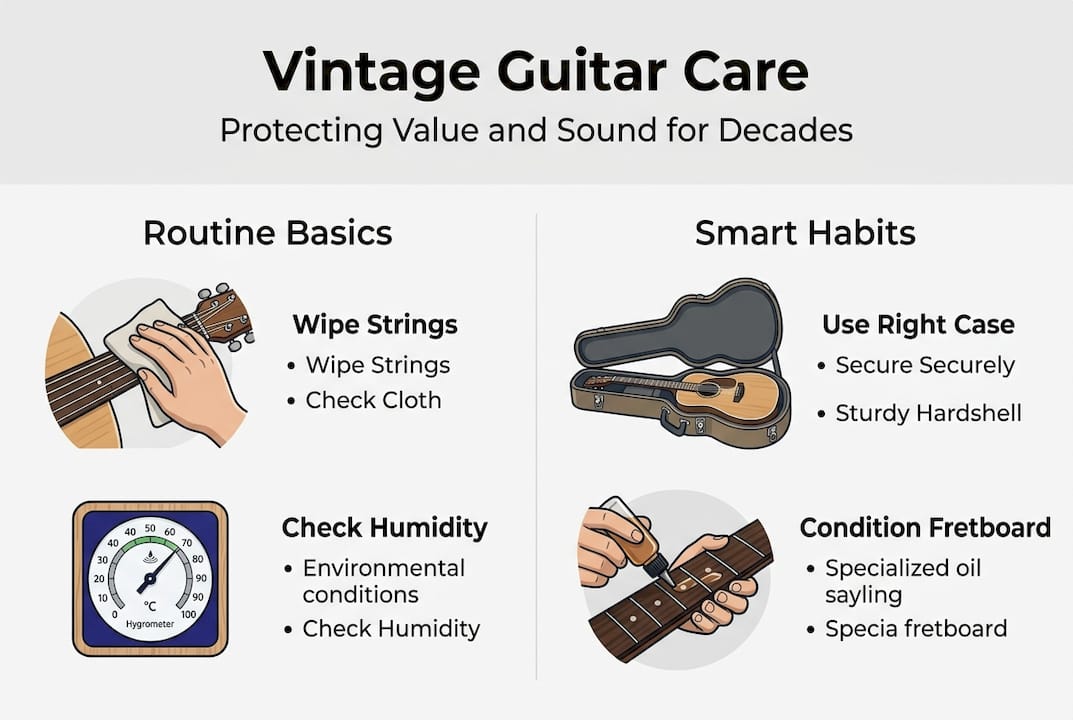
Consistent cleaning prevents finish deterioration and fretwear, two of the most common and costly forms of vintage guitar decline. Daily care does not have to be elaborate. After every session, wipe the strings, neck, and body with a clean microfiber cloth. This removes sweat, skin oils, and dust before they bond to the finish or corrode the strings.
Here is a simple four-step monthly routine to follow:
- Clean the body, neck, and hardware with appropriate instrument cleaners. Use separate cloths for the body and the fretboard.
- Inspect the entire instrument for new cracks, finish checking (fine cracks in the lacquer), loose bracing, fret wear, and any hardware that has loosened.
- Lubricate the nut slots with a small amount of graphite or specialized nut lubricant to prevent string binding, and apply a tiny drop of oil to tuning machine gears if they feel stiff.
- Change strings on a regular schedule, even if they look fine. Old strings create uneven tension and mask tonal problems.
“A finish that has been damaged by the wrong cleaner cannot be restored to its original state without affecting the guitar’s collector value. Prevention is always cheaper than correction.” This is a principle every serious collector should internalize before reaching for any product.
For fretboard care, unfinished rosewood and ebony boards benefit from occasional conditioning with a small amount of lemon oil or dedicated fretboard conditioner. Do not use these products on maple fretboards, which are typically finished and need only a damp cloth.
Pro Tip: Changing strings one at a time, rather than removing all at once, keeps tension on the neck consistent and can reveal cracks or loose braces that were hidden under string pressure. Check out these professional tips for more insights on what to look for during routine checks.
Safe handling and storage for long-term protection
Daily and monthly care are crucial, but how a vintage guitar is stored can decide its fate over the long run. Many collectors do everything right during play and everything wrong during storage.
Here are the core do’s and don’ts:
- Do store in a hard-shell case with a humidity pack inside
- Do keep the case away from exterior walls, which conduct outdoor temperature swings
- Do lay the case flat or stand it upright in a stable position
- Don’t hang vintage guitars on exterior walls or near windows
- Don’t leave a guitar in a car, even for a short time
- Don’t store near heating or cooling vents
- Don’t use a soft gig bag as primary long-term storage
Temperature and humidity swings are the top causes of vintage instrument decay, and over 70% of vintage guitar cracks result from improper storage conditions rather than physical accidents.
| Storage method | Pros | Cons |
|---|---|---|
| Hard-shell case | Best protection, humidity control possible | Less display value, requires space |
| Wall mount (interior) | Great display, easy access | No humidity control, dust exposure |
| Gig bag | Lightweight, portable | Minimal impact protection, no climate control |
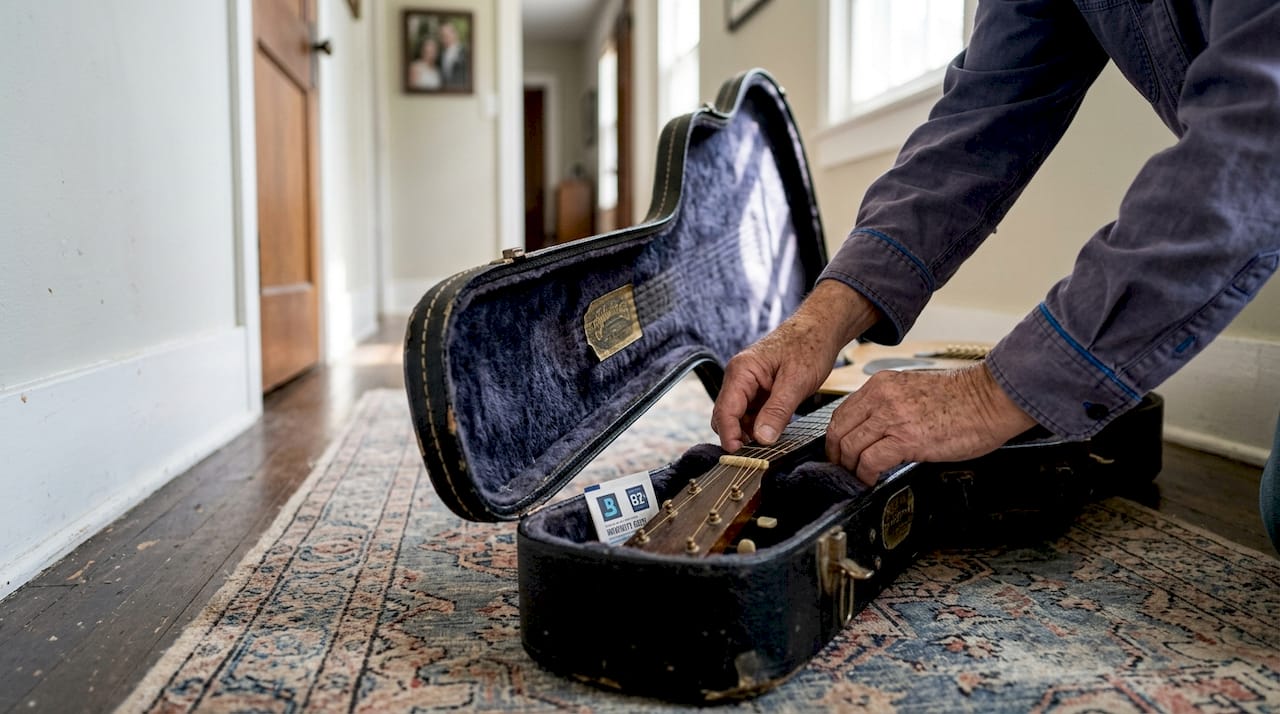
For travel, a quality hard case is non-negotiable. If you are flying, loosen the strings slightly to reduce neck tension during pressure changes in cargo holds. Pack the headstock area with extra padding. For home storage, Boveda 49% two-way humidity packs placed inside the case do the heavy lifting without any monitoring required. Replace them every two to three months depending on your climate. Good guitar storage tips make the difference between a guitar that lasts another century and one that quietly deteriorates in your living room.
Restoration and professional servicing: When and how
Even with great daily care and storage, some issues are beyond most collectors. Knowing when to stop and call a professional is one of the most important skills a vintage guitar owner can develop.
Here are the signs that mean you need a luthier, not a YouTube tutorial:
- Structural cracks in the top, back, or sides, especially near braces or the bridge plate
- Neck warping or back-bow that does not respond to truss rod adjustment
- Finish bubbling or lifting that suggests moisture has gotten beneath the lacquer
- Loose or separating braces that you can hear rattling inside the body
- Bridge lifting off the top, which affects both tone and structural integrity
“A non-reversible repair, one that uses modern glues or materials incompatible with the original construction, can permanently reduce a guitar’s collector value, even if it looks perfect afterward. Always ask your luthier what materials they plan to use before work begins.”
Professional restoration enhances playability and market value when done by experienced technicians who understand vintage construction methods and period-correct materials. When vetting a luthier, ask specifically about their experience with instruments from the same era as yours. Ask what adhesives they use, whether they have worked on similar models, and whether they can provide references or photos of past work.
For restoration for collectors, the goal is always to preserve originality while improving function. Understand the value of restoration before committing to any work, and if you own a classical instrument, the classical restoration guide covers the unique considerations for that category. DIY is fine for string changes and light cleaning. It is not fine for anything structural.
Avoiding mistakes: Common pitfalls for vintage guitar owners
To sustain the hard-won value and playability of your instrument, it is crucial to avoid these frequent pitfalls. Most of them come from good intentions applied with the wrong information.
The most common mistakes vintage guitar owners make:
- Swapping original parts for upgraded hardware, even when the originals are worn
- Over-cleaning with aggressive polishes that strip or dull vintage lacquer
- Ignoring humidity during winter months when indoor heating dries the air sharply
- Transporting without a hard case, even for short local trips
- Refinishing to make the guitar look newer, which erases collector-grade originality
Many collectors unintentionally hurt value by refinishing or over-cleaning, two actions that feel like care but function like damage. The authentic preservation guide outlines exactly what to avoid and why originality is the foundation of collector value.
Documenting your guitar’s condition is also something most collectors overlook until it is too late. Take dated, high-resolution photos of the entire instrument, including the headstock, serial number, interior label, and any existing wear. Store these with your purchase receipts and any provenance documents. This record protects you for insurance claims and dramatically strengthens your position when reselling.
Pro Tip: Never throw away original hardware, even if it is broken or corroded. A missing original tuner can reduce a guitar’s value by more than the cost of a professional repair. Store removed parts in a labeled bag inside the case.
What most collectors get wrong about vintage guitar care
Here is something we see constantly: collectors who obsess over cosmetic appearance while overlooking structural integrity. A guitar with honest play wear and a fully intact original finish is worth significantly more than one that has been buffed, touched up, or partially refinished to look pristine. Buyers and appraisers can spot the difference immediately.
What actually drives long-term value is documented maintenance history and structural originality. A guitar with receipts from a respected luthier, photos tracking its condition over years, and all original hardware will outperform a cosmetically perfect instrument with no paper trail at auction and in private sales.
The other thing most collectors miss is that a vintage guitar is supposed to age. The wood darkens, the finish checks, the frets wear. These are signs of a life well-played, and they tell a story that a refurbished guitar cannot. Chasing a like-new appearance often means erasing exactly what makes a vintage instrument rare and desirable. Check the expert buying tips to understand what serious buyers actually look for. Embrace the character. Protect the structure. That is the real job of a vintage guitar owner.
Find, restore, and protect your next vintage guitar
Ready to take the next step with your collection or restoration journey? Vintage Guitar World is your starting point for authentic instruments, trusted guidance, and access to expert knowledge built specifically for serious collectors.

Whether you are learning about types of vintage guitars to sharpen your buying instincts, exploring why vintage guitars matter from a historical and tonal perspective, or ready to browse a curated selection of rare and restored instruments, the vintage guitar shop has what you need. Every guitar listed has been evaluated, documented, and described with the detail that collectors actually rely on. Your next great instrument is waiting.
Frequently asked questions
How do I keep my vintage guitar from drying out or cracking?
Store your guitar in a hard case with a two-way humidity pack maintaining 40 to 50 percent humidity and keep it away from heating vents and exterior walls where temperature swings are most severe.
Is it safe to clean a vintage guitar with household products?
No. Only use cleaners approved for instrument finishes, because household products damage lacquer and vintage wood in ways that cannot be reversed without affecting collector value.
When should I seek professional restoration for my vintage guitar?
Consult a luthier immediately if you notice structural cracks, neck warping, or finish bubbling, because professional restoration improves value when performed by technicians experienced with vintage construction methods.
Will changing hardware or parts affect my vintage guitar’s value?
Yes. Swapping original parts can significantly reduce collector value, and refinishing or over-cleaning carries the same risk, so always store any removed original hardware in a labeled bag with the instrument.