




Start your ad with this formula: Brand + Model + Type + standout feature, followed by a first sentence naming the model, year, price, and a short condition tag. For example: “Fender Stratocaster 1978, original finish, favorable condition with minor fret wear.” Everything else, photos, full specs, and contact details, builds out the body below that opening line.
TL;DR:
- For private sales in Germany, a numeric condition grade can become a binding promise; the 2025 ruling treated a 2 to 3 rating that way.
- Compare recent sold listings for the same model, adjust for condition, and choose firm pricing or VB based on whether you expect negotiation.
- Show the full front, back, serial number, fretboard, bridge, and any damage clearly; an unprocessed demo can reveal pickup operation, fret buzz, and dead spots.
- For common midrange guitars, emphasize comfort, tone, and readiness, while rare instruments need provenance, originality, and supporting paperwork to interest collectors.
- Use local classifieds for bulky or lower value guitars where pickup is easier, and national marketplaces for rare or high value instruments.
Table of Contents
- Checklist: Essential Elements Every Guitar Sales Ad Must Have
- Three Ready-to-Use Ad Templates and How to Adapt Them
- How to Describe Condition Without Creating Unintended Legal Obligations
- Pricing Tactics and Phrasing That Increase Inquiries
- Photos and Presentation: Exact Shots and Captions Buyers Expect
- Publishing and Search: Keywords, Title Formulas, and Posting Logistics
- Who Is Actually Reading Your Ad: Collectors or Players?
- Highlighting What Makes an Instrument Worth a Premium
- Writing Style That Sells Vintage Instruments Without Overselling Them
- Best Practices for Sound Clips and Demo Videos in Your Listing
- Why Documentation Changes What a Vintage Guitar Is Worth
- Sell Through Vintage Guitar World: Consignment, Valuation, and Testing
- FAQ
- Sources
Checklist: Essential Elements Every Guitar Sales Ad Must Have
A strong listing title puts the brand first, then the model, then the type, then a word that signals rarity or craft, like “vintage” or “handmade.” A title reading “Gibson J-45 Vintage Acoustic, mid-1960s, Original Case” tells a buyer much before they even click.
Below the title, your ad body needs to answer every question a serious buyer would otherwise message you about. Skipping these invites a flood of repetitive questions, or worse, no questions at all because buyers move to a clearer listing.
- Identity facts: exact model, year or estimated decade, serial number if visible, scale length and neck profile, pickup type and string gauge, and any included case, cables, or straps.
- Condition specifics: fret wear location and severity, neck straightness, any cracks or finish checking, whether electronics are tested and working, and dates of recent repairs.
- Price and logistics: your asking price, whether it is firm or “VB” (negotiable), who handles shipping versus local pickup, and whether a deposit is required to hold a test-play appointment.
- Contact expectations: your preferred contact method and realistic response windows, for example “message only, phone calls 6:00 PM to 8:00 PM.”
A practical secondhand-selling guide from Verbraucherzentrale recommends exactly this kind of layered approach: clear description, accurate specs, disclosed defects, and shipping terms stated up front. Sellers who follow this structure tend to field fewer clarifying messages and close deals faster, simply because the ad already did the talking.
Three Ready-to-Use Ad Templates and How to Adapt Them
Different platforms reward different lengths. A marketplace app with a short preview needs a tight opener; a classifieds site with more room lets you build a fuller case. Here are three templates to copy and adjust.
- Short template (for quick marketplace listings): Title: “Yamaha FG800 Acoustic, Like New, Case Included.” Body: “Bought in 2023, played maybe 20 hours total. $280, firm. Pickup only, message to arrange.”
- Mid-length template (for classifieds): Open with the identity line, add a bullet list of specs (neck profile, pickups, strings), a one-line condition statement, a list of included accessories, and a note on shipping or pickup. Close with “Price is VB, reasonable offers welcome.”
- Long template (for high-value or vintage instruments): Lead with provenance (where and when acquired, any notable prior owner if documented), a maintenance history with dates, a detailed condition paragraph, an offer to arrange a test-play appointment, and a mention of any certification or appraisal document you hold.
When adapting these, replace every placeholder with your actual instrument’s details and resist the urge to add absolute claims like “flawless” or “perfect” unless you can back them with a report. Those words create expectations you may not be able to defend later.
Pro Tip: Write the long template first, even for a shortlisting. Trimming a detailed draft down is easier than remembering what to add to a thin one.
How to Describe Condition Without Creating Unintended Legal Obligations
Private sellers in Germany are generally free to exclude statutory Gewährleistung rights for used goods, but the wording has to be correct, and it can be overridden by what you actually write in the ad. According to legal guidance on private sales, an explicit condition statement, especially a numeric grade, can be read as a Beschaffenheitsvereinbarung, a binding condition agreement, which creates liability regardless of any disclaimer elsewhere in the listing.
A 2025 decision from the Bundesgerichtshof confirmed this directly: a stated condition grade of “2-3” in a sale was treated as a binding description with real consequences for the seller. That ruling is a clear signal to choose words carefully rather than reach for a tidy numeric scale.
Safer practice:
- Use dated, observational phrasing: “No visible cracks as of September 2026” rather than a flat “no damage.”
- Avoid numeric grades unless a luthier’s report backs the number.
- Document repairs with invoices or dated notes, and reference them directly in the ad.
- If you include “Privatverkauf, Gewährleistung ausgeschlossen,” pair it with accurate contract wording, since specific assurances you make can override that exclusion anyway.
Pricing Tactics and Phrasing That Increase Inquiries
Before you set a number, check recent sold listings for the same model and adjust for condition differences, then decide how much negotiating room you want to build in.
- Search completed or sold listings rather than active ones, since active prices often reflect hope rather than what buyers actually paid.
- Use “VB” (Verhandlungsbasis) when you expect offers, and reserve a firm price for instruments priced competitively from the start.
- State who pays for shipping and insurance explicitly: “Buyer covers shipping and insurance” removes a common point of friction.
- If you require a deposit to hold a test-play appointment, say so plainly: “A refundable $50 deposit secures a viewing slot.”
Photos and Presentation: Exact Shots and Captions Buyers Expect
Photos do more work than any paragraph of text. Buyers scan images first and read captions to confirm what they think they saw.
- Capture full front, full back, a close-up of the headstock and serial number, fretboard detail, the bridge, and the electronics cavity if applicable.
- Photograph any damage directly and without flattering angles, since hiding a flaw in photos invites disputes later.
- Shoot in even, natural light against a plain background, and name files descriptively, like “Gibson_J45_front.jpg,” so buyers can reference them easily.
- A short video showing a clean chord progression, the pickup selector switch, and a basic fret buzz check builds more trust than another static photo.
Pro Tip: Caption each photo with the date and what it shows, for example “Fretboard wear, photographed April 3, 2026.” That habit alone limits later arguments about when a flaw appeared. Our photography guide and its German-language edition walk through lighting setups in more depth.
Publishing and Search: Keywords, Title Formulas, and Posting Logistics
Getting found matters as much as writing well once your listing is live.
- Lead your title with Brand, then Model, then Type, then a short condition tag, for example “Gibson J-45 Vintage Acoustic, Good, Case Included.”
- Put the price, year, and condition summary in your first sentence since many marketplaces truncate previews after one line.
- Choose local classifieds for bulky or lower-value instruments where pickup is simpler, and national marketplaces for rare or high-value pieces where a wider buyer pool justifies shipping logistics.
- Post during evening hours or weekends when browsing peaks, and respond to messages within a few hours to avoid losing interested buyers to faster listings.
Who Is Actually Reading Your Ad: Collectors or Players?
A collector and a working musician are looking for different proof points, and your ad should signal which one you are writing for, or speak to both deliberately.
A collector cares about originality, rarity, and documentation. Mentioning an original finish, a matched serial number set, or a factory specification sheet speaks directly to that reader. A player, on the other hand, wants to know how the instrument feels and sounds in use: neck profile, action height, tone character, and whether it is gig-ready right now.
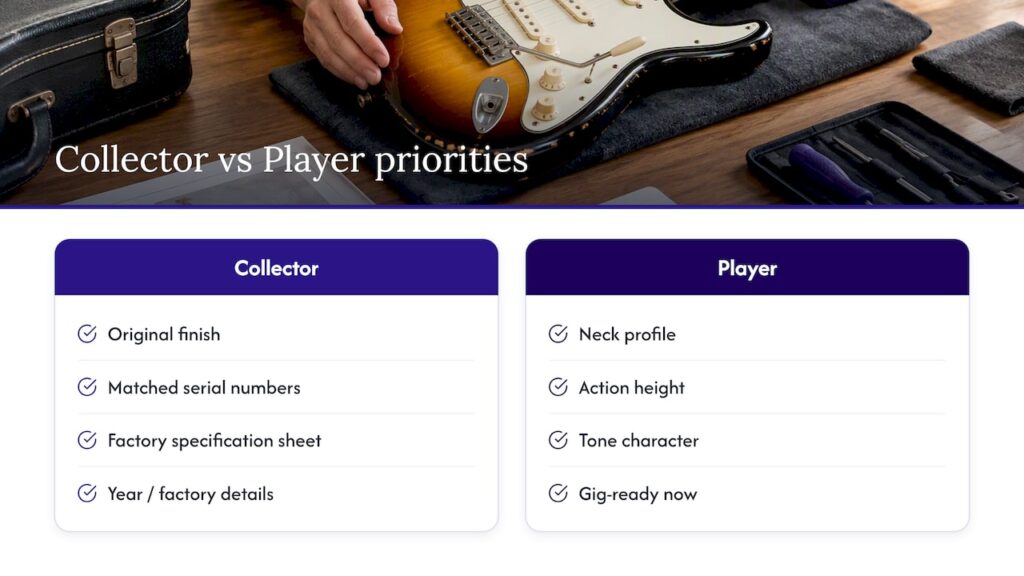
If you are selling a widely produced, mid-range instrument, lean into player language: comfort, tone, reliability, what genres it suits. If you are selling something rarer, a pre-war flattop, an early solid-body electric, a hand-built classical guitar, lead with the details collectors search for: year, factory, original parts versus replaced parts, and any supporting paperwork.
You do not have to choose only one audience. A well-written ad for a desirable vintage piece can open with the collector-facing facts (year, originality, provenance) and close with a player-facing note about how it actually plays and sounds today. That combination widens your buyer pool without diluting either pitch, since a collector still wants to know it is playable, and a player is often happy to pay a premium once they understand why the instrument is special.
Highlighting What Makes an Instrument Worth a Premium
Every guitar has a baseline value tied to brand and model, but the details that justify asking above that baseline are the ones most sellers leave out. If your instrument has a notable repair history from a known luthier, an unusual finish variant, or ties to a specific production run, say so explicitly rather than assuming a buyer will ask.
Historical and cultural context matters more for vintage instruments than for anything mass-produced in the last decade. A guitar built during a factory’s peak era, or one that reflects a design change before a model was later simplified, carries a story that collectors specifically pay for. If you know your instrument’s place in that story, even loosely, include it.
Be specific rather than general. “Rare color option” means little on its own; “Original Candy Apple Red finish, a factory option offered for only a few years” gives a buyer something concrete to research and value. The same goes for construction details: naming the bracing pattern, the wood species, or a specific pickup wind tells a knowledgeable buyer you understand what you are selling, which in turn makes your price more credible.
Writing Style That Sells Vintage Instruments Without Overselling Them
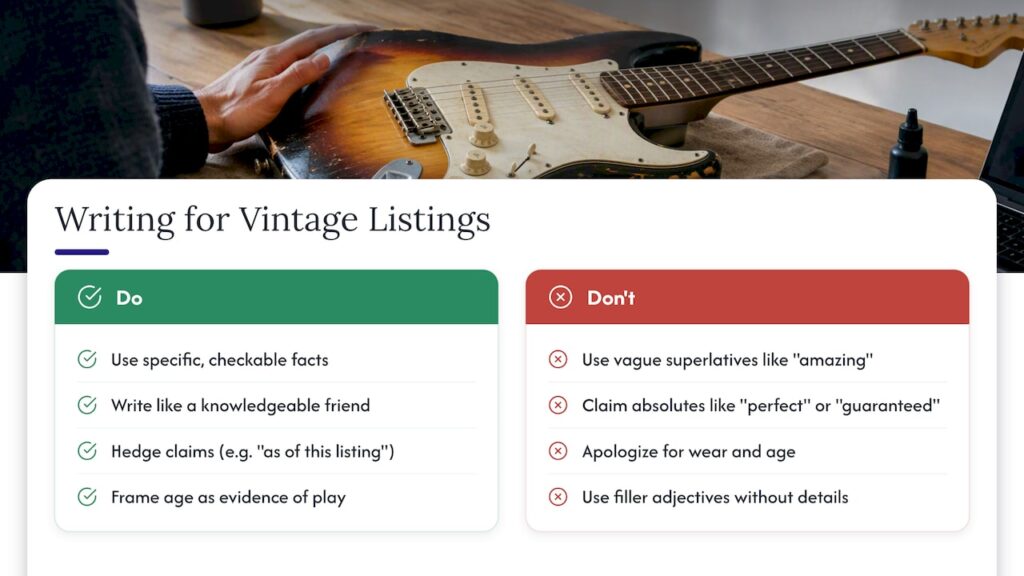
Vintage buyers respond to precision, not enthusiasm. A listing full of adjectives like “amazing” or “incredible” reads as filler to someone who has shopped this category before; a listing with specific, checkable facts reads as credible.
Write the way a knowledgeable friend would describe the instrument to another player: direct, a little opinionated about what makes it good, but grounded in detail. “The neck has worn into a comfortable, almost soft feel after decades of play” says more than “great playability” ever could.
Avoid absolute language unless you can back it. Words like “guaranteed” or “perfect” create expectations that a used instrument, especially a vintage one, usually cannot meet under scrutiny. Hedge where reality calls for it: “plays well with no noticeable buzz as of this listing” is honest and still persuasive.
Finally, let the instrument’s age work for you instead of against you. A scratch or a worn finish on a sixty-year-old guitar is not a flaw to apologize for, it is evidence the instrument has been played and loved, which is often exactly what a collector wants to hear.
Best Practices for Sound Clips and Demo Videos in Your Listing
A short audio or video clip answers the one question text cannot: how does it actually sound? Even a basic recording from a phone, posted as an unlisted video link, reassures a buyer far more than another paragraph of description.
Keep the clip short, generally under two minutes, and show a few specific things: an open chord progression across the neck, a pickup selector sweep if the guitar is electric, and a brief passage that reveals any fret buzz or dead spots. Skip heavy effects or studio processing since buyers want to hear the instrument itself, not a produced track.
Link the clip clearly in your ad text rather than burying it, for example “Demo video linked below, recorded September 2026, no effects.” If the instrument has any recording history worth mentioning, such as prior use in a release with documented rights, that context can matter to a buyer researching provenance, and resources on music rights for independent artists explain how usage and licensing history gets tracked in Germany.
Why Documentation Changes What a Vintage Guitar Is Worth
Provenance and certification do more than satisfy curiosity. For a collectible instrument, a documented repair history, original invoices, or a professional appraisal often shifts what a buyer is willing to pay, because it removes the guesswork that otherwise discounts an unverified vintage piece.
We provide services related to valuation, certification, consignment sales, restoration, and in-person testing appointments for sellers seeking professional handling of documentation. Private sale still makes sense for a common, lower-value instrument where the buyer pool is local and the stakes are modest. For a rarer or higher-value piece, a professional consignment route with a formal valuation behind it tends to produce a cleaner sale and a more defensible price.
— Vintage
Sell Through Vintage Guitar World: Consignment, Valuation, and Testing
When your instrument deserves more than a quick private listing, we handle the parts that are hardest to get right on your own. Our services cover exclusive testing appointments, consignment sales, and certificates and valuation reports, plus restoration for instruments that need work before they go to market.

Choose consignment and we start with a valuation, list your instrument alongside our curated vintage, acoustic, and electric inventory, and work on a commission basis once it sells. Visit our selling services page to get started.
FAQ
Welche Sprüche eignen sich für Gitarristen?
A short, specific detail about your instrument works better than a generic phrase, since vintage buyers respond to facts over slogans. Mention what makes the guitar distinct, such as its original finish or a documented repair, rather than reaching for a catchy tagline.
Gibt es einen Spruch für Gitarrensaiten?
There is no standard phrase required for describing strings in a sales ad. State the string gauge and brand if known, and note how recently they were changed, since that detail matters more to a buyer than any slogan would.
Was ist meine Gitarre wert?
Value depends on brand, model, year, condition, and documentation like repair history or certification, so there is no single number without an inspection. A professional valuation accounts for these factors directly, while checking recent sold listings for the same model gives a rough starting point on your own.
Welcher Akkord ist auf der Gitarre verboten?
No chord is legally or technically banned on guitar. Some chords, like certain open-string combinations in specific keys, are avoided in traditional music theory for sounding dissonant, but that is a stylistic choice, not a rule.
Sources
- Privatverkauf, Gewährleistung — JuraForum
- Bundesgerichtshof — Bedeutung der Angabe von Zustandsnoten