













TL;DR:
- Vintage pickups differ from modern ones because they are hand-wound with aged materials, creating unique harmonics and responsiveness. Over time, factors like wire insulation deterioration and slight magnet demagnetization enhance their organic, rich tone. Unlike reissues, authentic vintage pickups carry historical significance, material variability, and a character that automation cannot replicate.
Most guitarists assume pickups are largely interchangeable — swap one single-coil for another and you’ll land in the same sonic neighborhood. That assumption has cost more than a few players years of chasing a tone they couldn’t name. The role of vintage pickups goes far deeper than nostalgia or collector status. These components carry the fingerprints of hand-wound coils, aging magnets, and material choices that simply no longer exist in mass production. If you’ve ever wondered why a pre-CBS Stratocaster sounds alive in a way that a modern reissue doesn’t, you’re already asking the right question.
Table of Contents
- Understanding vintage pickups: What makes them unique
- Iconic vintage pickup types and their tonal characteristics
- How aging shapes the vintage pickup sound signature
- Vintage pickups versus modern reissues: What sets vintage apart?
- Choosing and caring for vintage pickups: Collector and player insights
- Why vintage pickups represent more than just sound quality
- Explore vintage guitars and pickups at Vintage Guitar World
- Frequently asked questions
Key Takeaways
| Point | Details |
|---|---|
| Material impact | Heavy Formvar wire and Alnico magnets in vintage pickups contribute uniquely to tone and clarity. |
| Construction variations | Hand winding and manufacturing inconsistencies create complex, lively tonal character. |
| Aging effects | Decades of aging soften highs and enrich lows, enhancing pickup responsiveness and warmth. |
| Vintage vs modern | Vintage pickups offer organic character that modern precise manufacturing cannot fully replicate. |
| Value preservation | Maintaining original pickups and documentation is crucial for tonal authenticity and collector value. |
Understanding vintage pickups: What makes them unique
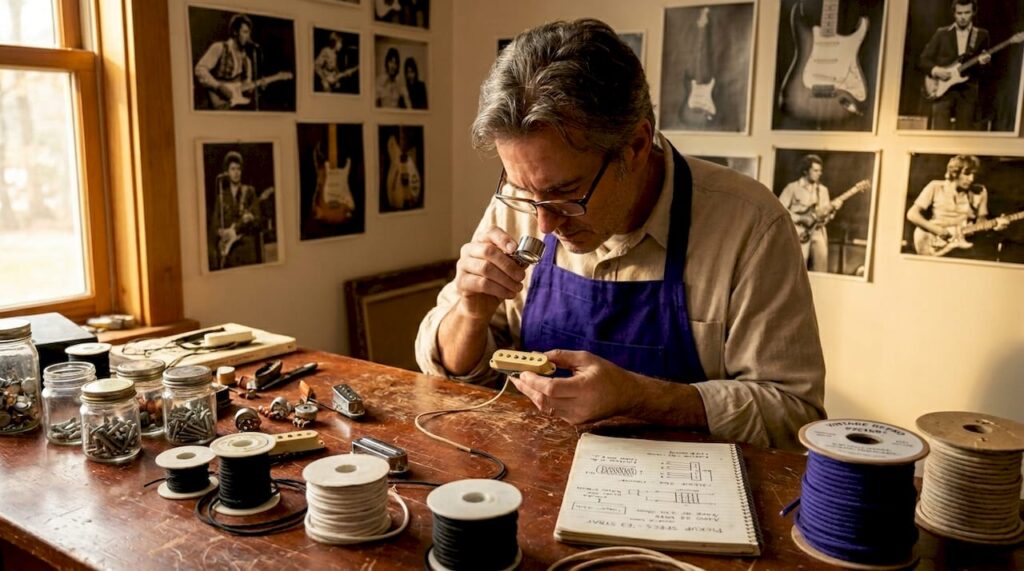
The construction of vintage guitar pickups is where everything begins. Modern pickups are wound by machines calibrated for consistency. Vintage pickups were wound by hand, guided by workers who adjusted tension, speed, and scatter by feel. That variability isn’t a flaw. It’s the source of the organic, responsive tone that collectors spend decades tracking down.
Several material choices from the original production era are central to why vintage pickups sound and behave the way they do:
- Heavy Formvar wire: Pre-CBS Strat pickups used 42 AWG Heavy Formvar wire, staggered Alnico pole pieces, and hand-guided winding, producing clear note separation and dynamic sensitivity that modern coatings don’t replicate.
- Alnico magnets: Alnico 2, 3, and 5 each have distinct magnetic strength and warmth. These aren’t interchangeable, and vintage builders didn’t always use the same grade consistently across a run, which created tonal variation between instruments built the same week.
- Fibreboard flatwork: Pre-CBS Telecaster pickups featured vulcanized black fibreboard flatwork and Alnico 3 to Alnico 5 rod magnets, contributing to organic resonance and classic twang that modern plastic bobbins can’t fully replicate.
- Staggered pole pieces: These were designed to balance string-to-string output based on typical string gauges of the era, preserving note clarity across the full register.
- Hand-guided scatter winding: Random variation in coil scatter changes the capacitance of the pickup, which in turn affects how the high frequencies roll off. More scatter generally means a warmer, more complex top end.
Understanding these vintage guitar features is the starting point for appreciating why no two vintage pickups are tonally identical, and why that matters.
Iconic vintage pickup types and their tonal characteristics
Three families of vintage pickups have shaped modern electric guitar tone more than any others: the pre-CBS Stratocaster single-coil, the pre-CBS Telecaster pickup set, and the Gibson PAF humbucker. Each represents a distinct engineering philosophy and a distinct sonic identity.
Pre-CBS Stratocaster pickups are famous for their glassy, chime-like clarity. The low output and hand winding produce a dynamic response that cleans up beautifully when you roll back the guitar’s volume. They’re articulate without being harsh, and they respond to pick attack in a way that feels almost conversational.
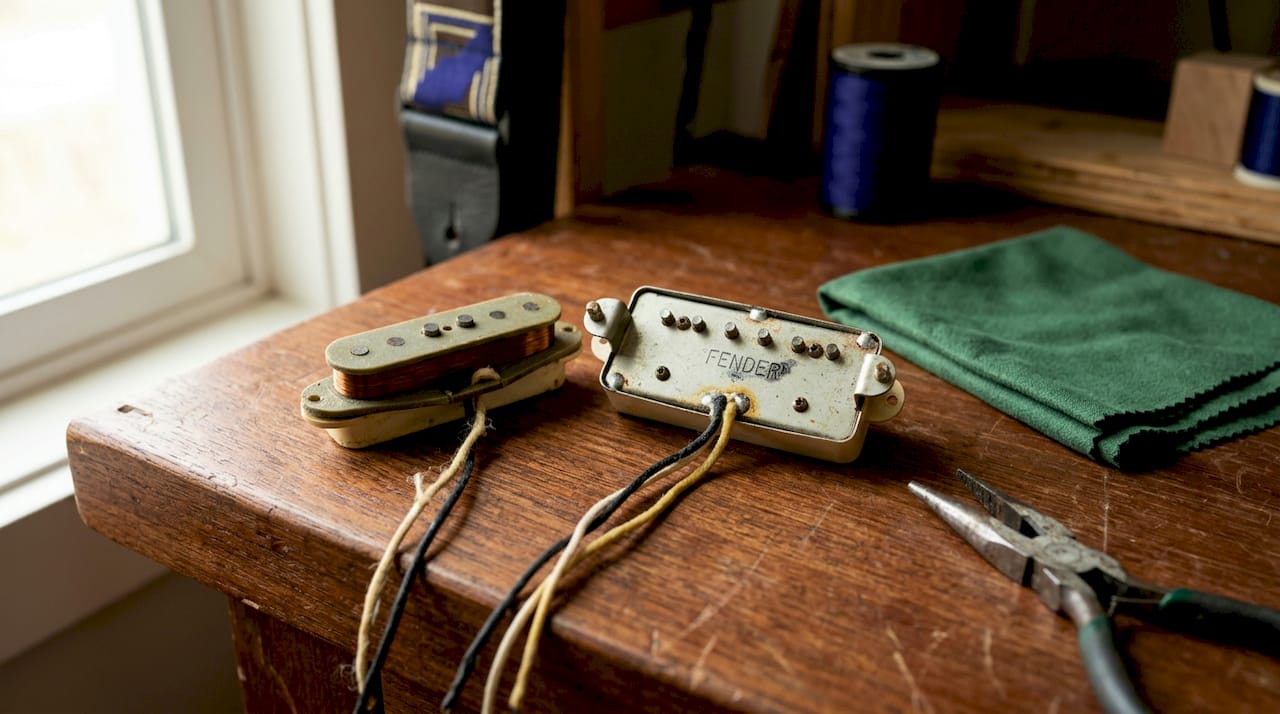
Pre-CBS Telecaster bridge pickups carry a steel baseplate beneath the coil. That baseplate adds twang and bite through magnetic interaction with the strings and body. The result is the cutting, country-bred snap that’s been driving Nashville session players for seven decades.
Gibson PAF humbuckers from 1957 to 1962 are in a category of their own. The coil imbalance in PAFs created complex harmonics and a warm, powerful tone that no subsequent humbucker has fully matched. That imbalance wasn’t designed. It happened because the builders didn’t have the tools to wind both coils to identical specs. The result became one of the most sought-after tones in rock and jazz history.
| Pickup type | Era | Core tone | Key construction feature |
|---|---|---|---|
| Pre-CBS Stratocaster | 1954–1965 | Clear, chime-like, glassy | Heavy Formvar wire, scatter winding |
| Pre-CBS Telecaster | 1950–1965 | Twangy, articulate, cutting | Steel baseplate, fibreboard flatwork |
| Gibson PAF humbucker | 1957–1962 | Warm, thick, harmonically rich | Unmatched coil winding, Alnico variance |
The advantages of vintage pickups become immediately clear when you line these three types up against their modern equivalents in a side-by-side comparison. Each has a personality. Modern versions have a specification.
Pro Tip: If you’re testing a guitar with claimed original pre-CBS pickups, plug into a clean amp at moderate volume and dig in with your pick attack. Vintage pickups respond to dynamics in real time. If the tone doesn’t open up when you back off, look closer at what’s actually installed.
How aging shapes the vintage pickup sound signature
Time does something to vintage guitar pickups that no factory process can replicate. The changes are gradual, cumulative, and irreversible. They’re also part of why vintage pickup sound qualities are so difficult to artificially reproduce.
Here’s what actually happens inside a vintage pickup over several decades:
- Wire insulation becomes brittle. The lacquer coating on vintage pickup wire was never designed for a 60-year lifespan. As it ages and partially breaks down, it creates a mild microphonic quality that opens up the tone, adding air and sensitivity that players describe as “bloom.”
- Coil windings loosen. Aging affects wire insulation brittleness, coil loosening, and slight demagnetization, all of which enhance tonal complexity and dynamic response in ways that feel organic rather than engineered.
- Alnico magnets demagnetize slightly. A fully charged Alnico magnet has a tight, focused response. A partially demagnetized one softens the attack, lets the lows breathe, and reduces the harshness at the top end of the frequency range. This is the “sweetness” players reference when describing vintage pickups.
- Manufacturing imprecision compounds over time. Small production variations and the lack of precise automated manufacturing lead to tones that are lively and complex in ways that modern pickups simply can’t replicate.
“The magic of vintage pickups isn’t something you can bottle. It’s what happens when imperfect materials meet time, and the result turns out to be exactly what music needed.”
The pickup aging effects are cumulative and non-linear. Two pickups from the same production run can sound noticeably different today because of how each guitar was stored, played, and maintained. That unpredictability is, paradoxically, a major part of their appeal.
Pro Tip: Never attempt to “re-energize” a vintage pickup’s Alnico magnets with a strong external magnet unless you’re certain of what you’re doing. Over-charging a partially demagnetized Alnico magnet will permanently change its character and likely devalue the instrument.
Vintage pickups versus modern reissues: What sets vintage apart?
This is where honest conversation matters. The question isn’t whether modern reissues are good. Many of them are excellent. The question is whether they do the same thing. They don’t.
Modern pickups use automated winding and consistent parts, resulting in less variation and a tonally tighter, more predictable sound versus the lively, unpredictable character of vintage originals. Consistency is the goal in modern manufacturing. In vintage production, consistency was the limitation. That limitation produced something no algorithm can replicate.
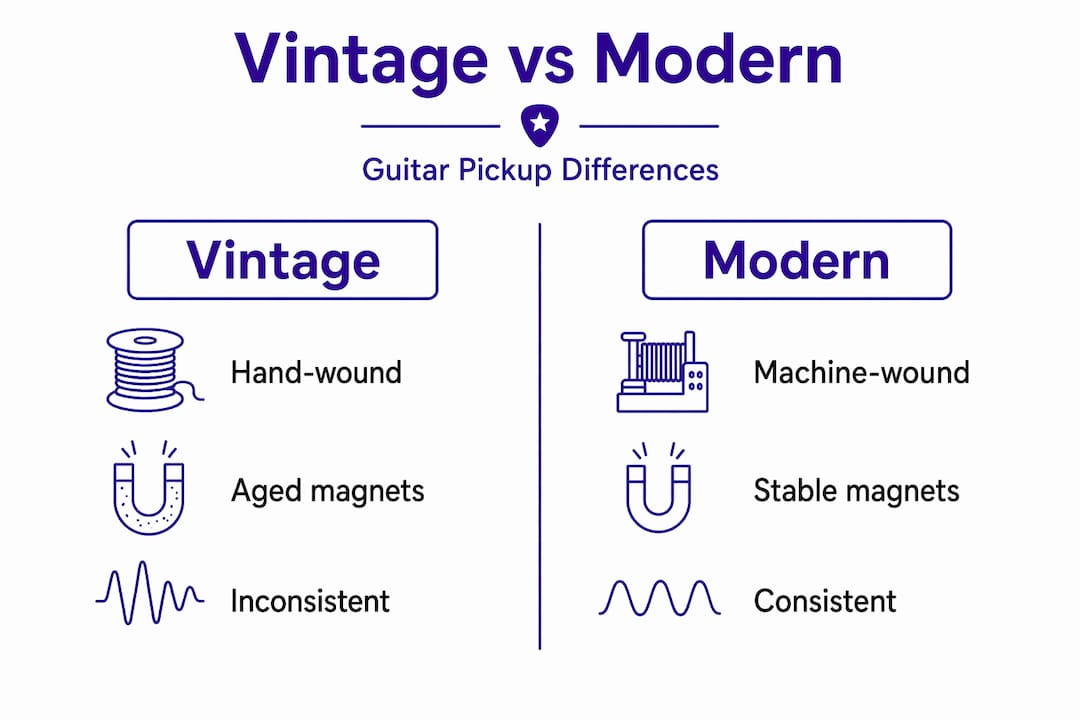
Here’s how the two categories compare across practical criteria:
| Characteristic | Vintage original | Modern reissue |
|---|---|---|
| Coil winding | Hand-guided, scattered | Machine-wound, consistent |
| Microphonic quality | Present, adds openness | Typically potted out |
| Tonal variation | Individual per pickup | Uniform across batch |
| Material aging | Real, cumulative | Simulated or absent |
| Collector value | High | Low to moderate |
| Reliability | Variable | High |
The vintage vs. reissue comparison comes down to what you’re optimizing for. A touring musician who needs zero-feedback consistency on a loud stage has legitimate reasons to prefer a well-potted modern pickup. A player or collector seeking the dynamic touch-response and harmonic complexity of a 1959 Les Paul’s original PAF? No reissue gets you there. Hand-guided winding and material inconsistencies from the vintage era create a dynamic response and complex harmonics that modern pickups, however skillfully made, simply weren’t built to produce.
The key differentiators of vintage originals:
- Unpotted coils that respond to touch and ambient vibration
- Aged wire insulation that creates openness without artificial processing
- Individual tonal character that makes each pickup a one-of-a-kind component
- Historical provenance that connects the instrument to a specific moment in music
Choosing and caring for vintage pickups: Collector and player insights
If you’re buying a guitar specifically for its vintage pickups, know what you’re looking at before you commit. Authenticity markers aren’t always obvious, but they’re consistent enough to learn.
How to identify authentic vintage pickups:
- Check the bobbin material. Black vulcanized fibre flatwork is a key marker on pre-CBS Fender pickups. Plastic bobbins indicate a later replacement.
- Examine the coil wire. Black fibre bobbins and staggered Alnico poles are the identifying features of authentic pre-CBS Stratocaster pickups. Look for the specific stagger pattern that matches the production year.
- Look for date codes. Many original pickups have ink-stamped or pencil-marked date codes on the bobbin or inside the control cavity.
- Research the guitar’s ownership history. Original pickups greatly impact a guitar’s value; rewound or replaced pickups can decrease value significantly, sometimes by 30 to 50 percent depending on the instrument.
Practical care guidelines for vintage pickups:
- Store guitars in stable humidity between 45 and 55 percent. Extreme dryness accelerates wire insulation breakdown.
- Avoid rewinding at all costs. A rewound pickup is no longer a vintage pickup in any meaningful sense.
- Keep magnets away from strong external fields, including some speaker cabinets and industrial equipment.
- Document everything. Photographs of the pickup, date codes, and service records protect value and help future buyers confirm authenticity.
Pro Tip: When identifying vintage pickups on a guitar you’re considering purchasing, bring a reference photo of the correct production-year pickup alongside a DC resistance reading. Original pre-CBS single-coils typically read between 5.8k and 6.4k ohms. Numbers far outside that range warrant closer scrutiny.
Why vintage pickups represent more than just sound quality
Here’s the perspective that most technical discussions miss: the impact of vintage pickups is not primarily about specs. You can memorize every AWG rating and magnet grade in existence and still fundamentally misunderstand what makes a 1961 Stratocaster pickup worth pursuing.
These components are artifacts. They carry the sonic decisions of engineers who were working without precedent, building instruments for a style of music that didn’t have a rulebook yet. The tonal complexity we admire today wasn’t designed. It was discovered. Vintage pickups represent not only sound but a link to history and the “happy accidents” of handcrafted production now impossible to reproduce at scale.
That matters because the experience of playing through a genuinely original vintage pickup is different in kind, not just degree. The way it responds to your touch, the way the harmonics shift when you dig in versus feather the strings, the subtle microphonic quality that makes the pickup feel “alive” — these are not features you can spec-sheet your way to. They emerged from constraint, from imprecision, from the specific era of materials and methods available in a given decade.
Modern builders who genuinely understand this don’t try to beat vintage pickups at their own game. They acknowledge that the passion around vintage guitars is partly a relationship with history, and that no amount of technical improvement changes the nature of that relationship.
The uncomfortable truth for purists: the tone isn’t separable from the story. You can’t fully replicate one without the other.
Explore vintage guitars and pickups at Vintage Guitar World
If this guide has sharpened your thinking about what vintage pickups actually do and why they matter, the next step is finding instruments where those principles are already at work.

At Vintage Guitar World, every instrument in our catalog has been evaluated for authenticity, originality, and tonal character. We offer an in-depth vintage guitar types guide that walks you through the histories and defining features of the instruments collectors prize most. If you’re weighing an acquisition decision, our vintage versus reissue guide cuts through the marketing noise with honest, experience-based analysis. And if you simply want to understand why vintage guitars keep holding their value and their fascination, we’ve covered that in depth too. Our team is available for valuation, certification, and testing appointments when you’re ready to take the next step.
Frequently asked questions
What makes vintage pickups sound different from modern pickups?
Vintage pickups sound distinct due to hand-wound coils, aged wire insulation, and material inconsistencies that create complex harmonics and dynamic response absent in precise modern pickups. Small production variations and the absence of automated manufacturing produce tones that are lively and genuinely difficult to replicate.
How does aging affect the tone of vintage pickups?
Aging causes pickup wire insulation to become brittle, coils to loosen, and magnets to demagnetize slightly, resulting in warmer and more resonant tones with improved openness and complexity. Wire insulation brittleness, coil loosening, and slight demagnetization collectively enhance tonal character in ways that are cumulative and irreversible.
Are vintage pickups always better than modern reissues?
Not always. While vintage pickups offer unique tonal character from aging and handmade variation, modern reissues provide reliability and consistency that suits high-volume performance needs. Automated winding and consistent parts give modern pickups predictability, but usually at the cost of the organic, complex nuances that define vintage originals.
How can I identify authentic vintage pickups for my guitar?
Authentic vintage pickups can be identified by original construction features including black fibre bobbin flatwork, specific coil wire gauges, staggered Alnico pole pieces, and documented provenance or date codes. Black fibre bobbins and staggered Alnico poles are among the clearest markers for authenticating pre-CBS Stratocaster pickups specifically.