












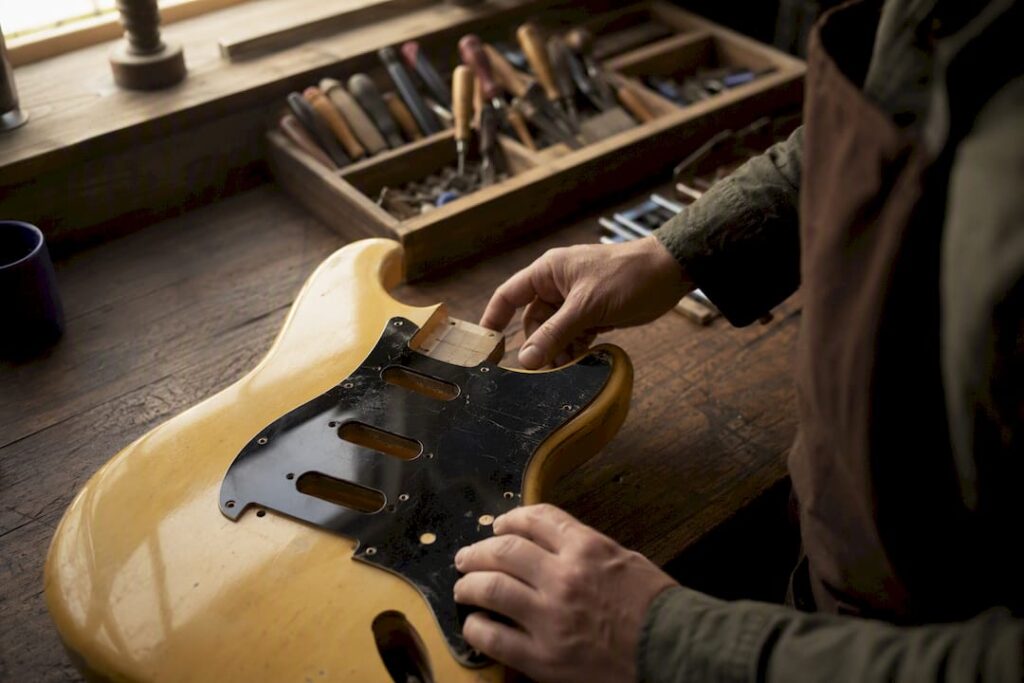

If the guitar in front of you has a single-ply black phenolic pickguard, a butterscotch blond finish with visible lacquer checking, a maple neck with a walnut skunk stripe, and flat polepieces on the bridge pickup, you’re likely looking at a real Blackguard Telecaster. That’s the verdict most collectors would give from across the room. But one cue alone proves nothing. Parts get swapped, guards get replaced, and refinishes fool plenty of experienced eyes at first glance.
Before you get attached to what you’re holding, photograph three things: the pickguard edges and screw patina, the neck heel for a penciled date or initials, and the potentiometers for their stamped date codes. Those three data points, when they line up, tell you far more than any serial number ever will.
- Check the pickguard: material, screw pattern, edge wear
- Check the neck heel: penciled date, initials, pencil style
- Check the pots: stamped date code, legibility, consistency with other dates
Pro Tip: Don’t remove hardware yourself to check these details. A loose neck screw or a pickguard pried up with the wrong tool can turn a $30,000 original into a “restored” one overnight.
Key Takeaways
A genuine Blackguard Telecaster is confirmed by concordant evidence, not any single feature, with neck-heel dates and pot codes carrying far more weight than serial numbers.
| Point | Details |
|---|---|
| Verify with multiple cues | Match pickguard, finish, neck heel date, and pot codes together rather than trusting one feature alone. |
| Distrust serial numbers | Pre-1955 serials overlap across years and plates get swapped, making them a weak dating signal on their own. |
| Trust neck heel and pot codes | Penciled neck-heel dates and stamped potentiometer codes are the most reliable physical evidence available. |
| Watch for conversions | Mismatched screw patina, fresh lacquer, and inconsistent pot dates often expose white-guard-to-Blackguard fakes. |
| Get expert verification | Vintage-guitar-world’s testing appointments document neck, pot, pickup, and finish evidence into a formal condition report. |
Table of Contents
- What Does “telecaster blackguard erkennen” Actually Mean in Practice?
- Which Physical Features Prove an Original Blackguard?
- Why Are Serial Numbers Unreliable for Dating a Blackguard?
- What Red Flags Suggest a Fake or Modified Blackguard?
- What Does an Expert Authentication Actually Check?
- Sources
What Does “telecaster blackguard erkennen” Actually Mean in Practice?
Identifying a Blackguard Telecaster is really a dating exercise disguised as a spotting exercise, and the terminology only makes sense once you know the timeline. Fender’s first solidbody, the Esquire, appeared in 1950. It was briefly renamed the Broadcaster, then sold with no name at all (collectors call these “Nocasters”) after Gretsch objected to the name over its existing Broadkaster drum kit trademark. Fender settled on Telecaster in 1951, and the name stuck.
Guitars built in the early 1950s carry the nickname “Blackguard” simply because of their black pickguards, according to the Fender Broadcaster history on Wikipedia. That’s the whole origin of the term. It’s not a model designation Fender ever used. It’s a collector shorthand that stuck because the guards were genuinely black, and they genuinely stopped being black around 1955 when Fender switched to white plastic laminate.
Two other production shifts matter for dating purposes:
- Around 1954 to 1955, Fender moved from black phenolic to white pickguards. This is a clean physical marker for the end of the Blackguard era.
- Serial numbers relocated from the bridge plate to the neckplate in late 1954, which is part of why pre-1955 serials behave so inconsistently.
Knowing this chronology matters because it tells you what era you’re even trying to authenticate. A guitar with a white guard and a neckplate serial isn’t a Blackguard candidate at all, regardless of how old it looks.
Which Physical Features Prove an Original Blackguard?
Work through these in order. Each one either confirms or contradicts the last, and the pattern matters more than any single find.
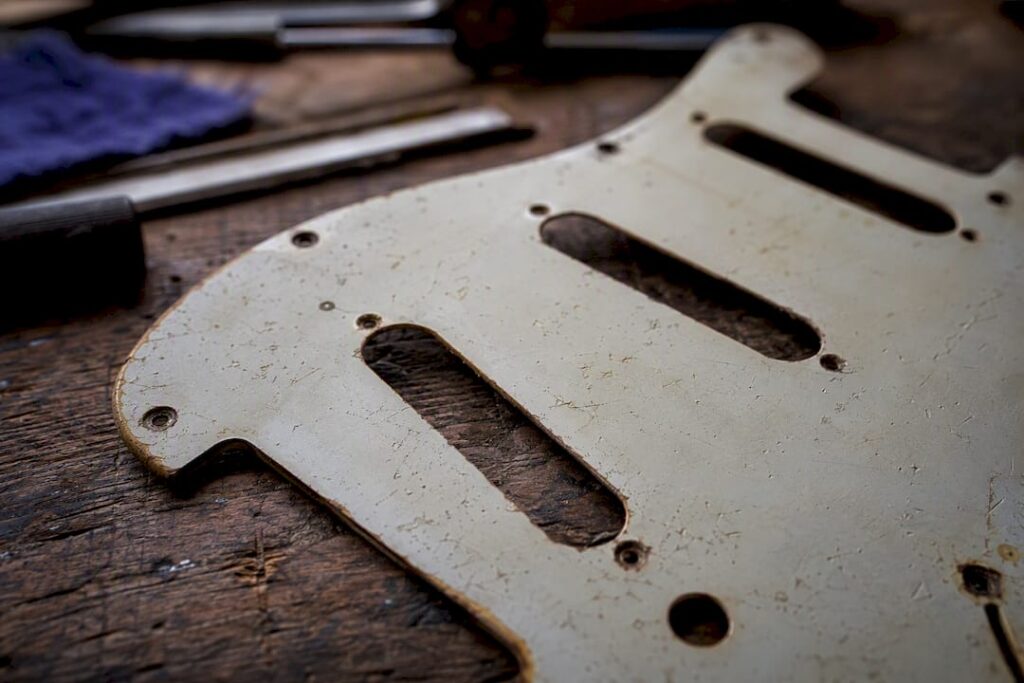
- Pickguard. Original guards are single-ply black phenolic, not the multi-ply ABS plastic used on modern reissues. Look at the screw pattern (five holes on the earliest examples) and check whether the material has yellowed or shrunk slightly at the edges, which phenolic does with age in a way plastic doesn’t.
- Finish. Butterscotch blond on genuine Blackguards was applied thin, and thin lacquer checks, yellows, and sometimes flakes at high-wear points like the edge behind the bridge pickup and around the strap button. A fresh or thick refinish tends to look too even, too glossy, or oddly uniform in color across the whole body.
- Neck and headstock. The neck should be maple with a visible walnut skunk stripe down the back, usually carved to a chunky soft U or V profile depending on the year. Check whether a headstock decal is present and what style it is. Decal presence and wording shift across this window and can help narrow the date.
- Bridge hardware. Early bridge plates and saddles evolved from brass to steel over the Blackguard years, and the bridge pickup should show flat polepieces rather than the staggered height polepieces that came later.
- Pickups and wiring. Pop the control plate (carefully, or have an expert do it) and look for cloth-covered wiring, period-correct pickup bobbin construction, and pots with legible stamped codes.
- Structural evidence. Look for factory nail holes and original routing marks under the pickguard, and check that screw patina matches across the whole instrument rather than showing one shiny replacement screw among nine aged ones.
Pro Tip: Screw patina is one of the most underrated tells. A guitar that’s genuinely sat untouched for seventy years shows consistent oxidation across every screw head. One bright, unworn screw among the rest usually means someone’s been inside that spot more recently than the others.
Why Are Serial Numbers Unreliable for Dating a Blackguard?
Serial numbers feel like the obvious place to start, and that’s exactly the trap. Fender’s early record keeping was inconsistent enough that experts now treat serials on 1950 to 1954 Telecasters as a weak signal at best, according to Guitar World’s history of Blackguard Telecasters. Numbers overlap across years, plates got swapped during repairs, and Fender didn’t move serials to the neckplate until late 1954, so anything before that was stamped on the bridge plate, which is one of the easiest parts to replace.
What holds up better in the field:
- Neck-heel penciled dates and initials, written by assembly line workers and often overlooked by anyone who hasn’t pulled the neck.
- Potentiometer date codes, stamped directly on the pot casing and one of the hardest details to fake convincingly.
- Pickup construction details, including wire type and polepiece style, which changed in ways that track fairly closely to build year.
- Lacquer aging patterns, which are difficult to replicate artificially without the giveaway signs of a modern finish.
Richard diZerega and other contributors to BlackguardLogs have documented just how much variation exists in early Fender records, and their consistent advice is to never lean on one indicator alone, per Guitarist magazine’s Teleology feature. A neck heel date that matches a pot code within a plausible window is a far stronger claim than either fact by itself. When three or four signals point the same direction, confidence goes up fast. When they conflict, that’s your red flag to slow down. Photograph every one of these details in good light before you draw any conclusion, so an outside expert can review the evidence without needing to see the guitar in person first.
What Red Flags Suggest a Fake or Modified Blackguard?
Most of the verification work can happen without touching a screwdriver to anything structural. Grab a strong flashlight and look at the finish edge underneath the pickguard, where original lacquer aging should be continuous rather than interrupted by a fresh line. Check whether the polepiece wear on the bridge pickup looks consistent with the surrounding lacquer wear, since mismatched aging between adjacent parts is a common tell.
Watch for these warning signs:
- A pickguard that flexes or feels lighter than phenolic should
- Pot codes that don’t fall within a plausible date range for the rest of the guitar
- Fresh lacquer overspray, especially around the neck pocket or control cavity
- Screws with modern threading or finishes that don’t match their neighbors
- Any sign the neck or bridge has been swapped from a different instrument
These practical, non-destructive techniques (checking screw patina, reading pot codes, and inspecting the finish under strong light) reflect standard practice documented by StewMac for initial authenticity assessments. If two or more of these flags show up together, photos alone won’t settle it. That’s when a hands-on expert inspection stops being optional.
Pro Tip: Experts have documented plenty of white-guard Telecasters converted into “Blackguards” over the decades. Finish and screw patina expose these conversions far more reliably than the pickguard color alone, since a black guard is trivially easy to source and swap.
What Does an Expert Authentication Actually Check?
A proper evaluation goes further than a photo review. When Vintage-guitar-world examines a Blackguard candidate, the process covers the neck heel for penciled dates, the potentiometers for date codes, the pickup internals for period-correct wire and bobbin construction, and the finish itself for age-consistent checking versus refinish evidence. Provenance history gets reviewed alongside the physical evidence, not instead of it.
Findings get documented into a formal condition report, which becomes the basis for a certificate or valuation. If you’re planning to bring in an instrument for review, gather what you already have first:
- Clear photos of the pickguard, neck heel, and control cavity
- Any known ownership or purchase history
- Prior repair or restoration records, if they exist
Collector perspective: originality versus playability
Purists chase every original screw. Working players often accept a sympathetic restoration, as long as it’s disclosed rather than disguised. The line that matters isn’t originality itself. It’s honesty about what’s been changed, and whether the changes were made to preserve the guitar or to deceive the next buyer.
— Vintage
Let Vintage Guitar World Verify What You’re Holding
Chasing pot codes under a jeweler’s loupe is satisfying right up until you hit a detail you can’t confidently read yourself. That’s the point where a second opinion earns its keep, especially on an instrument worth this much to get wrong.

Vintage-guitar-world offers testing appointments where an original Blackguard candidate gets the full treatment: neck heel inspection, pot date verification, pickup internals check, and finish analysis, all documented into a written condition report. If the instrument checks out, that report becomes the foundation for a formal valuation or certificate, the kind of paper trail that matters enormously at resale. Browse the current curated Blackguard-era inventory to see examples that have already been through this process, or book a testing appointment to get your own instrument looked at before you buy or sell.
Sources
- Blackguard Telecasters: The history and mythology behind the rare Fender guitars | Guitar World
- Teleology — Guitarist magazine (August 2020)
- Fender Broadcaster — Wikipedia
- Inspecting a historic guitar — StewMac