


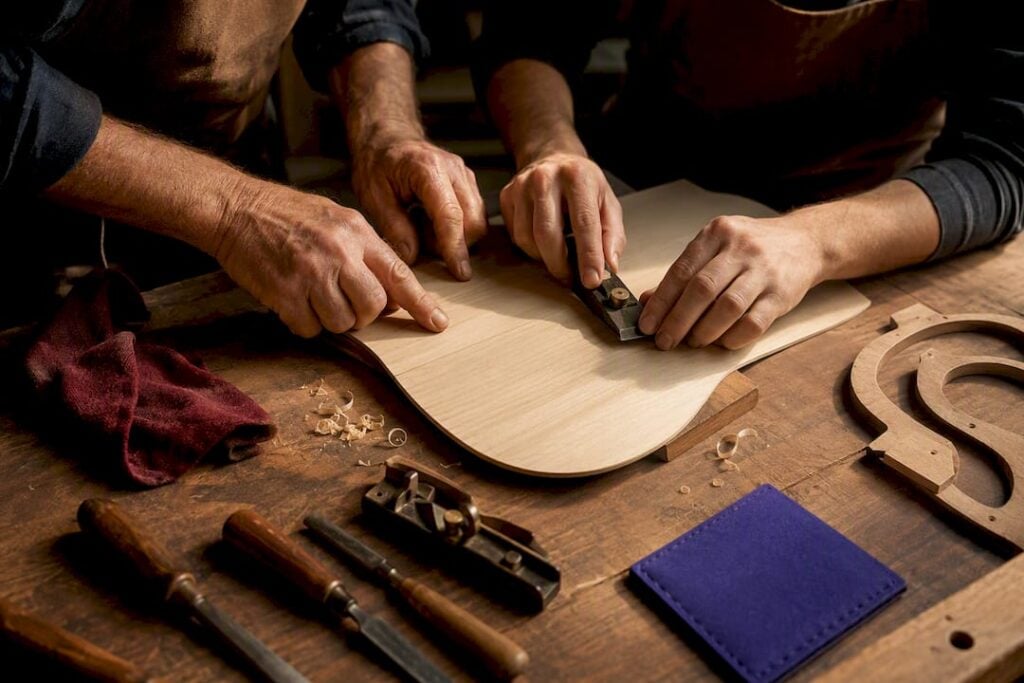

Choose Spanish immersion training if you want traditional tonal craft and hands-on technique fast; choose a German institutional program if you want a recognized credential, research-backed methods, and broad technical grounding. Short intensive schools like the European Institute of Guitar Making (EIGM) build artisan skill in weeks, while multi-year German programs at places like Markneukirchen produce documented, research-informed builders. Peer-reviewed acoustics research backs both approaches as valid, just aimed at different outcomes.
TL;DR:
- Spanish training focuses on hands-on, traditional methods like solera construction and French polishing, emphasizing tacit knowledge and stylistic nuance.
- German programs offer structured, research-backed education with formal credentials such as Bachelor’s degrees or Meisterbrief, integrating acoustics and materials science.
- Combining a short Spanish intensive course with a longer German vocational program provides both tactile mastery and recognized industry credentials.
- Acoustic research and technological tools are increasingly bridging the gap, with each tradition adopting selective machine assistance while preserving core techniques.
- Success depends on clear goals: for tonal mastery, choose Spanish immersion; for employment credentials, opt for German qualifications.
Table of Contents
- Spanish vs. German Luthier Schools: What Sets the Traditions Apart
- German Lutherie Education: Vocational Rigor Meets Research
- Comparing the Two Training Paths Side by Side
- How Each Tradition Approaches Sound and Construction
- How to Choose a Luthier School or Training Path
- Where to Read More on Spanish Craft and Instrument Evaluation
- Masters Who Shaped How Each Country Teaches
- What Career Outcomes Look Like After Graduation
- How Technology Is Changing Both Training Models
- What Students Actually Experience in Each System
- Choosing Based on What You Actually Want to Build
- Bring the Comparison Home: Play, Restore, or Collect Both Traditions
- Sources
- FAQ
Spanish vs. German Luthier Schools: What Sets the Traditions Apart
The Spanish tradition teaches guitar making the way it has been taught for centuries: one builder showing another, hands-on wood, no textbook required. Germany formalized that same craft into semester-based curricula with grading, accreditation, and lab access. Both produce excellent instruments. They just get there through completely different pedagogy, and that difference shapes everything from class size to what a diploma is even worth on a résumé.
Granada, Madrid, and Valencia remain the three centers that matter most in Spanish lutherie. Granada carries the workshop lineage tied to Antonio de Torres and later Ramírez family builders, and it’s still where the highest concentration of working ateliers operates today. Madrid has its own documented history stretching back to 1882, with builders who supplied the Spanish court and later the flamenco and classical concert circuits. Valencia developed a somewhat more commercial tradition, producing guitars at scale while still training apprentices in traditional joinery and finishing.
Most Spanish training happens through master-apprentice relationships inside family workshops, sometimes lasting years before a student builds an instrument solo. Short intensive schools have opened that path to outsiders who can’t relocate for a decade. EIGM in Granada runs one-month, hands-on courses with class sizes around six students, teaching traditional Spanish construction start to finish. Glissando follows a similar studio-style model, emphasizing direct technique transfer over lecture time.
The curriculum in these programs centers on a few signature methods:
- The solera method, a workbench jig that holds the guitar’s form during assembly and shapes the top’s arch
- French polishing with shellac, applied in dozens of thin coats by hand rather than sprayed
- Traditional hide-glue joinery, chosen for reversibility during future repairs
- Distinct finishing and setup routines for flamenco (lower action, brighter attack) versus classical (higher action, sustained resonance)
The result is a builder who has internalized tone by feel, not by formula, working in a small cohort where every hour is bench time.
German Lutherie Education: Vocational Rigor Meets Research
German training runs on structure. Where Spanish workshops pass down feel and intuition, German programs document, test, and grade competency at every stage, and that difference shows up the moment you compare a syllabus to an apprenticeship schedule.
Two institutions anchor the German system. The Markneukirchen program, run through Westsächsische Hochschule Zwickau, offers a Bachelor’s degree in Musical Instrument Technology that blends traditional workshop skills with acoustic testing and materials science. Markneukirchen itself has been a center of German instrument making since the 17th century, giving the program deep local infrastructure to draw on. The Mittenwald state vocational school takes a different route: a compact, full-time vocational track focused on practical certificate outcomes rather than an academic degree.
German programs generally share these structural traits:
- A semester system that alternates classroom theory with supervised workshop hours
- Access to acoustic labs where students test bracing changes against measured data rather than by ear alone
- Credential paths that include Bachelor’s degrees, state vocational certificates, and eventual Meisterbrief qualification for those who continue into master-craftsman status
- Entry requirements that typically include German language proficiency and, at some programs, an aptitude or manual-skills test before admission
A student coming out of Mittenwald or Markneukirchen carries a paper credential that German employers, workshops, and even orchestras recognize on sight. That’s a very different kind of proof than “I trained under a master in Granada for three years,” even when the second builder’s instruments sound just as good.
Comparing the Two Training Paths Side by Side
| Factor | Spanish immersion model | German institutional model |
|---|---|---|
| Program length and format | Weeks to a few months; intensive, hands-on | 2 to 4 years; semester-based, theory plus workshop |
| Credential | Certificate of completion, workshop reference | Bachelor’s degree, vocational certificate, Meisterbrief track |
| Teaching focus | Tradition, tactile skill, stylistic finishing | Research, engineering, acoustic measurement |
| Class size / ratio | Very small, often around six students | Larger cohorts, structured lab groups |
| Facilities | Workshop bench space, hand tools | Acoustic labs, testing equipment, research projects |
| Language and admission | Often English-friendly, minimal prerequisites | German proficiency and aptitude testing usually required |
A few things follow from that table worth spelling out:
- If your goal is a career credential recognized by German instrument makers or orchestras, the institutional route is close to mandatory. Employers there tend to ask for a Meisterbrief or Bachelor’s, not a workshop letter.
- If your goal is mastering flamenco or classical Spanish tonal character specifically, short immersion or long apprenticeship under a Spanish builder teaches things a syllabus can’t easily codify, particularly the tacit finishing judgment described in lutherie cultural surveys of Spanish workshops.
- If you can manage both time and budget, combining a short Spanish intensive course with a longer German vocational program gives you tactile tradition and formal credibility, and more builders are doing exactly that as travel and remote coursework get easier.
Language matters more than most applicants expect: German programs generally expect functional German by enrollment, while Spanish short courses often run comfortably in English for international students.
How Each Tradition Approaches Sound and Construction
Spanish builders tend to work from inherited templates, adjusting bracing and top thickness by ear and by feel, tweaking a design that’s already proven across generations of instruments. German programs lean toward model-based engineering, where bracing changes get tested against measured data before they’re called finished.
That difference isn’t cosmetic. A DOI-indexed acoustics paper archived acoustic fingerprints from roughly 60 valuable classical and flamenco guitars, then used analytical models and physical replicas to test how specific construction changes affected tone. The research documented collaboration between Spanish makers and German research workshops, essentially bridging the two traditions on a single technical question: what actually changes when you move the central bar half a centimeter, or thin the soundboard by a fraction of a millimeter.
Statistic Callout: The archival study behind that research measured a significant number of historically important Spanish guitars, providing a data set that enabled testing whether specific bracing and central-bar variations produced consistent, repeatable tonal outcomes rather than one-off results.
The practical tone implications split along predictable lines:
- Flamenco setup favors quick decay and percussive attack, achieved partly through lighter bracing and lower action
- Classical setup favors longer sustain and richer harmonic overtones, often through a heavier central bar and different bridge plate design
- German model-driven adjustments tend to optimize for consistency across a production run
- Spanish workshop adjustments tend to optimize for a single instrument’s character, shaped by the builder’s ear that day
Both traditions still rely on French polishing for finish work, and both increasingly use selective machine assistance for rough shaping before hand-finishing takes over. The gap isn’t in the tools. It’s in whether the builder trusts a model or trusts thirty years of calloused hands.
How to Choose a Luthier School or Training Path
Start with what you actually want at the end of the process, not just which country sounds more romantic. A career-track German credential and a Spanish tonal apprenticeship solve different problems.
- Define your goal first. Are you chasing a recognized qualification for employment, or a specific tonal skill set for your own building practice?
- Check hands-on hours, not just course length. A one-month Spanish intensive can deliver more bench time than a semester of German coursework padded with lecture hours.
- Ask about teacher pedigree. Who trained the instructor, and where do their own instruments sell or get played?
- Ask for workshop photos and class-size confirmation. A school claiming small cohorts should be able to show you the actual bench layout.
- Ask for recent alumni contacts. A program confident in its outcomes will connect you with graduates who finished in the last two or three years.
- Budget for both tuition and living costs. Immersion courses concentrate cost into a short window; degree programs spread tuition or semester fees over years.
Pro Tip: Email a shortlist of schools and ask one specific question: “Can I speak with a student who graduated in the last 12 months?” A program that hesitates or stalls on that request is telling you something about how it treats outcomes.
Watch for vague claims about “traditional methods” with no specifics on which methods, or degree programs that can’t clearly state their credential’s recognition status with German trade bodies.
Where to Read More on Spanish Craft and Instrument Evaluation
Researching either tradition gets easier once you’ve handled real instruments from both schools of thought, not just read about them. Vintage-guitar-world has covered the Granada tradition in depth, including how intensive course-style training shapes the instruments that come out of it, in a piece on the Granada school of guitar making. For historical context on the Madrid lineage and the makers who built its reputation since 1882, our guide on guitar making in Madrid fills in the timeline.
If you want to understand what actually makes a Spanish guitar sound and feel the way it does, structurally and stylistically, our collector’s guide to Spanish guitar elements breaks that down piece by piece. For readers specifically weighing flamenco training against classical technique, the role of luthiers in flamenco craftsmanship explains how setup and finishing diverge between the two disciplines. Anyone who wants to test what these building philosophies sound like in a finished instrument, rather than just on paper, can also arrange a hands-on session through our guitar testing appointments.
Masters Who Shaped How Each Country Teaches
Spanish lutherie education still runs on the influence of a handful of 19th and 20th century builders. Antonio de Torres, working in Granada and Seville in the mid-1800s, standardized the fan-braced top and larger body proportions that essentially defined the modern classical guitar. Everything taught in Granada workshops today traces back to decisions Torres made about how a top should flex and resonate. Later, the Ramírez family in Madrid extended that lineage commercially, training generations of apprentices who went on to open their own ateliers across Spain and abroad. Their influence explains why so much Spanish curriculum still centers on solera-based construction rather than jig-free freehand building.
German instruction carries a different lineage, rooted less in individual celebrity builders and more in regional guild traditions from Markneukirchen and Mittenwald, towns that have built instruments continuously since the 1600s and 1800s respectively. That guild structure is precisely why German programs emphasize documented competency and formal certification. When an entire town’s economy depended on consistent instrument quality for export, standardized training wasn’t optional. Modern German curricula inherited that institutional instinct: measure it, document it, certify it.
The contrast matters for prospective students because it explains why each tradition teaches the way it does, not just how. Spain’s education model grew out of individual workshops protecting proprietary technique. Germany’s grew out of towns protecting collective trade reputation.
What Career Outcomes Look Like After Graduation
Graduates of German vocational and degree programs generally have an easier time entering formal employment, particularly at established instrument manufacturers, orchestras’ repair departments, and retail workshops that require a recognized credential before hiring. A Meisterbrief or WHZ Bachelor’s carries institutional weight that shows up directly on a job application, especially within Germany’s own instrument-making trade structure.
Spanish-trained builders more often move toward independent workshop ownership rather than institutional employment. The apprenticeship model produces builders comfortable running their own bench from day one, since that’s effectively what the training already simulated. Many EIGM and Glissando graduates return home and either join an existing family workshop or launch small-batch production under their own name, selling directly to players rather than through manufacturer channels.
Neither path guarantees commercial success, and reputation in lutherie still travels mostly by word of mouth and by how an instrument performs in a player’s hands. A German credential opens doors that require paperwork. A Spanish apprenticeship builds a portfolio and a network that opens doors requiring proof of skill instead. Increasingly, ambitious builders pursue both: a formal German qualification for employability, paired with a Spanish intensive course or extended apprenticeship to round out tonal and stylistic range that purely research-driven training doesn’t emphasize as heavily.
How Technology Is Changing Both Training Models
German programs have integrated lab-based acoustic testing more deeply than most Spanish workshops, largely because the institutional structure already existed to support it. Students at programs tied to Markneukirchen’s research infrastructure can measure resonance frequencies, test bracing variants against baseline data, and use that feedback to refine designs before committing to a final build. That kind of iterative, measured approach is difficult to replicate in a one-month intensive course focused on finishing a single instrument by hand.
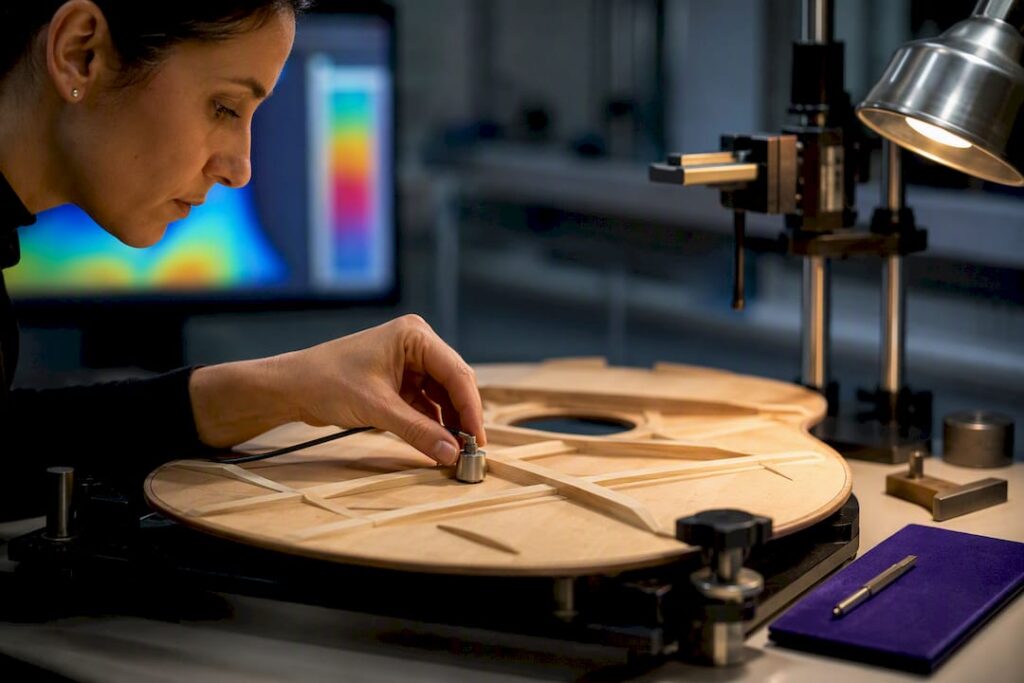
Spanish schools haven’t ignored technology so much as deployed it selectively. Machine-assisted rough shaping, laser-cut templates for solera jigs, and digital moisture meters for wood selection have found their way into many workshops without displacing the hand-finishing work that defines the tradition. The finishing stage, French polishing especially, remains stubbornly manual because the technique itself depends on tactile feedback a machine can’t replicate.
Archival acoustic research bridges both traditions rather than replacing either. Analytical models and physical replicas let researchers test hypotheses about historical Spanish instruments using German research methodology, producing findings useful to builders on both sides. This collaboration suggests the future of lutherie education is Spanish tradition informed by acoustic measurement, and German engineering informed by Spanish stylistic precedent.
What Students Actually Experience in Each System
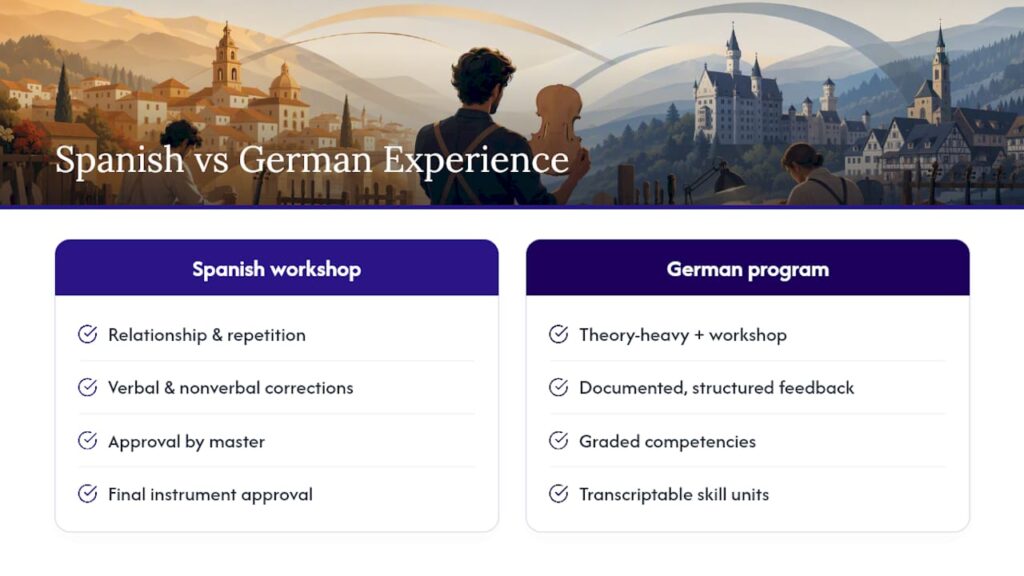
Ask someone who has trained in both systems and the cultural contrast comes up almost immediately. Spanish workshop training runs on relationship and repetition; a student might spend a full week doing nothing but sanding tops until the master approves the curve by feel, with correction delivered verbally and often nonverbally, a nod, a frown, a hand repositioning yours on the tool. There’s no rubric. Progress is measured in whether the work looks and sounds right to someone who has built hundreds of guitars.
German program students describe something closer to engineering school with sawdust. Coursework includes acoustics theory, materials science, and documented skill assessments alongside workshop time. One structural difference students consistently note: German programs grade you on defined competencies you can point to on a transcript, while Spanish apprenticeship success is measured almost entirely by whether your finished instrument earns approval from someone whose ear you trust.
Neither experience is objectively better, and the cultural mismatch cuts both ways. Students used to structured feedback sometimes find Spanish workshop silence disorienting, wondering if they’re doing something wrong when no one says anything at all. Students used to workshop intuition sometimes find German coursework’s emphasis on documentation and testing to feel disconnected from the actual craft, at least until the acoustic lab work starts producing results they can hear and measure simultaneously. That tension, structured feedback versus earned trust, is arguably the single clearest marker of which tradition a given student will thrive in.
Choosing Based on What You Actually Want to Build
If your ambition is tonal mastery of Spanish classical or flamenco style, immerse yourself in that tradition directly, whether through a short intensive course or a longer apprenticeship. If you want a credential that opens doors in formal instrument manufacturing or repair, the German vocational and academic route delivers something Spanish workshops generally can’t: paperwork employers trust. Visit a workshop before committing money to either path, sit in on a short course if one’s available, and book a testing appointment to hear how instruments from each tradition actually differ in your hands. The two paths aren’t mutually exclusive, and the strongest builders I’ve studied tend to have sampled both.
— Vintage
Bring the Comparison Home: Play, Restore, or Collect Both Traditions
Reading about Spanish and German training tells you how these instruments get built. Hearing and holding them tells you which one actually fits how you play. Vintage-guitar-world gives you a third route into this comparison: instead of enrolling in a program, you get direct access to instruments shaped by both traditions, evaluated and vetted before they ever reach your hands.
Playing appointments provide an opportunity to compare different traditions of guitar making in person, offering a direct understanding of tonal differences beyond theoretical descriptions. Restoration services, certification, and valuation reports are available to help owners maintain and verify the condition and value of their instruments. Anyone building a collection that spans both schools of craftsmanship can start browsing curated classical and flamenco instruments on our main shop to see what’s currently available for testing or purchase.
Sources
- Preserving the culture of sound design in Spanish guitars — analytical models and replicas
- Musical Instrument Technology (Bachelor) auf Westsächsische Hochschule Zwickau
- Musical Instrument Making School Mittenwald
FAQ
Who Are the Best Spanish Guitar Makers?
Antonio de Torres is the most historically influential Spanish guitar maker, credited with standardizing the fan-braced classical guitar design still taught in Granada workshops today. The Ramírez family in Madrid extended that legacy, training generations of apprentices whose influence still shapes Spanish curriculum, especially the solera-based construction method.
What Makes a Spanish Guitar Different From Other Guitars?
Spanish guitars are typically built using solera-jig construction, hide-glue joinery, and hand-applied French polish, techniques passed down through master-apprentice training rather than standardized coursework. This produces instruments with distinct flamenco or classical tonal character shaped by the individual builder’s ear rather than a fixed engineering model.
Who Is the Largest Guitar Manufacturer in the World?
Large-scale guitar manufacturing is dominated by mass-production factories rather than the artisan lutherie schools covered here, since factory output and handcrafted workshop production solve entirely different problems. The Spanish and German traditions discussed in this article focus on individual craftsmanship and formal training, not industrial-scale manufacturing.
What Is the Spanish Guitar Actually Called?
The classical guitar built in the Spanish tradition is often referred to simply as a “guitarra clásica” or “guitarra española,” depending on whether it’s built for classical or flamenco playing style. Flamenco-specific instruments are sometimes called “guitarra flamenca” and differ in bracing, action height, and finishing from their classical counterparts.
Can I Combine Spanish and German Training?
Yes, and it’s an increasingly common path among serious builders who want both tonal tradition and formal credentials. A short intensive course at a Spanish school like EIGM paired with a longer vocational or degree program in Germany gives you tactile craft skill alongside a recognized qualification.