


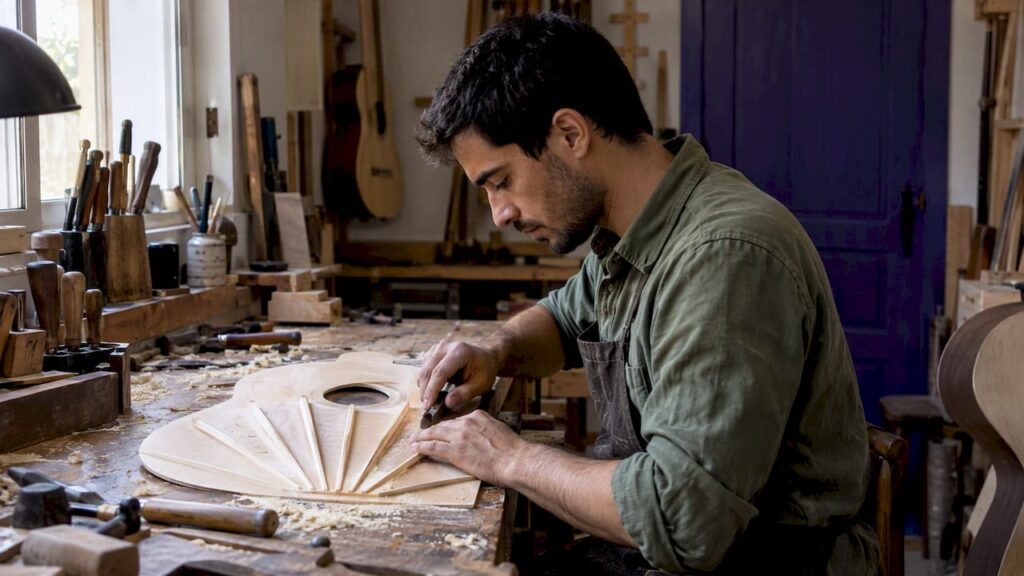

Spanish guitar making is best understood as a handful of masters and a few family lineages, grouped around two cities: Madrid and Granada. Antonio de Torres set the template in the 19th century, Santos Hernández shaped the flamenco guitar in the 20th, and families such as the Ramírez and Rodríguez carried the craft forward. This guide gives you that list, explains what each name stands for, and shows where people learn the trade in Spain today.
TL;DR
- Start with Antonio de Torres (1817–1892): he is the reference point for the modern classical guitar, and almost every later Spanish maker works in his shadow.
- Santos Hernández is the name to know for flamenco guitars, and the Rodríguez and Ramírez families show how the craft passes from generation to generation.
- Madrid and Granada are the two classic centers. Madrid guitars suit classical and flamenco playing, while Granada instruments are often preferred for accompanying singers.
- Training in Spain runs through private workshop schools such as the European Institute of Guitar Making in Granada, public training at Centro Albayzín, and a new vocational cycle approved in 2026.
- If you are buying rather than reading, a maker’s name matters less than the condition, provenance and documentation of the individual instrument.
Table of Contents
- What a luthier is, and why Spain has so many famous ones
- How to read a list of Spanish luthiers
- The historic masters
- Madrid: the capital’s guitar tradition
- Granada and Andalusia: the flamenco side
- Active Spanish luthiers: how to find the right one
- Where Spanish luthiers learn the trade
- What makes a Spanish guitar sound Spanish
- Our perspective
- Find a Spanish guitar with a documented history
- FAQ
- Sources
What a luthier is, and why Spain has so many famous ones
A luthier builds or repairs stringed instruments. Tourism Madrid goes a step further and describes the Spanish version of the job as understanding how to create emotions through wood. That sounds romantic, but it matches how the trade works: a luthier chooses a soundboard, shapes the bracing by touch and ear, and adjusts until the instrument speaks the way they want.
In Spain this has long been a family business, with skills passed down within families, as Classical Guitar Magazine points out in its look at guitar-building dynasties. That is why a list of Spanish luthiers reads less like a list of individuals and more like a set of family trees and apprenticeships.
How to read a list of Spanish luthiers
Three questions sort the names quickly.
- Is the maker historical or active? Some names (Torres, Hernández) belong to the past. Their instruments appear on the vintage market, not in new-order books. Active workshops take commissions today.
- Classical or flamenco? The two styles use different woods, different action and a different attack. Spanish makers often specialize in one, even when they build both.
- Which school? Madrid, Granada and, in the 19th century, Almería each left a recognizable sound and construction habit.
Keep those three questions in mind and the names below fall into place.
The historic masters
| Maker | Period | Known for |
|---|---|---|
| Antonio de Torres | 1817–1892 | Father of the modern classical guitar; standardized fan bracing and a larger body |
| Santos Hernández | 20th century | Flamenco guitars, including light cypress construction |
| Rodríguez family | 20th century | Highly sought-after instruments, including the Church Door guitars of the 1970s |
| Ramírez family | Madrid, since 1882 | Handmade guitars in cedar, palo santo, fir and cypress |
Antonio de Torres
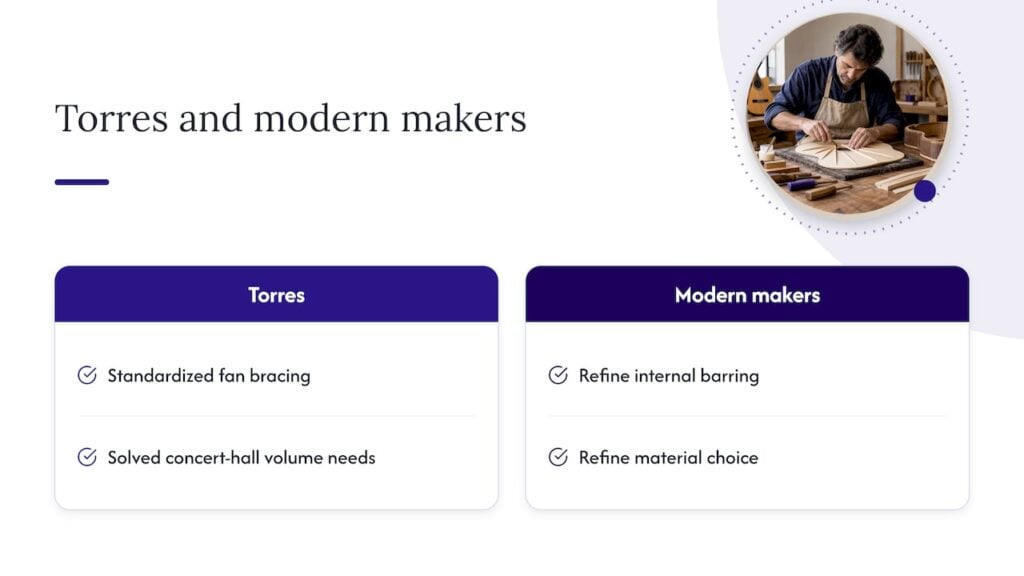
According to The Metropolitan Museum of Art, Antonio de Torres (1817–1892) standardized essential features such as fan bracing, which remain the benchmark for Spanish guitar construction. The same essay observes that Torres was solving a practical problem, namely the need for instruments loud enough for concert halls, while modern makers mostly concentrate on subtle refinements of internal barring and material choice.
If you want the full story, including how to judge a Torres-influenced instrument, read our pieces on Antonio de Torres, father of the modern classical guitar and on Torres’ technique, sound and evaluation criteria. The player who made Torres-style guitars the concert standard is covered in our profile of Francisco Tárrega.
Santos Hernández
The Met describes Santos Hernández as a renowned 20th-century luthier and a key figure in developing instruments for the flamenco style, including light cypress construction. Cypress gives a brighter, drier, quicker note than the rosewood typical of concert guitars, which is exactly what rhythmic flamenco playing wants. Our portrait of Santos Hernández, legendary master of guitar making goes deeper into his work.
The Rodríguez family
The Rodríguez family’s 20th-century instruments are highly sought after. Classical Guitar Magazine mentions the so-called Church Door guitars that Miguel Jr. built in the 1970s from wood taken from a church door. Stories like this are part of why provenance matters so much in the collector market.
Madrid: the capital’s guitar tradition
Madrid is where the best-known dynastic workshop story is told. According to Tourism Madrid, the Ramírez family has made handmade guitars in the city since 1882. Their guitars use red cedar soundboards, palo santo, fir and cypress, and the family has preserved wood aged up to 60 years. Tourism Madrid also notes that another well-known Madrid workshop traces its roots to the same year, 1882, which gives a sense of how crowded and competitive the city’s guitar scene was in the late 19th century.
In practice, a Madrid guitar suits both classical and flamenco playing, according to a FolkWorld interview with a Granada maker. If you want to understand the school’s standards and history in one place, see our overview of guitar making in Madrid since 1882. For the model families of the most famous Madrid name, our Ramírez guitar lines overview walks through each series.
Granada and Andalusia: the flamenco side
Granada has its own school. The same FolkWorld piece suggests that Granada guitars may better accompany flamenco singers, though it is careful to add that taste varies. That caveat is worth keeping: the difference is a tendency, not a rule, and the best way to settle it is to play both. Many players find that Granada instruments feel a little more responsive and intimate, which is what a singer’s accompanist wants.
Our guide to the Granada school of guitar making covers sound, technique and tradition in detail. Andalusia is also where Torres worked, so the region’s influence runs through both the classical and flamenco lines.
Active Spanish luthiers: how to find the right one
There are dozens of working Spanish makers, and a flat list of names ages quickly. Instead of naming workshops, here is how to sort them by type, so you can search with a purpose.
- Dynastic workshops in Madrid and elsewhere, where methods, molds and wood stocks pass between generations. They tend to have a recognizable house sound.
- Independent flamenco makers in Andalusia, usually trained in a family or master’s shop and building in cypress and spruce.
- Classical concert makers who work closely with professional players and refine bracing and wood selection.
- Restorers and repair specialists, who keep older Spanish instruments playable and whose judgment is essential when you buy a vintage guitar.
When you evaluate a maker, ask how long they trained, whose workshop they trained in, how old their wood is, and whether they will document the build. A maker who answers those questions openly is usually proud of the work.
Where Spanish luthiers learn the trade
The second query readers type is about schools, so here is the landscape.
Traditional workshop training
One of the best-known private options is the European Institute of Guitar Making (EIGM) in Granada. Its own website says it has offered traditional Spanish guitar-making courses for more than two decades, led by Stephen Hill. It is a school for people who want to build guitars the Spanish way, in Granada itself.
The traditional route is slower. The FolkWorld interview notes that top guitar making traditionally takes full-time learning in an experienced luthier’s shop, which may last more than ten or fifteen years. Short courses give you the method. Mastery takes far longer.
Public training in Andalusia
Centro Albayzín is described by the Junta de Andalucía as a national reference center in the manufacture and maintenance of musical instruments. Its training is practical and officially certifiable, and it connects professionals, businesses and organizations in traditional crafts and artistic restoration. Check the official page for current course offerings, since these change from year to year.
A new vocational cycle
Spain’s education ministry has approved a higher vocational training cycle in the craft design and construction of stringed musical instruments. Educaweb reported that the Council of Ministers approved it in April 2026, that the cycle is 2,000 hours, and that it is expected to be offered in centers in the coming school year. Admission requirements and locations depend on each center, so ask the regional education authority or the center directly.
Choosing between the routes
| Route | Best for | Format |
|---|---|---|
| Private guitar-making school in Granada | Hobbyists and aspiring makers who want a traditional Spanish method | Courses taught by an experienced maker |
| Public training at Centro Albayzín | People who want officially certifiable, practical training | Practical courses in instrument making, maintenance and restoration |
| New higher vocational cycle | Students who want a formal qualification | 2,000-hour cycle, offered through centers |
| Apprenticeship in a master’s shop | Those aiming at a professional career | Long, full-time learning |
What makes a Spanish guitar sound Spanish
Spanish guitars tend to share a group of choices: cedar or spruce soundboards, cypress or rosewood for the body, fan bracing descended from Torres, and wood that has been stored for years. Tourism Madrid’s description of aged wood and a mix of red cedar, palo santo, fir and cypress is a good snapshot of the palette. Flamenco guitars lean toward lighter cypress construction and a lower action, while concert guitars favor warmth, sustain and projection.
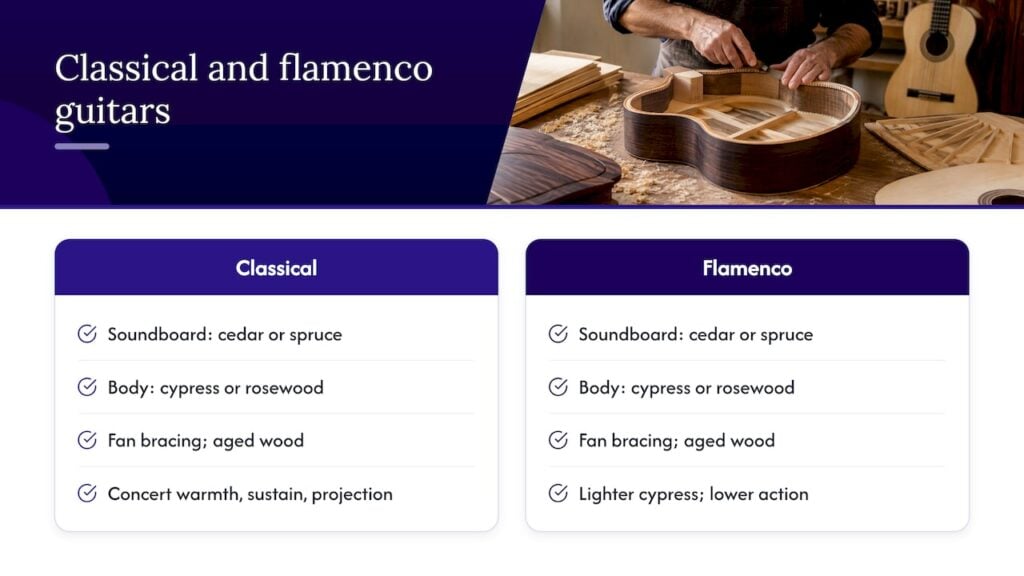
The Met’s observation is helpful here: since Torres, most of the progress has been in subtle refinements of barring and wood selection. That is why two guitars from the same school can sound so different, and why trying an instrument matters more than reading a specification.
Our perspective
We handle old Spanish guitars every week, and one lesson keeps repeating: the maker’s name opens the conversation, but the individual instrument decides the purchase. Two guitars with the same label can differ in top condition, repairs, bracing integrity and playability. That is why we put so much weight on expert evaluation, careful restoration and documentation, and why we encourage buyers to play an instrument before they commit.
The lineages in this article are also a guide to what to look for. A guitar from the Madrid school should show the discipline of its tradition. A flamenco guitar should respond fast and dry. A Torres-influenced classical guitar should project without losing warmth. When we describe a guitar, we try to place it in this context, so you know what you are hearing and why. If you want to understand why certification matters so much for rare instruments, our guide to the role of certification in guitar collecting explains how we think about it.
— Vintage
Find a Spanish guitar with a documented history
If this list has made you curious about playing the real thing, our selection of classical guitars (nylon) and vintage guitars is a good place to start. We also offer exclusive testing appointments, commission sales, certificates and valuations, and restoration. You can reach all of these through our main page.

If you own an older Spanish guitar that needs care, read about restoration costs and what drives them before you decide.
FAQ
Who was a famous Spanish guitar maker?
Antonio de Torres (1817–1892) is the best-known. The Met credits him with standardizing features such as fan bracing, which is why he is called the father of the modern classical guitar. For flamenco, Santos Hernández is the name most often mentioned.
What does a luthier do?
A luthier builds or repairs stringed instruments. In Spain the craft is closely tied to family workshops and long apprenticeships. A good luthier selects the wood, shapes the bracing and tunes the instrument’s response by ear and by hand.
Where are the best guitars made in Spain?
Madrid and Granada are the classic centers. Madrid guitars suit both classical and flamenco playing, while Granada instruments are often favored to accompany flamenco singers, as the FolkWorld interview notes. Taste varies, so try several.
Are there schools for guitar making in Spain?
Yes. The European Institute of Guitar Making in Granada teaches traditional Spanish guitar making. Centro Albayzín offers public training, and a 2,000-hour higher vocational cycle was approved in 2026. Check each provider’s official page for current availability.
How long does it take to become a guitar maker?
Courses give you the method in a shorter time, but the FolkWorld interview says top guitar making traditionally means full-time learning in an experienced luthier’s shop, possibly for more than ten or fifteen years.
Sources
- Madrid’s Luthiers, Tourism Madrid
- The Spanish Guitar, The Metropolitan Museum of Art
- Guitar-Building Dynasties Have Powered the Instrument’s Evolution, Classical Guitar Magazine
- FolkWorld #45: Guitarras Juan Álvarez
- European Institute of Guitar Making
- Escuela de Formación en Artesanía, Restauración y Conservación, Junta de Andalucía
- ¿Qué novedades hay en la oferta formativa de FP?, Educaweb