












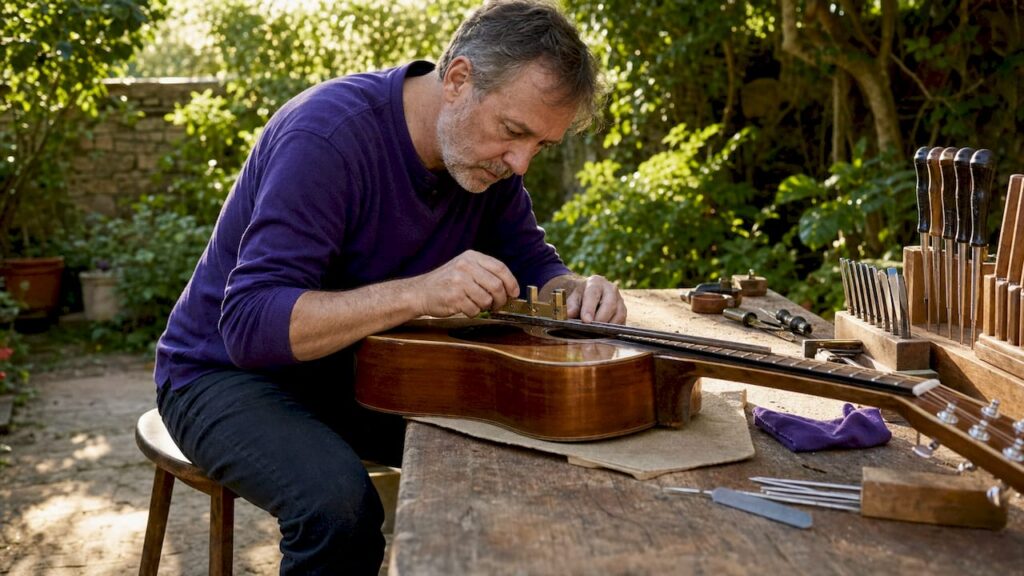

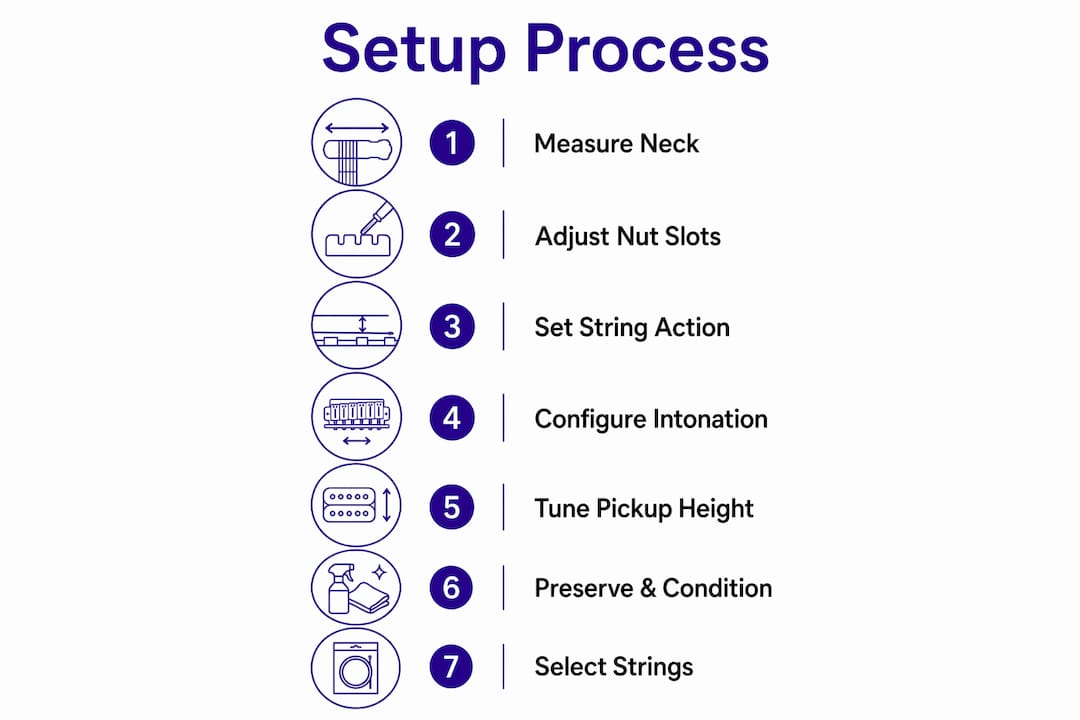
The setup process for rare guitars is not a standard tune-and-play routine. It’s a deliberate, measurement-driven workflow where stabilization outweighs optimization and every adjustment gets documented before you move to the next. The core steps are neck relief adjustment, string action setting, nut slot filing, intonation, and pickup height. Each one carries more risk on a rare instrument than on a production guitar, and each one demands tools and techniques chosen specifically for aged wood, original hardware, and finishes that cannot be replaced.
The critical difference from a standard setup: you’re not chasing the lowest action or the hottest pickup output. You’re finding the safest compromise that keeps the instrument playable without stressing its structure. Document every measurement before you touch anything. That baseline record is what lets you track movement over months and seasons.
What a complete rare guitar setup covers:
- Neck relief measurement and truss rod adjustment
- String action measurement and bridge height setting
- Nut slot filing with specialized files
- Intonation check and saddle adjustment
- Pickup height setting (electric and semi-hollow instruments)
- Fretboard cleaning and conditioning
- Hardware inspection and lubrication
- Environmental stabilization before and after work
- Full measurement log entry at completion
## 1. How to adjust neck relief on a rare guitar
Neck relief is the slight forward bow in the neck that prevents string buzz across the middle frets. On a rare guitar, measuring it correctly before touching the truss rod is not optional. Use a straightedge along the frets from the first to the last, then check the gap at the 7th or 8th fret with a feeler gauge. A small gap is a common target for most vintage instruments, though aged necks sometimes need slightly more relief to stay stable.
Truss rod adjustments on vintage instruments should go no more than a quarter turn at a time. After each turn, let the neck settle for several minutes before measuring again. Older single-action rods, common on pre-1970s instruments, have less tolerance for force than modern double-action rods. If you feel significant resistance before a quarter turn is complete, stop and consult a specialist. Forcing a stiff truss rod on a rare guitar risks a cracked headstock or a snapped rod, both of which are expensive and sometimes irreversible.
Pro Tip: Record neck relief in millimeters at the 7th fret before and after every adjustment. Over several setups, this log reveals whether the neck is stable or slowly moving, which is the earliest warning sign of structural change.
## 2. Setting string action and filing nut slots on a rare guitar
String action on a rare guitar is measured at the 12th fret, from the top of the fret to the bottom of the string. Low action improves playability but increases the risk of fret buzz on necks with uneven wear. On vintage instruments, a slightly higher action than modern spec is often the right call. It protects the neck geometry and reduces the chance of fret buzz caused by fret wear patterns that are decades old.
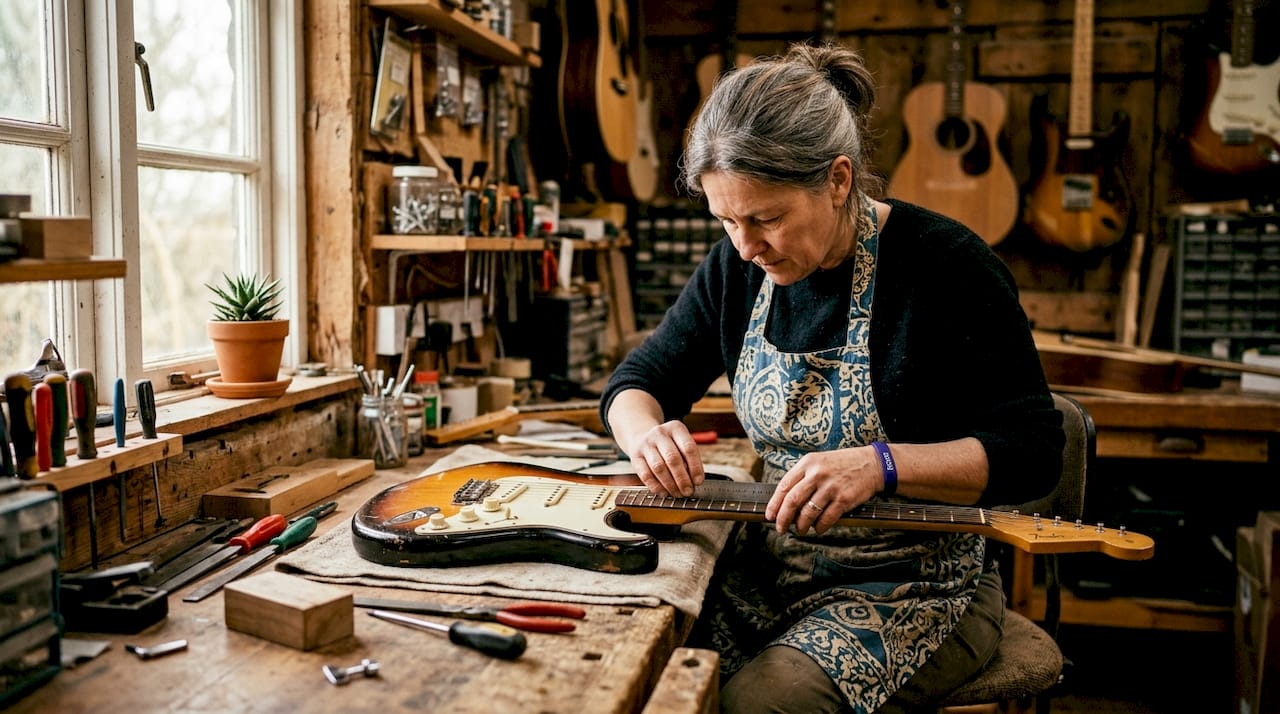
Nut slot filing is where collectors most often cause irreversible damage. The nut on a rare guitar is frequently original bone, ivory, or early synthetic material. Filing too deep drops the open string action below the first fret height, causing buzz that cannot be fixed without replacing the nut entirely. Use nut files sized to match each string gauge exactly, and remove material in small passes. A pencil graphite fill in the slot before filing gives you a visual guide: the file removes the graphite where it contacts, showing you the exact shape and depth of each pass.
Nut slot adjustments for different string gauges should be left to qualified technicians when the original nut material is irreplaceable. Proper nut slot lubrication with graphite powder reduces string friction without harming vintage materials.
Pro Tip: Tape low-tack painter’s tape on both sides of the nut before filing. It protects the finish from accidental file strokes and costs you nothing to apply.
String gauge matters here too. Vintage instruments were often built for lighter strings than modern players typically use. Heavier gauges increase neck tension and can widen nut slots beyond their original dimensions. Light or extra-light gauge strings are almost always the right choice for rare guitar maintenance.
## 3. Intonation and pickup height on a rare guitar
Intonation is the last step of the setup sequence, and it only means something after neck relief, action, and nut slots are already dialed in. The method is straightforward: play the 12th fret harmonic, then fret the same string at the 12th fret and compare the two pitches on a reliable chromatic tuner. If the fretted note is sharp, the saddle moves away from the neck to lengthen the string. If it’s flat, the saddle moves toward the neck.
On guitars with adjustable movable bridges, like many archtop jazz guitars, the entire bridge shifts forward or back. Never remove all strings at once on these instruments. The bridge is held in place only by string tension, and removing all strings simultaneously lets it shift out of position. Change strings one at a time and reset intonation after each string change.
Verification steps after intonation adjustment:
- Confirm the 12th fret harmonic matches the fretted 12th fret note on every string
- Check tuning stability after 10 minutes of playing
- Note any strings that drift more than others (a sign of friction at the nut or saddle)
- Log the final intonation drift in cents for each string
Pickup height on electric rare guitars affects both tone and string response. Pickups set too close to the strings create magnetic pull that disrupts sustain and causes false intonation. Measure from the top of the pole piece to the bottom of the string with the string fretted at the last fret. Adjust in small increments and listen for the balance between output level and clean sustain.
## 4. Preservation best practices and environmental control

Environmental stability is the single most important factor in rare guitar preservation, and it applies before, during, and after every setup session. The target range is 40%–50% relative humidity at 72°F. Dryness causes more severe and costly structural damage than excess humidity, including top collapse, fret sprout, and open seams. A digital hygrometer in the case or storage room gives you a real-time read on conditions.
Seasonal wood movement is why rare guitars need periodic professional setup rather than a one-time adjustment. Woods react to moisture content changes throughout the year, which shifts neck relief, action height, and even intonation. Annual setups are a reasonable baseline, with additional checks after any significant climate change, such as moving the instrument between regions or through winter heating season.
Statistic callout: Dehydration accounts for about 90% of climate-based guitar repairs, and damage from dryness is typically more severe and expensive to fix than damage from excess humidity.
Best practices for a safe preservation environment:
- Keep relative humidity between 40%–50% at all times
- Store the guitar in its case with a quality case humidifier during dry months
- Never leave a rare guitar near heating vents, radiators, or in direct sunlight
- Allow the instrument to acclimate in its closed case for at least one hour after temperature changes
- Use a room humidifier during winter in climates with low ambient humidity
- Avoid basements during high-humidity seasons, where moisture can accumulate inside the case
The non-invasive setup workflow that experts recommend for historic instruments follows this sequence: climate stabilization, condition documentation, dry cleaning, structural checks, mechanics servicing, setup adjustments, and a final log entry. Skipping the climate step before setup work means you’re adjusting a neck that may shift again within days as the wood continues to react.
## 5. How to clean and condition a vintage fretboard
Vintage fretboards require a different approach than modern instruments. Rosewood and ebony boards on older guitars can dry out over decades, which causes the wood to shrink and push fret ends past the edge of the neck. This is called fret sprout, and it’s a direct sign of dehydration. Rubbing raw linseed oil into the board with a clean lint-free cloth, after removing the strings, hydrates the wood and slows this process. Let the oil soak in for several minutes, then wipe away the excess completely.
Avoid steel wool on fretboards near vintage pickups. The fine metal particles it sheds are magnetic and will embed in pickup pole pieces, affecting output and tone. Use a fine-grit fretboard conditioner pad or a soft cloth instead. For vintage lacquer finishes, never use silicone-based polishes. Non-silicone guitar polish applied with a lint-free cloth is the correct choice. Silicone penetrates finish layers and makes future refinishing nearly impossible.
Maple fretboards with original finish should only be wiped with a dry or very slightly damp cloth. No oils, no conditioners. The finish seals the wood, and adding oil to a sealed surface does nothing except leave residue.
## 6. How to handle historical hardware and screws without causing damage
Original hardware on a rare guitar is often irreplaceable. Tuner buttons, strap buttons, pickguard screws, and truss rod covers from the 1950s and 1960s are frequently made from materials that crack or strip far more easily than modern equivalents. Always use a screwdriver that fits the slot perfectly. A blade that is too narrow will cam out and chew the slot. A blade that is too wide will scratch the surrounding finish.
For stuck or corroded screws, a small amount of penetrating oil applied with a toothpick and left for several minutes loosens the threads without soaking into the wood. Never use heat on vintage hardware. The adhesives and finishes around original hardware are not designed for heat exposure, and even a brief application from a heat gun can lift binding or bubble a nitrocellulose finish.
Tuning machines on vintage instruments benefit from a small drop of lightweight machine oil on the gear mechanism, applied with a cotton swab. This keeps the action smooth without attracting dust or contaminating the surrounding finish. Document the condition of every piece of hardware before and after the setup, including photos of any existing wear or corrosion. This record protects the instrument’s history and your work.
## 7. String selection guidance for rare guitars
String gauge is one of the most consequential choices in rare guitar maintenance. Most vintage acoustic guitars were designed for lighter gauges than what players commonly use today. Extra-light strings (typically .010–.047 on acoustic) reduce tension on the top, braces, and neck joint, all of which may have weakened glue joints after decades of use. The Benedetto owners manual recommends changing strings one at a time on guitars with movable bridges to prevent sudden tension changes that can shift the bridge or tailpiece.
For electric rare guitars, pure nickel strings are closer to what the instrument was originally voiced for. Modern nickel-wound strings have a brighter, higher-output character that can feel out of place on a vintage pickup. Pure nickel strings are warmer, lower in output, and gentler on original frets. They also tend to be easier on vintage nut slots.
Avoid coated strings on rare guitars with original bone or ivory nuts. The coating adds a small amount of thickness to the string, which can bind in a slot sized for an uncoated string. That binding causes tuning instability and, over time, can widen the slot unevenly. For vintage guitar care that extends to string selection, the rule is simple: match the gauge and material as closely as possible to what the instrument was originally built for.
Key Takeaways
The setup process for rare guitars prioritizes structural stabilization and documented measurements over maximum playability, with environmental control as the foundation of every adjustment.
| Point | Details |
|---|---|
| Stabilization over optimization | Setup targets on rare guitars favor structural safety over lowest action or highest output. |
| Document every measurement | Record action height, neck relief, and intonation drift before and after each adjustment session. |
| Humidity is the top risk | Keeping relative humidity at 40%–50% at around 72°F prevents the dehydration that causes 90% of climate-based repairs. |
| Annual setups are the baseline | Wood reacts seasonally; rare guitars need at least one professional setup per year, more after climate changes. |
| String gauge affects everything | Lighter gauge strings reduce tension on aging tops, braces, and neck joints on vintage instruments. |
Vintage-guitar-world offers expert setup consultations, guitar restoration services, and a curated selection of rare instruments that have been professionally evaluated and documented. Whether you’re working through a setup yourself or looking for a guitar that’s already been properly prepared, the team at Vintage-guitar-world brings the same measurement-first approach to every instrument.

Explore the full range of collector-grade instruments at Vintage-guitar-world, where every guitar comes with detailed condition documentation and expert guidance.