














Yes, you can remove most moldy or musty smells from a guitar if you act carefully, but not every case ends with a full recovery. Surface mold and light must caught early usually clears up with gentle drying and cleaning. Deep-seated contamination in the wood or a ruined case lining often does not, and no amount of scrubbing fixes that.
The moment you catch a whiff of that basement smell, do three things:
- Take the guitar out of its case and set it somewhere ventilated, out of direct sun.
- Inspect the body, neck, and case lining for visible fuzz, spotting, or discoloration.
- Move the instrument to a room holding steady 40–55% relative humidity, not a damp basement or a hot attic.
If the guitar is valuable, has a nitrocellulose finish, or you’re not sure what you’re looking at, hold off on any cleaner. Solvents and aggressive scrubbing can strip vintage finishes faster than any mold ever will.
Key Takeaways
Most musty odors clear up with gentle drying, dry-cleaning, and stable 40 to 55 percent humidity, but persistent smell after proper drying signals contamination that needs a luthier.
| Point | Details |
|---|---|
| Act fast, gently | Remove the guitar from its case, ventilate it, and inspect for visible mold before touching any cleaner. |
| Dry-clean before wet-clean | Vacuum and microfiber wipe first; only spot-clean with diluted isopropyl on sealed finishes after testing a hidden area. |
| Match cleaner to finish | Nitrocellulose and open-pore wood tolerate almost no solvents; avoid bleach, acetone, and undiluted fungicides entirely. |
| Replace or restore the case | Persistent odor or crumbling lining means the case needs replacement or professional re-lining, not more scrubbing. |
| Call a luthier past three weeks | Smell returning after two to three weeks of stable humidity points to deep contamination requiring expert decontamination. |
| Get it assessed professionally | Vintage-guitar-world offers testing appointments and valuation services for guitars with persistent odor or suspected finish risk. |
Table of Contents
- Schimmelgeruch Gitarre Entfernen: A Safe Cleaning Workflow
- Which Cleaners Are Safe for Vintage Finishes?
- Cleaning and Deodorizing a Musty Case
- When Should You Call a Luthier Instead of DIY Cleaning?
- How to Stop Mold From Coming Back
- Why We Take a Conservative Approach to Vintage Guitars
- Book a Guitar Evaluation Before You Risk the Finish
- Sources
Schimmelgeruch Gitarre Entfernen: A Safe Cleaning Workflow
Removing a musty odor from a guitar is less about brute force and more about patience and the right sequence. Rush it, and you risk pushing moisture into glue joints or dulling a finish that took decades to develop its patina. The German term for this exact problem, schimmelgeruch gitarre entfernen, translates directly to mold-odor removal, and the standard industry approach is the same everywhere: dry, inspect, spot-treat, then stabilize.
- Prep your workspace. Wear gloves and a mask if you’re sensitive to mold spores. Loosen or remove the strings, and set the guitar on a stand or a towel in a well-ventilated space, ideally outdoors on a dry day.
- Dry-clean first. Use a vacuum with a soft brush attachment to lift loose spores and debris from the body, neck, and inside the soundhole. Follow with a dry microfiber cloth. Do not scrub the finish at this stage.
- Spot-test before anything wet touches the guitar. Try any cleaner on a hidden area first, like the underside of the heel or inside the control cavity.
- Clean sparingly. A guitar-specific cleaner or a lightly diluted 70% isopropyl solution works on sealed, non-porous finishes. For interior spots, use a cotton swab with minimal liquid rather than pouring or spraying anything into the body.
- Dry slowly and completely. Blot with a dry microfiber cloth, then let the instrument air out over several days in that 40–55% humidity range. Rushing this step with a hairdryer or direct heat can crack lacquer.
- Check for smell. A genuine improvement usually shows within a few days to a week. If the odor fades and doesn’t return after normal handling, you’ve likely solved it. If it comes back within days, the contamination probably runs deeper than the surface.
Pro Tip: Never spray liquid directly into the soundhole. Dampen the cloth or swab first, then apply it. Liquid pooling inside the body can swell braces and glue joints in ways you won’t notice until the top starts to warp months later.
Which Cleaners Are Safe for Vintage Finishes?
The finish on your guitar determines what you can safely use, and guessing wrong is how good instruments get ruined. Gloss polyurethane tolerates more than most people assume. Nitrocellulose lacquer, common on vintage and reissue instruments from the mid-20th century onward, tolerates almost nothing. Improper solvents can dull, cloud, or lift a nitro finish permanently, and that kind of damage tanks resale value on a collectible instrument. Open-pore fretboards, meanwhile, need oil treatment rather than liquid cleaners of any kind.
Here’s what’s generally safe, used sparingly and always tested first:
- Guitar-specific cleaning products formulated for the finish type you have.
- A mild soap solution, heavily diluted, applied with a barely damp cloth.
- Diluted isopropyl alcohol, but only on sealed finishes, never on open-pore wood or nitro without testing.
- Baking soda or activated charcoal placed near the instrument, not touching it, to absorb lingering odor.
And here’s the list that ends up costing people money on vintage guitars every year: bleach, acetone, undiluted fungicides, and any aggressive scrubbing. Case humidifiers left unchecked deserve caution too. A sealed case with an over-saturated humidifier can trap moisture and actually create the mold-friendly microclimate you’re trying to eliminate. Nitro finishes and older tonewoods are particularly vulnerable because decades of aging make the surface more porous and reactive than a new instrument fresh off a modern production line. One wrong solvent, and you’re not looking at a cleaning job anymore. You’re looking at a refinish, which on a vintage piece can cut its value substantially. If you want to understand which finish is on your instrument before you touch it with anything, reviewing how different guitar varnishes behave is worth five minutes before you reach for a cloth.
Cleaning and Deodorizing a Musty Case
A clean guitar in a contaminated case just gets recontaminated. Treat the case as its own project.
- Vacuum the interior thoroughly, including seams and the underside of the neck support.
- Wipe the lining with a barely damp cloth and mild detergent, then let the case dry completely in sun or a ventilated space, lid open, for at least a full day.
- Once dry, add activated charcoal or silica gel packets inside the case, positioned so they never touch the instrument directly.
- If the smell persists after cleaning, or you find mold embedded in the lining fabric, vacuum first, wipe with mild detergent, dry thoroughly, then reassess before deciding whether to replace the case.
Crumbly, flaking, or fragile lining material is a hard stop. Replace it. But if the case itself is collectible or period-correct to the guitar, a professional re-lining service preserves both the case’s value and its historical match to the instrument, rather than tossing something irreplaceable.
When Should You Call a Luthier Instead of DIY Cleaning?
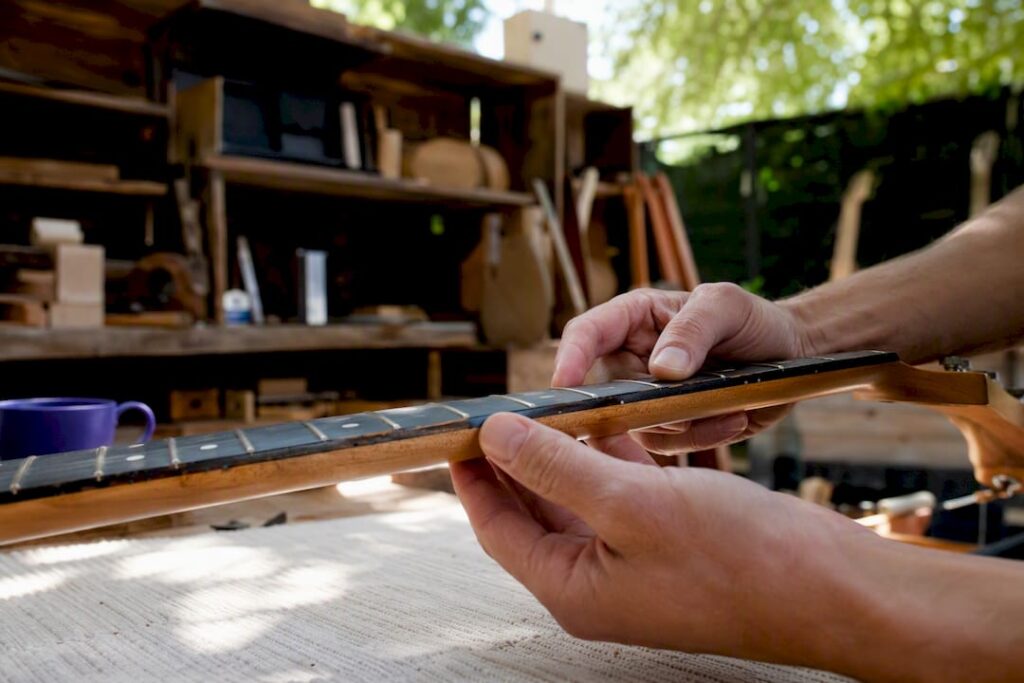
Some signs mean stop cleaning and call a professional. Persistent odor after two to three weeks of proper drying and stable humidity is one. Visible mold inside the body through the soundhole is another. So is any softening, discoloration, or crumbling of wood, weakened glue lines, or a smell that keeps returning no matter how well you air the instrument out.
A musty smell that survives stabilized humidity often points to deep-seated contamination that surface cleaning can’t reach. A qualified luthier handles this with controlled internal decontamination, can reline or replace the case properly, and documents the treatment, which matters enormously if you ever plan to sell or insure the instrument. Our guide to restoring collectible acoustic guitars walks through what that process typically involves.
Pro Tip: If a case keeps reinfecting an otherwise clean guitar, replacing or restoring the case usually costs less over a year than repeating the same DIY cleaning cycle every few weeks.
For a vintage or collectible instrument, professional restoration is frequently the better long-term investment. The cost of expert decontamination is often smaller than the value you’d lose from a botched home fix.

How to Stop Mold From Coming Back
Prevention is cheaper and far less stressful than remediation, and it comes down to controlling moisture, not chasing smells after the fact.
- Keep storage areas at 40–55% relative humidity and check it with an actual hygrometer, not a guess.
- Use a room humidifier or dehumidifier as needed rather than relying only on a case humidifier, which can turn a sealed case into its own damp microclimate if you’re not monitoring it closely.
- Never store guitars in basements, attics, or against exterior walls, where temperature swings and dampness concentrate.
- If your room’s humidity fluctuates a lot, leave the case latched but slightly ajar, and drop in silica gel packets during dry stretches.
- Wipe the instrument down after every playing session and do a quick smell and touch check periodically, especially after humid weather.
- Swap out case linings once they start to feel worn, thin, or musty themselves, even before mold shows up.
A structured preservation routine built around consistent humidity control does more to protect a guitar’s finish and resale value than any cleaning product ever will.
Why We Take a Conservative Approach to Vintage Guitars
We’d rather see an owner air out a guitar for a week and call us than reach for acetone. Vintage-guitar-world offers testing appointments and valuation services precisely for cases like this, where the smell won’t quit and the stakes are real. When in doubt, bring it in before you clean it further.
— Vintage
Book a Guitar Evaluation Before You Risk the Finish
If the smell won’t budge, or you’re holding a vintage instrument with a finish you don’t want to gamble on, Vintage-guitar-world gives you a path that doesn’t involve guessing with household chemicals. Rather than experimenting on a guitar that might be worth real money, you can bring it in for a hands-on evaluation from people who work with vintage and handcrafted instruments daily.

Our testing appointments let you get an expert read on whether an odor is surface-level or something deeper, and our valuation and certification services document the instrument’s condition, which matters if you ever decide to sell. This fits best for rare or vintage guitars, anything with an open-pore or nitrocellulose finish, or cases where you suspect the contamination reached beyond the surface. You can also read more about how our testing appointments work before you book. Start by browsing the current collection or reach out to schedule an in-person assessment for your instrument.
Sources
- Gitarre reinigen – der Pflege-Guide — Klangpilot
- Koffer stinkt nach Keller? So wird er wieder urlaubstauglich — Alltagsfuchs