













Saddle material changes three things above all else: how load or vibration moves through the contact point, how fast the material wears, and how much maintenance it demands. For horse saddles, the right material distributes pressure evenly across the horse’s back, but tree fit and panel geometry usually determine more than the material itself. For guitar saddles, material hardness and density govern how cleanly vibrations transfer from string to soundboard, which means the difference between a warm, sustaining note and a dull thud can come down to a single piece of bone or plastic sitting in a bridge slot.
- Horse saddles: Material affects pressure distribution, conforming behavior, and maintenance frequency, but correct tree fit and panel shape override material choice when fit is poor.
- Guitar saddles: Material governs vibrational transfer (tone and sustain) and wear rate; slot fit and contact quality matter as much as the material itself.
- Cross-domain properties that matter most: stiffness (how much the material resists deformation), damping (how much energy it absorbs rather than transmits), conforming ability (whether it molds to shape over time), and abrasion resistance (how long it survives under load).
Key Takeaways
Saddle material shapes function, tone, and longevity, but structural fit in both horse saddles and guitar saddles determines whether any material choice actually delivers its potential.
| Point | Details |
|---|---|
| Fit overrides material | A poorly fitted tree or bridge slot makes material choice largely irrelevant; fix fit first. |
| Bone and Tusq lead for guitar tone | Both transmit vibration efficiently; Tusq offers more consistent density across pieces than natural bone. |
| Wool flocking is adjustable; foam is not | Wool conforms and can be repacked by a fitter; foam holds shape but cannot be tuned once set. |
| Controlled tests reveal real differences | Pad trials and before/after audio recordings give objective data that single-ride or single-play impressions cannot. |
| Vintage-guitar-world offers expert evaluation | Testing appointments and appraisals assess saddle condition and setup on the specific instrument, not a generic spec sheet. |
Table of Contents
- How does saddle material role map to function across domains?
- Which horse saddle parts use which materials, and what changes when you switch?
- What do guitar saddle materials actually do to your tone?
- How do you choose the right saddle material for your situation?
- Why material rarely answers the whole question
- Sources
How does saddle material role map to function across domains?
Every saddle, regardless of whether it sits on a horse’s back or in a guitar’s bridge, works through the same physics. The material either transmits energy or absorbs it, holds its shape or conforms, and wears quickly or lasts decades.
Stiffness (elastic modulus) is the property that most directly predicts energy transfer. Rigid materials like carbon fiber, bone, and brass transmit force or vibration with minimal loss. Soft materials like rubber, foam, or low-density plastic absorb energy, which is useful for cushioning a rider but destructive for guitar tone.
Damping is the flip side. Viscoelastic foams (polyurethane, EVA) excel at absorbing shock because they convert mechanical energy into heat. That same property makes them poor choices for guitar saddles, where you want vibration to travel, not disappear.
Conforming and creep describe how a material changes shape under sustained load. Wool flocking in horse saddle panels conforms gradually to a horse’s back, which is why it needs periodic professional repacking. Foam holds a fixed shape longer but cannot be adjusted once set. Bone and Tusq in guitar saddles do not conform at all, which is exactly what you want: the saddle should never sink under string tension.
Density and consistency matter most for guitars. A dense, uniform material transmits vibrations predictably. Natural bone varies from piece to piece; engineered materials like Graph Tech Tusq are manufactured to a controlled density, which produces more consistent tonal results across instruments.
Abrasion resistance governs longevity in both domains. Leather outlasts most synthetics on horse saddle covers under UV and sweat exposure. Bone and Tusq outlast plastic guitar saddles by years under normal string tension.
Pro Tip: Identify your primary goal before choosing a material. If comfort and adjustability matter most (horse saddles), lean toward wool flocking with a qualified fitter. If tonal clarity and sustain are the priority (guitar saddles), choose bone or Tusq. If longevity with minimal maintenance is the goal in either domain, synthetic composites are worth the trade-off in adjustability.
Which horse saddle parts use which materials, and what changes when you switch?
Equestrian saddle construction serves three functions: protecting the horse’s back, supporting the rider’s balance, and managing weight distribution. Each part of the saddle uses a different material to serve one of those functions, and swapping any one of them changes the outcome in a specific, predictable way.
The saddle tree
The tree is the rigid frame that determines how weight spreads across the horse’s back. Wood and laminated wood trees have been the standard for centuries; they are stiff, repairable, and well-understood by fitters. Fiberglass trees offer similar stiffness with better moisture resistance. Molded synthetic and composite trees are lighter and more consistent in production, though quality varies considerably by manufacturer.
Tree stiffness directly controls spine clearance and load distribution. A tree that flexes too much under a heavy rider concentrates pressure at the contact points rather than spreading it. A tree that is too wide or narrow for the horse’s withers creates pressure peaks regardless of what the panels are made of. No panel material, however well chosen, compensates for a poorly fitted tree.
Panels and flocking
Panels sit between the tree and the horse’s back. Wool flocking conforms gradually to the horse’s musculature, distributes pressure broadly, and can be adjusted by a qualified saddle fitter. The trade-off: wool lumps and compresses over time and needs professional repacking, typically once or twice a year depending on use. Synthetic foam panels hold their shape longer and cost less to produce, but they cannot be adjusted once set, and peer-reviewed pressure measurements show that foam increased stride maximum pressures in some areas compared to wool in controlled trials, though the authors note results depend on foam type and saddle fit.
Outer covers and underside materials
Full-grain leather covers grip the rider, breathe reasonably well, and develop a patina that conforms slightly to the rider’s position over years of use. Synthetic leather and vinyl are lighter, easier to clean, and more resistant to wet conditions, but they offer less grip and tend to feel stiffer in cold weather. Sheepskin and numnah pads on the underside add a thin conforming layer between panel and horse, useful for micro-adjusting fit between professional reflockings.
| Part | Material | Function/Role | Comfort/Pressure relief | Durability/Wear resistance | Maintenance sensitivity | Typical use cases |
|---|---|---|---|---|---|---|
| Tree | Laminated wood | Rigid load distribution, spine clearance | Neutral (depends on fit) | High with proper care | Low (avoid moisture) | Dressage, eventing, trail |
| Tree | Fiberglass/synthetic | Consistent stiffness, lighter weight | Neutral (depends on fit) | High, moisture-resistant | Very low | Trail, endurance, everyday |
| Panels | Wool flocking | Conforms to horse’s back, adjustable | High when correctly fitted | Moderate (lumps over time) | High (annual repacking) | Dressage, show, long-distance |
| Panels | Synthetic foam | Fixed shape, consistent support | Moderate, non-adjustable | High (holds shape longer) | Low | Everyday, budget-conscious riders |
| Cover | Full-grain leather | Grip, breathability, aesthetics | Good rider stability | High (years with conditioning) | Moderate (regular conditioning) | All disciplines, traditional preference |
| Cover | Synthetic leather | Lightweight, wet-weather performance | Adequate grip | Moderate | Very low | Trail, wet climates, casual riding |
Pro Tip: Before changing panel material, do a short pressure-mapping or ridden test over a fixed gait pattern (walk, trot, canter on a consistent track) and note where the horse shows tension or resistance. Repeat the same test after any material change. That controlled comparison tells you far more than a single ride on a new surface.
What do guitar saddle materials actually do to your tone?
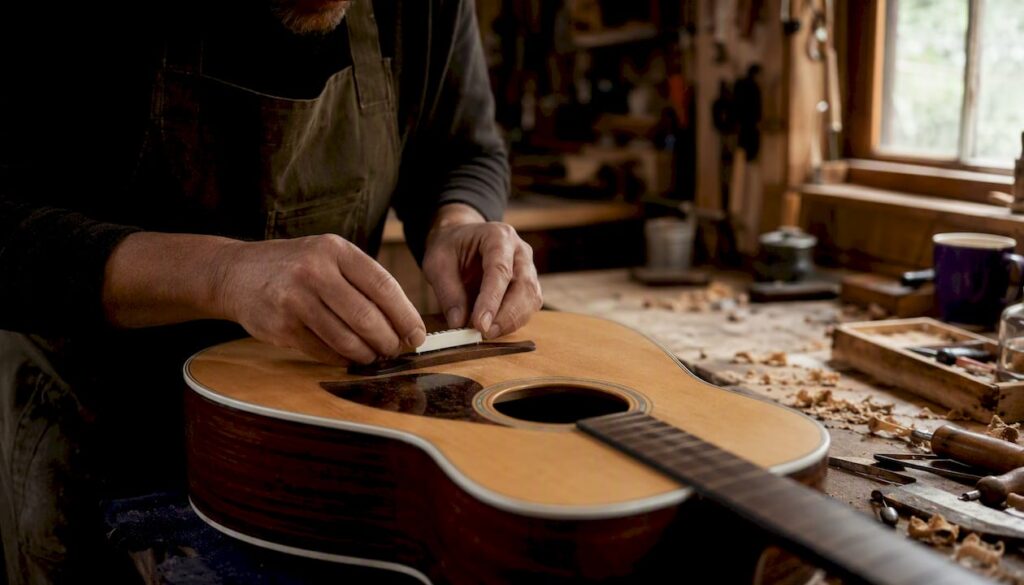
The guitar saddle sits in the bridge and transfers string vibration directly into the soundboard. Its material determines how much of that vibration reaches the top and how much gets lost in the saddle itself. Yamaha lab experiments replacing bone saddles with progressively softer materials (wood, layered paper, rubber) showed a clear pattern: each step down in hardness produced a more muffled sound, and the softest materials allowed strings to sink into the saddle, causing tuning and intonation problems.
Common materials and their sonic profiles
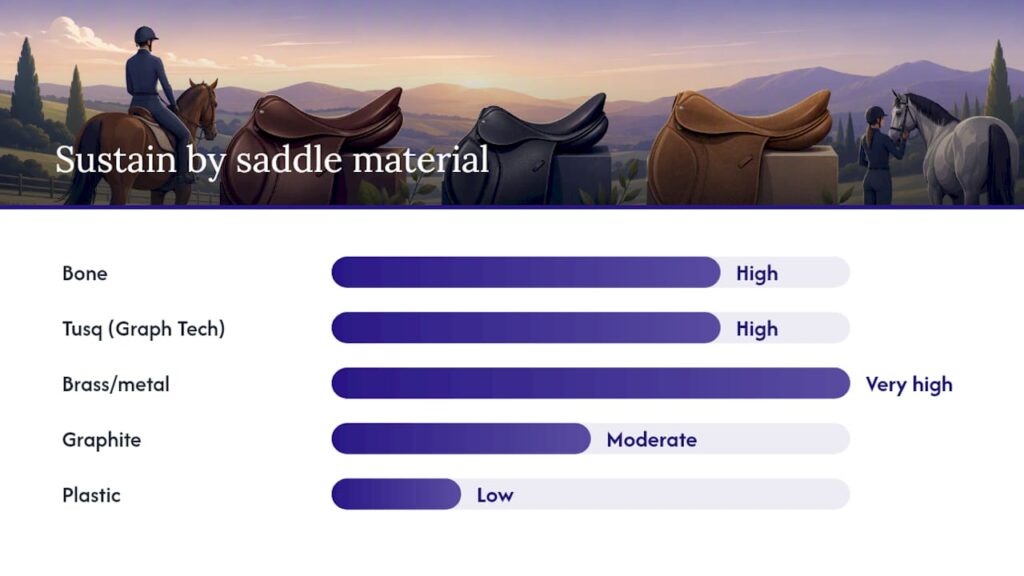
Bone is the traditional benchmark. It is dense, hard, and slightly porous, which gives it a warm but clear tone with good sustain. No two pieces are identical, so a skilled luthier needs to shape and fit each one individually.
Tusq (manufactured by Graph Tech) is an engineered polymer designed to replicate and standardize the tonal properties of bone. It offers consistent density across every piece, which means predictable brightness and sustain without the variability of natural material. Luthiers who work on production instruments often prefer it precisely because the results are repeatable.
Brass and metal saddles transmit vibration very efficiently, producing a bright, cutting tone with strong sustain. They are common on resonator guitars and some electrics but can sound harsh on instruments with already-bright tops.
Graphite sits in the middle: balanced tone, low friction (useful for guitars with vibrato systems or heavy bending), and reasonable sustain. It wears faster than bone under steel strings.
Plastic (the white or cream material on most entry-level guitars) is soft, inconsistent in density, and absorbs vibration rather than transmitting it. Sustain is noticeably shorter, and the tone tends to sound flat compared to bone or Tusq.
| Material | Tone/Transmitivity | Sustain | Durability/Wear rate | Maintenance and environmental sensitivity | Best for |
|---|---|---|---|---|---|
| Bone | Warm, clear, natural | High | High (years under normal use) | Moderate (can yellow, absorbs moisture) | Acoustic, classical, vintage instruments |
| Tusq (Graph Tech) | Bright, consistent | High | High | Low (stable across humidity changes) | Production guitars, consistent setups |
| Brass/metal | Bright, cutting | Very high | Very high | Low (corrosion-resistant alloys) | Resonators, slide players, electrics |
| Graphite | Balanced, smooth | Moderate | Moderate (wears faster under steel) | Low | Guitars with vibrato, heavy benders |
| Plastic | Dull, muted | Low | Low (grooves quickly) | Low | Factory stock only; upgrade recommended |
As luthier guides note, there is no universal best material. The right choice depends on the guitar’s voice, the player’s style, and how the instrument is set up overall. A bone saddle on a guitar with a bright spruce top and a stiff maple bridge can sound harsh; the same saddle on a cedar-top instrument with a rosewood bridge often sounds exactly right. Saddle material interacts with back and sides tonewoods and the entire acoustic system of the instrument.
When to replace a guitar saddle
Signs that a saddle needs attention: visible grooves where strings contact the saddle, buzzing that appears only on open strings, intonation drift that cannot be corrected by tuning alone, or uneven string height across the fretboard. A worn plastic saddle on a good instrument is one of the cheapest, highest-return upgrades available. A snug, flat fit in the bridge slot matters as much as the material itself; a loose saddle transmits vibration poorly regardless of what it is made from.
Pro Tip: To test a saddle upgrade, record a short clip (30 seconds, same position, same pick pressure, same strings) before and after swapping the saddle. Listen specifically for sustain on the high E string and clarity on the wound G string. Those two strings reveal tonal transfer differences most clearly. Also note that high humidity causes bone to absorb moisture and can slightly soften its response; Tusq is more stable across seasonal humidity swings, which matters in climates with wide temperature ranges.
How do you choose the right saddle material for your situation?
Six questions narrow the choice faster than any material chart.
-
What is your intended use or style? Dressage and long-distance trail riding demand different panel properties. Fingerstyle acoustic playing rewards bone or Tusq; slide or heavy-bending electric playing benefits from graphite’s low friction.
-
What is your primary goal? Comfort and adjustability point toward wool flocking (horses) or bone (guitars). Longevity with minimal maintenance points toward synthetic composites in both domains.
-
What are your fit constraints? A saddle tree that does not fit the horse’s withers makes panel material irrelevant. A guitar saddle that does not sit flat and snug in the bridge slot wastes the properties of even the best bone. Fit comes first, always.
-
What is your environmental exposure? Leather saddle covers degrade faster in wet climates without regular conditioning. Bone guitar saddles absorb moisture in high-humidity environments; Tusq holds its dimensions more reliably. Riders in hot, sweaty conditions should consider synthetic covers that resist salt damage.
-
What is your budget? Wool flocking requires professional repacking, which adds ongoing cost. Bone saddles cost more upfront than plastic but rarely need replacement for years. Tusq sits between the two in price and delivers consistent results.
-
How serviceable is the material? Wool flocking can be adjusted by a qualified fitter. Foam cannot. Bone can be reshaped by a luthier; plastic is usually just replaced. Know whether you want a material you can tune over time or one you set and forget.
Maintenance checklist
Horse saddles:
- Leather covers: clean and condition every 2–4 weeks with a leather-specific conditioner; inspect for cracking at stress points.
- Wool flocking: have a qualified fitter check panel evenness every 6–12 months; rebook sooner if the horse shows back soreness or changes in gait.
- Synthetic panels: wipe clean after each ride; inspect for compression or deformation annually.
- Sheepskin/numnah pads: wash regularly to prevent salt and sweat buildup, which degrades fibers and reduces cushioning.
Guitar saddles:
- Bone and Tusq: wipe down after playing to remove skin oils; inspect the contact grooves every 6 months under a bright light.
- Graphite: check for groove depth after heavy use; graphite wears faster than bone under steel strings.
- All materials: check intonation and string height seasonally, especially after humidity changes.
Red flags that need a professional: persistent horse back soreness after a saddle check, pressure sores or white hairs under the saddle area, guitar intonation that drifts despite tuning, buzzing on open strings that worsens over time, or visible saddle slot damage in the bridge.
Why material rarely answers the whole question
The most consistent finding across peer-reviewed equine research and luthier practice is that material is one variable in a system, not the system itself.
A controlled trial across five commercial saddle pads found that some pads significantly lowered mean pressure beneath the saddle while others increased it or produced inconsistent effects. The outcome depended on pad material, pad model, and saddle fit working together. No single pad material reliably reduced pressure across all conditions. That finding matters because it directly challenges the idea that upgrading pad material alone solves a pressure problem.
The flocking research reinforces the same point. Pressure measurements comparing wool flocking to foam showed that foam increased stride maximum pressures in some areas and expanded the loaded area compared to wool, but the authors are explicit: results depend on foam type and saddle fit. Wool performed better under the specific conditions tested, not universally.
The guitar side tells the same story from a different angle. Yamaha’s experiments showed that material hardness is a floor condition: below a certain hardness, the saddle simply fails to function. But above that floor, the difference between bone and Tusq is subtle and instrument-dependent. A well-fitted Tusq saddle on a production guitar often outperforms a poorly fitted bone saddle on the same instrument. Fit and contact quality are not secondary considerations; they are the primary ones.
The cycling industry has reached a parallel conclusion. Shell design and stiffness often drive comfort more than padding; excessive plush padding can increase rubbing while a properly shaped shell disperses load efficiently. The structural geometry comes first; the surface material refines the outcome.
A practical experiment for guitarists: record a 30-second clip before and after a saddle swap, using the same strings, same pick, same position. Listen for sustain decay on the high E and tonal clarity on the G string. For riders, a short pressure-mapped test over a fixed gait pattern before and after a pad or panel change gives you real data rather than impressions.
What the evidence actually supports
The evidence supports a hierarchy, not a single answer. Get the structure right first (tree fit for horses, slot fit for guitars), then choose the material that best serves your primary goal within that structure. Material upgrades on a poorly fitted saddle produce inconsistent and often disappointing results.
What the evidence does not support
The evidence does not support the idea that any single material is universally superior. Wool outperformed one specific foam under specific conditions in one study. Bone outperforms plastic in most guitar contexts, but Tusq matches or exceeds bone in consistency. Context, fit, and the specific materials being compared all determine the outcome.
A perspective on fit-first philosophy
The most common mistake riders and guitarists make is treating a material upgrade as a substitute for a fitting. A new pad does not fix a tree that pinches the withers. A bone saddle does not fix a bridge slot that is too wide. Both domains reward the same sequence: fit first, then optimize material within that fit.
Ask your saddle fitter to show you a pressure map before and after any panel change. Ask your luthier to check slot width and depth before installing a new saddle. Those two questions, asked before any material decision, save more time and money than any material chart.
Expert evaluation for your guitar
Choosing the right saddle material for a vintage or handcrafted guitar is easier when you can hear and feel the difference on the actual instrument. Vintage-guitar-world offers guitar testing appointments and expert appraisals where specialists evaluate setup, saddle condition, and tonal performance on the specific instrument in front of them, not a generic model. That means you get a real answer about whether a saddle upgrade makes sense for your guitar’s voice, not a guess based on material specs alone.

For collectors and players considering a vintage instrument, the guitar appraisal checklist is a practical starting point. Browse the full selection of vintage and handcrafted guitars or book a testing appointment to hear the difference a properly fitted saddle makes on an instrument worth playing.
Sources
The sources below were used to build the recommendations in this article. Each is linked to the specific claim it supports.
- Horse saddles — Mad Barn
- Effect of five commercially available saddle pads on saddle pressure — Dittmann et al. (2022)
- The Structure of the Acoustic Guitar: Changing the material of the saddle and nut — Yamaha
- Best Guitar Nut & Saddle Materials & How To Choose — The Art of Lutherie
- Road