


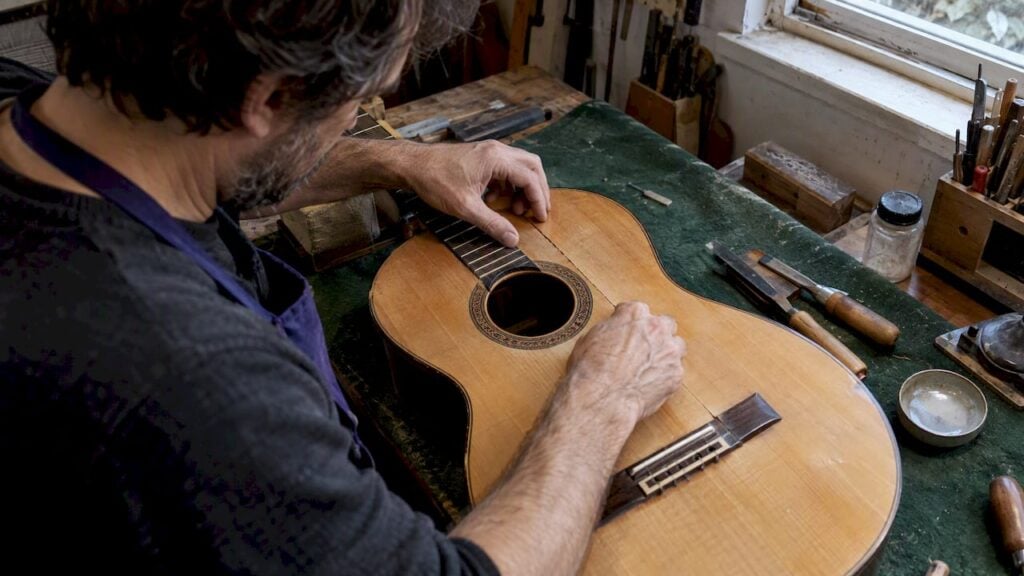

A crack in a classical guitar is usually repairable, and the repair is far easier the sooner it is done. Protect the crack, keep the guitar in stable humidity, do not glue it yourself with household products, and have a luthier look at it in person. This guide explains how to tell a harmless finish crack from a structural one, what a professional repair involves, what it costs in Germany and when repairing is the wrong move for a vintage instrument.
TL;DR
- Tell the two types apart first: a hairline in the finish is cosmetic, a crack in the wood is structural and can spread quickly.
- Do not run your finger along a fresh crack, do not use alcohol-based cleaners and never squeeze in household glue.
- Many humidity cracks close on their own once the wood is slowly re-humidified, which is a job for a luthier or done with great care.
- Prices depend on length, location and severity, so serious workshops quote only after seeing the instrument.
- On a vintage or handmade guitar, stabilize first and refinish as little as possible: overspraying destroys originality and value.
Table of Contents
- First: is it a finish crack or a wood crack?
- What to do in the first hour
- Why classical guitars crack
- How a luthier repairs a crack
- Which cracks are most serious?
- What does crack repair cost?
- Repair, restore or leave it alone?
- Prevent the next crack
- Our perspective
- Have a guitar repaired or restored with us
- FAQ
- Sources
First: is it a finish crack or a wood crack?
Luthiers sort cracks into two groups. As Taylor’s repair guidance describes it, cosmetic damage affects only the finish, while structural damage affects the wood itself. Cosmetic damage generally does not change how the guitar plays. Structural cracks can progress quickly.
A few quick checks, done by eye and with a flashlight, no probing:
- Light test. Hold a flashlight at a low angle across the surface. A finish crack looks like a fine spiderweb or line that stays on the surface. A wood crack is a clean line you can see running into the grain.
- Look inside. Shine the light through the soundhole. If the line continues on the underside of the top, back or side, the wood is cracked.
- Check for movement. If the two edges sit at different heights, or buzzing appears when you play a certain note, the crack is open and active.
- Note the location. A crack near the bridge, along the center joint of the top, or at the side where it meets the neck block carries much more stress than one on the lower bout of the back.
If you are unsure, treat it as structural. Waiting costs nothing in a case of cosmetic damage and can save the soundboard in the other.
What to do in the first hour
The goal is to protect the crack until a specialist sees it, not to fix it.
- Do not touch the crack with your fingers. Premier Guitar’s repair column warns that running a finger over a fresh crack pushes skin oils and dirt into open wood fibers, which complicates the glue-up and can leave a permanent dark line.
- Keep it clean. Some German luthiers suggest covering the line with tape so dirt cannot get in. Use low-tack tape, keep it off a delicate finish, and remove it gently. If the finish is French polish, ask first, because adhesive can lift shellac.
- Slacken the strings a little if the crack is on the top, near the bridge or along the soundboard. Less tension means less force pulling the edges apart.
- Skip cleaners and polish. Luthiers caution against generic polishes and anything containing alcohol on traditional French polish. Shellac dissolves, and the resulting damage can cost more to repair than the crack.
- Do not glue it. Superglue and wood glue pushed into a dirty, moving crack make a proper repair harder, because the luthier must remove the residue before the wood can be joined cleanly.
- Put the guitar in its case with a stable humidity, away from radiators, windows and cars.
Why classical guitars crack
A classical guitar is a thin wooden box. According to the Premier Guitar column, the wood is only about .090 to .150 inches thick, so it takes little to damage it. The usual causes:
- Dry air. The most common reason in Germany is winter. Central heating can drive indoor humidity far down, the top shrinks across the grain and splits along the weakest line. Many luthiers recommend keeping the instrument between 40% and 60% relative humidity, a range also given by Douglas Niedt.
- Knocks and drops. These cause sharp, localized cracks, often with a dent, and sometimes loosen the braces inside.
- Temperature shock. A guitar taken from a cold car into a warm room can crack its finish and, in worse cases, the wood.
- Old glue joints. On guitars from the 1960s and 70s the bracing or the seam can let go after decades of seasonal movement.
Knowing the cause matters. A crack caused by dryness will return unless the environment changes, no matter how well it is repaired.
How a luthier repairs a crack
Workshops differ in detail, but the logic is the same.
Step 1: Re-humidify if the crack is moisture-related
Before any glue is used on a dryness crack, many professionals first let the wood recover. The Premier Guitar column describes placing the guitar in a sealed plastic bag with a humidity source for several weeks, so the wood swells and the crack closes, often removing the need for filler or oversize patches. This is slow, and a rushed attempt at home can do harm, so we leave it to a specialist.
Step 2: Clean and align the edges
The crack is cleaned of dust, old glue and oils. If one edge sits lower, the two sides are pulled level. Specialized clamps and crack-repair tools exist for this: StewMac describes tools that pull the two sides of a split together so they are level and ready for gluing.
Step 3: Glue
Thin, penetrating hide glue or a suitable wood glue is worked into the crack, and the excess is wiped away. Which glue is chosen matters for vintage instruments, because a future repairer must be able to reverse and rework the joint.
Step 4: Reinforce from inside with cleats
A glued line alone is rarely enough on a moving soundboard. Small wooden strips, called cleats, are glued across the crack on the inside. Taylor notes that internal reinforcement combined with careful finish matching allows a repair that is nearly invisible. Orientation counts: according to StewMac, the cleat grain should sit at roughly 45 degrees to the crack, which resists the forces that opened it better than parallel grain.
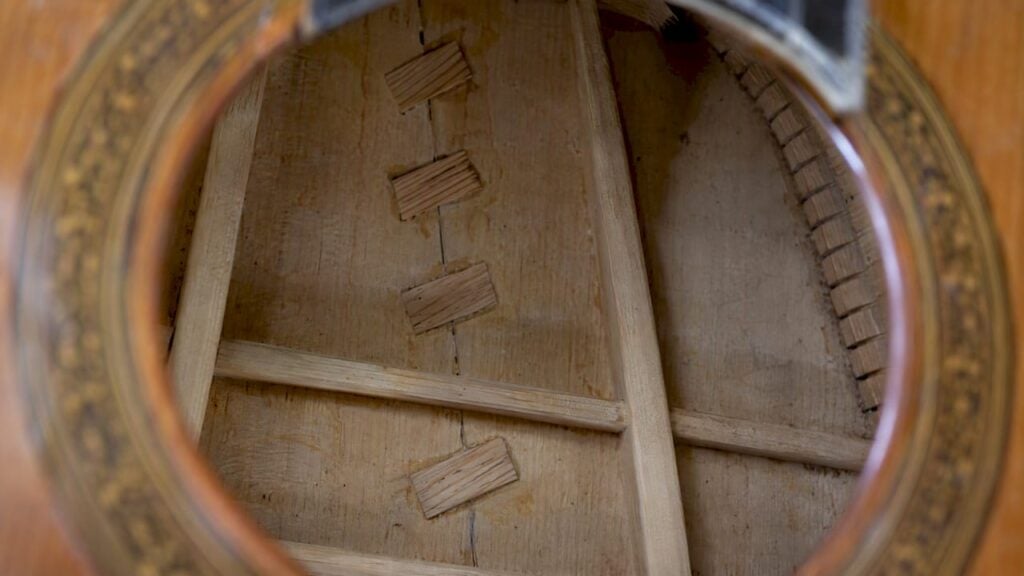
This is also why a repair that looks fine from outside can be poor: if there is no support inside, the crack tends to return.
Step 5: Touch up the finish
Only now does the surface come into play. A good luthier fills and retouches only the damaged area. On a French-polished classical guitar, that means shellac, not a modern spray lacquer. Our own overview of shellac varnish for guitars explains why this finish needs to be treated differently.
Which cracks are most serious?
| Crack type | Typical cause | Urgency | What it needs |
|---|---|---|---|
| Hairline in the finish only | Temperature change, age | Low | Observation; touch-up if you wish |
| Short crack in the top, away from bridge | Dry air | Medium | Re-humidify, glue, cleats |
| Crack along the center joint | Dry air, old glue | High | Professional glue-up and reinforcement |
| Crack running through the bridge area | String tension | Very high | Slacken strings, see a luthier promptly |
| Crack with dent after a knock | Impact | High | Check braces inside, repair and level |
| Side (rib) crack | Impact, dryness | High | Glue, cleats, often finish retouching |
| Fretboard crack | Dryness, age | Medium | Fill and stabilize |
The last row is not exotic: a cracked fretboard can often be treated with a simple filling technique, as StewMac demonstrates in a video.
What does crack repair cost?
There is no fixed price. Costs depend on the length, location and structural severity of the crack, and serious German workshops generally quote only after they have the instrument in hand, since photos rarely show the full extent of the damage. The Gitarrenwerkstatt is an example of a specialist shop that works this way. As a rough orientation, small, localized repairs can begin in the low three-digit euro range, while comprehensive structural work on a valuable vintage guitar can climb well beyond that depending on the hours involved.
What drives the bill:
- Length and number of cracks. Several cracks mean more clamping, more cleats and more drying time.
- Location. Work at the bridge or along the soundboard seam is more demanding than a crack in the back.
- Finish. French polish needs hand retouching. A matching retouch takes more skill than the glue-up.
- Condition of the braces. If the cracks revealed loose bracing, that must be fixed too.
- Your expectations. Stabilizing the guitar is cheaper than making the crack nearly invisible.
If you plan to sell, compare the repair bill with the likely resale benefit. Our article on what a cracked guitar is worth and what repairs cost goes through that calculation in detail.
Repair, restore or leave it alone?
For an ordinary student guitar, the answer is simple: repair it well, and play it. For a vintage or handmade instrument it is a real decision.
- Never overspray to hide a crack. Experts warn that on vintage instruments refinishing should be avoided, to preserve historical integrity and value. The goal is to stabilize first. Cosmetic perfection is secondary and often optional.
- A repaired crack is not a defect in the same way as a refinish. A documented, well-done structural repair usually sits better with collectors than a new coat of lacquer.
- Document everything. Photograph the crack before and after, and keep the workshop’s invoice and description. This helps with later valuation or sale.
If you are weighing how far to go, read our guide on restoring versus preserving original condition, and for a bigger project, our classical guitar restoration guide.
Prevent the next crack
Most classical guitar cracks are avoidable.
- Measure humidity. A small hygrometer in the case or room costs little. Aim for roughly 40% to 60%.
- Humidify in winter. Use an in-case humidifier or a room humidifier while the heating runs, and check it regularly.
- Avoid extremes. No radiators, no sun on the case, no car trunks.
- Acclimatize. After a cold trip, let the closed case sit for an hour or two before opening it.
- Use a good case, and loosen the strings slightly if you plan to leave the guitar unplayed for a long time.
- Care for the finish gently. A soft dry cloth is enough for most days. For shellac, see our daily shellac care routine.
Our perspective
We handle old and handmade instruments every day, and one lesson repeats itself: the crack itself is rarely the problem. The problem is what happens in the weeks after someone discovers it. A guitar that is slackened, kept at stable humidity and shown to a specialist early usually needs a modest repair. The same guitar after household glue, a polish with alcohol or an overspray often needs a long, expensive correction, and may lose part of its originality for good.
We also judge cracks differently depending on the instrument. A crack on a working concert guitar is a matter of sound and reliability. On a rare vintage guitar it is also a matter of documentation, honesty and value. That is why we prefer minimal, reversible work, a clear description of every repair and, where it applies, a written valuation afterwards. A repair is not a mark against a guitar. An undisclosed repair is.
— Vintage
Have a guitar repaired or restored with us
If your classical guitar needs more than a quick fix, our restoration service is where to start. We do not publish prices for restoration, because the work depends on the instrument. For guitars you want to sell, we also offer commission sales, certificates and valuation reports. You will find the details on our main page, and if you are looking for a replacement or a second instrument, browse our classical guitars.
FAQ
Can I repair a crack in my classical guitar myself?
Only very minor things, such as a cracked fretboard or a small finish chip, are realistic for a careful hobbyist. Cracks in the top, sides or around the bridge need clamping, proper glue and internal reinforcement. A poor first attempt makes the professional repair harder and sometimes more expensive.
How much does it cost to repair a crack in the top?
There is no standard price, because length, position and the finish all change the work. Specialist workshops usually quote after inspecting the guitar. Small repairs can start in the low three-digit euro range, and complex work on valuable vintage instruments can cost considerably more.
Will a repaired crack come back?
It does not have to. If the cause was dry air and you keep the guitar at stable humidity, and the repair included internal cleats, the crack is unlikely to reopen. If the humidity problem stays, the wood can split again, in the same place or a new one.
Does a repair reduce the value of my guitar?
A clean, documented repair costs less value than an open crack or a visible overspray. For vintage instruments, minimal and reversible work is preferred. Our guide on cracks and value explains typical effects.
Should I tape over a crack until I see a luthier?
Some German repair shops advise covering it so dirt cannot enter. If you do, use low-tack tape and be careful on shellac, and do not press on the crack. Slackening the strings slightly is often the more useful step.
Sources
- Acoustic Soundboard: When Cracks Happen, Premier Guitar
- Guitar Crack and Ding Repair, Taylor Guitars
- StewMac Crack Repair Tool Instructions
- Simple trick for repairing cracks on a guitar fretboard, StewMac
- Classical Guitar Care and Maintenance, Douglas Niedt
- Die Gitarrenwerkstatt