



A used José Ramírez 1A in Germany typically sells for roughly €3,200 to €5,500. Asking prices climb well above that for early, well-documented instruments, and the studio models sit far below. The spread is wide because “Ramírez 1A” describes a model, not a single quality level: the builder, the year, the woods and the condition each move the price by thousands of euros.
This guide explains what drives those numbers, how to read a listing, and what to check before you pay for a guitar that may be 40 or 60 years old.
TL;DR
- Typical used 1A range in Germany and Europe: about €3,200 to €5,500. Exceptional or well-documented guitars can pass €7,500.
- The builder’s initials, the wood (Brazilian or Indian rosewood) and the condition matter more than the year alone.
- Labels can be faked or moved from one guitar to another, so a label never proves authenticity by itself.
- Treat the asking price as a starting point: repairs, cracks and refinishing can cut the real value sharply.
- Get an independent valuation or certificate before buying a guitar above the low four-figure range.
Table of Contents
- What used Ramírez guitars cost in Germany
- The factors that move the price
- How to read a listing
- Spotting a fake before you pay
- Why a certificate pays for itself
- Our perspective
- Buying or selling a Ramírez with us
- Practical tips before you commit
- FAQ
- Sources
What used Ramírez guitars cost in Germany
The price you see depends on which Ramírez you mean. The workshop in Madrid has built several lines over the decades, and they sit in very different price tiers. Our overview of all Ramírez model series explains the differences in detail. In short:
| Category | What it is | Typical used price logic |
|---|---|---|
| Studio and student models (R-series) | Factory-built entry guitars, often laminated or solid-top | Low to mid hundreds up to roughly €1,000, depending on age and condition |
| Mid-range solid-wood models | Solid tops and better woods, still series-built | Mid four figures at the upper end, usually below the 1A |
| 1A, post-1990s | Handmade concert guitar, workshop built | Often at the lower part of the 1A range |
| 1A, 1960s and 1970s | The period collectors chase, with identifiable builders | Upper part of the range and above |
| Documented or historic guitars | Known owner, original paperwork, exceptional state | Beyond €7,500, case by case |
The central figure to remember is the 1A range of about €3,200 to €5,500 for the German and wider European market in late 2025 and 2026. It is a typical band, not a rule. We see guitars outside it in both directions, and a single listing tells you what a seller hopes for, not what a buyer paid.
Asking price versus real value
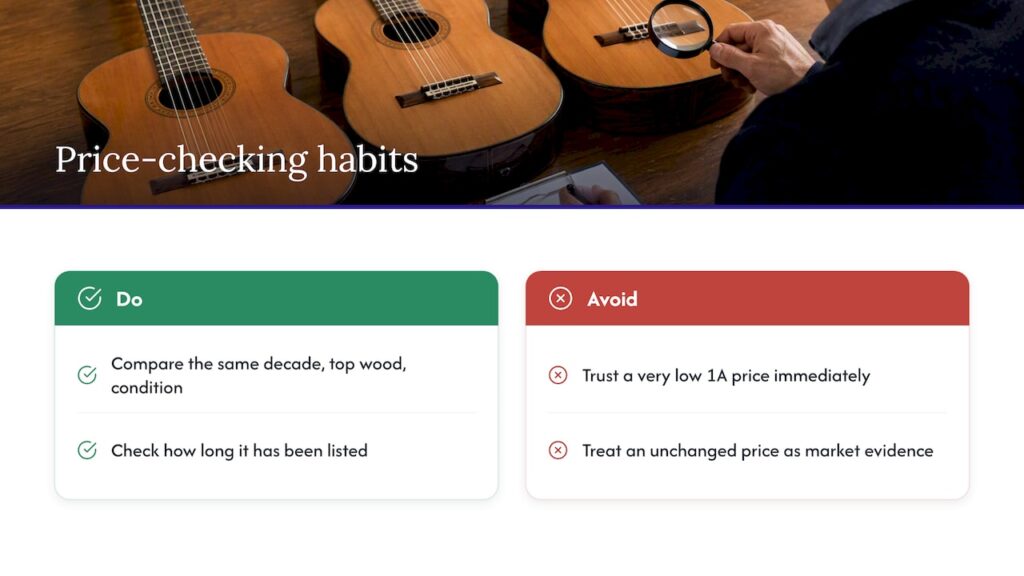
Public marketplaces mix private sellers, dealers and speculative listings. A dealer who has inspected, set up and warranted an instrument will ask more than a private seller clearing out an estate, and sometimes that extra money is well spent. A private ad with a very low price on a “1A” should raise questions before it raises hope.
Two habits help. First, compare like with like: same decade, same top wood, similar condition. Second, look at how long a guitar has been listed. A price that never moves tells you more about the seller than about the market.
The factors that move the price
The builder behind the guitar
Ramírez 1A guitars were built by different luthiers in the workshop, and collectors care who built which instrument. Many carry internal initials stamps that point to the maker, for example “AM” for Antonio Martinez or “MM” for Miguel Malo. The initials link a guitar to a specific master during a specific period, which is why two guitars from the same year can carry very different prices.
If a listing does not show the inside of the guitar, ask for a photo of the stamp. A seller who cannot or will not provide it is telling you something.
Woods: Brazilian rosewood or Indian rosewood
Back and sides in Brazilian (Rio) rosewood usually command a premium over Indian rosewood. Rio rosewood is also subject to international trade rules, which matters when you export or import a guitar. If the instrument is leaving Germany or the EU, ask about the paperwork before you agree on a price. The top wood, cedar or spruce, shapes the sound and the taste of the buyer. Neither is automatically worth more, but a clean, even top with no heavy repairs is always worth more.
Condition, cracks and repairs
A 1A is a thin, lightly built instrument. After decades of playing, hairline cracks, bridge lifts, refretting and re-varnishing are normal. They are not automatically a problem, but they change the price:
- Properly closed top cracks with clean cleats: modest discount.
- Refinished top or back: large discount, because the finish is part of the sound and the originality.
- Replaced bridge or neck problems: ask for a repair history.
- Fresh frets and a clean setup: a small plus, nothing more.
If you buy a guitar that needs work, add the restoration cost to the price before comparing. Our page on guitar restoration explains how we approach it. We do not publish a price list for restoration, because each instrument needs a personal assessment.
Year and label
The year matters, but it is the least reliable part of a listing. The factory labels of handmade Ramírez guitars act as the guitar’s identity card, but until 1967 label use was not strictly controlled, so dates for older instruments are approximate. From 1967 onward the labels were signed by the luthier, which gives a better paper trail. Forged labels are common, and a label can be moved to another body.
We wrote a separate guide on dating the label of a Spanish guitar if you want to read a label yourself.
How to read a listing
When a used Ramírez ad crosses your screen, work through it in this order.
- Model and label. Does the label match the model? Is the label glued where it should be, with no signs of being lifted?
- Initials stamp. Is there one, and is it shown in a photo?
- Woods. Is the rosewood type stated, and is there paperwork if it is Brazilian?
- Photos of the inside. Look through the soundhole for braces, cleats and glue marks.
- Repair history. Ask in writing about cracks, refinishing and neck resets.
- Case and papers. An original case and any documentation add value.
- Return policy. A private seller usually offers none. A dealer should.
If three or more of these answers are missing, you are not looking at a bargain, you are looking at a risk.
Spotting a fake before you pay
The more a model is worth, the more it is imitated. Ramírez guitars are no exception: lookalike instruments carry copied labels, and genuine labels turn up in the wrong guitars. Experts stress that for vintage guitars the label is one part of the check; the structure of the instrument and the builder’s initials have to agree with it.
Our guide to spotting a fake Ramírez walks through six quick checks, from bracing to the shape of the headstock. Run them before you transfer money, not after.
Why a certificate pays for itself
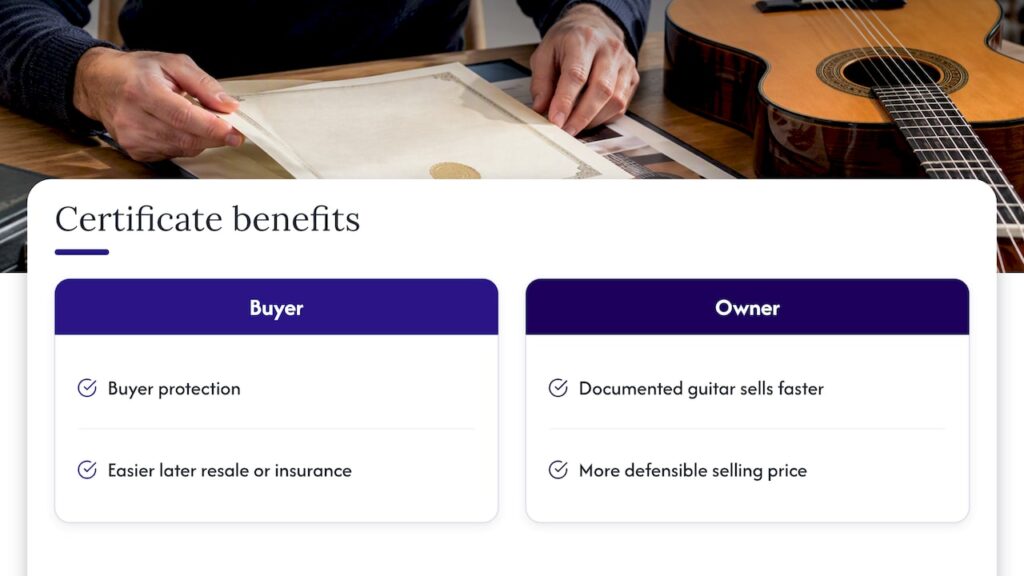
On a guitar that costs as much as a used car, a few days of verification is cheap. A written valuation does two things: it protects you as a buyer, and it makes the guitar easier to resell or insure later. If you already own a Ramírez, the same applies in reverse: a documented guitar sells faster and at a more defensible price.
We offer certificates and valuation reports as a service, with no published price, because the effort depends on the instrument. You can read more in our guide on the role of certification in guitar collecting.
Our perspective
We handle vintage classical and flamenco guitars every week, and one pattern repeats: buyers focus on the number in the ad and forget to ask what is behind it. A fair price for a Ramírez is the price of the guitar as it actually is, not as the label says it is.
Our approach is simple. We look at the whole instrument first: the builder’s stamp, the construction, the repairs, the originality of the finish. Only then do we talk about money. That is why we prefer to let people play a guitar before they decide. A 1A that sounds right for your hands and your repertoire is worth more to you than a better-documented one that does not.
We also tell sellers the truth. A guitar with a refinished top and a replaced bridge is a good player’s instrument, but it is not a collector’s piece, and it should be priced as one or the other. When the facts are on the table, both sides can agree on a number that holds up.
— Vintage
Buying or selling a Ramírez with us
If you are searching for a used Ramírez, you can look at our current concert guitars and our vintage guitars. For instruments in the shop, we offer exclusive playing appointments, so you can test a guitar in person. If you own a Ramírez and want to sell, we also handle sales on commission. You can reach all of these services from our main page, and you will find our broader range in the shop.
Practical tips before you commit
- Set a ceiling in advance. Include the cost of a setup, new strings and a proper case in your budget.
- Play it, or have someone you trust play it. A recording or a video is not a test.
- Check shipping and insurance. A fragile guitar needs proper packing and insured transport, so ask who bears the risk in transit.
- Keep every document. Receipts, certificates and correspondence all add value when you sell.
- Be patient. The market for 1A guitars is thin. Waiting for the right guitar usually costs less than rushing into the wrong one.
FAQ
How much does a used Ramírez 1A cost in Germany?
Most used 1A guitars in Germany and Europe are offered between about €3,200 and €5,500. Exceptional guitars, for example early ones with a famous builder or provenance, can go beyond €7,500. Condition and builder explain most of the difference.
Why are some Ramírez guitars so much cheaper than a 1A?
The studio and student lines are series-built instruments and were never meant to compete with the handmade 1A. They are good guitars for their purpose, but the work, the woods and the collector demand behind a 1A are of a different order. Check which model line you are looking at before comparing prices.
Does the label prove that a Ramírez is genuine?
No. Labels were not strictly controlled until 1967, forged labels exist, and a genuine label can be moved into another guitar. The builder’s initials, the construction and the guitar’s history have to agree with the label. If you are not sure, ask an expert to examine it.
Should I buy a used Ramírez privately or from a specialist?
A private sale can be cheaper, but you usually carry the risk alone. A specialist inspects the instrument, can explain its repairs and normally offers a return or a way to test the guitar. For a purchase in the thousands of euros, that security often justifies the difference.
Sources
This article cites no external web pages. The price ranges are typical figures for the German and European used market in late 2025 and 2026 and are meant as orientation, not as a quote. For guidance on our own pages, see our guide to Ramírez model series and our article on guitar certifications for musicians and collectors.