













TL;DR:
- Provenance verifies the documented history, authenticity, and origin of vintage guitars, greatly impacting value. A clear provenance increases a guitar’s worth, especially when linked to famous artists or verified originality. Proper documentation and scientific testing are essential for confirming authenticity and protecting collectors from fraud.
Provenance is defined as the documented history of ownership, origin, and authenticity that follows a guitar from its creation to the present day. The role of provenance in guitar collecting goes far beyond paperwork. It confirms that an instrument is genuine, connects it to a specific moment in music history, and directly determines what a collector pays for it. Verified provenance serves as a certificate of authenticity and historical record, making it the single most important factor separating a collectible guitar from a well-made copy. Vintage-guitar-world treats provenance as the foundation of every instrument it evaluates, sources, and sells.
What is the role of provenance in guitar collecting?
Provenance answers three questions every serious collector asks: Where did this guitar come from? Who owned it? And can that history be proven? Without clear answers, even a technically flawless vintage instrument carries risk. With strong documentation, a guitar becomes a verifiable artifact with a story that collectors and investors trust.
The industry term most often paired with provenance is “authentication.” Authentication is the formal process of confirming that a guitar is what it claims to be, using provenance as the primary evidence. Both concepts work together. Provenance supplies the historical record; authentication validates it.
Collectors rely on provenance to protect themselves from forgeries, misrepresented repairs, and inflated claims. The collectible guitars history market has grown sophisticated enough that buyers at every level now expect documentation before committing serious money. Provenance is no longer optional. It is the price of entry for high-value transactions.
How is provenance verified and documented in the vintage guitar market?
Verification draws on multiple types of evidence, and the strongest cases combine several sources rather than relying on one alone.
Common provenance documentation includes:
- Original purchase receipts or dealer invoices
- Factory build records or serial number logs
- Photographs from the original owner or recording sessions
- Letters, contracts, or handwritten notes connecting the guitar to a specific player
- Expert evaluation reports from certified appraisers
- Certificates issued by auction houses or recognized authentication bodies
Technology has strengthened the verification process significantly. Spectral analysis and chemical testing now allow specialists to examine a guitar’s materials at a molecular level, cross-referencing findings against millions of data points from verified period instruments. This means a forger cannot simply age wood and apply vintage hardware. The chemistry of the finish, the composition of the fret wire, and the specific lacquer formulas all leave fingerprints that science can read.
Credible verification also requires independent, court-defensible reports that examine every aspect of the instrument, including decals, finish layers, hardware, and fret wire. A report that only covers the serial number is not sufficient for high-value transactions.
Pro Tip: Most collectors focus on ownership history and overlook build documentation. A guitar with factory build photos, original spec sheets, and modification records is far easier to authenticate than one with only a famous name attached to it.
What impact does provenance have on the value of collectible guitars?
Provenance creates measurable price premiums. Collectors regularly pay 50% or more in added value for instruments with clear, verified documentation compared to identical guitars with no traceable history. That premium reflects the reduced risk, the confirmed story, and the confidence that the guitar will hold or grow its value over time.
Artist association takes that premium to another level entirely. Noel Gallagher’s Epiphone Les Paul, an instrument with modest intrinsic value, sold for £132,000 at auction because of its provenance. The guitar itself was not rare. The documented connection to a defining figure in British rock made it irreplaceable.
“Provenance combines both emotional and financial value through the connection to artists and historical narrative.” — Sotheby’s
The table below shows how different value factors interact in the vintage guitar market.
| Value factor | Impact on price | Provenance dependency |
|---|---|---|
| Artist association | Very high | Entirely dependent on documentation |
| Verified originality | High | Requires authentication reports |
| Rarity of model | Moderate to high | Enhanced by build records |
| Condition and playability | Moderate | Independent but complemented by provenance |
| Tonal quality | Moderate | Independent; subjective |
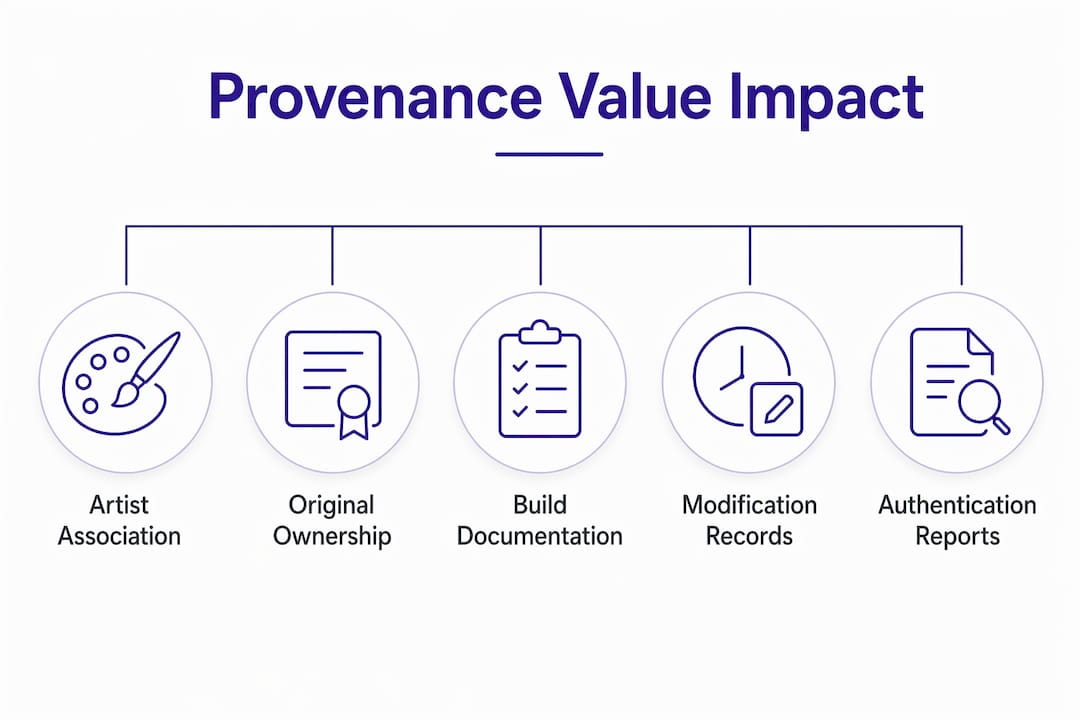
The clearest takeaway from this table is that the highest-value factors all depend on provenance. Playability and tone matter, but they cannot push a guitar into six-figure territory on their own.
What nuances should collectors understand about provenance versus other guitar attributes?
Provenance is not a substitute for quality. The most prized guitars combine inherent quality with documented historical significance. A guitar that plays beautifully and carries strong documentation is worth more than either quality or provenance alone. Collectors who chase provenance without evaluating the instrument itself often end up with historically interesting guitars that disappoint as musical objects.
The deeper insight is that provenance represents stewardship, not just ownership. When you acquire a guitar with documented history, you take on responsibility for preserving that record and passing it forward. This shifts the collector’s mindset from “what did I buy?” to “what am I protecting?” That perspective changes how collectors maintain instruments, store documentation, and make decisions about modifications.
Key nuances collectors should keep in mind:
- Provenance confirms what happened to a guitar, not whether it sounds good. Always play the instrument before buying.
- Artist association provenance and craft provenance are different things. A guitar built by a master luthier carries its own lineage worth documenting.
- Modifications reduce provenance value unless they are documented and traceable. An undocumented refret or refinish creates gaps that buyers will discount.
- Emotional value and financial value often align, but not always. A guitar with personal significance to a collector may not carry the same market premium.
Understanding guitar model heritage adds another layer. Some models carry historical significance at the design level, independent of any individual owner. Knowing that context helps collectors weigh provenance claims accurately.
How can collectors assess and leverage provenance when acquiring vintage guitars?
A structured approach to provenance assessment protects collectors from costly mistakes and positions them well for future resale.
- Request all documentation upfront. Ask for purchase receipts, build records, photographs, and any prior authentication reports before negotiating price. A seller who cannot produce documentation should not command a provenance premium.
- Cross-reference serial numbers. Match the serial number against known manufacturer records or published databases for the specific brand and era. Discrepancies are immediate red flags.
- Commission an independent expert evaluation. Rely on certified appraisers or authentication specialists who produce written, signed reports. Verbal assurances carry no weight in resale or insurance contexts. Vintage-guitar-world offers expert guitar valuation services that include provenance review.
- Examine the physical instrument for consistency. Hardware, finish, fret wire, and tuning machines should all match the documented production period. Inconsistencies suggest repairs, replacements, or misrepresentation.
- Verify the chain of ownership. Each transfer of ownership should be traceable. Gaps in the chain reduce confidence and value. The guitar certification process formalizes this chain into a recognized document.
Once you own a guitar, maintaining its provenance is just as important as verifying it at purchase. Good provenance documentation includes build photos, certificates, original product pages, and a clear record of any modifications made during your ownership. Store physical documents in archival-quality sleeves and keep digital backups in at least two locations.
Pro Tip: When you make any modification to a vintage guitar, document it immediately. Photograph the before and after, note the date, and record the parts used. Future buyers will pay more for a guitar with a transparent modification history than for one with unexplained changes.
Watch for common red flags: sellers who resist independent inspection, provenance claims based solely on verbal history, documentation that looks printed recently rather than aged with the instrument, and prices that seem too low for the claimed history. Low price plus strong provenance claims is one of the most reliable warning signs in the market.
Key Takeaways
Provenance is the single most powerful factor in determining a vintage guitar’s authenticity, value, and long-term collectibility, and no serious acquisition should proceed without it.
| Point | Details |
|---|---|
| Provenance defines authenticity | Documented ownership history confirms a guitar is genuine, not a replica or misrepresented instrument. |
| Verified provenance adds measurable value | Collectors pay 50% or more in added value for guitars with clear, verified documentation. |
| Artist association multiplies premiums | A guitar’s connection to a famous player can push value into six figures regardless of intrinsic quality. |
| Stewardship mindset protects value | Documenting modifications and maintaining records during ownership preserves value for future buyers. |
| Provenance and quality work together | The most desirable guitars combine strong documentation with genuine playability and craftsmanship. |
Why provenance changed how I think about every guitar I handle
I used to evaluate guitars the way most players do: pick it up, play it, listen. If it sounded right and felt right, the paperwork was secondary. That changed the first time I held a guitar with a complete, unbroken ownership chain going back to its original factory order. The documentation did not make the guitar sound better. But it made me understand it differently. Every decision the builder made, every player who owned it, every repair that was or was not done, all of it was visible. The guitar became a record of choices, not just an object.
What I have found over years of working with vintage instruments is that collectors who treat provenance as a burden tend to lose money. They buy guitars with gaps in the history, assume the gaps do not matter, and then discover at resale that buyers discount exactly those gaps. Collectors who treat provenance as part of the instrument itself, something to protect and extend, consistently get better outcomes.
The debate about whether provenance or quality matters more is the wrong question. The right question is whether you are willing to do the work to know what you actually own. A guitar with a great story and no proof is just a guitar with a story. A guitar with a great story and solid documentation is a piece of history you can sell, insure, and pass on with confidence.
My recommendation: before you spend serious money on any vintage instrument, read the historical context behind guitar value. Understanding why certain guitars matter historically makes provenance claims much easier to evaluate.
— Vintage
Guitars with documented history, available at Vintage-guitar-world
Vintage-guitar-world curates every instrument in its collection with provenance in mind. Each guitar listed on the platform comes with detailed historical context, expert evaluation notes, and clear documentation of its condition and origin.

Collectors researching their next acquisition can browse the full range of vintage guitar types and investment potential directly on the site. For collectors who want to understand what their current instruments are worth, Vintage-guitar-world also provides expert valuation advice tailored to the 2026 market. Every listing reflects the platform’s commitment to transparency, accuracy, and the kind of documentation that serious collectors require.
FAQ
What does provenance mean for a guitar?
Provenance is the documented record of a guitar’s origin, ownership history, and authenticity. It serves as a historical record and certificate of authenticity that confirms the instrument is genuine and traceable.
Why should collectors authenticate vintage guitars?
Authentication protects collectors from forgeries and misrepresented instruments. Guitars with verified provenance command significantly higher prices and are easier to insure and resell.
How does provenance affect a guitar’s market value?
Verified provenance adds measurable premiums, with collectors paying 50% or more above comparable unverified examples. Artist-associated instruments can reach six-figure prices regardless of the guitar’s intrinsic quality.
What documents make up strong guitar provenance?
Strong provenance includes original purchase receipts, build records, photographs, modification logs, and independent authentication reports. Complete provenance documentation covers the full chain from manufacture to current ownership.
Can technology replace traditional provenance documentation?
Technology like spectral analysis strengthens authentication but does not replace documentation. Scientific testing and paper records work together to produce the court-defensible reports that high-value transactions require.