




Vintage-guitar prices have climbed steadily for decades, with broad-market benchmarks posting mid-single-digit average annual gains while a handful of rare, original-condition models delivered double-digit annualized returns. That said, the market has cooled slightly since late 2024. Outcomes still hinge on condition, originality, rarity, and provenance far more than on age alone, so a “vintage” label alone guarantees nothing.
TL;DR:
- The best vintage guitars, such as Gibson EDS‑1275 and Rickenbacker RM series, have historically gained up to 20% annually due to rarity and provenance.
- Condition, originality, provenance, and specific features significantly influence a guitar’s value, with unmodified, well-documented instruments commanding premium prices.
- Vintage guitar indices increased around 86% to 91% over five years but declined slightly since late 2024, indicating market maturity rather than a bubble.
- Top-performing models have rare finishes, documented ownership, or association with famous players, contributing to outsized gains compared to the broad market trend.
- When appraising, verifying serial numbers, checking for original parts, and consulting recent comparable sales ensure a realistic valuation before buying or selling.
Table of Contents
- How Has the Vintage Guitar Price Trend Moved Over Time?
- Which Vintage Guitar Models Have Gained the Most Value?
- What Actually Moves the Price of a Vintage Guitar?
- How Do You Appraise a Vintage Guitar Before Buying or Selling?
- Does Restoration Increase or Decrease a Vintage Guitar’s Value?
- When Should You Get an Expert Valuation or Certification?
- Buy for the Music, Price It Like an Investor
- Get a Real Valuation Before You Buy or Sell
- Where to Verify Vintage Guitar Prices Yourself
- Sources
- FAQ
How Has the Vintage Guitar Price Trend Moved Over Time?
The preisentwicklung vintage gitarren story of the last decade is one of strong long-term appreciation with real bumps along the road. Price-guide indices tracking large samples of instruments show the kind of compounding that turns a decent guitar into a genuine asset over time. The 42‑Guitar Index rose roughly 86% over five years, and the broader 3000‑Guitar Index gained about 91% over the same stretch, figures that track thousands of individual sale prices rather than a handful of headline auctions.
That consolidation traces to a few overlapping pressures: a shifting buyer base as younger collectors enter with different tastes, tighter liquidity in a higher-rate environment that makes big-ticket purchases feel riskier, and growing wariness around counterfeit or “parts” instruments flooding online marketplaces.
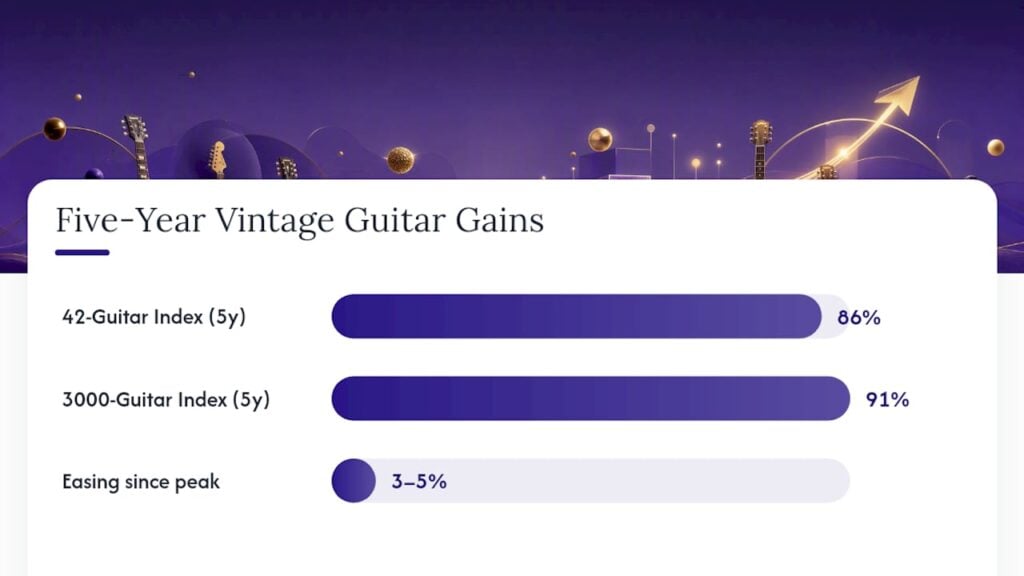
Statistic Callout: Broad vintage-guitar indices gained 86% to 91% over five years, then eased 3% to 5% from their peak starting in late 2024, a pattern more consistent with a maturing collectible market than a bubble deflating.
Zoomed out further, the global vintage guitar market is valued in the low billions of dollars, with projected steady annual growth through 2035. Compare that to familiar benchmarks:
- Gold has historically delivered long-run average annual returns in the mid-single digits, similar to the broad guitar index.
- Broad equity indices like the S&P 500 have generally outpaced both over the very long term, though with their own volatility.
- Top-tier vintage guitars, unlike gold or stock index funds, add a layer of return that comes from scarcity and cultural cachet rather than any yield or dividend.
For deeper context on where this trend may head next, see our take on vintage guitar market trends.
Which Vintage Guitar Models Have Gained the Most Value?
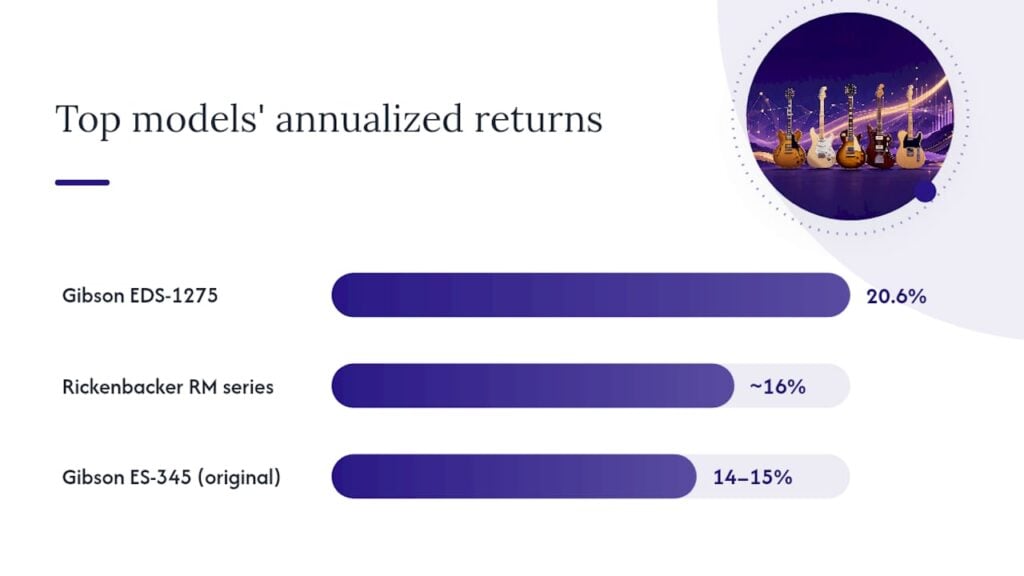
Averages hide the real story. A small set of standout models pulled far ahead of the broad market, while plenty of ordinary vintage instruments barely kept pace with inflation. That gap between median and top-quartile performance is the single most important thing to understand before treating any guitar as an investment.
Documented examples from long-term price-guide analysis include:
- Gibson EDS‑1275 (double-neck, 1960s): annualized returns around 20.6%, driven by extreme rarity and its association with famous stage use.
- Rickenbacker RM series: roughly 16% annualized, tied to originality and a small surviving population.
- Gibson ES‑345 (late 1950s to early 1960s, original finish): around 14% to 15% annualized, reflecting steady collector demand for Gibson’s semi-hollow line.
- Pre-war Martin flat-tops in original condition: strong multi-decade appreciation, though annual figures vary widely by model and finish.
- Fender Stratocasters and Telecasters from the late 1950s: solid long-term gains, concentrated heavily in all-original examples.
- Gretsch hollow-bodies with rare finish options: meaningful premiums over standard-finish counterparts.
Every one of these outperformed the broad index because of the same combination: scarcity, unmodified original parts, and, in some cases, a documented link to a notable player. A small set of top models accounts for outsized gains, while the broad-market average masks the real spread between typical and exceptional instruments. These numbers describe what happened to specific, well-documented examples. They are not a promise about what any particular guitar you own or are considering will do.
What Actually Moves the Price of a Vintage Guitar?
Ranked roughly by influence, here is the framework that separates a guitar that appreciates from one that just sits in a case:
- Maker and era. Gibson, Fender, and Martin instruments from their respective “golden eras” carry the deepest collector interest and the most liquid resale markets.
- Originality. Unmodified electronics, hardware, finish, and case components matter enormously; a guitar with its original pickups can be worth multiples of an otherwise identical one that has been swapped.
- Condition. Structural integrity, finish checking versus finish loss, and neck straightness all factor into the grade a guitar receives.
- Provenance. Documented ownership, especially by a known player, adds a premium that can dwarf the value of the instrument alone.
- Rarity. Limited production runs, discontinued finishes, or short-lived spec changes create scarcity that collectors chase.
- Spec variations. Small details, a one-piece neck, a specific pickup wind, a rare color option, can shift price bands by thousands of dollars even within the same model year.
- Market demand. Trends in music and pop culture periodically revive interest in specific models, temporarily accelerating price growth.
Pro Tip: If you’re buying with one eye on long-term value, prioritize guitars with complete original hardware and a paper trail over guitars that merely look clean. Documentation ages better than a fresh polish job.
Curious how finish aging factors into all this? Our piece on how aging affects a vintage guitar’s market value breaks down why original patina often outsells a repaint.
How Do You Appraise a Vintage Guitar Before Buying or Selling?
Building a reliable value estimate takes more than a quick look at listing prices. Work through this sequence:
- Check the serial number and any interior labels against known factory records for that maker and year.
- Inspect construction details, headstock shape, neck joint, bracing pattern, against documented specs for that exact production period.
- Assess finish originality, refinished guitars usually show telltale overspray in cavities or under the pickguard.
- Note any repairs: refrets, neck resets, or crack repairs should be documented, ideally with before-and-after photos from the luthier.
- Grade the overall condition, from Mint to Player grade, since each step down typically corresponds to a meaningful price discount.
Once you have a condition grade, pull real comparable sales rather than asking prices. Price guides, auction archives, and completed consignment sales give a far more honest picture than active listings, which sellers routinely overprice.
- Collect three to five recent comps in similar condition.
- Adjust up or down for spec differences and documented repair history.
- Subtract typical consignment fees, often around 10% to 20%, from the expected gross sale price to estimate real net proceeds.
Our seven-point checklist for buying vintage guitars expands on each of these steps, and our guide to valuing collectible guitars walks through sample pricing math.
Does Restoration Increase or Decrease a Vintage Guitar’s Value?
The market has long paid a premium for untouched original finishes, and that has not changed. What has shifted is tolerance for well-documented, professionally executed restoration work.
- A clean, professionally done refret with clear documentation is often neutral or only modestly negative for resale value, especially when it noticeably improves playability.
- A full non-original refinish typically cuts collector value more sharply, even though it can widen the pool of buyers who just want a great player-grade instrument.
- Refrets and careful restorations have become more accepted among players and buyers, even as untouched original finishes still command the strongest collector premiums.
Pro Tip: Keep every invoice, photo, and note from restoration work. A neck reset done by a documented specialist reads very differently to a buyer than an undocumented repair, even if the physical result looks identical. Our guide to neck resets covers what a proper reset should look like and how it’s typically priced.
When Should You Get an Expert Valuation or Certification?
Getting a serious valuation matters most once a guitar’s condition, rarity, or history makes its worth genuinely uncertain, not obvious from a quick market scan. Certification and consignment services are available for sellers who want documented proof of authenticity and condition before listing a high-value piece, along with options for owners who prefer a dealer network to handle the sale. Sellers of high-value instruments may benefit from certification since it generally increases buyer confidence and can reduce the time a listing remains unsold. For instruments needing physical work first, restoration services and appointment-based playing sessions can help confirm condition before pricing.
Buy for the Music, Price It Like an Investor
Buy the guitar that moves you to play it. But once a piece crosses into serious collector territory, treat it with the same discipline you’d apply to any illiquid asset: document everything, verify condition against real comps, and get expert eyes on anything you’re not certain about before you commit real money.
— Vintage
Get a Real Valuation Before You Buy or Sell
Most collectors guess at value using asking prices from online listings, which routinely run high because sellers set them, not buyers. Vintage-guitar-world takes a different approach: expert evaluation grounded in documented condition, originality checks, and real comparable sales, the same framework this article just walked through.

If you’re sitting on a piece you suspect is worth real money, Zertifikate und Wertgutachten gives you documented proof of authenticity and condition that buyers trust. If you’d rather have a dealer network handle the sale, Verkauf in Kommission puts your guitar in front of serious buyers without you managing the listing yourself. And if a piece needs work before it’s sale-ready, our Restaurierung service documents every repair so nothing gets lost in translation between you and the next owner. Browse current vintage guitars in stock, or book an Exklusive Anspieltermin to test a piece in person before you decide.
Where to Verify Vintage Guitar Prices Yourself
- Reverb’s vintage guitar definitions and market FAQ
- Deutschlandfunk’s reporting on vintage guitars as collectibles
- WiseGuyReports global vintage guitar market analysis
Sources
- 25 tips for finding your dream guitar (for the right price) | Guitar World
- Vintage Guitars – Everything You Need To Know | Reverb
- Vintage Guitar Market Report | In-Depth Market Analysis 2035 | WiseGuyReports
- Vintage-Gitarren – Zwischen Wahnsinn und Wertanlage | Deutschlandfunk
FAQ
Which Guitars Increase in Value the Most?
Rare, all-original examples from Gibson, Fender, and Martin’s peak production eras tend to gain the most, especially models with documented provenance or unusual factory specs. The Gibson EDS‑1275 has shown annualized returns near 20.6%, far above the broad market average, largely because so few survive in original condition.
What Are Old Guitars Actually Worth Today?
It depends entirely on condition, originality, and documented history rather than age alone. A guitar generally needs to predate roughly 1980 to be considered genuinely vintage, but a rough, modified example from that era can be worth far less than a clean, all-original guitar from a later decade.
Are Guitars a Good Investment?
Vintage guitars have delivered long-term average annual gains in the mid-single digits across broad indices, with select rare models far exceeding that. They carry real risks though: limited liquidity, authentication challenges, and short-term price swings, so they work best as a long-horizon holding rather than a quick flip.
How Much Does It Cost to Sell a Guitar Through a Dealer?
Consignment selling through a reputable dealer typically costs around 10% to 20% of the sale price, but it often nets a higher final price than a private sale because it reaches committed, serious buyers. Consignment and certification pricing is available on request through the relevant service provider’s site.