


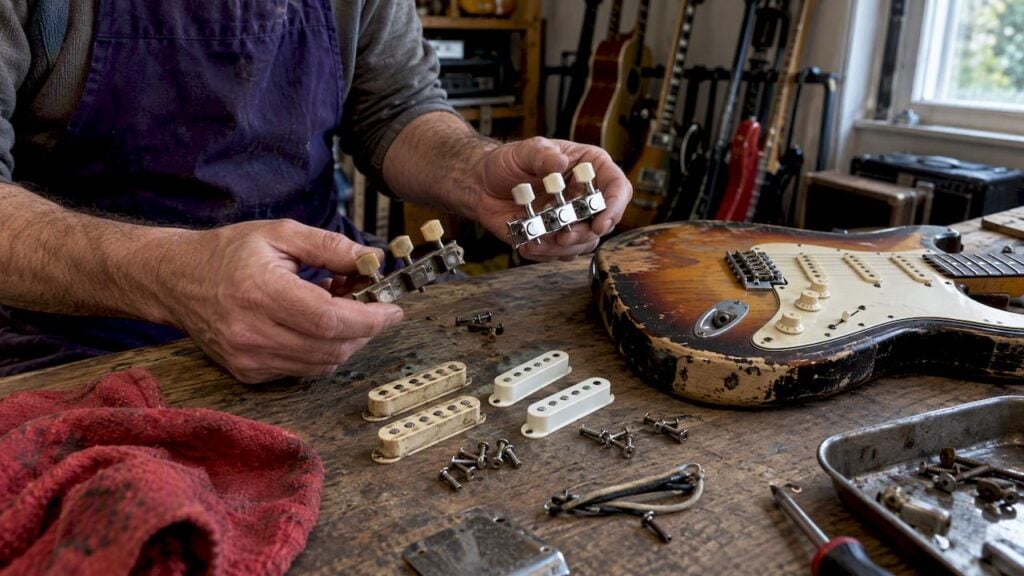

Original parts preserve a vintage guitar’s market value, while reversible or like-for-like replacements hold onto most of that value and pragmatic swaps simply make an instrument easier to play. If a guitar is rare or sought after, keep every original part and talk to a specialist before touching anything. If it’s a working player’s instrument, prioritize playability, but box up whatever you remove.
TL;DR:
- Original hardware and electronics, such as pickups, tuners, and finish, are crucial for determining a vintage guitar’s collector value and are best preserved.
- Swapping pickups or tuners generally causes only moderate value loss if the original parts are kept, but irreversible modifications like refinishings seriously reduce worth.
- Careful inspection of screws, solder joints, and serial numbers helps verify originality, especially before purchase or repair.
- Replacements for playing, such as modern tuners or refrets, are acceptable if properly documented and easily reversible; irreversible changes, like routing or paint removal, are highly penalized.
- Maintaining detailed records, photographs, and original parts significantly increases resale value and builds buyer trust when selling or restoring vintage guitars.
Table of Contents
- Which Parts Matter Most for Collector Value
- Checklist: How to Inspect a Guitar for Original Parts
- When Replacements Help (Player) and When They Harm (Collector)
- Practical Sourcing and Fitting Tips
- Preservation, Documentation, and a Legal Pointer
- When to Call a Specialist
- Balancing Sound and Value
- How We Can Help: Valuation, Restoration, Appointments
- FAQ
- Sources
Which Parts Matter Most for Collector Value
Not every component carries the same weight when a collector or appraiser looks at a guitar. Some parts are decorative or easily sourced; others are tied directly to the instrument’s identity and era, and swapping them changes how the guitar is classified and priced. Original hardware and electronics, including pickups, tuners, branded bridges, pickguards and finish, significantly shape a vintage guitar’s market classification.
The components that matter most tend to be:
- Pickups and wiring: era-specific windings and components are hard to replicate and are closely tied to tone and authenticity.
- Tuners and branded hardware: stamped or logo-marked tuners confirm an instrument’s originality at a glance.
- Bridge and tremolo systems: these parts carry casting marks and wear patterns that collectors check first.
- Finish: an untouched original finish, even with honest wear, almost always outranks a repaint.
- Pickguards: often overlooked, but missing or swapped guards are an easy giveaway of past work.
- Neck stamps and serial numbers: these anchor the instrument to a specific production run and date.
A swapped set of pickups is a meaningful change, but it’s usually reversible if the originals survive. A refinish is a different story: once the original lacquer or varnish is gone, it’s gone for good, and that irreversibility is exactly why collectors penalize it more heavily than a pickup swap or a changed set of tuners. Missing branded tuners hurt far more than replaced mounting screws, because the screws carry no identity while the tuners do. The general rule among serious buyers is that reversible changes cost you some value, but irreversible ones cost you much more.
Checklist: How to Inspect a Guitar for Original Parts
A careful inspection, done in order, tells you most of what you need to know before you buy, sell, or repair anything.
- Start with provenance: pull the case, original paperwork, and any serial numbers, and photograph all of it before touching the instrument.
- Check hardware and electronics: look for matching patina across screws and plates, consistent solder quality, and brand marks or casting numbers that match the era.
- Look for structural clues: extra screw holes, signs of routing, uneven paint edges at the pickguard or neck pocket, and fretwork that doesn’t match the fingerboard’s wear.
- Document every removed part: box and label originals, and note who performed any work and when.
- Watch for red flags: fresh solder on supposedly untouched electronics, mismatched screw finishes, or a seller who can’t explain a repair history.
Before buying from a private seller, ask direct questions: has anything been refinished, refretted, or rewired; are the original parts included; is there a receipt or workshop invoice; who performed any repairs; is the serial number consistent with the claimed year; are there photos from before any work was done? A seller who answers these without hesitation is usually telling the truth.
Pickups and tuners age in ways that are hard to fake. Original components fabricated decades ago use materials and wiring styles that era-accurate reproductions rarely match exactly, which makes solder joints and harness styles a reliable diagnostic.
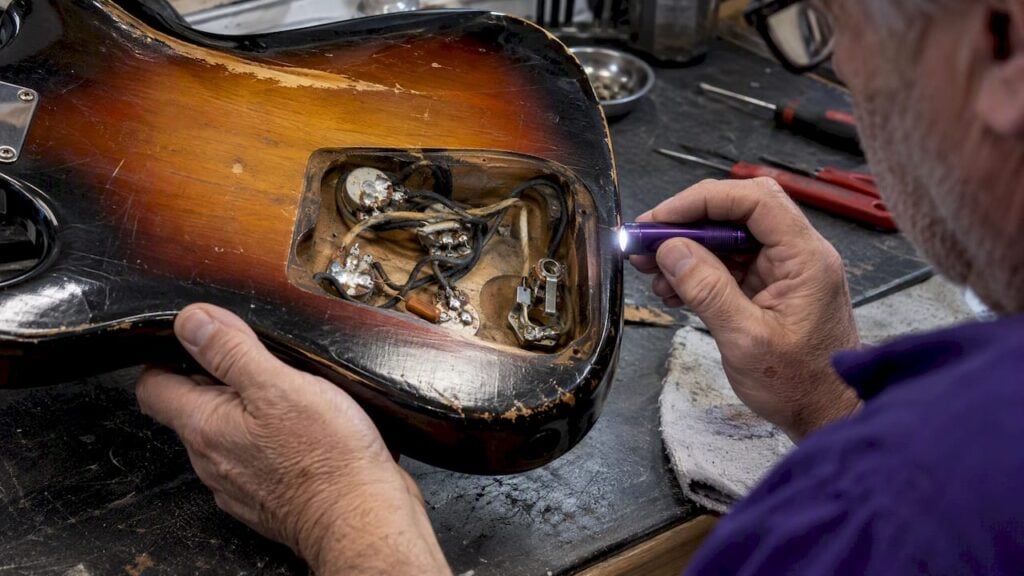
Pro Tip: Photograph every hidden cavity, cover plate, and neck heel before a repair starts. It’s the single easiest way to prove originality later.
When Replacements Help (Player) and When They Harm (Collector)
The right move depends on one question: is this instrument primarily for playing or primarily for keeping? Work through it in order: assess how rare the guitar is, check whether period-correct parts are even available, then decide whether a repair can be reversible or has to be permanent.
For a player-focused guitar, these swaps are generally fine:
- Tuners: modern replacements improve tuning stability with little downside if the originals are kept.
- Frets: a well-done refret restores playability and is widely accepted as routine maintenance.
- Wiring: fresh pots and capacitors fix dead electronics, though purists will note the change.
- Saddles: adjusting or replacing a worn saddle rarely affects resale in a meaningful way.
Actions that commonly hurt collector value include a full refinish, irreversible routing for new hardware, and permanently losing original branded parts. Returning original parts to a buyer, or simply keeping them boxed and labeled, mitigates most of that loss because it restores the option to reverse the work later.
Practical Sourcing and Fitting Tips
Getting replacement parts right starts before you order anything. Measure the original component, photograph the mounting footprint, and confirm shaft sizes and hole spacing so the new part actually fits without modification.
- Match the footprint: confirm screw spacing, shaft diameter, and cavity size before buying.
- Prefer OEM or specialist reproduction parts: a close match reduces the need for any permanent alteration.
- Use an experienced luthier for fitting: a skilled hand with a reversible approach protects both playability and resale value.
- Insist on getting originals back: a good technician returns every part they remove, documented and labeled.
Modern equivalents are a reasonable choice when the fit is correct, the work is reversible, and the instrument is primarily there to be played rather than preserved.
Pro Tip: Ask any technician upfront whether their repair can be undone by a future luthier. If the answer is no, treat that repair as a last resort.
Preservation, Documentation, and a Legal Pointer
Keeping removed originals, receipts, photos, and service notes does more for resale value than almost anything else you can do. Clear documentation and retained parts materially help later valuation and certification, and honesty about past repairs tends to build buyer trust rather than scare buyers off.
- Label each removed part with the date, the reason it was removed, and who did the work.
- Store small parts in a labeled box kept with the case, not loose in a drawer.
- Keep digital copies of photos and receipts in case physical paperwork is lost.
One more thing worth knowing: guitars built with protected woods, including Brazilian rosewood, can fall under CITES rules that require documentation for legal resale. If you’re unsure whether an instrument is affected, consult the relevant authorities or a specialist before selling across borders.
When to Call a Specialist
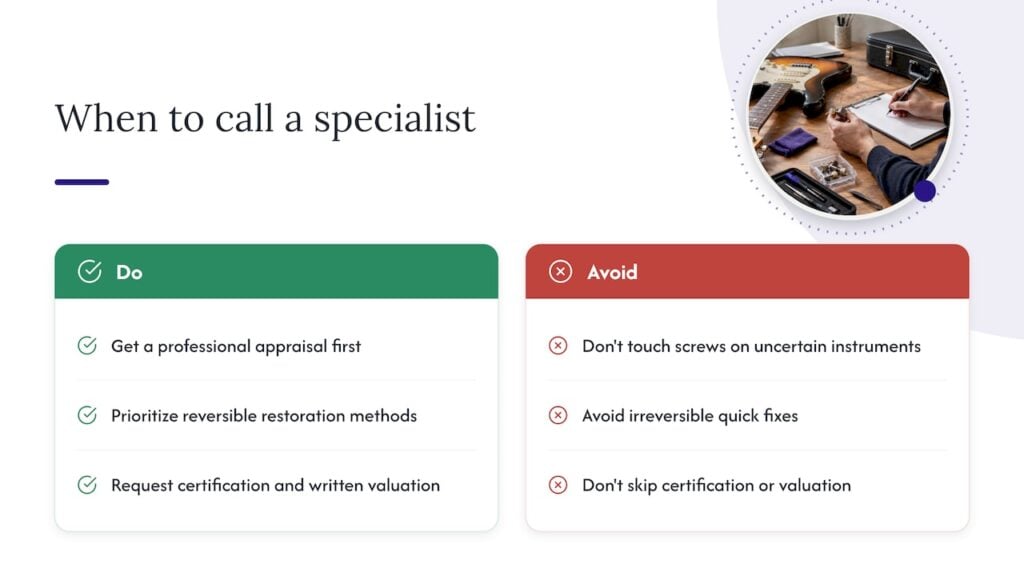
High-value instruments or anything with uncertain history are worth a professional appraisal before you touch a single screw. Restoration differs from simple repair: a skilled workshop prioritizes reversible techniques that preserve as much original material as possible, rather than the fastest fix. Certification and written valuations give buyers the documentation they expect from a serious sale.
Balancing Sound and Value
Preservation is the safer bet on anything genuinely collectible: when in doubt, don’t alter it. Players should chase good tone and comfort, but keep every original part in a box. Whichever path you take, document it and disclose it when you sell.
— Vintage
How We Can Help: Valuation, Restoration, Appointments
We built our approach around the exact tension this article describes: protecting an instrument’s history while keeping it playable. Vintage Guitar World offers expert evaluation, personalized service, and a curated catalog for collectors who want that balance handled by someone who deals with it daily.

| Service | Solves this problem |
|---|---|
| Zertifikate und Wertgutachten | Buyers need documentation before a sale |
| Restaurierung | A playable vintage instrument needs repair without losing originality |
| Exklusive Anspieltermine | You want to test an instrument in person before deciding |
| Verkauf in Kommission | You want to sell without handling the process yourself |
If you’re weighing a restoration or need a written valuation before selling, our restoration services page explains typical scopes, and our homepage lists every service alongside our current catalog of vintage guitars.
FAQ
Wie nennt man die einzelnen Teile der Gitarre?
A guitar’s main parts include the body, neck, headstock, fretboard, bridge, tuners, pickguard, and, on electric models, the pickups and wiring harness. Each of these parts can be original or replaced, which is exactly why inspection checklists focus on them individually.
Wer ist der beste Gitarrenbauer der Welt?
There’s no single agreed answer, since luthier reputation varies by instrument type, era, and personal taste among collectors. Rather than naming one builder as definitively best, most serious buyers judge craftsmanship case by case, looking at build quality, materials, and documented history.
Was ist der Unterschied zwischen einer Gitarre und einer Guitalele?
A standard guitar typically has six strings tuned to the familiar E-A-D-G-B-E layout, while a guitalele is a smaller hybrid instrument tuned like a guitar’s top four strings with a capo at the fifth fret, closer to a ukulele in size. The guitalele trades range and volume for portability.
Wann ist eine Gitarre vintage?
There’s no single universal cutoff, but the term generally applies to instruments at least a few decades old that reflect the construction methods and materials of their original era. What matters more for value than age alone is whether the instrument retains its original parts, finish, and documentation.
Sources
- Gitarre: Originalität und Modifikationen
- Ersatzteile für die Gitarre: So kommen Hobby-Gitarristen an die richtigen Teile
- CITES (context for conservation and legal constraints)