


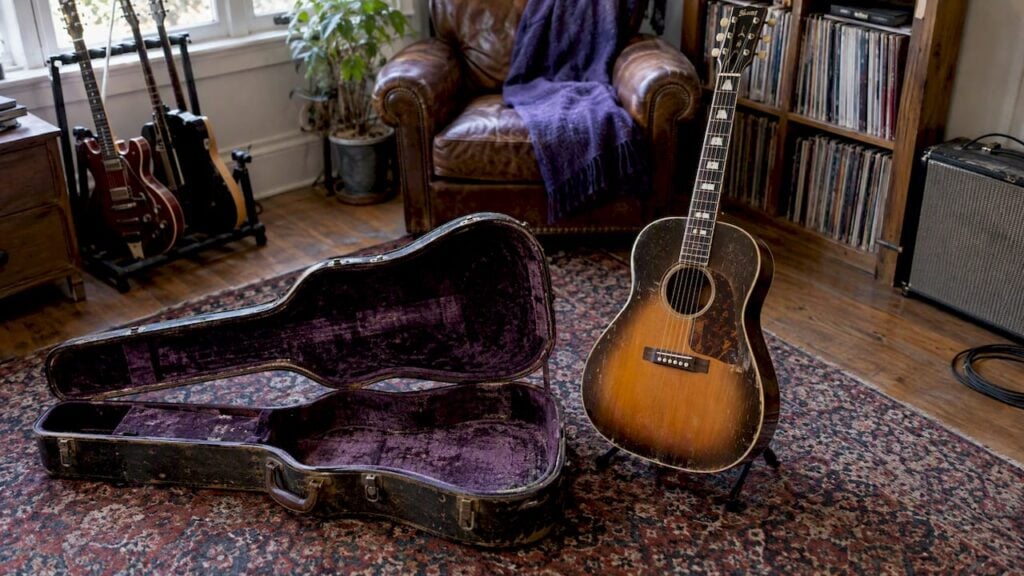

Yes, but how much depends on the guitar. On an investment-grade vintage instrument, the original case is part of the asset and its absence costs you at the sale. On an entry-level guitar, the case rarely moves the price at all. This guide shows where your guitar sits on that scale, what makes a case “original”, and what to do with it once you own it.
TL;DR
- On collector-grade guitars, a matching original case counts as part of the instrument’s value. On inexpensive guitars it adds little.
- Condition and correctness matter more than the logo. Latches, hinges, handle and lining tell you more than the lettering.
- Keep a worn original case. Even a damaged one is evidence of provenance, and a careful restoration beats decay.
- Use a modern case for gigs and travel, and keep the original at home.
- Document the case in your records and tell your insurer about it. A missing case can lead to a valuation dispute after a claim.
Table of Contents
- Why the case counts at all
- How much value does an original case add?
- What counts as an “original” case
- Condition: worn, restored or replaced?
- Keep the damaged case anyway
- Use a modern case on the road
- Insurance, claims and the missing case
- Shipping a guitar in its original case
- Our view: the case is evidence, not decoration
- Want a second opinion on your guitar and its case?
- FAQ
- Sources
Why the case counts at all
A case looks like packaging. For a collector it is a witness. How a guitar was stored, whether it traveled, whether it sat in a damp cellar: the case records all of that. The German antiques guide Antiklounge makes the same point. A case is first a protective container, but it can also say a lot about how an instrument was used and stored.
Buyers read it the same way. On investment-grade vintage guitars, appraisers treat the original case as an essential part of the asset’s worth. Its absence is often read as a sign of a fragmented or neglected history, according to the Antiklounge discussion of accessories and paperwork. The reverse also holds. For entry-level instruments, the same source cautions against overvaluing “completeness”, because the guitar itself rarely justifies a premium for the case.
So the first question is not “what is my case worth?” It is “what kind of guitar is it sitting next to?”
How much value does an original case add?
There is no official price list for cases, and anyone quoting a fixed percentage is guessing. What we can say is how the market tends to reason.
| Type of guitar | Role of the original case | What to expect |
|---|---|---|
| Entry-level or mass-produced instrument | Nice to have | Little or no premium. A good modern case serves you better. |
| Solid mid-range vintage player | Supporting factor | Helps a sale and builds buyer confidence, but the guitar’s condition and originality dominate. |
| Collector-grade, golden-era instrument | Expected part of the package | Missing case is a visible gap. Buyers tend to deduct for it or ask more questions. |
| Documented rarity or provenance piece | Part of the evidence | Case, papers and photos together support the price. |
One data point from the collector world: in a thread on the Unofficial Martin Guitar Forum, a member argued that for a golden-era Martin the original hard shell case in excellent condition is assumed present in price guide listings, and that about 7% could be deducted when it is missing. That is one collector’s opinion on one brand, not a rule. Treat it as a sense of scale, not a formula.
If you want a number for your own guitar, a written valuation does the job better than any forum. Our guides on how to value collectible guitars and guitar appraisal for collectors explain what a valuer looks at, and the case is one line on that list.
What counts as an “original” case
This is where most buyers and sellers go wrong. “Original” can mean three different things:
- Factory-supplied with that guitar. The case that left the workshop or dealer with the instrument. This is the strongest claim and the hardest to prove.
- Period-correct. Made in the same era, in the same style, and correct for the model, but not necessarily the one that shipped with this exact guitar.
- Later or generic. A replacement from any other time.
The second category is bigger than people think. Cases for famous brands were often made by third-party manufacturers, not by the guitar makers themselves. A discussion on Guitarworld.de about whether a Gibson case is genuine shows how murky this gets. Owners compare lettering, hinges, latches and lining and still disagree. Some participants even say original cases should not be taken too seriously.
What that means in practice: a logo alone proves little. Look at the details that were hard to fake or that changed over the years.
A quick inspection list
- Latches and hinges: Do they match the era and the model? Replaced hardware is a red flag, but so is hardware that looks too new.
- Handle: Material, attachment and wear should fit the case’s age.
- Interior lining: Color, fabric and wear pattern should be consistent with the case’s history. A pristine lining in a battered shell needs an explanation.
- Shape and fit: A true match fits the guitar’s body, neck and headstock without forcing. A case that is slightly off often belongs to another model.
- Labels, stickers, dealer tags: Useful evidence if they are consistent with the rest. They are also easy to add, so never rely on them alone.
- Case candy: Original strap, hang tags, warranty card and other papers raise confidence when they fit the story.
If you are buying, ask the seller for close photos of every one of these details. Our 7-point checklist for buying vintage guitars and our guide to avoiding scams when buying a guitar both cover how to check a seller’s claims, including accessories.
Condition: worn, restored or replaced?
Collectors prize originality, but they are realistic about cases. As guitar dealer and author George Gruhn explains in a Vintage Guitar magazine Q&A, cases take far more wear than the instruments inside, so they are expected to be less than pristine, especially after touring. A well-restored, working original case is worth considerably more than one left to decay, provided the restoration uses historically accurate methods and materials.
That gives you a rough order of preference:
- Original case in good, honest condition.
- Original case, sympathetically repaired with correct materials.
- Period-correct case in good condition, described honestly as such.
- Original case in advanced decay (still worth keeping, see below).
- No period case, with a good modern one.
The wording on that last step matters. A modern case is not a defect. It is simply not part of the value story.
Do not “improve” a case
Do not repaint a shell, replace all the hardware or re-line the interior with whatever is cheapest. A tidy case that has lost its original features can be worth less to a collector than a scruffy one that has kept them. If a case needs work, find someone who knows period materials, and keep the replaced parts. The same thinking applies to the instrument itself, which we discuss in restoring versus preserving original condition.
Keep the damaged case anyway
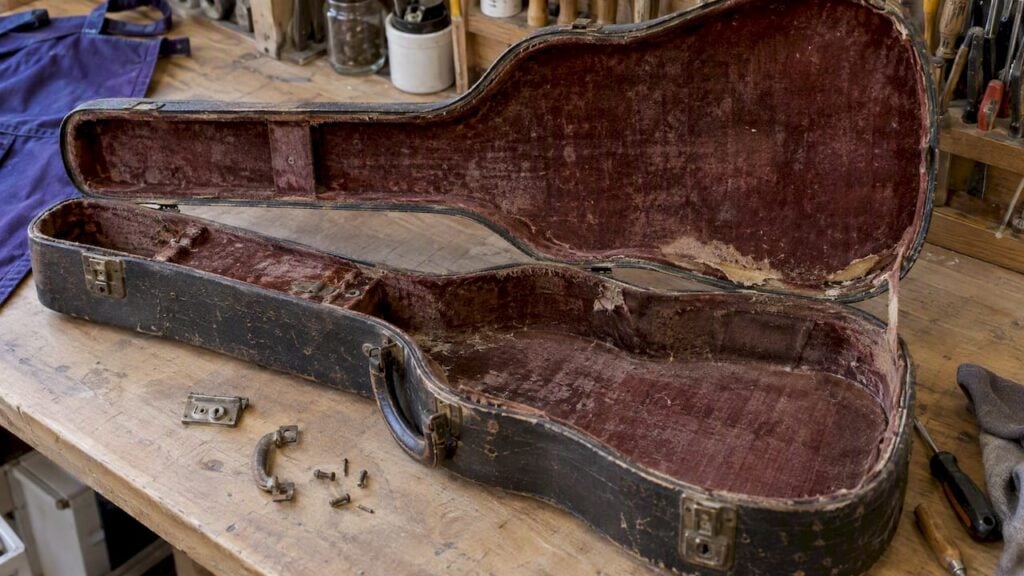
It is tempting to throw out a crumbling case and buy a new one. Do not. Experts quoted by German insurance broker MAWA advise keeping even a damaged original case, because it is physical evidence of the instrument’s provenance and storage history. The same page recommends a complete “Stammbuch” for each instrument: photos, purchase receipts and repair records.
A simple version for your own collection:
- Photograph the guitar and case together, front and back, with the case open and closed.
- Photograph latches, hinges, handle, labels and the interior lining.
- File receipts, appraisals and repair invoices in one folder, paper and digital.
- Note the date you acquired the case and whether it came with the guitar.
That folder is often what turns a good guitar into a well-documented one. Our guitar appraisal checklist lists what else to record.
Use a modern case on the road
The practical conclusion of all this is simple: do not gig with your collector case. Gruhn’s advice in the same Vintage Guitar interview and common practice among collectors point the same way. Keep the original vintage case safely at home, and use a modern, heavy-duty case for transport. Regular use wears the original down and can cause structural damage that eats into collector value.
Store the original case:
- In a room with stable temperature and humidity, not in a cellar, attic or garage.
- Away from radiators and direct sunlight.
- With the guitar inside only if the climate is stable and the interior lining is in good, clean condition. Old linings can react with finishes on some instruments, so ask a luthier if you are unsure.
Insurance, claims and the missing case
In a claim, the case can become a point of dispute. MAWA notes that a missing or non-original case can lead to arguments over valuation. The same page also stresses that the insured sum is the foundation of the policy: if it is wrong, the rest hardly matters. Vintage, custom-shop and collector pieces are especially tricky because their values vary so widely.
What to do:
- Insure the guitar at an appraised value, not at what you paid years ago.
- Make sure the valuation states whether the original case is included, and describe its condition.
- Keep the photos and papers from the previous section where you can reach them after a loss.
- Ask your insurer in writing whether the case is covered together with the instrument or separately.
A written valuation from an independent expert is the strongest document you can attach. We explain how in our guide to determining the value of guitars.
Shipping a guitar in its original case
If you are selling, buying or sending a guitar for repair, think twice before shipping the old case with the guitar inside, or at all. A hard case adds weight and size, and carriers charge for that.
In Germany, a standard DHL parcel is limited to 120 × 60 × 60 cm. A guitar in a case often exceeds that, which makes it bulky goods, as DHL’s Sperrgut page explains. The guide gitarre-versenden.de lists a domestic Sperrgut surcharge of 28.99 EUR and notes that standard liability is limited to 500 EUR. It gives higher cover as an option, for example up to 25,000 EUR for about 20 EUR. Check current rates with the carrier before you ship, since both can change.

For a valuable instrument, our vintage guitar shipping workflow walks through packing, insurance and documentation. For the original case itself, the safest approach is often to ship the guitar in a modern case and hand over the original in person or send it separately with its own insurance.
Our view: the case is evidence, not decoration
We see this question at every price level, so here is where we stand.
First, we describe cases honestly. When a guitar comes with a case that is original to it, we say so. When it comes with a period-correct or modern one, we say that instead. A buyer who knows what he is getting is a buyer who does not feel misled later.
Second, we do not let a case carry a guitar. A beautiful case does not make a modified or heavily refinished instrument original, and a missing one does not make an honest, well-kept guitar a bad purchase. Playability, structural soundness and originality of the instrument itself always come first.
Third, we advise against over-restoring. A case with honest wear and its original hardware is usually more convincing than one that has been “freshened up”. If a case needs repair, do it with correct materials, and keep what you replace.
Fourth, we recommend paperwork. Photos, receipts, certificates and a valuation protect you at resale and in an insurance claim. Our valuation and certification services exist because documented guitars are easier to trade and easier to insure.
— Vintage
Want a second opinion on your guitar and its case?
If you own a vintage instrument and want to know what it is worth with the case you have, we can help. We offer certificates and valuations, and we sell guitars on commission for owners who prefer not to deal with buyers directly. You can also arrange an in-person test appointment if you are considering a purchase. Start on our main page, or browse the vintage guitars we currently offer. If your case or guitar needs work, see our restoration page.
FAQ
Is a guitar worth less without its original case?
Often, but not always. On collector-grade vintage instruments, buyers tend to deduct for a missing case and may ask whether the history is complete. On entry-level guitars the effect is small. How much to deduct is a matter for a valuer, since forum opinions vary by brand and era.
Can I sell the original case separately?
You can, but it usually costs you more than it earns. A case separated from its guitar loses its provenance, and the guitar loses a piece of its evidence. If you must sell them apart, document both thoroughly and say so in the listing.
How do I know if my case is really original to my guitar?
Compare hardware, handle, lining and fit with known examples from the same period, and look for matching labels or papers. Because many cases were made by third-party makers, a logo alone proves little. A written valuation from a specialist is the most reliable way to settle the question.
Should I use my original case for gigs?
No. Collectors generally keep the original case at home and use a modern, heavy-duty case for transport, because regular use wears the original out and lowers its collector value.
Does my insurance cover the case as well?
That depends on your policy, so ask your insurer in writing. A missing or non-original case can lead to a valuation dispute in a claim, so state the case’s condition in your valuation and keep photos and receipts.
Sources
- Q&A With George Gruhn: A Strong Case, Vintage Guitar magazine
- Added Value of Original Case, The Unofficial Martin Guitar Forum
- Zubehör, Koffer, Belege: Wie wichtig?, Antiklounge
- Gibson Koffer: Ist der echt?, Guitarworld.de
- Instrumentenversicherung für Musiker, MAWA Finanz
- Sperrgut verschicken, DHL
- Gitarre versenden leicht gemacht, gitarre-versenden.de