


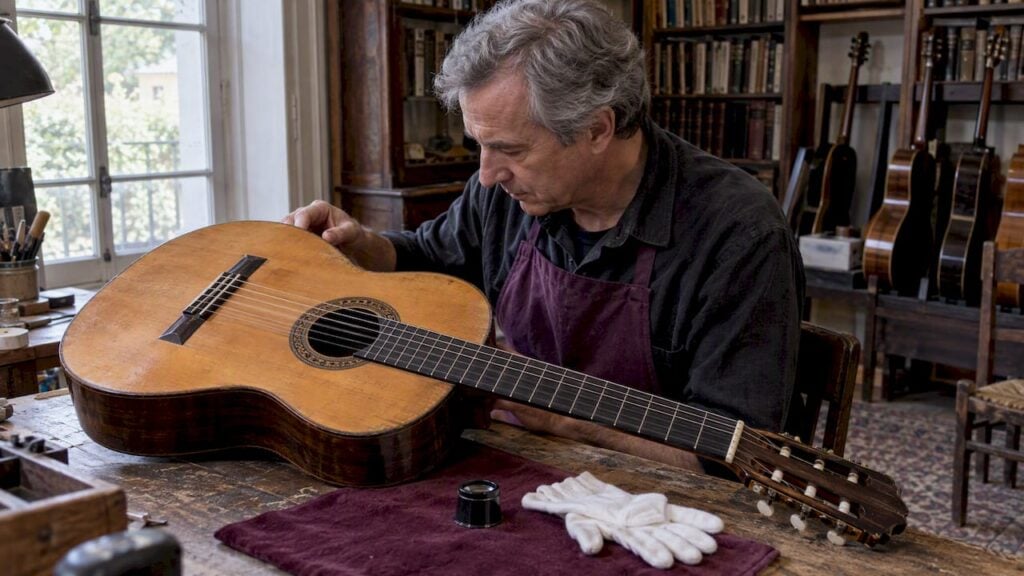

The most reliable way to recognize a genuine Manuel Reyes guitar is to check four things together: the label, signature, and address match a known period; the rosette and decoration style fit the model; the internal fan strutting pattern is consistent with the era; and some form of provenance documentation backs the instrument’s history. When any of these conflict with each other, treat the guitar as unconfirmed until a qualified luthier or specialist examines it in person.
TL;DR:
- Confirm internal fan strutting patterns match the guitar’s claimed era, as Reyes used five or seven struts depending on the period.
- Verify the label’s address, signature, and date are consistent with documented examples from the relevant timeframe before making an assumption.
- Check for cedar tops or Tipo C features, noting that cedar-top Reyes guitars are extremely rare and require extra provenance verification.
- Gather and scrutinize all available provenance documents, such as receipts and correspondence, to strengthen the authenticity case.
- Use a thorough inspection process, including photographing features and internal construction, before seeking expert evaluation and certification.
Table of Contents
- Visual features that identify Manuel Reyes guitars
- Label, signature, and date: how to read and interpret them
- Internal construction clues worth checking inside the guitar
- Materials and known rare variants: Tipo C and cedar-top notes
- Provenance and documentation: what counts and how to assemble it
- Quick authentication checklist you can use now
- How professionals verify Manuel Reyes guitars
- Why documented, conservative identification protects collectors
- Book an appraisal, get a certificate, or arrange restoration with us
- FAQ
- Sources
Visual features that identify Manuel Reyes guitars
Start with what you can see without opening the instrument. Reyes rosettes range from simple, hand-set patterns on Tipo C flamenco models to more detailed, layered designs on his concert classical guitars, so a plain rosette is not automatically a warning sign. The headstock shape, bridge style, and top finish tend to follow consistent workshop habits across decades, though minor variations show up as his career progressed.
Label placement matters as much as its wording. Earlier labels often reference a Plaza del Potro address in Córdoba, while later instruments show different address details as his workshop location changed. A label that looks too crisp, oddly positioned, or printed with modern fonts deserves closer scrutiny.
- Check the rosette style against the guitar’s apparent model and era.
- Compare the address on the label to known period variants before assuming it is wrong.
- Remember that unsigned or unstamped labels can still appear on authentic Tipo C examples, so absence of a signature alone does not rule out authenticity.
Label, signature, and date: how to read and interpret them
A genuine label usually includes the maker’s name, a location, and sometimes a handwritten date or serial reference, but the exact fields shift across decades as Reyes’s labeling practices evolved. Signature placement also changed over time: some guitars carry a stamped signature near the label, others have none at all, which is why context matters more than a single missing mark.
Watch for practical red flags when examining a label up close: fresh glue residue around the edges, typography that does not match the printing style of the claimed period, or ink that looks newer than the surrounding paper. None of these alone proves forgery, but together they should slow you down.
- Cross-check the address, the date, and the maker’s name for internal consistency rather than judging each in isolation.
- Compare label wording and layout to documented examples before relying on a single detail.
- Treat a perfectly pristine label on an otherwise aged instrument as a reason to look closer, not a reason to panic.
For a deeper walkthrough of label conventions, our guide to dating a Spanish guitar label covers how wording and format shifted across different workshop periods.
Internal construction clues worth checking inside the guitar
The inside of a Reyes guitar often tells you more than the label does, but it has to be read carefully and in context. Fan strutting patterns varied across his career, with some instruments built on five struts and others on seven, and matching the pattern to the guitar’s apparent period is one of the more dependable checks available to a careful buyer.
- Note the number and arrangement of fan struts visible through the soundhole and compare them to the guitar’s claimed era.
- Look for hand notes, stamps, or kerfing style that matches period-appropriate construction rather than modern repair work.
- Pay attention to glue type and color consistency, since mismatched or clearly recent adhesive can signal a repair or alteration.
- Weigh the instrument if possible: lightweight flamenco Blanca-style Reyes guitars are a known characteristic of certain models, not a flaw.
- Leave any physical opening of the body to a qualified luthier, and instead photograph the soundhole area in sharp detail for remote review.
Materials and known rare variants: Tipo C and cedar-top notes
Tipo C refers to a simpler, lower-decorated line within Reyes’s output, and specialist forum discussions describe these guitars as sometimes unsigned or unstamped even when genuine, a pattern tied to how Tipo C guitars were discussed on ForoFlamenco. Community threads there also note that cedar-top Reyes guitars are notably uncommon, so a cedar top deserves closer documentation rather than automatic suspicion.
- Tipo C models were built with reduced ornamentation, which can make them look plainer than concert-grade Reyes guitars without making them less authentic.
- A cedar top on a Reyes guitar is uncommon enough that it warrants extra provenance work before you accept it at face value.
- Wood matching, visible knots, and old repairs all affect both identification confidence and eventual value, so document them rather than ignoring them.
Provenance and documentation: what counts and how to assemble it
Paper trail evidence often carries as much weight as the label itself, especially for older or simpler instruments. The strongest provenance items include original sales receipts, letters referencing the maker or his workshop, auction records, and any past valuation or appraisal reports tied to the specific guitar.
- Original receipts and maker correspondence rank highest because they tie the instrument to a specific transaction and date.
- Auction records help corroborate a guitar’s history even when family paperwork is missing or incomplete.
- Provenance can validate early Tipo C examples that lack a signature, since the documentary trail fills the gap the label leaves open.
A practical sequence works well: photograph the instrument thoroughly, gather whatever paperwork exists, then search auction and dealer archives for comparable examples. Our guide to proving a guitar’s provenance walks through digitizing and organizing older paperwork so it holds up under expert review.
Quick authentication checklist you can use now
Work through these steps in order before deciding whether a professional opinion is worth arranging.
- Inspect the exterior: rosette, headstock, bridge, and finish.
- Read the label closely for wording, address, and date consistency.
- Photograph the inside through the soundhole, focusing on strutting and stamps.
- Note any structural features, repairs, or unusual materials like a cedar top.
- Gather whatever provenance documents exist, even partial ones.
- Decide whether the evidence is strong enough on its own or whether an expert should weigh in.
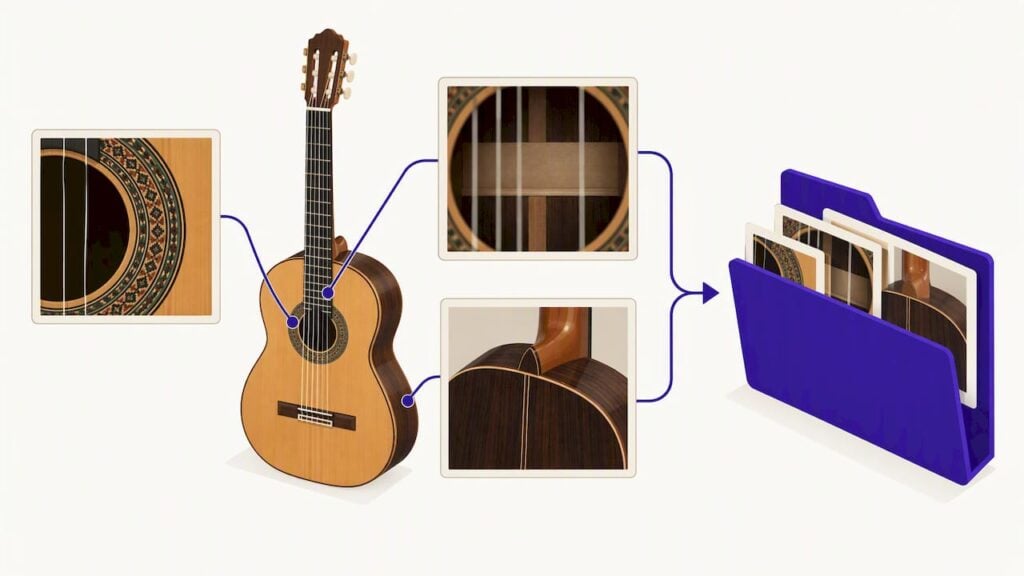
Take full front and back shots, a label close-up, the rosette, the headstock, and a clear interior shot through the soundhole.
Pro Tip: Name your photo files by feature (label, rosette, interior) and send the full set together so an expert can form a remote opinion without follow-up requests.
For a longer walkthrough of this process, see our authenticity checklist for vintage guitar collectors.
How professionals verify Manuel Reyes guitars
A thorough in-person inspection covers more ground than photos alone can. Professionals typically check the label and signature against known examples, examine the interior structure and wood under proper lighting, assess tonal response, and compile a written condition report alongside any provenance found.
- Expect a documented process: photos, structural notes, and a written assessment rather than a verbal opinion alone.
- A valuation or certificate, where warranted, gives the instrument a documented record for resale or insurance purposes.
- We offer hands-on testing appointments, formal documentation for collectors, and conservation work for instruments before or after authentication.
Readers preparing an instrument for inspection can review our restoration workflow guide to understand what conservation work typically involves.
Why documented, conservative identification protects collectors
We favor documented authenticity over confident guesswork, because a certificate and a paper trail hold up at resale in ways a label alone never does. Playability and tone matter just as much as any mark on the headstock.
— Vintage
Book an appraisal, get a certificate, or arrange restoration with us
If your identification work raises more questions than it answers, we offer a direct path forward. We provide hands-on testing appointments, formal documentation for resale or insurance, and restoration services addressing structural or cosmetic issues before a valuation is finalized.

To get started, bring any paperwork you have, your photo set from the checklist above, and the instrument itself if a visit is practical. Every assessment we provide comes with transparent condition notes, so you know exactly what you are being told and why. Visit our shop and services page to review current offerings and arrange a visit, or browse our restoration services if conservation work comes first.
FAQ
How can I tell if a Manuel Reyes guitar is a Tipo C model?
Tipo C guitars are a simpler, lower-decorated line, often with plainer rosettes and sometimes without a signature or stamp, a pattern documented in specialist forum discussions. A missing signature on an otherwise period-correct instrument does not rule out authenticity on its own.
Why do some authentic Manuel Reyes guitars have no signature?
Some Tipo C instruments left the workshop unsigned or unstamped even though they are genuine, according to community threads tracing these variants. Provenance documentation, such as receipts or correspondence, often fills that gap.
Are cedar-top Manuel Reyes guitars rare?
Yes, cedar-top examples are described as extremely rare in discussions tracking Reyes’s output, so a cedar top warrants closer documentation rather than automatic doubt. Wood matching and visible repairs should be checked carefully on any cedar-top example you encounter.
What documents count most for proving a guitar’s provenance?
Original sales receipts, letters referencing the maker, auction records, and past valuation reports carry the most weight when establishing an instrument’s history. Our guide to documenting provenance covers how to organize and present this material.
Can Vintage Guitar World authenticate my Manuel Reyes guitar?
We offer exklusive Anspieltermine for in-person testing along with Zertifikate und Wertgutachten for formal documentation, which together support a thorough authenticity assessment. Pricing for these services is available on request through our services page.