


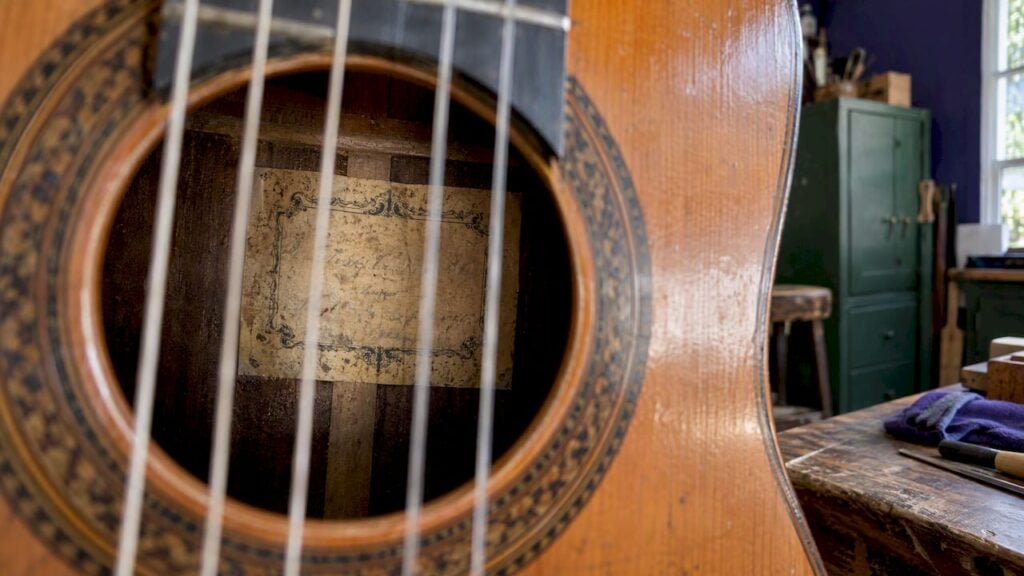

A luthier’s signature is usually one of three things: a paper label glued inside the body (in German, a Zettel), a brand stamp on the headstock, neck block or inside back, or a handwritten name, often with a date, on the soundboard’s underside or the inside back. To recognize it, shine a light through the sound hole, photograph everything you find, read name, place and year, and then test whether the mark fits the instrument around it. A label alone never proves a maker. It is a clue that has to agree with the wood, the construction and the wear.
This guide walks you through that process step by step, for classical, flamenco, acoustic and electric guitars.
TL;DR
- Look first inside the sound hole (upper and lower bout, neck block, inside back), then at the headstock, heel and back of the neck.
- A mark can be a paper label, a stamp, a branded logo, a serial number or a handwritten signature. Each is read differently.
- Name, place, year and sometimes a model or opus number are the facts to extract. Write them down exactly as printed.
- Labels can be replaced, copied or moved between instruments, so compare paper, printing, aging and the guitar itself.
- If the mark is missing or unreadable, good photos plus construction details are the way forward. A written expert opinion comes last.
Table of Contents
- Where to look for a signature or label
- The kinds of marks you will meet
- What a label can tell you
- Original, retailer or later addition?
- Famous names are the riskiest
- Serial numbers and construction details
- How to photograph a label for an expert
- When the label is missing, damaged or unreadable
- What to do before you buy
- Our perspective
- Test, certify or sell with us
- FAQ
- Sources
Where to look for a signature or label
Start with the place where most makers leave their mark: the inside of the body. Remove nothing and loosen nothing yet. Hold the guitar with the soundboard facing up, tilt it, and shine a small flashlight through the sound hole. A dental mirror or your smartphone camera on a selfie stick helps you see surfaces you cannot reach with your eye.
Check these spots in order:
- The inside back, near the sound hole. On many Spanish-style guitars the label sits on the back, centered, where you can read it by looking diagonally through the hole. Labels on bowed instruments traditionally sit on the inside back as well, which is why guitar makers adopted the habit.
- The neck block (the wood mass where the neck meets the body). Makers often stamp, pencil or write a number, a name or a date here.
- The underside of the soundboard and the braces. Some luthiers sign in pencil or ink across a brace, or write a date and a model number there.
- The headstock, front and back. Look for decals, inlays, engraved or burned-in names, and number stamps. On factory electrics, a serial number may be stamped into the wood or sit on a plate.
- The heel and the end of the fingerboard. Small stamps, initials and workshop marks are sometimes hidden under the heel cap or beneath the fingerboard extension.
- The control cavity and the pickup routes (electric guitars). Dates, pencil notes and part numbers show up here, and they often tell you about repairs as well.
Write down where you found each mark. Later, the position of a label matters as much as its text, because a label in an unusual position is one of the first signs that something has been changed.
The kinds of marks you will meet
Not every mark is a label, and not every label is a signature. Knowing the type tells you how much weight to give it.
Paper labels
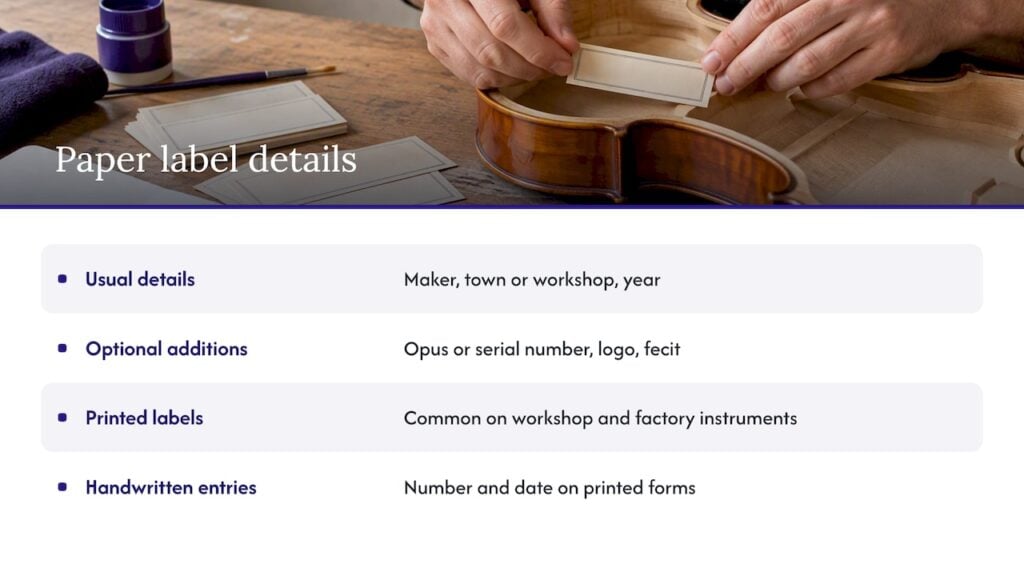
A traditional label is a small piece of paper glued inside the instrument. As a rule it gives the maker’s name, the town or workshop, and the year. Some add an opus or serial number, a logo, or a Latin formula such as fecit (“made by”). Printed labels are common on workshop and factory instruments. Handwritten entries on a printed form are common on small workshops, where the maker fills in the number and date by hand.
Brand stamps and branded marks
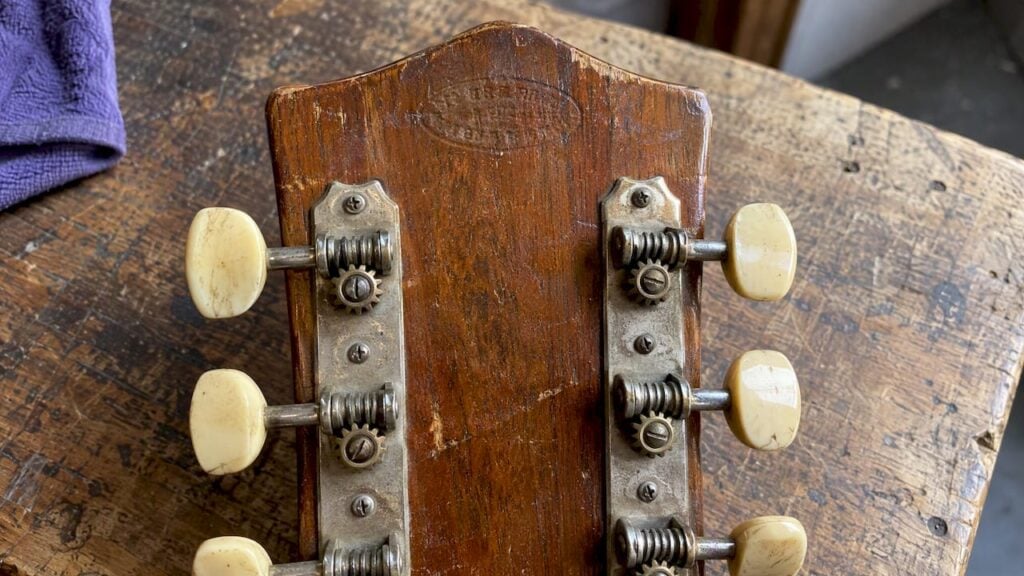
A stamp is pressed or burned into the wood. You will find it on the headstock, the neck block, the inside back or on the heel. Stamps are harder to move to another instrument than a paper label, so they carry more evidential weight. They can also be faked, but a convincing stamp has to sit in a convincing position with convincing aging around it.
Handwritten signatures
Many independent luthiers sign and date the soundboard from the inside, or write on the neck block. Handwriting is individual. Compare it with documented examples of the maker’s hand, such as other signed instruments, letters or workshop papers, never with a single photo from a forum thread.
Serial numbers, plates and codes
Factory makers usually identify instruments with serial numbers, internal plates or stamped year codes. The system differs from firm to firm and sometimes changes across decades, which is exactly why a serial number only makes sense against that maker’s own documented system. A number without the maker’s table is just a number.
What a label can tell you
Once you can read the mark, extract the facts in a fixed order. This keeps you from reading what you hope to see.
- Name. Is it a person (a luthier), a firm, or a brand name used by a distributor? Many guitars carry the name of the shop or wholesaler that sold them, not of the hands that built them.
- Place. A town on a label helps you narrow down the workshop. Check whether the spelling, the postal format and the street name match the period. A postal code format that did not exist yet when the guitar was supposedly built is a classic red flag.
- Date. The year of construction may appear in numerals, in words or in a code. Remember that a year on a label can also mean the year of a repair or the year of a printing run.
- Model or number. An opus number or a model name lets you compare with catalogs and with other known instruments.
- Extras. Logos, slogans, medals and “fecit” formulas help to date the printing style.
The layout and typography are evidence too. Two labels from the same workshop but a decade apart will rarely look identical. Learn the maker’s typical label evolution before you decide that a label “looks wrong.” If you are dealing with a Spanish guitar, our guide on dating the label on a Spanish guitar explains the typical formulas, number systems and handwritten entries in detail.
Original, retailer or later addition?
This is where most buyers go wrong. A readable label feels like proof, yet labels are the easiest part of a guitar to alter. There are five common situations:
- A genuine maker’s label. It matches the instrument in age, construction and position.
- A retailer or distributor label. The guitar was built by one workshop and sold under another name. This is perfectly legitimate and historically interesting, but the value and the attribution are different.
- A repair or restoration label. A restorer’s note, a repair date or a shop sticker. It tells you the instrument’s later history, not its origin.
- A replaced label. The original was damaged or removed, and a new one was fitted, sometimes honestly as a replica, sometimes not.
- A reused or forged label. A label from a different instrument, or a deliberately made copy, glued into a guitar to raise its apparent value.
The approach is always the same: compare the paper, the printing technique and the content of the label, and then compare all of that with the instrument it sits in. Specialists in historical instruments point out that non-experts usually cannot decide authenticity from a label alone, and that is a fair warning for guitars too.
Practical tests you can do yourself
- Glue and edges. An old label sits flat, with glue that has aged and darkened evenly with the wood. A fresh, bright edge or a bubble under the paper suggests recent handling.
- Dirt and light. Dust, finish overspray, and sun exposure should be consistent between the label and the surrounding wood. A spotlessly clean label in a grimy interior is suspicious.
- Position. Compare with known examples of the maker. Many workshops placed labels consistently. A deviation needs an explanation.
- Construction match. Do the bracing pattern, the neck joint, the tuners, the bridge and the finish belong to the claimed maker and period? Authentication is the sum of period-consistent construction, wear patterns and a timeline that makes sense, including whether a newer label sits in an older body.
- Language and typography. Spelling, abbreviations and typefaces should fit the place and decade.
Our longer guides on authenticating vintage guitars for collectors and on checking the authenticity of a vintage guitar go through the full process, including paperwork and provenance.
Famous names are the riskiest
The more famous the name, the more likely it is that you will meet copies, homages and “in the style of” instruments. Hauser is a good example. Researchers of the Hauser tradition note that many makers offer “Hauser” models that in most cases have little in common with the original. A label with a famous name therefore needs more checking, not less. If you suspect a Hauser or a similar high-end attribution, our guide to identifying a Hauser guitar shows how to work with documented comparables from museums and auction houses.
The same logic applies to factory brands. A famous headstock shape, a well-known logo or a familiar model name can be reproduced easily. Neck profile, hardware, wiring, wood and serial number all have to tell the same story.
Serial numbers and construction details
On industrially made guitars, the serial number often does more than the label. Many German and international factories stamped or plated their instruments with model numbers and a code for the production year, and some used letters for months. The rule for reading them is simple: use only the maker’s own documentation, and check that the code matches the features. An instrument whose serial number says one year but whose hardware, finish or body shape belong to another needs an explanation.
In practice, put four items in a table before you decide:
| Evidence | What to record | What it can tell you |
|---|---|---|
| Label or stamp | Exact text, position, paper, typeface | Claimed maker, place, year |
| Serial number or code | Number, location, stamping style | Production period, model line |
| Construction | Bracing, neck joint, wood, finish, hardware | Whether it fits the claimed maker and era |
| Alterations | Refret, refinish, new pickups, replaced parts | Originality and value impact |
Alterations matter for value. For collectible guitars, modifications such as refinishing, refretting or replacing pickups should be considered carefully and documented, as gearnews notes in its overview of guitars as an investment. We explain the effects in our articles on what a refret means for value and on retrofitting pickups only if reversible.
How to photograph a label for an expert
Good photos save weeks of back-and-forth. Take them before you ask anyone for an opinion:
- Overall views. Front, back, sides and headstock, in daylight, with the camera straight on to the instrument and no wide-angle lens, which distorts proportions.
- The label itself. Several angles, with and without flash, and one with a ruler or coin next to it for scale.
- The interior. Loosen the strings if you need room, push the phone through the sound hole, and rotate it in different directions with the flash on. Cover the upper block, the lower block, the bracing and the inside back.
- Stamps and numbers. Close-ups of the headstock, neck block, heel and any plates, shot raking light across the surface so the impression stands out.
- Flaws and repairs. Cracks, patches, replaced bridges, refinished areas. Do not hide them. Experts read these as part of the story.
Keep the original files. Compressed screenshots lose the detail you need for paper fibers and ink.
When the label is missing, damaged or unreadable
Missing labels are normal on old guitars. Paper detaches, humidity stains it, and repairs remove it. It does not mean the guitar is not genuine, but it does mean the attribution has to rest on other evidence.
- Document what remains. Glue traces, the outline of a removed label, and pencil notes can all help.
- Use the serial number and the style. With a surviving number and clear photographs of the interior, makers and workshops with archives can sometimes check their build records. Some small workshops keep a build card per instrument, and it is worth asking.
- Compare with known examples. Museum collections, auction records and monographs show how the maker built and labeled in a given period.
- Look at the details a maker cannot hide. Rosette, bridge shape, headstock outline, bracing and neck joint are a maker’s handwriting even without a name.
- Get a written opinion. For a significant instrument, a signed certificate from a recognized expert is the proper end point. Auction houses regularly describe such certificates, signed and dated by the expert, as part of a guitar’s provenance.
Be wary of anyone who identifies a maker from one photo of a label. A confident answer from a stranger on a forum is not an appraisal.
What to do before you buy
If you are buying a guitar on the strength of a label, a short checklist protects you:
- Ask for photos of the label, the interior and all stamps before you ask about the price.
- Ask how the seller knows the attribution: documents, previous owners, expert opinion, or only the label.
- Ask what has been replaced or restored, in writing.
- Ask for a trial appointment, so you can examine the instrument yourself with a light and a mirror.
- Ask whether a certificate or a valuation is part of the sale.
A seller who answers these openly is usually a seller worth trusting. One who avoids them is giving you an answer as well.
Our perspective
We handle labels every week, and the most useful lesson we can share is this: read the guitar first and the label second. A label tells you what someone wants you to believe, or at least what the maker intended. The wood, the bracing and the wear tell you what happened.
That is why every instrument we offer is evaluated by hand before it is described, and why we show interior photographs along with the label. We want you to see what we see, and to be able to question it.
If a guitar arrives without a label, we do not guess. We describe what we can verify, we explain what we cannot, and we offer certification and valuation where an instrument deserves it. Collectors who work this way build collections that hold up, whether they play the guitars or keep them.
Vintage
Test, certify or sell with us
If you want to see a label in person, we arrange exclusive testing appointments, where you can examine a guitar’s interior, play it and ask us anything about its history. If you own an instrument with a mark you cannot place, we offer certificates and valuation reports, and we sell selected instruments on commission for owners. Prices for these services are not published, so contact us through our site and describe what you have.
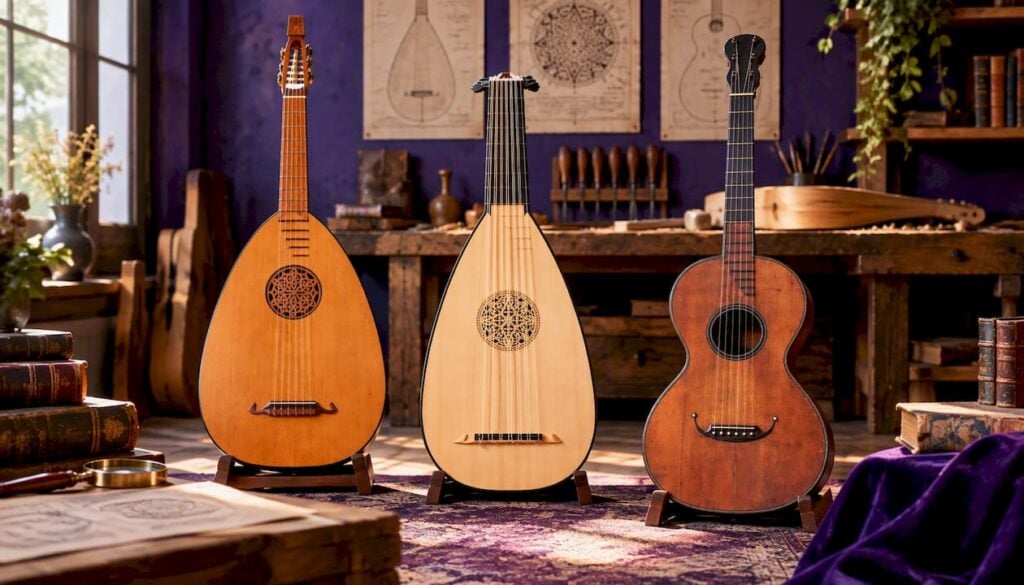
If you are looking for something to play, browse our vintage guitars, our classical guitars and our acoustic guitars. If a restoration is on your mind, our page on restoration costs is the place to start.
FAQ
Where is the maker’s label usually found on a classical guitar?
Usually on the inside of the back, below the sound hole, and readable with a flashlight or a mirror. Some makers sign the underside of the soundboard or the neck block instead, so check all three before you conclude that a guitar has no mark.
Does a label with a famous name prove the guitar is genuine?
No. Labels can be replaced, reused or copied, and famous names attract imitations and homages. Authenticity rests on the label, the construction, the wear and the documented history agreeing with each other.
Can I identify a maker from a serial number alone?
Only on factory instruments, and only with that maker’s own documentation of numbers and year codes. Even then, check that the hardware, finish and body shape fit the period the number suggests.
What if my guitar has no label at all?
Photograph the interior, the headstock, the heel and any numbers, then compare construction details with documented examples. Some makers can check build records from a serial number. For a valuable instrument, ask a recognized expert for a written opinion.
How should I photograph a label for an expert?
Use daylight and a straight-on camera for the exterior, and put the phone through the sound hole with flash for the interior, rotating it in several directions. Add close-ups of the label with a scale reference and keep the original image files.