


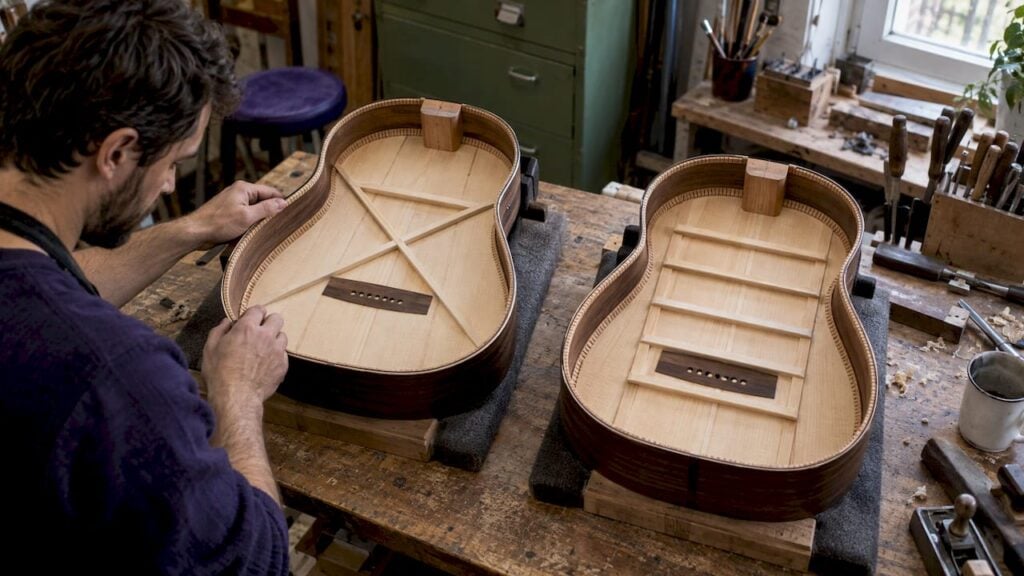

X bracing is the standard for steel-string flattops because it resists string pull and gives a full, balanced voice. Ladder bracing is the older, simpler layout. It gives a raw, punchy, midrange-forward sound that suits blues and folk, and it belongs mostly to light parlor guitars and budget instruments from the early 20th century. Neither is “better” in the abstract. They are two answers to the same question: how do you stiffen a very thin top without choking it? Here is how each works, how each sounds, and what to look for when you are choosing a vintage acoustic.
TL;DR
- X bracing: two braces cross just below the sound hole and support the bridge area. It is the pattern on nearly every steel-string flattop made today.
- Ladder bracing: parallel braces run across the top, perpendicular to the strings. It is lighter in character and gives a woody, punchy, midrange-heavy voice.
- Tension: X bracing copes better with steel-string tension, which is why it displaced ladder bracing on most steel-string guitars.
- Choosing: fingerstyle blues and vintage color point to ladder; fuller bass, shimmering highs and all-round versatility point to X.
- Vintage buying: check the bracing, the top’s condition and its history before you commit. The pattern is only part of the picture.
Table of Contents
- What the two patterns look like inside
- Why the top needs bracing at all
- Strength and string tension
- How they sound
- Which one suits your playing
- The collector’s view
- Worked example: choosing between two vintage acoustics
- Find your bracing at Vintage Guitar World
- FAQ
- Sources
What the two patterns look like inside
Open the sound hole of a steel-string acoustic and shine a light at the underside of the top. In most cases you will see two long braces crossing in an X just below the sound hole. The lower arms of the X straddle the bridge and run toward the tail block. Premier Guitar’s survey of the market puts it plainly: on virtually every flattop steel-string guitar sold today, you would spot that X intersection 99 percent of the time. Smaller tone bars and finger braces fill in around it.
Ladder bracing is exactly what the name says. Several straight struts are glued across the top, perpendicular to the strings and parallel to each other, like the rungs of a ladder. This is Classical Guitar describes it as probably the simplest form of bracing, with struts glued perpendicular to the grain of the soundboard. Most guitars, including X-braced ones, use ladder-style braces on the back. When people compare “ladder vs X”, they mean the pattern on the top, the soundboard.
Where each came from
Ladder bracing dominated early guitar building. Around 200 years ago most guitars used it, and early American steel-string makers used it too. C. F. Martin is credited with developing X bracing, which Premier Guitar’s Ervin Somogyi dates to the 1850s. Ladder bracing did not vanish. It survived in inexpensive guitars, and Somogyi notes it is found in cheap Harmony instruments that were widely used to play early blues, so much so that their sound became identified with that music.
If you want the maker’s story behind the X, our article on Christian Frederick Martin and the modern acoustic guitar covers it. For the wider picture of how the instrument evolved, see our history of the acoustic guitar.
Why the top needs bracing at all
An acoustic top is thin, often only around 0.08 to 0.125 inches, according to Guitar Repair Bench. Six strings pull on it constantly. The braces have two jobs: hold the top together against that pull, and control how the top moves.
Somogyi argues the second job matters more. In his view, top bracing has everything to do with shaping sound and rather little to do with simply keeping the guitar together. Without bracing, a flimsy top would vibrate chaotically and sound flat and harsh. Reverb’s explanation of the same trade-off is easy to remember: a top that is stiff but heavy will not respond, and a light top that is not stiff gives a loose, blurred tone. Builders aim for a thin, light top with just enough bracing for definition.
That is the lens for the comparison. Ladder and X bracing are different ways of spending a limited stiffness budget.
Strength and string tension
The X pattern spreads load across the whole top, and its arms cross behind the bridge to counter the strings’ pull. Ladder bracing supports the top with parallel bars, which leaves the area around the bridge less reinforced.
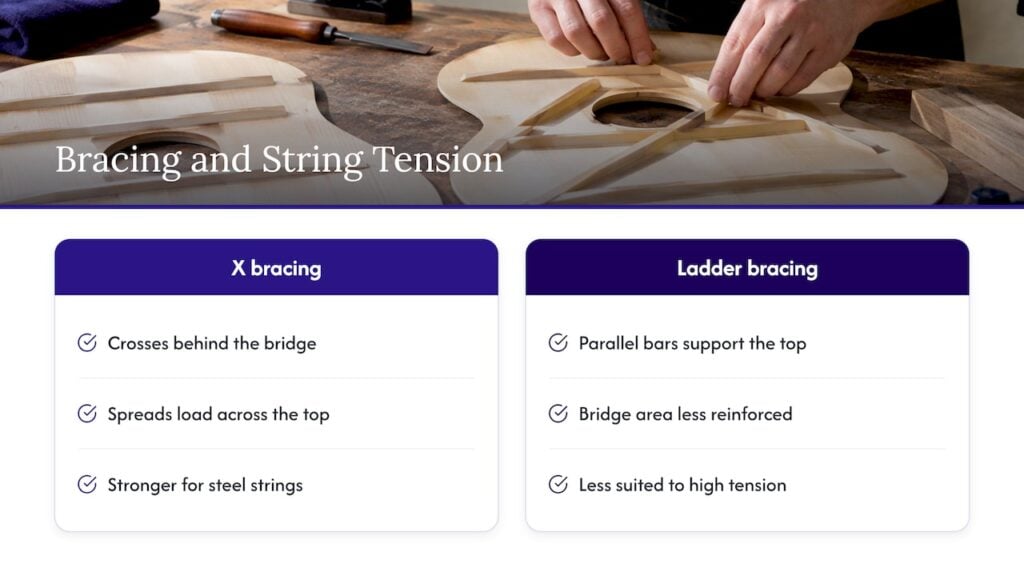
This mattered when steel strings arrived. This is Classical Guitar notes that ladder bracing did not withstand the high tension of steel strings very well, while X bracing was stronger. Even so, ladder bracing stayed in use on cheaper models well into the 1950s. Guitar World’s Huw Price adds that relatively few vintage parlor guitars had X braces or ladder braces sturdy enough to cope with steel strings.
For a vintage buyer this has one practical meaning: match the strings to the instrument. A light parlor guitar built for gut or very light strings is not the place for a heavy set.
A note on scalloping
Builders also shape the braces themselves. Scalloped braces are carved to reduce weight and let the top move more freely. We explain the details, and why many collectors prize the feature, in Scalloped Bracing Explained for Guitar Players. Bracing is more than a pattern choice. Its height, shape and placement all tune the result.
How they sound
Tone descriptions always carry some subjectivity, because wood, body size, top thickness and the player matter as much as the pattern. Still, there are consistent impressions.
X-braced guitars are usually described as loud for their size, with abundant low end and shimmering highs. Reverb’s review of the pattern says they respond well to both fingerstyle and flatpicking, and that the exact result depends on build quality and tonewoods.
Ladder-braced guitars tend to be raw, woody and midrange-forward. A rare side-by-side comes from Acoustic Guitar magazine’s review of a vintage-style model offered with either bracing. The reviewers found the ladder-braced version raw and punchy yet balanced from the lowest string to the highest. The X-braced example sounded a little smoother and more refined. They rated the two equal in responsiveness and playability.
That last point is the useful one. The difference is a matter of character, not quality. Premier Guitar’s Richard Johnston observes that the old wisdom that any non-X pattern was inadequate has softened. Players now appreciate the whining trebles of a ladder-braced vintage design and put that tone to work.
| Ladder bracing | X bracing | |
|---|---|---|
| Layout | Parallel struts across the top | Two braces crossing below the sound hole |
| Typical character | Punchy, woody, midrange-forward | Fuller bass, shimmering highs, balanced |
| Best known on | Parlor guitars, early blues and folk instruments, budget models of the 1920s to 1950s | Most steel-string flattops since the early 20th century |
| String tension | Better suited to lighter setups | Built for steel-string tension |
| Strong suit | Raw, vintage color for fingerstyle blues | Versatility for strumming, flatpicking and fingerstyle |
Which one suits your playing
Start with what you play.
- Fingerstyle blues, early folk, slide in a small body: ladder bracing is the classic voice. Its mid-forward punch is the sound many people associate with those styles.
- Strumming, flatpicking, singer-songwriter work: X bracing gives the bass depth and projection that fill a room.
- Recording a single acoustic that must do everything: X is the more flexible default.
- Classical and flamenco players: your guitars use another system again, fan bracing. Fan Bracing on Classical Guitars explains why it matters for nylon-string instruments.
Body size changes everything too. See How Guitar Body Shape Affects Your Tone before you decide on bracing alone.
The collector’s view
History shapes what you will meet on the vintage market. In the 1920s and 1930s, the budget lines of the big makers, such as the Kalamazoo and Recording King guitars described by Reverb, used simpler appointments and ladder bracing, and a majority of flattops of that period were ladder-braced. Gibson’s small LG-1 is the well-known example, and Johnston’s article on its revival is a good read on why players have rediscovered it.
Bracing therefore tells you something about a guitar’s origin and tier. Treat it as one piece of evidence next to model, year, wood, finish, repairs and originality.
What to check when you assess a vintage acoustic
- Identify the pattern. Look through the sound hole with a flashlight and a mirror. Note whether you see an X, parallel bars or another layout, and where the X crosses. The crossing point can sit in different places, and that placement influences bass response and projection.
- Check the top for belly or bulge. Pull from the strings acts on every top. Look for raised areas between bridge and sound hole, and for a bridge that has begun to lift or tilt.
- Inspect the braces. Look for loose braces, buzzing, glue failures and cracks near brace ends. Rattles when you tap the top are a clue.
- Match the strings. Ask what string gauge the instrument was set up for. Lighter builds want lighter sets.
- Consider climate. Aging wood reacts to humidity extremes, with cracking or warping as risks. This is a storage matter for any vintage instrument.
- Get it documented. Originality of bracing and any repairs affect value and should be recorded.
A photo cannot answer most of these questions. That is why we offer exclusive testing appointments at our shop, so you can hear and handle an instrument before you decide.
For a deeper look at the whole subject, see Bracing Systems in Guitars: What Collectors Need to Know and Bracing in Acoustic Guitars: Sound and Stability. For the bigger structural picture, read What is guitar construction?
Worked example: choosing between two vintage acoustics
Imagine you play fingerstyle blues at home and are looking at two guitars of similar age. One is a small ladder-braced parlor model, the other an X-braced flattop of medium size.
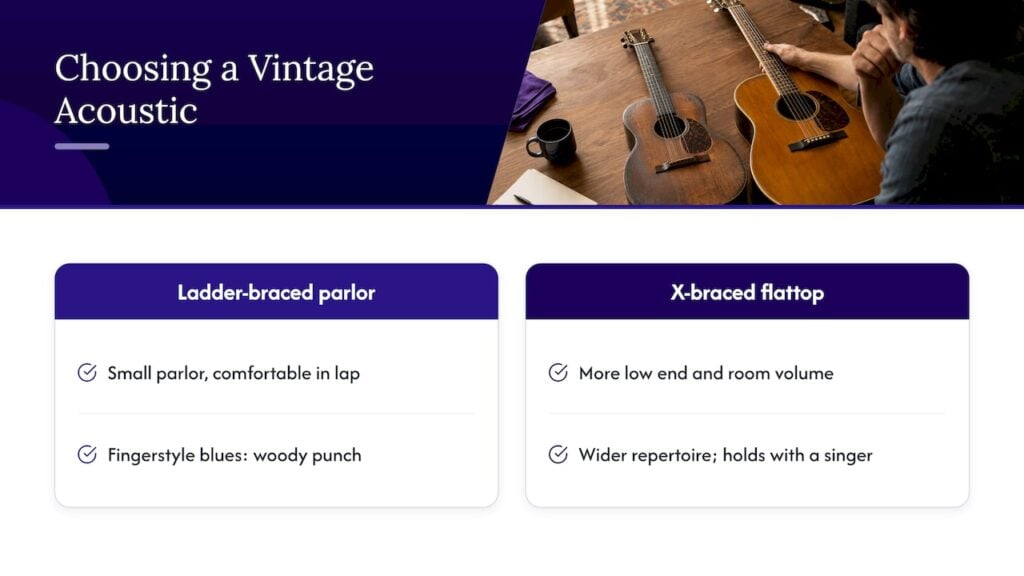
The parlor guitar will likely give you the immediate, woody punch of the blues recordings you love, and it will be comfortable in the lap. The X-braced flattop will give you more low end and more volume for the room, and will take a wider range of repertoire. If you add a singer or a second player, the X-braced guitar usually holds its place better.
So the right question is not which pattern wins but what the guitar will be asked to do. If both appeal, play both. Reading about tone gets you only part of the way there. Your hands settle it.
Our perspective
Bracing is where a guitar’s character is decided, and it is why we describe each instrument in detail instead of reducing it to a spec line. When we evaluate an acoustic, we look at how the top has aged, how the bracing has held and what the guitar was built to do.
We value both patterns. X bracing gave the steel-string guitar its full, balanced voice, and ladder bracing gave us some of the most characterful sounds in early American music. A collector or musician is best served by knowing which voice they want and then finding an instrument that delivers it in sound condition.
That is why we pair every instrument with careful descriptions, historical context, personal advice, testing appointments, and certification and valuation services for the pieces that deserve them.
Vintage
Find your bracing at Vintage Guitar World
If you are ready to hear the difference yourself, browse our curated acoustic guitars and vintage guitars. Our selection includes rare, restored and well-maintained instruments, each with a detailed description and historical context. We also offer personalized advice, exclusive testing appointments, commission sales for owners, and certificates and valuation reports. If an instrument in your collection needs work, we also offer restoration.

To discuss which bracing fits your playing, start from our home page and ask us.
FAQ
Is X bracing better than ladder bracing?
Not in every respect. X bracing is stronger under steel-string tension and gives a fuller, more balanced sound, which is why it became the standard. Ladder bracing gives a punchy, midrange-forward voice that many players choose on purpose for blues and folk. In the Acoustic Guitar review mentioned above, the two versions were equals in responsiveness and playability.
Can a ladder-braced guitar use steel strings?
Many do, but they were generally built for lighter loads. Ladder bracing did not hold up to steel-string tension as well as X bracing, according to This is Classical Guitar. Check the maker’s intent and the string gauge the guitar was set up for, and have the top inspected for belly or a lifting bridge.
Who invented X bracing?
C. F. Martin is credited with developing it. Premier Guitar’s Ervin Somogyi dates it to the 1850s. It later became the dominant layout for steel-string flattops.
How can I tell which bracing my guitar has?
Look inside the sound hole with a flashlight and a small mirror. Parallel bars across the top mean ladder bracing. Two braces crossing below the sound hole mean X bracing. If you are unsure, we can identify it as part of an evaluation or valuation.
Do classical guitars use ladder or X bracing?
Classical and flamenco guitars normally use fan bracing, a different system for nylon strings. We explain it in our article on fan bracing.
Sources
- Acoustic Soundboard: Ladder-Bracing Revival, Premier Guitar
- What Makes an Acoustic Tick?, Premier Guitar
- Bracing Styles for Classical Guitars, This is Classical Guitar
- Acoustic Guitar Bracing Patterns and Designs, Guitar Repair Bench
- Acoustic guitar shapes explained, Guitar World
- Three New Waterloos review, Acoustic Guitar