


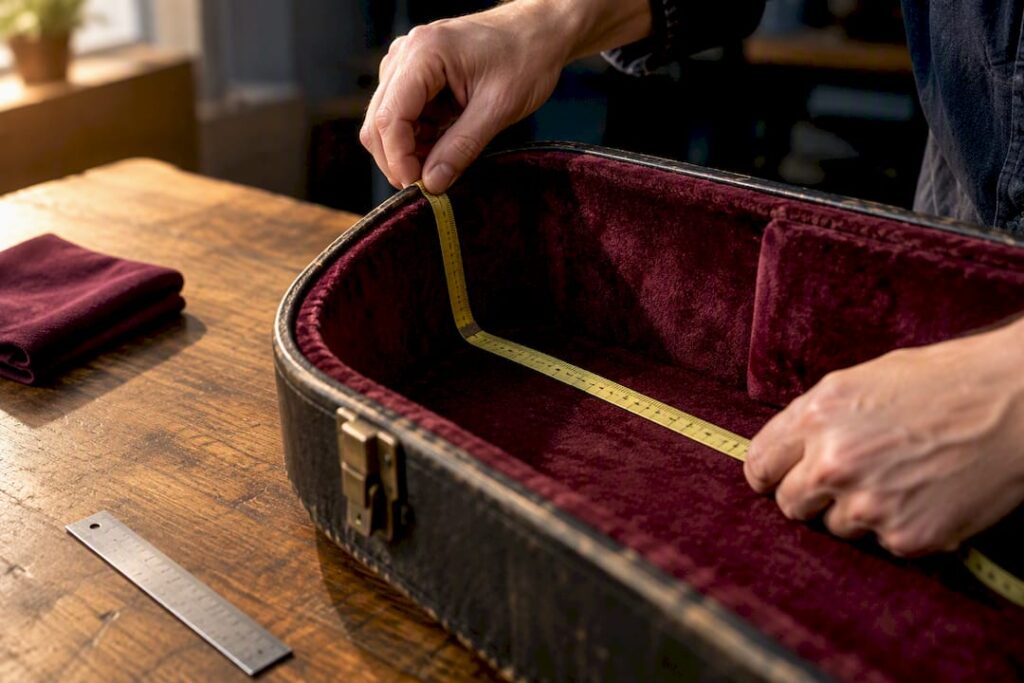

For most vintage electrics and classicals, a form-fitting hardshell case beats every other option because it holds the instrument still, cradles the neck, and buffers humidity swings better than a loose-fitting box ever will. Heavy touring or checked-flight transport changes that calculus toward a rectangular or flightcase build. Either way, the decision starts with a tape measure, not a model number, since handcrafted vintage instruments rarely match factory spec sheets exactly.
TL;DR:
- Vintage guitars require a snug, shaped case with a proper neck cradle to minimize movement and prevent damage during daily handling and storage.
- The interior support, especially the neck cradle, and hardware quality are more critical for preservation than the shell material, with plywood and fiberglass options offering different balances of weight and impact resistance.
- Accurate measurements of length, width, and depth are essential for fitting a case, as model names often differ from actual dimensions due to handcrafting and repairs.
- When flying, always choose a flightcase or reinforced hard shell for checked baggage, loosen strings, and secure hardware to reduce damage risks during transit.
- Store vintage guitars in environments with 45-55% humidity, avoid basements or attics, and regularly check the instrument for signs of stress or finish changes, using a hygrometer for accurate readings.
Table of Contents
- Kofferwahl Vintage Gitarre: Which Case Type Actually Protects Your Instrument?
- What Materials And Construction Actually Preserve A Vintage Guitar?
- How Do You Measure A Vintage Guitar For A Case?
- Should You Check Or Carry Your Guitar On A Flight?
- How Should You Store A Vintage Guitar Inside Its Case?
- Which Case Fits Your Actual Use Case?
- A Quick Checklist Before You Buy Or Pack A Case
- Why Fit And Climate Beat Looks For Vintage Guitar Cases
- How Vintage Guitar World Helps You Get The Fit Right
- Sources
- FAQ
Kofferwahl Vintage Gitarre: Which Case Type Actually Protects Your Instrument?
Every case family trades weight against protection, and vintage instruments punish the wrong trade far more than a modern factory guitar would. A 1962 Stratocaster or a hand-built flamenco guitar from the 1970s has decades of wood movement, finish checking, and repair history baked into it. The case has to work with that fragility, not against it.
- Form-fitting (shaped) cases trace the outline of a specific body shape and keep the instrument from sliding during handling. They’re lighter than rectangular cases and the standard recommendation for daily transport, though the snug fit means they’re model-specific, which matters more with vintage instruments that vary even within the same production run.
- Rectangular (square) cases sacrifice some snugness for interior room. They’re the most stable standard option for demanding travel because the extra space tolerates minor fit mismatches and leaves room for a humidifier, spare strings, or a capo.
- Flightcases built from ply with aluminum edges deliver the highest level of impact protection, the right call for checked airline baggage or a touring schedule that puts the guitar in a truck every night.
- Carbon and ABS shells land between a hardshell and a flightcase: nearly the same protection at meaningfully less weight, at a higher price point.
- Gigbags trade protection for portability. Fine for a five-minute walk to a rehearsal space with a guitar you’re not worried about; a poor match for a pre-war flattop or an original PAF-loaded electric.
Classical and flamenco guitars need extra care here because their tops are thinner and more sensitive to point pressure than most electric bodies, so a shaped case with a real neck cradle matters even more than it does for a solid-body electric.
What Materials And Construction Actually Preserve A Vintage Guitar?
The shell material decides how much shock reaches the guitar, and the interior decides whether that guitar sits comfortably or fights the case every time you close the lid. Plywood shells wrapped in Tolex remain the industry default because they flex slightly under impact instead of transferring the full force inward. ABS plastic is lighter and resists moisture better, but a poor-quality ABS shell can crack under a sharp impact where plywood would only dent. Fiberglass and carbon composites sit at the top of the price range and offer the best strength-to-weight ratio, which is why touring professionals often pay the premium.
Inside the case, three things matter more than the shell itself:
- A neck cradle that supports the neck along its length, not just at the headstock. Headstock-only support puts constant strain on the neck joint over months of storage.
- Latches and hinges rated for repeated use. Cheap hardware fails first, and a case that won’t latch securely is worse than no case at all.
- Humidity-control features like a built-in humidifier pocket or a desiccant compartment, which help buffer the interior against the swings that cause top cracks and fret sprout.
Pro Tip: Before buying any used case, run your hand across the entire interior lining. Old cases sometimes hide staples, dried adhesive ridges, or a collapsed foam edge that will scratch a finish the first time you close the lid.
How Do You Measure A Vintage Guitar For A Case?
Model names lie. A guitar built by hand in a small shop, or repaired and refinished decades ago, can differ from its catalog specification by enough to make a “perfect fit” case genuinely too tight or loosely floppy. Measure the actual instrument every time.
- Overall length from the top of the headstock to the strap pin at the base of the body. This determines whether the case interior has room for the full instrument plus a little clearance for a soft lining.
- Maximum lower-bout width, taken at the widest point of the body. This is the measurement most cases get wrong when a shape looks close but isn’t identical.
- Maximum body depth, measured at the thickest point, usually near the bottom edge. Deep-body flattops and archtops need noticeably more interior clearance than a solid-body electric.
Compare all three numbers against the case’s published interior dimensions, not its exterior size. Retailers in the German market, including product listings on Thomann, typically list interior measurements alongside fit notes such as “fits Strat-style bodies, not double-cut shapes.” Read that fine print before you buy.
Leave a small margin for padding and for any accessories you plan to store inside, like a capo or a spare set of strings. If you’re buying a used case sight unseen, ask the seller for interior width and depth photos with a tape measure visible in the frame; that single request catches most fit problems before the guitar ever ships. The checklist and warning on model-name reliability applies to nearly every hand-built or vintage instrument, electric or classical alike.
Should You Check Or Carry Your Guitar On A Flight?

Hand-carry whenever the airline allows it. Most carriers treat a guitar as an oversized item that fits in a closet or overhead bin on many aircraft, and it costs nothing extra when it works. Call ahead and get the policy confirmed for your specific route, because it varies by aircraft type and airline.
When checking is unavoidable, the case matters more than anything else in this guide. A flightcase or a reinforced hardshell built for baggage handling is the only sensible choice, and even then, prepare the instrument itself:
- Loosen the strings roughly one whole tone to reduce neck tension during pressure and temperature changes.
- Pad the headstock area with a cloth or foam to fill any gap and stop it from knocking against the case wall.
- Immobilize loose hardware like pickup selector switches or tremolo arms so they can’t rattle or snag during handling.
Pro Tip: Don’t open the case the moment you land. Let the guitar acclimatize to room temperature for 30 to 60 minutes with the lid closed before you tune it up. Rapid temperature swings are what crack finishes, not the flight itself.
How Should You Store A Vintage Guitar Inside Its Case?
Climate control inside the case matters more than the case’s exterior toughness once the guitar isn’t traveling. Aim to keep relative humidity inside the closed case in the 45 to 55 percent range, using an in-case humidifier during dry months and switching to a desiccant pack if you’re in a humid climate.
- Never store a case on a concrete floor, in a basement, or in an attic. Those spaces swing hardest on temperature and humidity, exactly what a vintage finish and old glue joints can’t tolerate.
- Check the guitar every few months even in storage, looking for new fret sprout, a rising action, or finish changes.
- Loosen the strings slightly for long-term storage to ease tension on the neck joint.
- Position the instrument so the neck cradle carries its share of the weight; never let a guitar sit with all the load on the body alone.
Pro Tip: Keep a small hygrometer inside the case. A five-dollar sensor tells you more about whether your storage is working than any assumption about your basement being “pretty dry.”
Which Case Fits Your Actual Use Case?
The right case depends entirely on how often the guitar moves and how far.
- Daily transport to lessons or rehearsal calls for a form-fitting hardshell or a well-padded reinforced gigbag, balancing weight against protection for a guitar that’s handled often but rarely thrown around.
- Frequent touring justifies the cost of a flightcase or a carbon/ABS hardshell with strong neck support, since repeated loading into vans and trucks is exactly the abuse those cases are built for.
- Shipping or long-distance moves call for professional packing technique on top of a flightcase, plus documentation and insurance for anything genuinely valuable. Our step-by-step shipping guide walks through the packing details.
- Collector storage prioritizes interior climate control and exact fit over toughness, since the guitar isn’t going anywhere. A dedicated storage guide covers the routine inspection habits worth building.
If you’re preparing for a tour specifically, our complete practical guide covers the logistics beyond just the case.
A Quick Checklist Before You Buy Or Pack A Case
Run through this before handing over money for any case, new or used:
- Measure length, lower-bout width, and body depth on the actual instrument.
- Confirm those numbers against the case’s interior specification, not its exterior size.
- Check for a full-length neck cradle, not headstock-only support.
- Inspect latches, hinges, and feet for wear or looseness.
- Look inside for old adhesive ridges, staples, or collapsed foam that could scratch a finish.
- Test the fit with the guitar in hand before you close the lid the first time, and listen for any rattle when you shake the case gently.
If a case needs an interior modification, custom foam cut, or an added neck block, that’s a job for a technician familiar with vintage instruments rather than a DIY foam kit. Fitting appointments and referrals to restoration specialists are recommended for instruments where the original finish and hardware carry real collector value, to ensure careful handling and preservation.
Why Fit And Climate Beat Looks For Vintage Guitar Cases
A beautiful case that doesn’t fit is a liability, not protection. Preservation choices here protect both playability and resale value, so treat a professional fitting or valuation as worthwhile for any instrument that actually matters to you.
*— Vintage
How Vintage Guitar World Helps You Get The Fit Right
Getting the case right the first time saves you from the slow damage that comes from a poor fit, something a quick online search can’t verify but a hands-on check can. Exclusive playing appointments are available where you can test an instrument’s fit against different case options in person, along with certificates and value assessments for anything considered for restoration, insurance, or sale.

If you’re shopping for the instrument itself before worrying about the case, browse our current vintage guitar listings to see what’s available right now. Instruments that need work before they’re case-ready can go through our restoration service, where cost guidance is available upfront. Reach out to book a playing appointment or request a measurement check on an instrument you already own. It’s the fastest way to know exactly what case specification you need before you spend money on the wrong one.
Sources
FAQ
How Do I Best Store My Guitar Inside Its Case?
Keep the case closed in a stable environment with relative humidity around 45 to 55 percent, using an in-case humidifier or desiccant depending on the season. Avoid basements and attics, loosen the strings slightly for long stretches in storage, and check the instrument every few months for changes in action or finish.
How Do I Ship A Guitar Safely In A Case?
Use a flightcase or a reinforced hardshell rather than a standard gigbag, loosen the strings about one whole tone, and pad the headstock area to stop it from shifting. Our guitar packing guide walks through the full sequence for sale, shipping, or repair transport.
What Determines The Value Of An Old Guitar?
Value depends on originality, condition, rarity, and documented history, not just age alone. A guitar with its original hardware, finish, and case in good condition is worth considerably more than the same model with replaced parts, and Vintage Guitar World’s certification and valuation service can give you a documented assessment.
What’s Considered A Great Guitar Solo?
That’s genuinely subjective and comes down to personal taste in tone, phrasing, and the song it’s built around. What’s not subjective is that a well-preserved vintage instrument, properly cased and cared for, tends to hold the tone and playability that make those solos possible for another fifty years.