


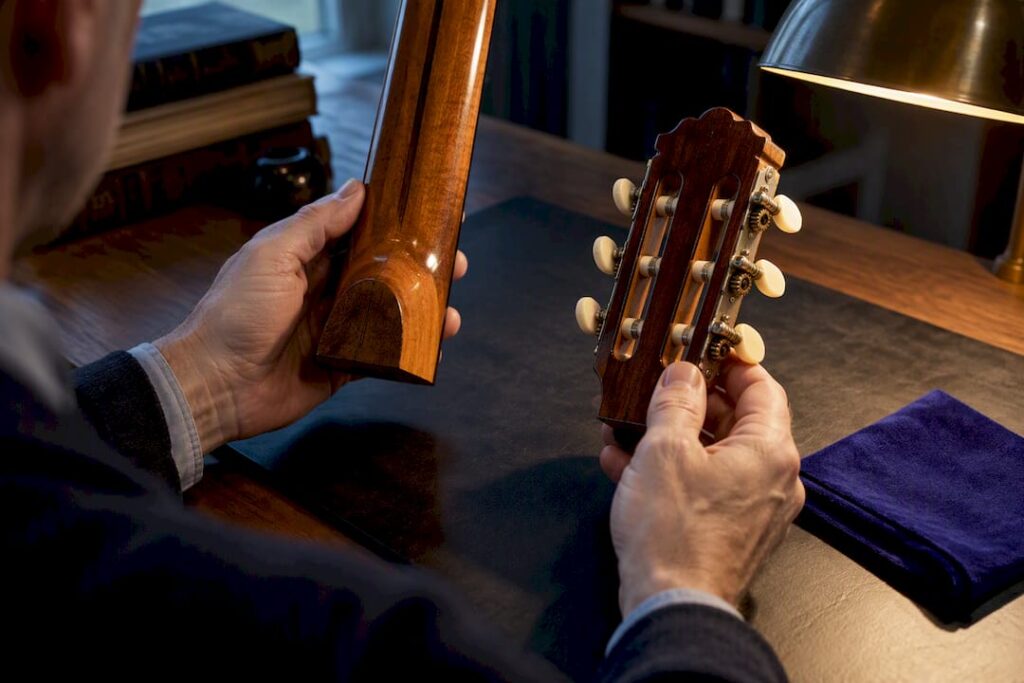

You usually cannot confirm a genuine Hermann Hauser guitar by photos alone. The single most decisive check is the internal inscription or label combined with verifiable provenance, and when doubt remains, an expert appraisal settles the question. Ask the seller for internal soundboard photos, close-ups of the label, and any ownership documents before you commit to anything.
TL;DR:
- Verifiable provenance and internal inscriptions are the most reliable indicators of a genuine Hauser guitar, confirmed through detailed photos and expert appraisal.
- Comparing wood grain, finish type, hardware, and internal inscriptions against documented examples can help identify authentic period instruments and detect potential forgeries.
- Documentation such as bills of sale, auction records, and museum references are critical in establishing a reliable ownership history and authenticating an instrument.
- Restoration practices vary in impact on value; only conservative, well-documented repairs preserve the guitar’s authenticity, while refinishing often significantly reduces worth.
- Evasive seller behavior, inconsistent labels, modern hardware, and suspiciously low prices should raise red flags, warranting professional appraisal before purchase.
Table of Contents
- A prioritized checklist for inspecting a Hauser guitar
- Construction details and materials that help date a Hauser
- Verifying provenance through documents and public records
- How restoration choices affect authenticity and value
- Common forgeries and the red flags that expose them
- When to bring in an expert appraiser
- A step-by-step routine before you commit to a purchase
- Why documentation matters more than instinct
- Getting help from testing, appraisal, and restoration services
- Sources
- FAQ
A prioritized checklist for inspecting a Hauser guitar
Before you send money or travel to see an instrument, work through the checklist in order. Each step filters out a category of problem, so skipping ahead wastes time on a guitar that fails an earlier test.
- Request the label and internal inscription first. Ask for a straight photo of the printed label, a shot of the underside of the top, and an image taken through the soundhole with a small mirror, since many genuine inscriptions sit where a camera cannot reach directly.
- Compare wood grain and color to known examples. Spruce tops age to a warm amber, and rosewood backs show a tight, consistent grain rather than a patchy or painted look.
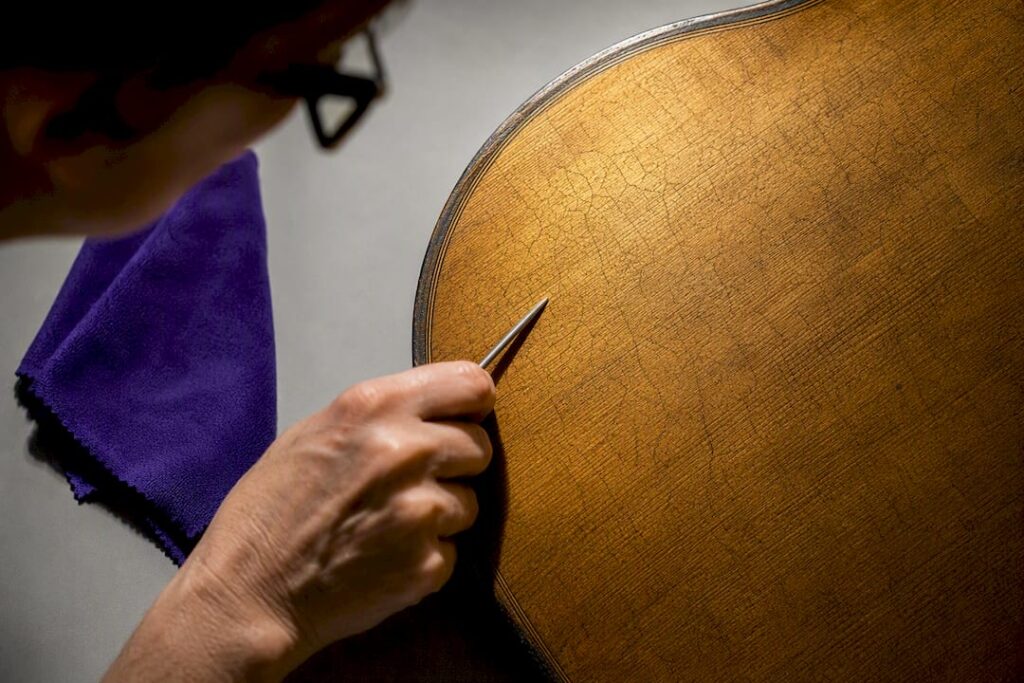
- Check the finish type. Older instruments typically carry a thin nitrocellulose finish that develops fine crackle lines and a soft sheen, while a glossy, uniform, plastic-looking coat suggests a later respray.
- Inspect tuners, bridge, and nut. Original hardware from the instrument’s period should match in wear pattern and style; a modern tuner set bolted onto an otherwise old body is worth questioning.
- Ask what has been repaired and when. A seller who volunteers a repair history before you ask is a good sign; one who deflects the question is not.
Pro Tip: Never rely on a single photo angle. Ask for at least six images, including one of the label taken straight on with no glare, before you form an opinion.
None of these checks alone proves authenticity. A correct label paired with mismatched hardware, or a beautiful finish with no provenance at all, should slow you down rather than reassure you. The goal at this stage is not certainty, it is narrowing the field to instruments worth a deeper look, which is where construction details and documented history come in.
Construction details and materials that help date a Hauser
Hermann Hauser’s workshop favored specific materials and techniques that specialists use to place an instrument in a particular period. Spruce was the standard top wood, chosen for its light weight and responsiveness, while backs and sides on many instruments were built from Brazilian rosewood or, on some examples, mahogany. These choices were not arbitrary. Spruce’s stiffness-to-weight ratio suited the projection classical players wanted, and Brazilian rosewood’s density gave the back and sides the reflective quality that shaped the instrument’s tone.
Bracing pattern is one of the clearest attribution tools available to an examiner. Experts compare the fan bracing layout, the thickness of the braces, and how they meet the top’s edges against known reference instruments, since small deviations often point to a different maker or a later repair that altered the original structure.
- Top wood: spruce, chosen for stiffness and low mass relative to strength.
- Back and sides: Brazilian rosewood on many period instruments, mahogany on others.
- Bracing: a fan pattern with joinery details that specialists cross-check against documented examples.
- Internal inscriptions: handwritten notes or dedications, sometimes in French on guitars connected to performers who worked internationally.
Labels and internal writing carry more weight than most buyers expect. Some Hauser instruments made for specific performers carry dedications in French rather than German, a detail tied to the instrument’s original owner and destination rather than to the maker’s usual practice. A guitar with an internal inscription that does not match the language, phrasing, or placement seen on documented examples deserves closer scrutiny, not automatic rejection, since variation existed across decades of workshop output.
Museum documentation gives buyers a genuine reference point. The Metropolitan Museum of Art holds a 1937 Hauser guitar closely associated with Andrés Segovia, complete with catalog notes on its materials and history. Comparing a prospective purchase against a museum-documented instrument is one of the few ways an amateur collector can check details against a verified original rather than another seller’s claim.
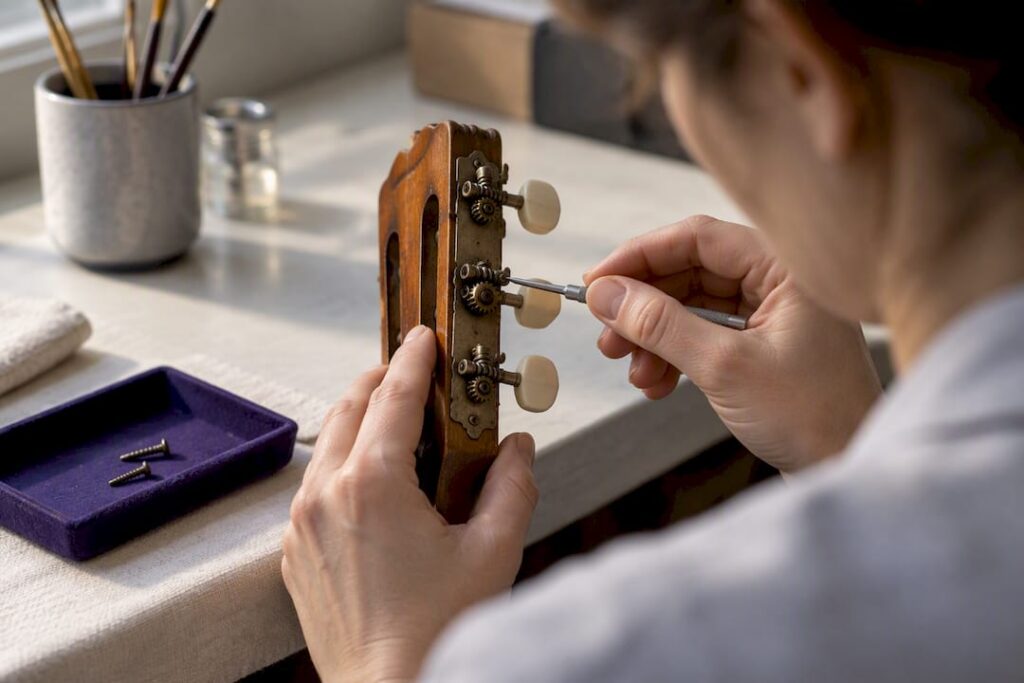
Tuning machines matter too. Instruments from certain periods commonly carry Landsdorfer mechanisms, and a mismatch, such as modern sealed tuners on a guitar claimed to be from the 1930s, is a signal that parts have been swapped at some point. That does not necessarily mean the whole instrument is fraudulent, but it does mean the guitar has a more complicated history than a clean, all-original example, and that history should be priced and disclosed accordingly. For a closer look at how joinery and material choices reveal handcrafted construction more broadly, see our guide to recognizing a handmade guitar.
Verifying provenance through documents and public records
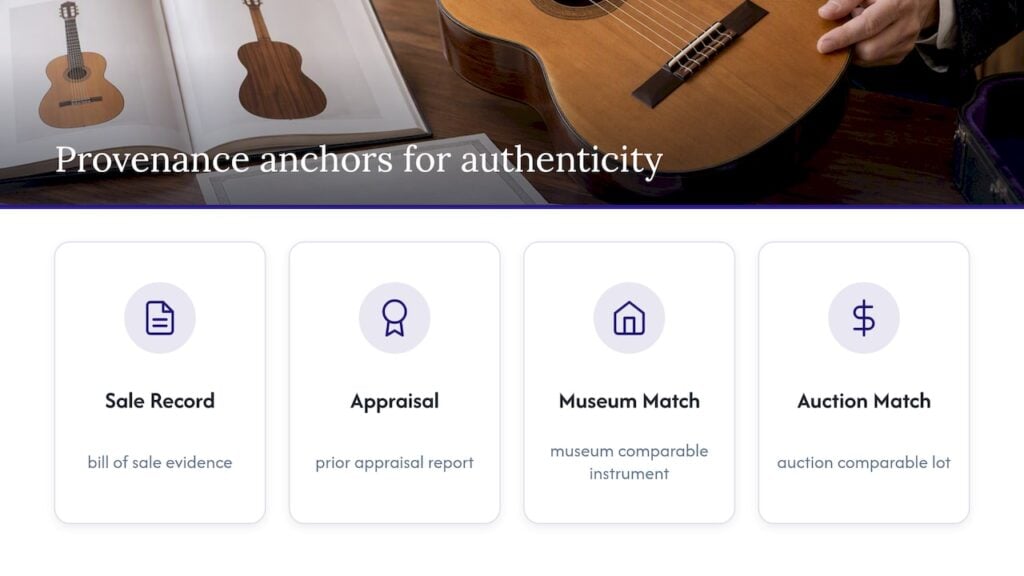
An instrument’s paper trail often matters as much as its wood. Ask for a bill of sale, any prior appraisal reports, insurance valuations, or certificates that mention the guitar by serial number or distinguishing feature. A seller who has owned the instrument for decades should be able to produce at least one of these, even if the full chain of ownership has gaps.
Public auction and museum records give you something to check claims against instead of taking a seller’s word for it. Christie’s auction listings for a Hermann Hauser Sr. guitar built in Munich in 1939 include detailed lot descriptions and transcriptions of internal inscriptions, which makes them useful comparables when you are trying to date or verify wording on a different instrument. The Met’s catalog entry serves the same purpose for museum-grade examples.
- Bills of sale and receipts that name the instrument specifically, not a generic description.
- Prior appraisal or certification documents, ideally from a named appraiser rather than an anonymous report.
- Archive or auction house references, which you can cross-check against public catalog entries.
- Correspondence or dedications tying the instrument to a specific original owner, when such a claim is made.
Treat vague Segovia connections with particular caution. Claims that an instrument was “played by” or “gifted to” a famous performer are common in vintage instrument marketing, but a credible claim comes with a specific reference, a name, a date, a transaction record, not just a story repeated from listing to listing. The Met’s documented Segovia-associated Hauser shows what a verifiable connection actually looks like: a named performer, a dated instrument, and a museum record anyone can check.
Provenance does more than satisfy curiosity. A documented ownership history affects insurance valuations, loan eligibility for exhibitions, and resale value, since buyers and institutions alike pay a premium for instruments whose history they do not have to take on faith.
How restoration choices affect authenticity and value
Not all repair work is equal, and the difference between conservation and reconstruction shapes what an instrument is worth. Conservation means stabilizing what exists, a reversible crack repair, a careful refret that preserves original fret slots, cleaning that does not strip original finish. Reconstruction means replacing substantial original material, a new top, a full refinish, a replaced bridge, work that may make the guitar sound and look better while quietly erasing the history buyers are paying for.
- Crack repairs and relining are common and generally acceptable when done conservatively and disclosed.
- Refrets are routine maintenance and rarely affect value unless the original fret slots were altered.
- Full re-glues of the top or back are more significant and should be documented with photos of the work.
- Refinishing is the repair type most likely to reduce collector value, since it removes original surface material permanently.
Pro Tip: A finish that looks flawless under close inspection is not automatically reassuring. Original nitrocellulose develops fine crackle and slight color shifts over decades, and a spotless surface on a supposedly 80-year-old guitar can mean the original finish was stripped and replaced.
Nitrocellulose lacquer ages in a way that is difficult to fake convincingly, developing a network of fine checking lines and a mellowing of color that happens gradually under real-world humidity and temperature swings. A guitar claimed to be original from the 1930s with a uniform, glossy modern finish and no checking at all is more likely a respray than an unusually well-preserved original.
Disclosure is the deciding factor in almost every case. A restored instrument sold honestly, with photos and a written account of what was done, holds its value far better than one where restoration surfaces only after purchase. Ask directly, and ask for documentation, not just a verbal assurance.
Common forgeries and the red flags that expose them
Counterfeiters typically take one of two routes: building a generic classical guitar and adding a fake label, or taking a genuine older instrument of lesser value and altering it to resemble a more desirable maker’s work. Both leave traces if you know where to look.
- Check the label against known wording and placement. A label glued in at an odd angle, printed with modern fonts, or worded differently from documented examples such as those in Christie’s lot descriptions is a warning sign.
- Look for modern glue lines and adhesive residue around joints that should be decades old, since newer glue often has a different color and texture than aged hide glue.
- Check bracing pattern through the soundhole with a flashlight, since incorrect or overly simplified bracing is one of the harder details for a forger to get right.
- Note any hardware that looks newer than the rest of the instrument, including tuners, bridge pins, or a nut made from a modern synthetic material.
- Treat listings with missing internal photos as incomplete, not merely inconvenient. A legitimate seller can produce them on request.
- Be skeptical of prices well below comparable auction results, since a genuine Hauser priced far under what Christie’s or comparable sources show for similar instruments usually means something is wrong with the guitar or the claim.
- Do not treat a serial number as proof by itself. Numbers can be copied or invented, and they only carry weight when corroborated by a label, construction details, and provenance together, a point detailed further in our guide to spotting a fake guitar.
A seller who refuses to answer provenance questions or grows evasive when asked for internal photos is, on its own, one of the strongest red flags available to a buyer with no other resources.
When to bring in an expert appraiser
Certain situations call for a professional opinion rather than a confident guess. Get an appraisal when the seller claims a specific performer connection, when the asking price sits at the high end of the market, or when internal inscriptions need verification against a reference an individual buyer cannot access.
An expert appraisal is treated as essential rather than optional when authenticity is uncertain in the high-end vintage market, since forged or heavily modified instruments are common enough that inspection of labels, hardware, glue joins, and finish aging routinely changes the assessed value. This is a core finding in Guitar-Player’s inspection guide for spotting fakes, which treats professional inspection as the deciding step for any doubtful instrument.
A qualified appraiser typically examines the instrument’s internal structure, tests the finish for age and composition, traces the ownership history as far as records allow, and compares the guitar against documented museum and auction examples.
- Auction house specialists bring access to extensive comparable sales records and typically handle high-value or contested pieces.
- Independent luthiers with vintage classical guitar experience offer a more accessible route for buyers who do not need a full auction-house appraisal.
- Ask for a written report that documents materials, condition, restoration history, and a reasoned conclusion, not just a verbal opinion.
Appraisal costs vary by scope and appraiser, so ask for a quote before committing. Reputable events and gatherings for classical guitar specialists, for example, the Ards International Guitar Festival, can also be a starting point for finding luthiers and experts active in the field.
A step-by-step routine before you commit to a purchase
Work through this sequence in order rather than skipping to the parts that feel most interesting.
- Request internal photos and any provenance documents before discussing price in detail.
- Check the label and inscription against known reference wording from museum and auction sources.
- Compare the instrument to auction and museum comparables, noting materials, bracing, and hardware.
- Arrange an in-person test or a formal testing appointment whenever the price justifies travel.
- Commission a written appraisal when the price is high or the provenance claim is significant enough to affect value.
Pro Tip: Keep every photo, document, and email exchange in one folder from the first inquiry onward. If a dispute arises later, a complete record protects you far better than memory.
For high-value transactions, use a payment method with buyer protection and confirm return terms in writing before sending funds. A seller confident in their instrument’s authenticity rarely objects to reasonable safeguards.
Why documentation matters more than instinct
Collectors tend to trust their eye more than they should. A guitar can look convincingly old, sound beautiful, and still carry a swapped label or a replaced top that a photograph will never reveal. The instruments that hold value over decades are not necessarily the ones in the best cosmetic condition, they are the ones with a paper trail that survives scrutiny: a bill of sale, a prior appraisal, a museum or auction comparable that matches.
The uncomfortable truth is that a well-executed fake can fool a casual buyer far more easily than it fools an appraiser who knows what bracing pattern, label wording, and finish aging are supposed to look like on a genuine instrument from a specific period. Buyers who skip documentation because a guitar “feels right” are the ones most often disappointed later.
We favor transparency over showmanship: conservative restoration that preserves original material, and reports that lay out exactly what was examined and why a conclusion was reached, rather than a confident assertion with nothing behind it.
— Vintage
Getting help from testing, appraisal, and restoration services
Verifying a Hauser guitar on your own has real limits, which is why we built our services around the gaps buyers hit most often. Services such as hands-on evaluation appointments, documentation to support authenticity and condition, and restoration focused on conservation rather than full reconstruction are available to assist buyers.

If you already own an instrument you believe may be a genuine Hauser, or you are close to purchasing one and want a second opinion before the money changes hands, our Verkauf in Kommission option also gives sellers a route to a qualified buyer pool without guesswork on pricing. Book a testing appointment or request a valuation through Vintage Guitar World to get a documented answer instead of a guess. If you are ready to browse verified instruments directly, our vintage guitar collection is a reasonable next stop.
Sources
- Gefälschte Gitarren erkennen – Tipps für den sicheren Kauf
- Hermann Hauser – Guitar – The Metropolitan Museum of Art
- HERMANN HAUSER SR. , A CLASSICAL GUITAR, MUNICH, 1939 | Christie’s
FAQ
What is the difference between a flamenco guitar and a classical guitar?
A flamenco guitar typically uses cypress for the back and sides, has a thinner top and lower action for a brighter, more percussive sound, while a classical guitar favors rosewood or similar dense woods for a warmer, sustained tone. The construction choices reflect the different playing styles each instrument was built to serve.
How can you tell if a guitar is well made?
Look for even, tight grain in the top wood, clean and consistent joinery at the neck and body joints, and a finish applied evenly without pooling or thin spots. Precise fret work and a neck that sits straight without twist are also strong indicators of careful construction.
How do you identify nitrocellulose lacquer on a guitar?
Nitrocellulose finish typically develops fine crackle lines over years of temperature and humidity changes, along with a soft sheen rather than a hard, glossy plastic look. A finish with no aging at all on a guitar claimed to be decades old is worth questioning, as detailed in Guitar-Player’s inspection guide.
Who are 7/8-size guitars suitable for?
A smaller-size guitar suits players with smaller hands or shorter reach, including many younger or petite adult players, since the shorter scale length and narrower body make it easier to manage. It is a practical option for anyone who finds a full-size classical guitar physically uncomfortable to play for extended periods.
Can Vintage Guitar World confirm if my guitar is a genuine Hauser?
Vintage Guitar World offers certification and valuation services that examine construction, materials, and available provenance to support an authenticity assessment. Book a testing appointment or request a valuation through Vintage Guitar World to get a documented opinion on your instrument.