














Buy from a dealer if you want the 14-day withdrawal right, a vetted setup, and someone to answer for the guitar after the sale. Buy private if you know exactly what to inspect and want to save money, since private sellers typically price 25-40% below new retail with no statutory return rights attached. The real trade-off is simple: dealers sell you certainty, private sellers sell you a discount. The checklist and decision flow later in this guide show you exactly how to act on either choice.
TL;DR:
- Buying from a dealer provides statutory 14-day withdrawal rights and automatic defect liability, ensuring legal protection and a pre-inspected, playable guitar.
- Private sellers often offer prices 25 to 40 percent lower than new retail, with room for negotiation, but lack statutory returns and have higher fraud risks.
- Expect private used guitars to cost 25 to 40 percent below new retail, with additional setup, shipping, and minor repair fees totaling roughly $50 to $200.
- Dealers supply official invoices with warranty and provenance details, which are essential for resale, while private sales rely on informal receipts and lack legal protections.
- A thorough in-person or remote inspection follows a structure checking structure, electronics, and playability, with dealers expecting longer test periods and private sellers favoring careful, deliberate testing.
Table of Contents
- Händler vs Privatkauf Gitarre: The Pros and Cons Side by Side
- What Should a Used Guitar Actually Cost?
- Do You Have the Same Legal Protection From Both Sellers?
- The Field-Tested Inspection Checklist
- How Do You Pay and Ship Without Getting Burned?
- The Three-Step Way to Decide Right Now
- How Does Buying a Guitar From a Dealer Affect Your Taxes and Paperwork?
- Does the Return Policy End When the Legal Minimum Does?
- How Do You Negotiate Differently With a Dealer vs a Private Seller?
- How Do You Verify a Seller Is Actually Trustworthy?
- How Should You Handle a Test Play Depending on Where You’re Buying?
- Vintage Guitar World’s Perspective: What Most Buyers Get Wrong
- How Vintage Guitar World Makes the Dealer Route Worth It
- Sources
- FAQ
Händler vs Privatkauf Gitarre: The Pros and Cons Side by Side
Every guitar purchase is really a bet on two things: how well you can judge the instrument yourself, and how much protection you want if you judge it wrong. Dealers and private sellers split those two variables in opposite directions, and neither side wins outright.
Buying from a dealer means paying for someone else’s expertise and legal exposure. A private purchase means keeping that money in your pocket, but carrying the exposure yourself. Here’s how that plays out across the details that actually matter.
Dealer advantages:
- Statutory 14-day withdrawal right for distance sales under German and EU consumer law, so you can send the guitar back if it’s not what you expected.
- Gewährleistung (statutory liability for defects) applies automatically, giving you a legal claim if a hidden fault surfaces after the sale.
- Pre-sale inspection and setup, meaning the guitar usually arrives playable rather than needing immediate work.
- A clear point of contact for disputes, returns, or warranty claims instead of a stranger who’s gone quiet on WhatsApp.
Dealer disadvantages:
- Prices run higher, since the dealer is pricing in inspection labor, setup time, and the liability they’re taking on.
- Selection is limited to what a given shop has in stock at that moment, unlike the sprawl of a private classifieds market.
- Less room to haggle, because the price already reflects a business’s margin structure rather than a motivated seller’s mood.
Private seller advantages:
- Lower asking prices, often the single biggest reason buyers go this route in the first place.
- Room to negotiate directly, sometimes shaving another 10 to 15 percent off an already-lower price.
- Local pickup means you can play the guitar before a single euro changes hands.
- Occasional genuine bargains from sellers who underprice out of ignorance or urgency.
Private disadvantages:
- No statutory withdrawal right. Once you’ve paid and taken the guitar, you generally own whatever problems come with it.
- Legal recourse is thin. Private sales fall under general contract law, not consumer protection statutes built for trader-to-consumer transactions.
- Fraud risk is real, particularly for remote purchases where you can’t verify the instrument exists as described.
- You’re the inspector. Miss a hairline crack or a reset neck, and that mistake is entirely yours to live with.
Community buying guides consistently push private buyers toward in-person testing whenever possible, and for good reason: it’s the one advantage private buyers have that dealers can’t fully replicate, since dealer purchases are more often remote or catalog-based to begin with.
What Should a Used Guitar Actually Cost?
Set your budget using market data, not gut feeling. A widely cited benchmark for common used electric guitars puts the price at 25% to 40% below new retail, though rare or collectible models swing far outside that band in either direction.
Pro Tip: Before you make an offer, search sold listings, not just active ones. Active asking prices tell you what sellers hope for; sold prices tell you what buyers actually paid, which is the number that matters.
Dealer pricing sits on top of that private-market baseline. A premium of roughly 15% to 30% over a comparable private sale is typical, and that markup isn’t padding. It covers inspection time, a professional setup, storage, and the liability the dealer assumes the moment they sell it to you.
Consignment sits between the two. A dealer sells the instrument on a seller’s behalf for a commission commonly between a low to moderate percentage range. Because the piece reaches a wider, more qualified pool of buyers, it often nets the seller more than a private listing would, even after the fee.
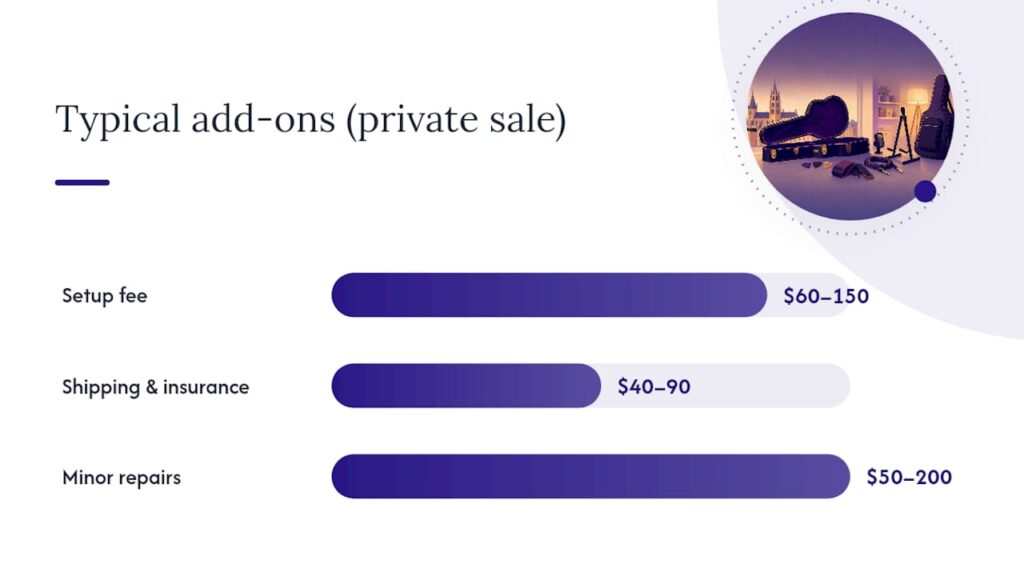
Whatever route you choose, the sticker price is never the full cost. Build your budget around these additions:
- Setup fee: $60 to $150 depending on the tech and the instrument’s condition; a used guitar is rarely optimized out of the box.
- Shipping and insurance: varies by distance and declared value, but insured domestic shipping for a guitar-sized package commonly runs $40 to $90.
- Minor repairs: fret dressing, electronics cleaning, or a new set of strings can add $50 to $200 before the guitar is truly ready to play.
- Appraisal or certification: relevant mainly for vintage or high-value instruments where provenance affects resale value down the line.
A guitar priced at $1,200 privately can easily cost $1,400 to $1,500 once setup, shipping, and minor repairs are factored in. That’s the number to compare against a dealer’s all-in price, not the raw sticker figure.
Do You Have the Same Legal Protection From Both Sellers?
No, and the gap is bigger than most buyers expect. Traders selling to consumers at a distance must honor a 14-day right of withdrawal under German and EU law. You can test the guitar during that window the way you’d reasonably test it in a shop, then send it back if it’s not right, no explanation required. Dealers must also provide clear pre-contractual information and return instructions, and skipping that step can extend your withdrawal window well past 14 days.
Gewährleistung is a separate protection and often gets confused with a manufacturer warranty. Gewährleistung is statutory liability for defects that existed at the time of sale, and it runs two years by default on new goods. For used goods sold by a trader, that period can be contractually shortened, commonly to one year, but never eliminated entirely. A private seller, by contrast, can exclude Gewährleistung altogether in the sales agreement, and most private listings do exactly that with a standard “sold as seen, no warranty” clause.
The coverage gap comes down to who you’re buying from, not what you’re buying. A trader selling to a consumer triggers both the withdrawal right and Gewährleistung. A private individual selling to another private individual triggers neither, unless the seller made specific, provably false claims about the instrument’s condition.
Protect yourself regardless of which route you take:
- Photograph the guitar from every angle before you pay, including close-ups of the serial number.
- Get the seller’s description of condition and any repairs in writing, not just verbally.
- Keep every message, invoice, and payment confirmation until well after the sale closes.
- Note the exact serial number and cross-check it against any documentation the seller provides.
The Field-Tested Inspection Checklist
Whether you’re standing in a shop or squinting at photos on a marketplace listing, the inspection process follows the same logic: check structure first, electronics second, playability last.
In-person checklist:
- Sight down the neck from the headstock to check for warping or twist.
- Check fret wear under raking light, looking for flattened spots on the most-used frets.
- Test the action at the first and twelfth fret; excessively high action often signals a truss rod or neck issue.
- Check intonation by comparing the open string to the twelfth-fret harmonic and fretted note.
- Inspect the body for cracks, especially around the neck joint and any finish checking that suggests age or damage.
- Look for glue separations at the bridge, seams, and binding.
- Test every electronic component: pickups, pots, switches, and the output jack, listening for crackle or dead spots.
- Play chords and single notes up and down the neck to feel for dead frets or buzzing.
Remote-check checklist: ask for high-resolution photos from every angle, a close-up of the serial number, and a short video of the guitar being played unplugged and, if electric, plugged in. Refusal to provide any of this is a warning sign worth taking seriously, and buyer guides consistently flag it as one of the clearest indicators of a problem listing. Ask directly whether the instrument has been repaired, refretted, or modified, and get the answer in writing.
Not every defect is a deal breaker. Cosmetic wear like buckle rash or faded lacquer is usually negotiable and rarely affects playability. Structural issues, a cracked headstock, a warped neck that won’t respond to truss rod adjustment, or evidence of a poorly executed repair, are different territory and often justify walking away entirely. For anything you can’t confidently assess yourself, particularly on vintage or higher-value instruments, an expert appraisal or a dealer testing appointment is worth the time before money changes hands. Our own seven-point checklist for vintage guitars goes deeper on what separates a fixable flaw from a structural one.
How Do You Pay and Ship Without Getting Burned?
Payment method is where most fraud actually happens, not the guitar itself. For any distance purchase, use a method with built-in buyer protection, such as PayPal Goods and Services or a marketplace’s own escrow system. Never send Friends and Family payments to a stranger; that option waives your right to a refund entirely if the deal goes wrong.
Pro Tip: If a seller pushes hard for a bank transfer or a payment method with no dispute process, treat that as the loudest red flag in the entire transaction.
For shipping, insist on insured shipping that covers the instrument’s full value, not just the courier’s default liability limit, which is often far too low for a decent guitar. Photograph the packaging before it ships and the instrument’s condition the moment it arrives, before you even take it out fully. Our shipping workflow guide walks through packaging standards that actually survive freight handling.

For local, in-person deals: meet in a public place, bring a second person if possible, and always test the instrument before any money changes hands. Cash works fine for smaller local purchases, but write a simple bill of sale anyway, noting the price, date, and serial number. Keep every message and receipt. If a dispute ever arises, that paper trail is often the only thing standing between you and a total loss.
The Three-Step Way to Decide Right Now
You don’t need to agonize over this decision. Three questions settle it.
- Define your non-negotiables first. Do you need a return window? Are you willing to pay extra for a guitar that’s already set up and ready to play? If yes to either, that alone tips you toward a dealer before you even look at a specific instrument.
- Apply the inspection and legal filter. Can you physically test the guitar or get thorough remote documentation? If not, and you also need return rights as a backstop, a dealer purchase is the safer default. If you can inspect thoroughly and you’re comfortable absorbing the risk, private sellers open up better pricing.
- Negotiate and close. A fair private offer typically lands 10% to 15% below the asking price, adjusted for any flaws you found during inspection. Walk away from any seller who won’t allow a proper test or grows evasive about repair history. If you’re selling rather than buying, consignment through a dealer is worth considering. It splits the difference, giving broader market reach without the full discount of an outright private sale.
How Does Buying a Guitar From a Dealer Affect Your Taxes and Paperwork?
A dealer purchase always comes with a proper invoice showing the price, VAT where applicable, and the seller’s business details. That invoice matters for warranty claims, insurance valuations, and resale documentation later. If the instrument ever needs a Gewährleistung claim, the invoice is your proof of purchase date and price.
A private sale between two individuals doesn’t involve VAT at all, since VAT only applies to business transactions. What you get instead is, at best, a simple handwritten or emailed bill of sale, and plenty of private deals close with nothing more than a bank transfer confirmation. That’s legally acceptable for a private transaction, but it leaves you with far less paper trail if the guitar’s condition or provenance is ever questioned.
For collectors buying high-value or vintage instruments, invoice quality becomes a resale issue down the line. A dealer invoice with clear provenance documentation and, ideally, a certification of authenticity, adds real credibility when you eventually sell. A guitar bought privately with no documentation at all is harder to place with confidence in front of a future buyer, even if the instrument itself is genuine and excellent.
Neither route creates a personal income tax event for the buyer in a typical consumer purchase. The paperwork difference is about proof and provenance, not tax liability.
Does the Return Policy End When the Legal Minimum Does?
Not with a reputable dealer. Statutory Gewährleistung sets the legal floor, but many dealers offer service that goes further, an extended return window for exchanges, a setup adjustment included in the sale, or a direct line to ask questions about the instrument’s history after the purchase closes.
That after-sale relationship is one of the most underrated differences between the two routes. A private seller typically disappears the moment payment clears. A dealer worth buying from stays reachable if the action needs adjusting after a season change or if you have a question about a repair down the line.
When you’re comparing dealers, ask directly what happens after the statutory return window closes. Some offer nothing beyond the legal minimum. Others build ongoing service into the relationship, treating the sale as the start of a relationship with the instrument rather than the end of the transaction. That distinction rarely shows up in the price tag, but it shows up the first time something needs attention six months after delivery.
How Do You Negotiate Differently With a Dealer vs a Private Seller?
Private sellers usually expect negotiation. Listing prices often carry 10% to 20% of built-in room, and a polite, specific counteroffer, one that references a flaw you found during inspection rather than a vague “can you do less,” tends to land well. Sellers respond better to “the fret wear on the first three frets and the need for a setup puts this closer to $X for me” than to a lowball with no reasoning attached.
Dealers negotiate differently, because their price already reflects labor, setup, and liability rather than personal motivation to sell fast. There’s usually less room to move on the sticker price itself, but more room to negotiate what’s included: a free setup, a case thrown in, or a small discount for cash payment. Asking a dealer “what can you include at this price” often gets further than asking them to simply lower the number.
In both cases, timing helps. End-of-month or end-of-season conversations, when a dealer is managing inventory targets or a private seller is getting impatient, tend to produce more flexibility than an opening approach on day one of a fresh listing.
How Do You Verify a Seller Is Actually Trustworthy?
For dealers, check how long the business has operated, whether they offer testing appointments or in-house appraisal, and whether their return and Gewährleistung terms are stated clearly before you buy rather than buried in fine print after. A dealer willing to put you in a room with the actual instrument, or offer a documented appraisal process, is signaling confidence in what they’re selling.
For private sellers, reputation is harder to verify but not impossible. Look at how long the listing has been active, whether the seller can answer specific technical questions about the instrument without hesitation, and whether they’re willing to do a video call or in-person meeting before you commit. A seller who’s vague about why they’re selling, or who pressures you to decide quickly, deserves extra scrutiny.
Cross-reference serial numbers against the manufacturer’s records where possible, particularly for anything marketed as vintage or rare. And search the seller’s other listings or selling history if the platform shows it. A pattern of flipping instruments quickly isn’t automatically a red flag, but it’s worth factoring into how much you trust the stated backstory.
How Should You Handle a Test Play Depending on Where You’re Buying?
At a dealer, take your time. A legitimate shop expects you to plug in, run through multiple amp settings, and check the guitar under conditions close to how you’ll actually use it. Bring your own cable or pedal if tone consistency matters to you. Testing appointments exist specifically for this, letting you evaluate an instrument thoroughly before committing rather than rushing through a five-minute counter interaction.
For a private, in-person sale, structure the test deliberately: check tuning stability first, then play across the entire neck, then test any electronics through a small practice amp if one’s available. Bring a tuner and, if you can, a basic cable tester for electrics. Don’t let a seller rush you through this step; a genuine seller with nothing to hide won’t mind you taking fifteen minutes to check things properly.
Remote test plays are the trickiest scenario. A short unedited video, ideally showing the guitar being tuned and played across a few registers, is the closest substitute to hands-on testing you’ll get. If a private seller won’t provide one, that hesitation tells you something on its own.
Vintage Guitar World’s Perspective: What Most Buyers Get Wrong
The private sales that go wrong almost never fail on price. They fail because the buyer skipped a structural check they didn’t know to run, or trusted a description that turned out to be optimistic. Dealer vetting exists to catch exactly that gap. Testing appointments, valuation, and certification aren’t paperwork for its own sake; they’re what turns an educated guess into a documented decision, especially for anything vintage or high-value.
— Vintage
How Vintage Guitar World Makes the Dealer Route Worth It
If the checklist above left you wanting someone else’s trained eye on the instrument, that’s exactly what a curated dealer relationship is for. Some dealers offer testing appointments, professional valuation, and certification services specifically for buyers who’d rather verify an instrument’s condition and provenance before money changes hands, not after a problem surfaces.

Collectors chasing a specific vintage piece benefit most from our appraisal and certification process, since provenance documentation directly protects resale value down the road. Players buying for everyday use benefit more from a straightforward testing appointment, where you can play the instrument thoroughly before committing, rather than gambling on a private listing with no return rights attached.
Browse our current curated vintage guitar selection and book a testing appointment before you commit to any instrument you haven’t personally played.
Sources
- Gebrauchte Gitarren online: Das Fernabsatzrecht für Käufer und Verkäufer
- 9 tips for buying second-hand gear securely
- Gitarre gebraucht kaufen — Gitarrenbeginner
- 25 tips for finding your dream guitar (for the right price) | Guitar World
FAQ
What should you check before buying a guitar?
Check the neck for straightness, inspect frets and the body for cracks or glue separation, test every electronic component, and play chords and single notes across the whole neck before deciding.
How much does it cost to ship a guitar with a courier?
Insured domestic shipping for a guitar typically runs $40 to $90 depending on distance and declared value, and you should always insure it for the instrument’s full worth rather than the courier’s default coverage.
What does “custom shop” mean on a guitar?
Custom shop refers to a manufacturer’s in-house division that builds instruments to higher, often hand-finished specifications or custom buyer orders, distinct from standard factory-line production.
How much should you spend on a guitar?
Set your budget around the 25% to 40% below new retail benchmark for common used electrics, then add setup, shipping, and any repair costs on top of the sticker price to get your real total cost.
Is it worth buying from a dealer instead of a private seller?
It’s worth it if you value the 14-day withdrawal right, Gewährleistung coverage, and a pre-tested instrument enough to pay the typical 15% to 30% premium over private pricing; if you can inspect thoroughly yourself and accept the risk, a private purchase saves money instead.