












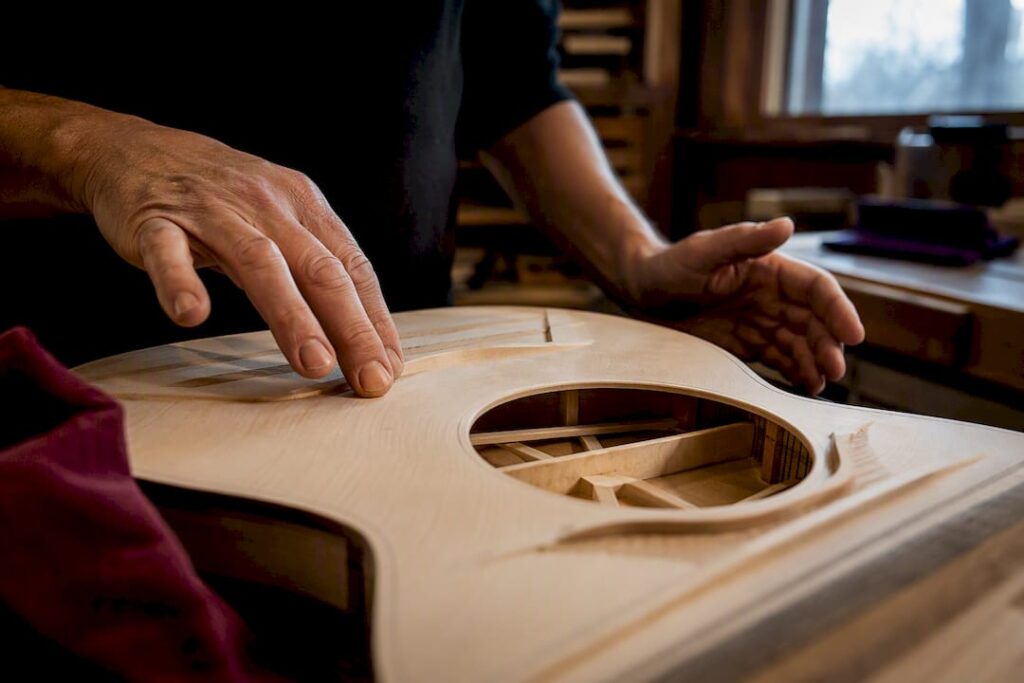

Handbuilt guitars win on voicing, uniqueness, and long-term value potential; factory guitars win on consistency, price, and availability. A luthier hand-tunes bracing and graduation to one specific piece of wood, according to Scharpach’s guide to custom-built acoustic guitars, while factory lines repeat a proven design across thousands of units. Collectors and serious players chasing individuality and resale potential lean handmade. Beginners and working musicians who need dependable tone right now, without a wait list, are usually better served by a well-built factory model.
TL;DR:
- Factory guitars offer higher consistency and faster availability, making them ideal for beginners, gigging musicians, and those needing reliable performance.
- Handbuilt guitars provide unique voice, customization options, and potential long-term value, appealing mainly to collectors and players seeking specific tonal characteristics.
- The tonal quality of a guitar hinges on hand-tuning, finish thickness, and internal voicing, which factory models cannot replicate with the same precision.
- Carefully sourced and aged tonewood significantly influences price and tonal individuality; factory wood grading offers consistency at a lower cost.
- Buyers should request setup details, provenance, and build history before purchasing; in-person testing or certification is recommended for high-value or vintage instruments.
Table of Contents
- Handgebaut vs Fabrik Gitarre: The Core Differences
- How Build Choices Shape Tone and Feel
- Wood Selection, Grading, and Aging
- Setup Numbers That Actually Predict Playability
- What Actually Drives the Price Tag
- Which Option Actually Fits You
- How Vintage Guitar World De-Risks a Handbuilt Purchase
- The Editorial Case for Buying Handbuilt
- Ready to Test a Handbuilt Guitar Yourself?
- Sources
- FAQ
Handgebaut vs Fabrik Gitarre: The Core Differences
The real split between a handbuilt guitar and a factory guitar comes down to four things: who touches the wood, how many hours go into the build, how much you can change, and how long you wait.
A factory relies on jigs, CNC routing, and a repeatable process to turn out instruments with tight unit-to-unit consistency. A solo luthier or small workshop relies on judgment, adjusting each brace and top thickness to the piece of wood in front of them. Neither approach is inherently “better.” They’re built for different outcomes.
- Build process: Factories use standardized templates and machine-assisted steps for repeatable output; handbuilt shops rely on hand-carving, tap-tuning, and individual voicing decisions made instrument by instrument.
- Consistency: Factory production typically delivers higher unit-to-unit consistency because tolerances are locked into the manufacturing process, not left to a builder’s ear.
- Customization: A handbuilt commission can change scale length, bracing pattern, wood pairing, and cosmetic details; factory models offer a handful of finish and hardware options at most.
- Lead time: A factory guitar ships from stock or within weeks; a boutique build routinely runs from several months to over a year, depending on the builder’s queue.
- Bench hours: Handbuilt instruments can absorb dozens of hours of hand labor per top and back, while factory production compresses that time through tooling and batch processing.
The trade-off is straightforward. Factories give you predictability, dealer support, and warranty networks. Boutique builders give you a direct line to the person who shaped your top, and an instrument that exists nowhere else. For a beginner picking their first guitar, that difference barely registers. For a collector building a serious instrument, it’s the whole point.
How Build Choices Shape Tone and Feel
Two guitars can share the same wood species, body shape, and scale length and still sound nothing alike. The difference is voicing: the process of shaping bracing height, top graduation, and internal tuning so the instrument responds the way the builder intends. A luthier taps the top repeatedly during construction, listening for resonance, then shaves wood off the braces until the plate “speaks” the way they want. Factories can’t replicate that because it requires a person, in real time, adjusting to one specific piece of spruce or cedar.
That hands-on tuning is why handmade guitars often sound more individual and responsive than an off-the-shelf model with identical specs on paper. Finish thickness matters too. A thick polyurethane coat dampens vibration; a thin nitrocellulose or French-polish finish lets the top move more freely. Bridge mass and neck geometry change how energy transfers from the strings into the body, and boutique builders often obsess over both in ways a production line, built around consistency and speed, simply can’t.
Here’s a quick way to test any guitar, in a shop or over video call:
- Attack test. Pluck a single note hard, then soft. A well-voiced top shows a clear dynamic range between the two.
- Sustain check. Let an open chord ring out. Count how long it stays audible before dying.
- Register balance. Play the same phrase on the low E string, then the high E string. The tone should feel connected, not lopsided.
- Tap test. Knock lightly on the upper bout and the lower bout. A resonant, musical thud (not a dull thunk) suggests good tap-tuning.
Pro Tip: Record the attack and sustain tests on your phone and play them back side by side against another guitar. Your ear catches differences on playback that it misses in the room.
Wood Selection, Grading, and Aging
Tonewood is where the price gap starts to make sense. A boutique builder often selects a single top and back set by hand, matching grain density and stiffness to the specific instrument they’re planning. A factory buys wood in graded batches and matches sets by broad category, not by individual tap tone.
- Selection method: One-off selection lets a builder pair a stiff, resonant top with a specific bracing plan; batch grading gets consistent quality but sacrifices that instrument-specific matching.
- Seasoning: Spruce and rosewood that have air-dried for years lose internal moisture and stress unevenly, which is why aged tonewood carries a premium among luthiers and collectors alike.
- Provenance risk: Some boutique builders experiment with reclaimed, unusual, or sustainably harvested woods; ask for documentation, since rare-wood claims are easy to overstate and hard to verify after the fact.
- Price link: Higher prices in acoustic guitars often trace back to carefully selected, well-seasoned tonewood as much as to labor hours or brand name.
None of this means factory wood is bad wood. Modern factories have gotten far better at sourcing and drying stock over the past two decades. It means the ceiling for tonal individuality sits higher on a hand-selected set, and that ceiling is exactly what collectors are paying to reach.
Setup Numbers That Actually Predict Playability
Sticker price tells you almost nothing about how a guitar plays out of the case. Setup does. Two identical models can feel completely different depending on how the action and relief were dialed in before it left the shop or bench.
A reasonable target for string action at the 12th fret runs in a low millimeter range on the bass and treble sides for an acoustic, with electric players often running lower depending on style. Neck relief, the slight forward bow in the neck under string tension, typically sits in a low fraction of a millimeter range when measured at the 7th or 8th fret with the string fretted at both ends. Buyers should expect sellers to hand over these numbers on request, along with confirmation that a fresh setup is available if the instrument hasn’t been played in a while.
| Check | What it reveals | Quick method |
|---|---|---|
| Action at 12th fret | Playing effort, fret buzz risk | Feeler gauge or ruler, both strings |
| Neck relief | Neck stability, truss rod health | Capo 1st fret, measure gap at 7th |
| Fret buzz scan | Fret leveling, nut/saddle height | Play each string up the neck, listen |
| Dynamic range | Voicing quality, top responsiveness | Soft-to-loud pluck on open chord |
Factory guitars usually leave the line with a generic setup tuned for an average player. A handbuilt instrument typically gets a final, bespoke regulation from the maker before delivery, matched to the buyer’s playing style if they’ve communicated it.
What Actually Drives the Price Tag
Price on any guitar breaks down into a handful of concrete inputs: wood grade and rarity, hours of hand labor, hardware brand, finish type, and provenance if the instrument has any history worth documenting.
- Wood and labor are the two biggest levers, and both climb steeply once you move from factory-grade timber to hand-selected, aged sets.
- Hardware brand (tuners, bridges, pickups) adds a smaller but real premium, especially on electrics.
- Finish type matters: hand-sprayed nitrocellulose costs more in labor than a sprayed-on polyurethane shell, even before you account for how it affects tone.
- Provenance (a known builder, a notable prior owner, a documented restoration) can swing resale value more than any spec sheet.
Depreciation behaves differently across the two categories. A mid-price factory model tends to lose value predictably, similar to a car, with well-known models holding better than obscure ones. A scarce, well-documented boutique instrument can hold or gain value over time because supply never increases and demand from collectors tends to grow with the builder’s reputation. The practical question to ask before paying a premium: is this price buying audible performance, or mostly buying a name and a finish? Sometimes it’s genuinely both.
Which Option Actually Fits You
- Beginner or budget player: Buy factory. You want reliability and low risk while you’re still figuring out your technique, not a wait list.
- Gigging musician: Buy factory or a production-boutique hybrid. You need a backup available, parts on hand, and a guitar that survives temperature swings on the road.
- Studio player chasing a specific tone: Consider a handbuilt commission. You have the patience for a lead time and a clear enough ear to specify what you want voiced.
- Collector: Go handbuilt, prioritize provenance and documentation, and treat the wait as part of the value.
Before buying either type, ask the seller for setup numbers, wood provenance, and build history. Vague or evasive answers on any of those three are a red flag worth walking away from.
How Vintage Guitar World De-Risks a Handbuilt Purchase
Buying a handbuilt or vintage instrument sight unseen is where most collectors get burned. Testing appointments let you play an instrument in person before committing, and valuation and certification services provide a documented opinion on authenticity, condition, and fair market price before money changes hands.
- Listings include detailed photos, measurements, and historical notes so instruments can be compared like a luthier would, not just by catalog description.
- Testing appointments allow buyers to run attack, sustain, and relief checks on the actual instrument before purchase.
- Certification and valuation services support provenance claims with documented evaluation rather than a seller’s word alone.
The Editorial Case for Buying Handbuilt
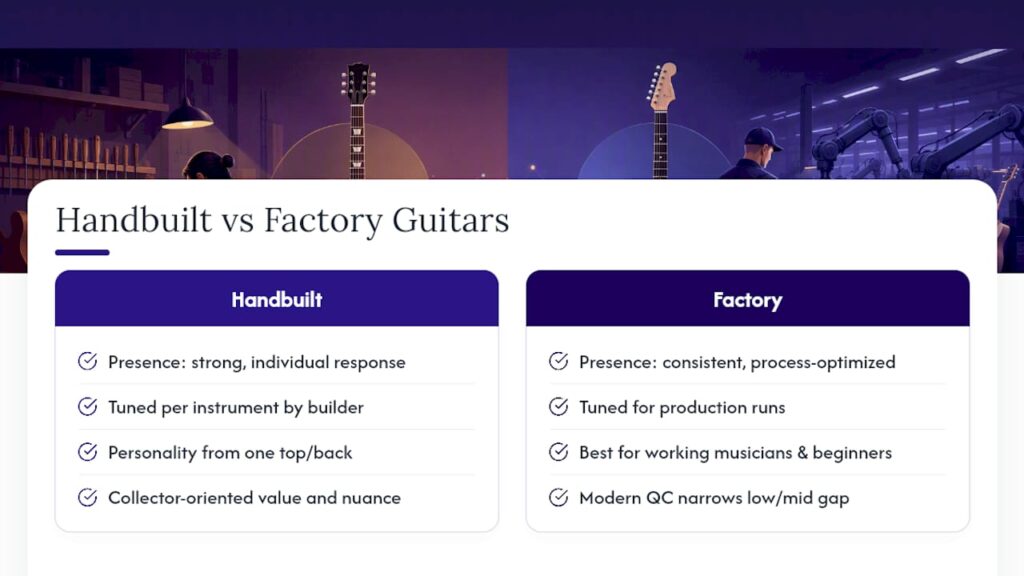
A handbuilt guitar has a presence a factory model rarely matches. Pick one up and it tends to respond like it’s listening back, with a dynamic range and a personality that feels specific to that one top and back. That’s not nostalgia. It’s the direct result of a builder tuning one instrument instead of optimizing a process for a thousand of them.
Factory guitars still deserve their place. For most working musicians and every beginner, a well-built factory instrument is the sensible, low-risk choice, and modern factory quality control has genuinely closed the gap on the low and mid end. But if you’re collecting, the discipline that matters most isn’t taste. It’s documentation: get the setup numbers in writing, get the provenance in writing, and only then trust your ear.
— Vintage
Ready to Test a Handbuilt Guitar Yourself?
Reading about voicing and tap tone only gets you so far. At some point you need to put a guitar in your hands. A curated selection of handcrafted and vintage instruments is offered, backed by expert evaluation, helping buyers avoid relying solely on photos and spec sheets.

Listings include documentation such as measurements, historical notes, and setup details. If you’re serious about a specific instrument, book a testing appointment to play it in person before you commit, or request a valuation and certification if you’re weighing an existing piece against the market. Browse the current selection of handcrafted guitars and start narrowing down the instrument worth building your search around.
Sources
- Klingt eine teure Gitarre automatisch besser? – Bonedo
- Instrumentheritage
- Why Do Handmade Guitars Sound Better? – Scharpach custom built acoustic guitars
FAQ
Which guitar-holding posture works best?
Classical technique, resting the guitar on the raised left leg with a footstool, gives the most consistent left-hand reach and is the standard for serious classical and flamenka playing. For steel-string or electric, whatever posture keeps your fretting wrist straight and your strumming arm relaxed is the right one.
Which guitars have the best sound?
There’s no single winner. Well-seasoned, hand-selected tonewood combined with careful voicing tends to produce the most responsive tone, but many factory instruments sound excellent and satisfy most players’ expectations without a custom build.
What makes a Spanish guitar special?
Traditional Spanish classical and flamenco guitars are built around cypress or rosewood bodies, fan or lattice bracing, and a voicing approach tuned for immediacy and projection rather than sustain. Builders shape that response by hand, adjusting bracing to the specific top for each instrument.
Is a handbuilt guitar always better than a factory guitar?
No. Handbuilt instruments generally offer more individual voicing and customization, while factory guitars offer stronger consistency and availability at a lower price. The right choice depends on your budget, timeline, and how much you value uniqueness over predictability.
How do I check a guitar’s setup before buying?
Ask for the action measurement at the 12th fret and the neck relief figure, then run a quick fret buzz scan and dynamic range test yourself. Vintage Guitar World’s appraisal checklist walks through this exact process step by step.