


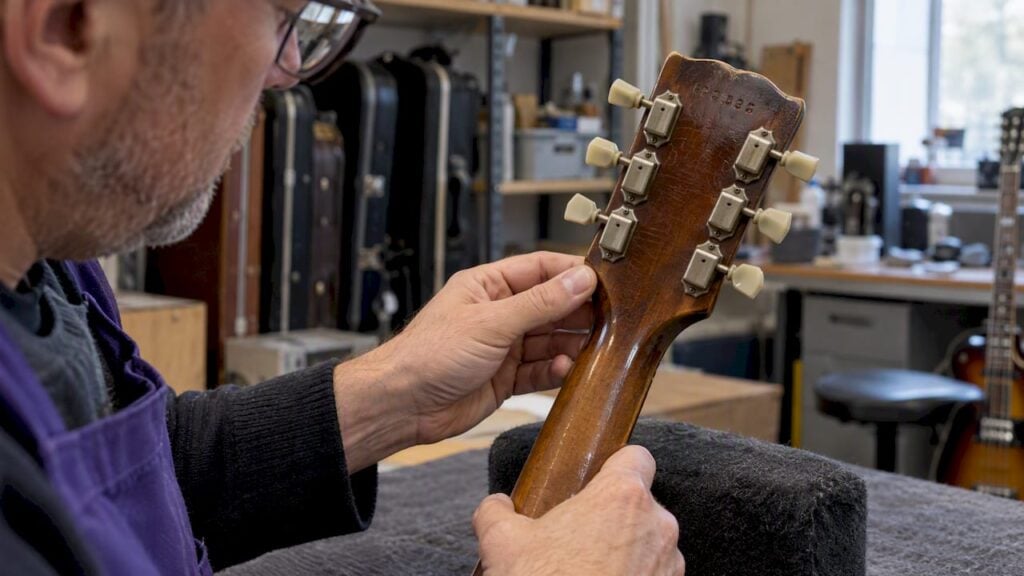

A serial lookup usually gives an approximate production year and factory location when the serial format matches a known pattern, which can be helpful. It does not, by itself, prove a guitar is authentic. If the number doesn’t turn up a match, treat that as a prompt to run a fuller check, not a verdict. Start by photographing and transcribing the serial exactly as stamped.
TL;DR:
- A serial usually identifies the production year or range, factory, and batch, but component dates can differ from final assembly by months.
- On electric guitars from the 1960s onward, check the back of the headstock first; acoustic serials may appear on labels or bridge plates.
- Enter every letter and leading zero exactly; an empty manufacturer result may reflect incomplete records, so verify the transcription and consult a documented community decoder.
- Compare headstock shape, logo, hardware, pot codes, and neck dates with the claimed era, and seek an expert inspection before high value purchases.
Table of Contents
- What a serial number can tell you, and where it falls short
- Where to find the serial on your guitar
- How to decode brand formats and era rules
- Official lookup tools, community decoders, and their limits
- Practical verification workflow: step-by-step checks to confirm authenticity
- Why methodical verification matters for buyers and collectors
- Getting a hands-on inspection, certification, or valuation
- FAQ
- Sources
- Curated links and tools for further verification
What a serial number can tell you, and where it falls short
A serial number typically encodes a handful of fields: the production year or a year range, the factory or country of manufacture, and a batch or sequence number within that run. On many instruments that’s all you get, and even that comes with caveats, because factories often date components separately from final assembly, so a neck date and a body date can land months apart.
A few things to keep in mind when you’re reading a serial:
- Production year, factory location, and batch sequence are the most common pieces of encoded data.
- Modular assembly means the serial reflects a batch, not necessarily the day the guitar left the building.
- Custom shop runs, export models, and early vintage pieces often use formats that don’t appear in published tables at all.
- Pot codes and neck heel dates serve as supporting evidence, never as a replacement for the serial itself.
When a serial looks unusual, that’s a cue to dig deeper, not to assume the worst. Some of the most collectible instruments carry the least standardized numbering.
Where to find the serial on your guitar
Locating the serial correctly is half the battle, since the spot varies by era and builder.
- Check the back of the headstock first, since it’s the most common location on electric guitars from the 1960s onward.
- Look at the front of the headstock on older or reissue models where the number sits near the logo.
- Inspect the neck plate on bolt-on electrics, where four screws hold a metal plate stamped with the number.
- Read the soundhole label on acoustic guitars, usually visible with a flashlight angled through the hole.
- Examine the bridge plate on some acoustic models, accessible through the soundhole with a mirror.
- Check the neck heel, where some builders stamp or ink a number that’s only visible with the neck removed or under strong light.
Backup evidence often sits in the control cavity (pot codes), on internal labels, or as heel stamps hidden under the neck joint. When you photograph any of these, use steady, even lighting, include a ruler or coin for scale, and shoot both a full-instrument reference photo and a tight close-up of the stamp or label. Blurry or poorly lit photos are the single biggest reason a lookup or an expert review stalls.
How to decode brand formats and era rules
Most serial schemes follow a handful of patterns: a letter or number prefix indicating the factory, a two-digit year, sometimes a Julian-day or month code, and a trailing sequence number. Once you know the pattern a brand used for a given era, decoding becomes a matter of matching digit positions to the right table.
Take two neutral examples. A prefix-plus-year format might read as a factory letter, followed by the last two digits of the year, followed by a four or five-digit sequence number: the prefix tells you where it was built, the next two digits tell you when. A Julian-date format instead encodes the year and the day of the year it was stamped, so a number reading “year, then day 047” points to the forty-seventh day of that year, with the remaining digits marking sequence within that day’s batch.
To find the right table, look at three things: how many digits the serial has, what prefix letters appear, and whether the number is inked, stamped, or impressed into the wood or metal. Each of those narrows down the era and factory fast.
A few edge cases are worth flagging before you commit to a decode:
- Export models sometimes carry a separate numbering block from domestic-market instruments.
- Transitional years, when a factory switched numbering systems, can produce overlapping or duplicate serials.
- Limited editions and anniversary runs frequently use their own short-run prefixes that don’t match the standard table.
Documented examples show some manufacturers encode a factory prefix followed by year, month, and sequence digits in a single string, with databases that get updated over time as new serials surface. When a serial doesn’t fit cleanly, cross-check it against hardware specs and label style before trusting the decode.
Official lookup tools, community decoders, and their limits
A few different tool types exist, and each has a role. Manufacturer lookup pages are the first stop for mainstream production instruments. Brand-specific decoders handle niche or boutique builders that don’t have an official database. Community archives and in-browser decoders fill gaps where official records are thin or simply unavailable.
When you use an official lookup, enter the serial exactly as stamped, including letters and leading zeros, and select the correct model family or era if the tool asks for it. Read any warning the database gives about incomplete records before concluding anything from the result.
- Manufacturer databases are frequently incomplete, so a failed manufacturer lookup doesn’t on its own prove a guitar is fake.
- Community-built decoders that run entirely in the browser keep your serial private, since nothing gets sent to a server.
- Reputable decoders document which manufacturer or community references each format rule traces back to.
If a lookup comes back empty, re-check your transcription first since a misread letter or digit is the most common cause. Then consult a community dataset built specifically for that brand, and if the serial still doesn’t resolve, start gathering documentation for an expert to review.
Pro Tip: Photograph the serial before you clean, polish, or touch the finish near it: stamps can be shallow, and even gentle cleaning has erased legibility on original examples.
Practical verification workflow: step-by-step checks to confirm authenticity
A workflow beats a single lookup every time, because it builds a record you can hand to a buyer, seller, or appraiser.
- Photograph and transcribe the serial, noting spacing, prefix letters, and whether the stamp is ink, impression, or engraving.
- Identify the brand and narrow down the correct era or table before attempting to decode anything.
- Run the serial through an official and third-party lookup tool, recording both results even when they agree.
- Cross-check physical details: headstock shape, logo placement and font, hardware specs, and pot or neck dates, since these catch mismatches a serial alone won’t reveal.
- Document any discrepancies, and for higher-value instruments, arrange a hands-on inspection or formal valuation before you commit to buying or selling.
Each step adds a layer that a lone database query can’t provide on its own.
Pro Tip: Keep every photo, pot-code reading, and seller message in one folder as you go. That file becomes your evidence set if you need a second opinion later.
Why methodical verification matters for buyers and collectors
Too many listings skip basic documentation: no serial photo, no close-up of the headstock, no mention of repairs. That gap is where expensive mistakes happen.
A buyer who photographs everything and checks hardware against the claimed era protects themselves and gives a seller a faster, cleaner sale. For instruments where the stakes are high, we offer inspection and valuation services that pick up exactly where a serial lookup leaves off.
— Vintage
Getting a hands-on inspection, certification, or valuation
A serial lookup gets you a starting point. What it can’t do is examine the wood, confirm provenance, or put a signature behind the result, and that’s where our services pick up.

We offer playing appointments for instruments you want to hear and handle before buying, consignment sales for owners looking to place a guitar with serious buyers, and certificates and valuations backed by hands-on inspection and provenance research. When wear or past repairs complicate a verification, we also handle restoration work that documents what was done and why.
If your lookup came back inconclusive, or you just want a second set of trained eyes before a high-value purchase, visit Vintage Guitar World to book an appointment or request a valuation.

FAQ
How do I verify a guitar serial number?
Photograph and transcribe the serial exactly, then run it through the manufacturer’s official lookup tool for that brand. If the result is incomplete, cross-check the number against a community decoder and compare the guitar’s hardware and labels against known examples from that era.
How do I check a serial number in general?
Locate the number on the headstock, neck plate, or label depending on the instrument type, then enter it into the manufacturer’s lookup tool exactly as stamped, including letters and leading zeros. If no official tool exists, a documented community archive is the next best resource.
How do I verify a Gibson serial number?
Look for the serial on the back of the headstock or on an interior label, then check it against Gibson’s own era-specific numbering guidance, since the company has used several different formats over time. A missing match in official records means you should consult documented community references or arrange an expert review rather than assume the instrument is fake.
How can I tell a guitar’s age from its serial number?
Most serial formats encode the production year directly, either as a two-digit year or embedded within a longer sequence, so matching the right era table to the serial’s digit count and prefix reveals the approximate build year. Supporting evidence like neck-heel dates or pot codes can confirm that estimate, though component dates sometimes differ from the final assembly date.
Sources
Curated links and tools for further verification
Start with a community decoder or lookup tool for format-matching. For hands-on inspection or valuation, visit our shop.