














TL;DR:
- Guitar grading assesses condition, originality, and material quality to determine market value and playability. The grading scale ranges from Mint to Poor, heavily influencing price and collector interest. Accurate evaluation requires examining wear, components, tonewood, and modifications for informed buying and selling decisions.
Guitar grading is the standardized evaluation of an instrument’s condition, originality, and material quality to determine its market value, playability, and authenticity. Whether you’re hunting for a 1960s Fender Stratocaster or a handcrafted classical guitar, understanding the guitar grading system separates smart acquisitions from costly mistakes. Grades range from Mint at the top to Poor at the bottom, with each tier carrying real price consequences. This guide covers every layer of the grading process, from cosmetic wear and component originality to tonewood quality, so you can read any listing with confidence.
What are the common guitar grading categories?
Guitar condition grading uses six primary tiers, and each one carries a specific set of criteria that directly drives market price variations in vintage and used guitar sales.
- Mint: A Mint grade guitar shows zero play wear, a factory-fresh finish, and 100% original components. This grade is rare in the vintage market because even a single replaced tuner disqualifies it.
- Excellent: Light surface marks only, with no structural issues and all or nearly all original parts intact. This is the most common top-tier grade for well-preserved vintage instruments.
- Very Good: Moderate cosmetic wear such as pick scratches, minor dings, and some fret wear, but fully playable and structurally sound. Original parts may include one or two period-correct replacements.
- Good: Noticeable wear throughout, possible non-original hardware, but the guitar plays well and holds its setup. Buyers at this grade should inspect fret life carefully.
- Player Grade: Significant cosmetic damage and heavy fret wear are acceptable here, provided the guitar remains fully functional and structurally sound. Player Grade instruments are workhorses, not display pieces.
- Poor: Structural damage, unplayable action, or missing components. Poor condition instruments typically retain only 10–30% of their original market value.
Condition grading directly drives price variations from 100% for Mint down to a fraction of that for Poor condition instruments. That range makes accurate grading one of the highest-stakes skills a collector can develop.
Pro Tip: When reading online listings, always ask the seller to confirm whether “Excellent” means no replaced parts or simply no visible damage. Those two definitions produce very different prices.
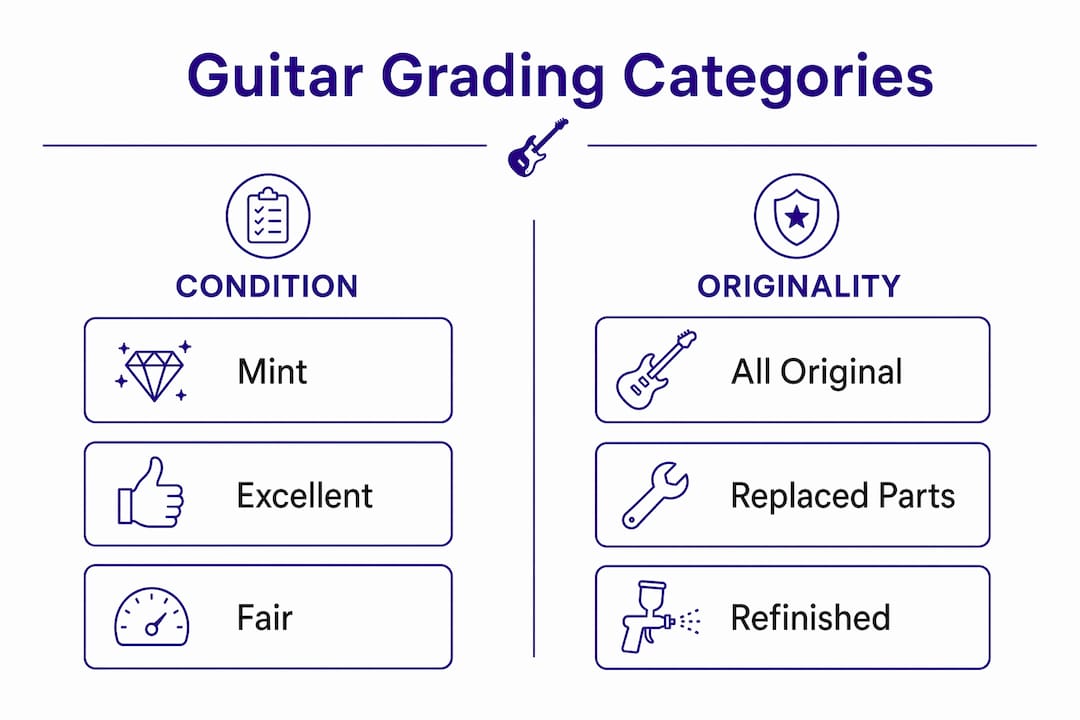
Before any resale, reputable dealers inspect electronics, hardware, and playability to assign accurate grades. That process protects both buyer and seller from disputes after the transaction closes.
How does originality affect guitar grading and valuation?
Originality is the single most debated factor in vintage guitar grading. A guitar can look pristine and still lose significant value the moment a non-original part is discovered. The industry term for this is “parts originality,” and it carries more weight on pre-1980 instruments than on modern production guitars.
Here is how originality factors are ranked by their impact on grade and value:
- Finish: A refinished body is the most damaging change a vintage guitar can carry. A refin on a 1950s or 1960s instrument typically drops its value by 40–60% compared to an all-original example in the same cosmetic condition.
- Pickups: Original pickups define the tone and the provenance of an instrument. Replacing a single tuner on a 1960s Fender can reduce value by 10–20%. Swapping pickups carries an even steeper penalty.
- Tuners, bridge, and nut: These are frequently replaced for playability reasons, but period-correct originals always command a premium.
- Pots and wiring: Original electronics are harder to verify visually, which is why date codes on potentiometers matter so much to serious collectors.
- Neck: A replaced neck on a bolt-on guitar like a Fender Telecaster is a major red flag. On a set-neck Gibson Les Paul, a neck reset is acceptable; a full neck replacement is not.
The distinction between reversible and irreversible modifications is critical. Reversible modifications such as a pickguard swap or strap button change have minimal impact on grading. Irreversible changes like routed pickup cavities or a refin permanently reduce the grade, regardless of how well the work was done.
Pro Tip: Always check the back of the headstock for finish overspray. A refin almost always leaves a telltale line where the original finish ended and the new coat began.
For modern guitars, originality matters less because replacement parts are widely available and the instruments carry no historical scarcity premium. For anything pre-1980, treat every non-original component as a negotiating point. You can learn more about verifying vintage authenticity before committing to a purchase.
What role does tonewood grading play in guitar evaluation?
Most buyers focus entirely on cosmetic condition and overlook tonewood grading. That is a mistake, especially when evaluating acoustic guitars, classical instruments, or high-end electrics with carved tops.
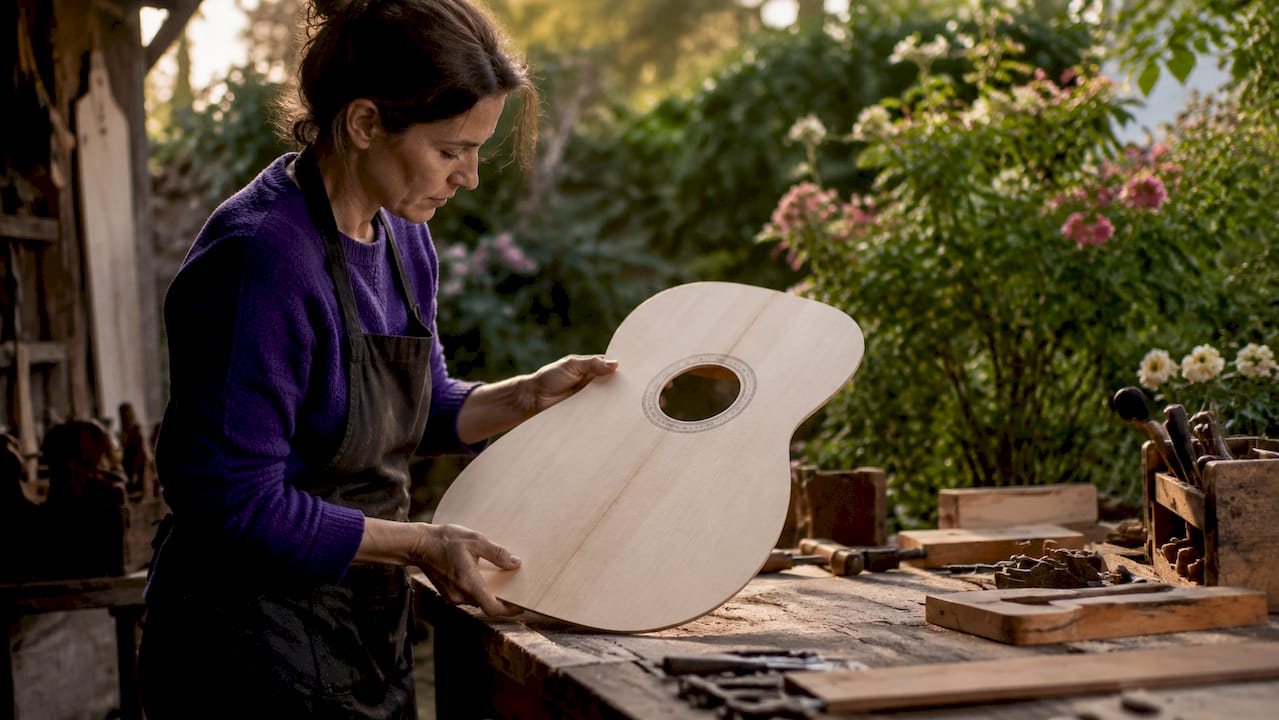
Tonewood grading evaluates a soundboard on visual and acoustic criteria. The primary visual factors are growth ring uniformity and quarter-sawn accuracy, which predict structural stability and acoustic vibration efficiency. A top with tight, even rings cut perfectly on the quarter will move air more consistently than one with irregular grain or flat-sawn orientation.
| Tonewood Grade | Growth Ring Density | Quarter-Sawn Accuracy | Typical Use |
|---|---|---|---|
| Master Grade | Very tight, uniform | Near perfect | Concert and collector instruments |
| Premium Grade | Tight, mostly uniform | High accuracy | Professional performance guitars |
| Standard Grade | Moderate density | Acceptable deviation | Mid-range production guitars |
| Utility Grade | Irregular or wide | Low accuracy | Student and entry-level instruments |
Slow, tight growth rings from high-altitude trees yield a better stiffness-to-weight ratio and a refined acoustic response. European Spruce and Alpine Spruce with tighter rings are highly valued for soundboards precisely because of this relationship between density and resonance.
“Experienced luthiers select guitar tops by acoustic response beyond just visual grading. A top that looks imperfect on paper can outperform a visually flawless piece when it vibrates freely.” — Maderas Barber
Visual imperfections in tonewood do not always correlate with poorer sound. Some tops with minor cosmetic irregularities perform better acoustically than visually perfect specimens. This is why a luthier’s tap test and flex assessment matter as much as the grade label on the wood.
For collectors, a Master Grade tonewood top on a handcrafted instrument adds measurable long-term value. The wood stabilizes over decades, and the acoustic properties often improve with age, which is a key reason why well-preserved vintage acoustics command prices far above their original retail cost.
How to apply guitar grading when buying, selling, or collecting
Understanding guitar grading explained in theory is one thing. Applying it at a guitar show, in a private sale, or while reviewing an online listing is another skill entirely. Here is a practical checklist for assessing any instrument through the lens of grading criteria.
- Start with the finish. Check under strong light for checking, crazing, or overspray. Original lacquer on a vintage instrument will show age-appropriate checking patterns. Fresh lacquer on an old guitar is a warning sign.
- Inspect the frets. Fret wear is one of the most honest indicators of how much a guitar has been played. Deep grooves under the first five frets on a supposedly Excellent-grade guitar contradict the listing.
- Check all hardware for originality. Compare tuner buttons, bridge saddles, and nut material against documented specs for that model and year. Reference resources like the Vintage Guitar Price Guide or model-specific forums for factory specifications.
- Test every electronic component. Scratchy pots, intermittent output, or dead pickups all affect grade. Guitars are inspected for electronics and hardware function before any accurate grade can be assigned.
- Assess structural integrity. Look for cracks at the heel joint, top bellying behind the bridge on acoustics, and headstock repairs. A repaired headstock crack on a Gibson Les Paul is common and acceptable if disclosed; an undisclosed repair is a grading violation.
- Evaluate playability. Grading includes playability and structural soundness, not just cosmetic wear. A guitar that cannot hold a setup or plays out of tune above the 12th fret cannot be graded above Player Grade regardless of how it looks.
The most common pitfall for buyers is accepting a seller’s grade without independent verification. Grades are subjective unless the seller follows a documented standard. Always cross-reference the grade against the specific criteria listed above, and use a step-by-step condition assessment process before finalizing any purchase. For a deeper look at how condition scores translate to dollars, the Vintage-guitar-world resource on condition and guitar value breaks down the relationship with real market examples.
Key takeaways
Guitar grading is a multi-layered evaluation covering condition, originality, and material quality, and mastering all three layers is what separates informed collectors from buyers who overpay.
| Point | Details |
|---|---|
| Condition grades drive price | Mint to Poor grades shift value from 100% down to 10–30% of market price. |
| Originality is non-negotiable for vintage | A single replaced tuner on a 1960s Fender can reduce value by 10–20%. |
| Tonewood grade affects long-term value | Master Grade tops with tight growth rings improve acoustically over decades. |
| Reversible vs. irreversible mods matter | Irreversible changes like refins permanently lower grade regardless of quality. |
| Playability is part of the grade | A guitar that cannot hold a setup cannot exceed Player Grade, no matter how it looks. |
Why grading discrepancies cost collectors more than they realize
I have handled hundreds of vintage instruments over the years, and the grading errors I see most often are not outright fraud. They are honest mistakes made by sellers who conflate cosmetic condition with overall grade. A guitar can look stunning in photographs and still be a Player Grade instrument the moment you discover a replaced bridge pickup or a neck pocket shim that was never disclosed.
The vintage market in 2026 is more competitive than it has ever been. Buyers are better informed, and pricing data is more accessible. But that accessibility creates a false sense of security. Knowing that a 1964 Gibson ES-335 in Excellent condition trades at a certain price range does not help you if the instrument in front of you has been misgraded. The gap between Excellent and Very Good on a desirable vintage model can represent thousands of dollars.
My honest advice: treat every grade as a starting point for your own inspection, not a conclusion. The sellers who use documented grading standards and disclose every known issue are the ones worth building long-term relationships with. Transparency in grading is not just good ethics. It is the foundation of a healthy collector market.
— Vintage
Explore vintage guitars and expert grading resources
Understanding guitar grading is the first step. Finding instruments that have been graded honestly and transparently is the second.

Vintage-guitar-world curates a selection of rare, restored, and well-documented instruments across classical, flamenco, acoustic, and electric categories. Every listing reflects a commitment to accurate condition reporting and material quality assessment. If you want to go deeper on what separates a good investment from a great one, the Vintage-guitar-world guide to types of vintage guitars covers how features, history, and grade interact to determine long-term value. For a structured approach to pricing, the guitar valuation guide connects grading criteria directly to market worth.
FAQ
What is guitar grading?
Guitar grading is the evaluation of an instrument’s condition, originality, and material quality to assign a standardized grade such as Mint, Excellent, Very Good, Good, Player Grade, or Poor. Each grade reflects the guitar’s market value and playability.
How does a mint grade guitar differ from excellent?
A Mint grade guitar shows zero play wear and retains 100% original components, while an Excellent grade allows for light surface marks and minor cosmetic imperfections with most original parts intact.
Does a replaced part always lower a guitar’s grade?
Irreversible changes like a refinished body or routed pickup cavity permanently reduce the grade, while reversible modifications such as a pickguard swap have minimal grading impact.
Why does tonewood grading matter for acoustic guitars?
Tonewood grading evaluates growth ring uniformity and quarter-sawn accuracy to predict structural stability and acoustic performance. Higher-grade tonewoods often improve in sound quality over decades, which directly supports long-term instrument value.
Is player grade worth buying?
Player Grade guitars are fully functional and structurally sound despite heavy cosmetic wear, making them excellent choices for gigging musicians who want a quality instrument without paying a collector premium.