














TL;DR:
- Guitar certification validates musicians’ skills and confirms a guitar’s authenticity for collectors. These credentials open career doors, support university admissions, and establish provenance and market value. Choosing the right certification depends on goals, whether for professional advancement or instrument verification.
Guitar certification is an official credential that verifies a player’s skill level or confirms a guitar’s authenticity, and the role of guitar certifications extends far beyond a framed piece of paper. For musicians, these credentials open doors to teaching positions, university admissions, and structured career growth. For collectors and investors, they serve as the primary tool for authenticating provenance, establishing market value, and reducing transaction risk. Organizations like the Royal Conservatory of Music (RCM), Trinity College London, and Vintage-guitar-world each operate within this credentialing space, though they serve distinct purposes. Understanding both sides of certification gives you a real edge, whether you play or collect.
What kinds of guitar certifications exist and who issues them?
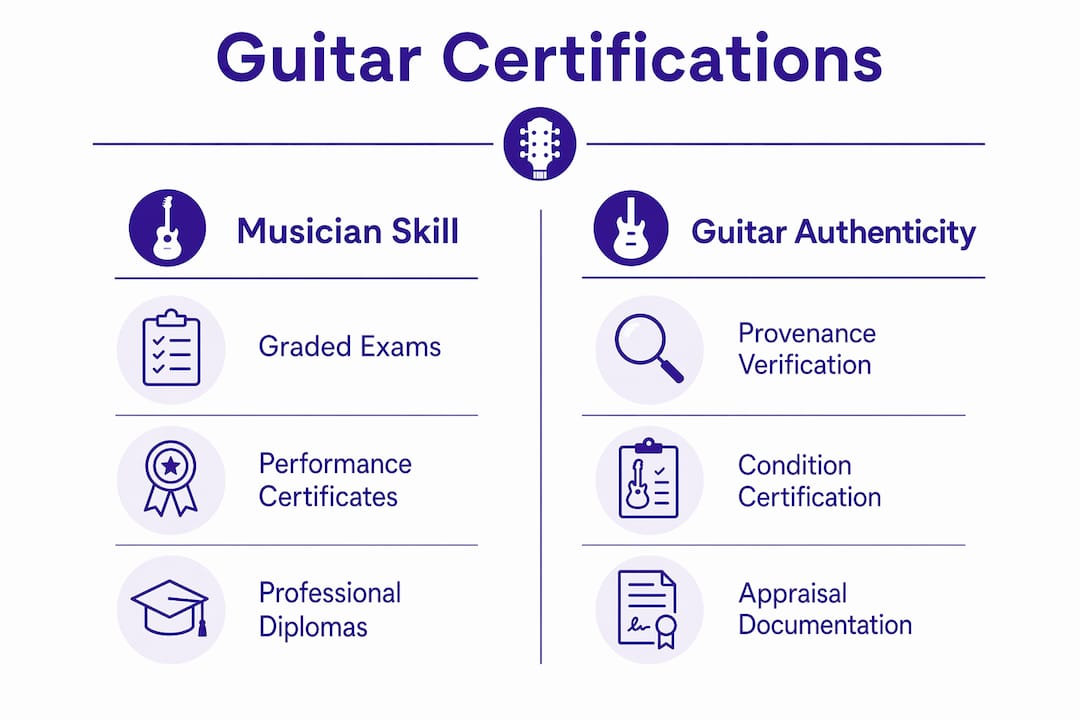
Guitar certifications fall into two distinct categories: musician skill certifications and guitar authenticity certifications. Knowing which type applies to your situation is the first decision you need to make.
Musician skill certifications are graded credentials issued by recognized exam boards. The most widely accepted programs include:
- RCM (Royal Conservatory of Music): Grades 1–10 plus ARCT diploma, covering technique, theory, and repertoire.
- Trinity College London: Grades 1–8 plus diploma levels (ATCL, LTCL, FTCL), recognized globally by universities and conservatories.
- RSL Awards (Rockschool): Grades 1–8 mapped to the UK’s Regulated Qualifications Framework, with grades 6–8 equivalent to A-levels and eligible for UCAS points.
- Baltimore Classical Guitar Society: Issues a formal signed certificate with jury feedback upon passing, requiring a $35 registration fee plus active membership.
Guitar authenticity certifications are a separate category entirely. These documents verify a vintage or collectible guitar’s provenance, condition, and originality. They are issued by appraisal experts, specialist dealers, and organizations like Vintage-guitar-world, which provides valuation and certification services for rare instruments. Unlike skill exams, authenticity certificates are tied to a specific instrument, not a person.
| Certification type | Issued by | Primary purpose |
|---|---|---|
| Musician skill (graded exam) | RCM, Trinity, RSL Awards | Validates technical and musical competency |
| Diploma level | Trinity, RCM (ARCT) | Supports university and professional teaching roles |
| Guitar authenticity | Appraisal experts, specialist dealers | Confirms provenance, condition, and originality |
| Society certificate | Baltimore Classical Guitar Society | Formal recognition with jury evaluation |
Music certification boards such as RCM, Trinity, and RSL provide internationally accepted pathways that validate both technical and musical competency. That global acceptance is what makes these credentials worth pursuing for anyone with professional ambitions.
What are the benefits of guitar certification for musicians?
Certification gives musicians something that self-directed practice cannot: external, verifiable proof of ability. A musical certificate functions like a driver’s license, verifying skill levels and supporting teaching roles, college admissions, and performance opportunities worldwide. That analogy is accurate. Without it, your skill is your word. With it, your skill is a documented fact.
The advantages of guitar certification go deeper than credentialing, though. Certification structures replace random practice routines with clear graded goals, providing sustained motivation and measurable achievement. That shift from aimless playing to purposeful practice is one of the most underrated benefits of guitar certifications for students at every level.
Here is what musicians gain from pursuing formal guitar certification programs:
- Structured learning path: Each grade builds on the last, covering scales, sight reading, ear training, and repertoire in a logical sequence.
- Motivation through milestones: Passing a grade creates a concrete achievement that sustains long-term commitment.
- Teaching credentials: Most private music schools and public programs require at least a Grade 8 or diploma-level certification before hiring instructors.
- University applications: Advanced grades carry academic weight. RSL Awards’ Grades 6–8 earn UCAS points in the UK, and similar frameworks apply in Canada and Australia through RCM.
- Performance opportunities: Certified musicians qualify for competitions, ensembles, and festivals that require verified skill levels.
- International recognition: Boards like Trinity and RCM are accepted by conservatories and universities across North America, Europe, Asia, and beyond.
The importance of guitar qualifications also shows up in how educators design lessons. Teachers who work within a certification framework report that students practice more consistently because the exam creates a real deadline and a real consequence. That accountability is difficult to replicate in informal settings.
Pro Tip: If your goal is to teach professionally, prioritize diploma-level certifications like LTCL or ARCT over lower grades. Lower grades build skill; diplomas build careers. Align your exam path with where you want to be in five years, not where you are today.
How do guitar certifications impact collectors and investors?
For collectors, the word “certification” means something entirely different than it does for musicians. A guitar authenticity certificate is a formal document that confirms an instrument’s identity, originality, and condition. Without one, a vintage guitar is a claim. With one, it is a verified asset.
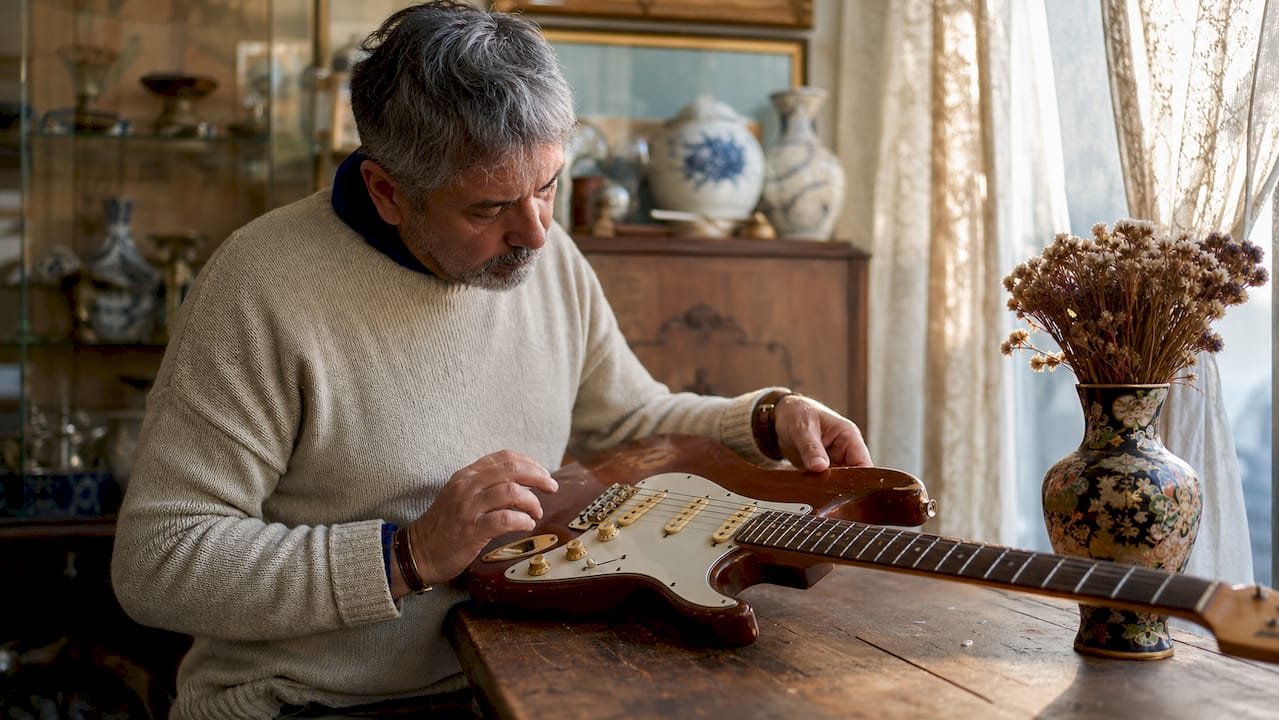
Certification confirms authenticity and provenance by establishing a documented chain of ownership and verifying that original components have not been replaced. A 1959 Gibson Les Paul Standard, for example, commands a dramatically different price depending on whether its pickups, tuners, and finish are original. A certificate from a credible appraiser or specialist like Vintage-guitar-world makes that determination official. You can learn more about how this process works through Vintage-guitar-world’s guitar certification guide.
Certifications also reduce buyer risk in transactions. When a seller provides a condition certificate from a recognized source, the buyer does not need to rely solely on photographs or seller descriptions. That reduction in uncertainty directly supports higher sale prices and faster transactions. Collectors who understand certification in guitar collecting consistently report stronger negotiating positions on both sides of a deal.
Insurance and resale value both depend on documented condition. Insurers require formal appraisals to set coverage amounts, and those appraisals carry more weight when paired with a condition certificate. At resale, a certified guitar moves faster and at a higher price than an equivalent uncertified instrument.
Pro Tip: Collectors often overlook the cost of not certifying. An uncertified guitar may sell for significantly less than its certified equivalent, even when the instruments are identical in condition. The certificate is not just paperwork. It is the difference between asking price and accepted price.
The table below clarifies the distinction between the two certification types for collectors making purchasing or investment decisions:
| Factor | Musician skill certification | Guitar authenticity certification |
|---|---|---|
| Purpose | Validates player competency | Confirms instrument provenance and condition |
| Issued to | The musician | The instrument |
| Issuer | RCM, Trinity, RSL Awards | Appraisers, specialist dealers |
| Impact on value | Career and education access | Market price and insurability |
| Transferable? | Yes, follows the musician | No, tied to the specific guitar |
What should you consider when choosing a guitar certification path?
Not every certification path fits every musician or collector. The right choice depends on your goals, your timeline, and how you define success.
For musicians, the first decision is between a Practical exam and a Performance Certificate. Selecting between these formats depends on student goals. Practical exams cover comprehensive musicianship, including theory, ear training, and sight reading alongside repertoire. Performance Certificates focus exclusively on repertoire with fewer theory requirements. If you want the full academic credential, take the Practical exam. If you want to demonstrate playing ability without the theory component, the Performance Certificate is the faster route.
Diploma-level certifications carry the most professional weight. Top-level certifications like ARCT and LTCL diplomas have the greatest influence on university and professional recognition, while lower levels primarily serve as developmental milestones. That hierarchy matters when you are deciding how much time and money to invest.
Contemporary exam boards have developed flexible repertoire and set list parameters that allow artistic freedom while maintaining academic rigor. Trinity’s Rock and Pop diplomas, for example, let candidates build programs around their own musical identity rather than a fixed syllabus. That flexibility makes certification accessible to guitarists who play outside classical traditions.
Key considerations before committing to a certification program:
- Career vs. recreation: Diploma-level credentials matter for professional musicians and teachers. Lower grades serve hobbyists and students building foundational skills.
- Exam format: Face-to-face exams remain standard, but some boards now offer digital submission options for certain levels.
- Fees and membership: Costs vary by board and level. The Baltimore Classical Guitar Society charges approximately $35 plus membership. RCM and Trinity fees scale with grade level and region.
- Time investment: Higher grades require months of dedicated preparation. Align your timeline with your actual availability.
- Academic goals: If university admission is the target, prioritize boards whose grades earn recognized qualification points in your country.
Many advanced guitarists reach high skill levels without formal certifications. Certification is a strategic choice, not a universal requirement. The musicians who benefit most are those who need external validation for a specific purpose, whether that is teaching, university entry, or professional performance.
Pro Tip: Before registering for any exam, write down your three-year goal. If certification does not directly support that goal, the time and money may be better spent on lessons, recording, or live performance experience.
Key Takeaways
Guitar certifications serve two distinct functions: validating musician skill for career and education, and confirming instrument authenticity for collectors and investors.
| Point | Details |
|---|---|
| Two certification types | Skill certifications validate musicians; authenticity certificates verify instruments. |
| Academic weight matters | RSL Awards Grades 6–8 equal A-levels and earn UCAS points for university applications. |
| Collectors need documentation | Certified guitars command higher prices and are easier to insure and resell. |
| Choose the right exam format | Practical exams cover full musicianship; Performance Certificates focus on repertoire only. |
| Certification is strategic | Advanced diplomas like ARCT and LTCL carry the most professional and academic value. |
What I have learned from years inside the vintage guitar market
The certification conversation splits cleanly into two camps, and most articles pick one side. Musicians read about grades and diplomas. Collectors read about appraisals and provenance. The reality is that these two worlds overlap more than people expect.
A guitarist who holds an LTCL diploma and also collects vintage instruments brings a different level of credibility to every transaction. They understand construction, tonal quality, and playability in ways that purely financial collectors do not. That combination of musical knowledge and collecting instinct is genuinely rare, and it shows up in better buying decisions.
What I have seen consistently at Vintage-guitar-world is that collectors who treat certification as an afterthought pay for it later. An instrument without documented provenance sits longer, sells lower, and creates disputes that erode trust. Certification is not bureaucracy. It is the foundation of a clean transaction.
The other thing worth saying plainly: certification frameworks have improved. Trinity’s contemporary diplomas now accommodate rock, pop, and world music in ways that the classical-only boards never did. That shift means more guitarists can pursue formal recognition without abandoning the music they actually play. The system has caught up with the players, and that is worth acknowledging.
Use certifications as tools. Know what each one does, who recognizes it, and what it costs you in time and money. Then decide deliberately, not by default.
— Vintage
Certified instruments and curated guitars at Vintage-guitar-world
Vintage-guitar-world brings together expert evaluation, provenance documentation, and a curated selection of rare instruments for musicians and collectors who take quality seriously.

Whether you are researching vintage guitar features and investment value or need a formal guitar appraisal and valuation before buying or selling, Vintage-guitar-world provides the expertise to make that decision with confidence. Every instrument in the collection is evaluated for authenticity, condition, and historical significance. Collectors who want instruments backed by documented assessments, and musicians who want to understand what makes a guitar worth owning, will find both the inventory and the knowledge base they need in one place.
FAQ
What is the role of guitar certifications for musicians?
Guitar certifications validate a musician’s technical skill and musical knowledge through graded exams issued by boards like RCM, Trinity, and RSL Awards. They support teaching credentials, university applications, and professional performance opportunities.
How do guitar certifications affect a vintage guitar’s value?
An authenticity certificate from a credible appraiser confirms a guitar’s provenance and original condition, which directly supports higher resale prices and easier insurance coverage. Uncertified instruments of equal quality consistently sell for less.
What is the difference between a Practical exam and a Performance Certificate?
A Practical exam covers comprehensive musicianship including theory, ear training, and sight reading alongside repertoire. A Performance Certificate focuses on repertoire only, with fewer theory requirements, making it faster to complete for players with specific goals.
How do I get guitar certified through a recognized program?
Register with a board like RCM, Trinity, or RSL Awards, prepare the required repertoire and theory for your chosen grade, and book an exam session. Some organizations, like the Baltimore Classical Guitar Society, also require membership alongside a registration fee.
Are advanced guitar grades worth pursuing for university admission?
RSL Awards Grades 6–8 map to Level 3 on the UK’s Regulated Qualifications Framework, equivalent to A-levels and eligible for UCAS points. Diploma-level certifications like ARCT and LTCL carry the most weight for conservatory and university applications globally.