














TL;DR:
- Auction houses specialize in verifying, valuing, and showcasing rare vintage guitars to collectors worldwide.
- Auction results influence market trends, set price benchmarks, and shape collector perceptions of value.
- Proper authentication and provenance research are vital to avoid risks when buying outside auctions.
When Jeff Beck’s 1954 Oxblood Gibson Les Paul sold for £1,068,500 at Christie’s, it wasn’t just a headline. It was a signal to every serious collector worldwide that the vintage guitar market had entered a new era. Guitar auction houses like Christie’s, Sotheby’s, Heritage Auctions, Julien’s, and Backstage Auctions have become essential infrastructure for collectors and musicians seeking rare, documented, and historically significant instruments. This guide walks you through how these houses work, what drives auction values, how authentication protects buyers, and how you can participate with confidence.
Table of Contents
- What are guitar auction houses and why do collectors trust them?
- How auction houses influence guitar values and market trends
- Authentication, provenance, and the risks of buying outside auctions
- Participating in guitar auctions: what collectors and musicians need to know
- The hidden power of auctions: More than just a sales venue
- Find your next vintage guitar with expert support
- Frequently asked questions
Key Takeaways
| Point | Details |
|---|---|
| Auction houses validate authenticity | Buyers can trust the provenance and quality of vintage guitars at reputable auctions. |
| Record sales drive market value | Legendary auction results set price benchmarks across the world of vintage guitars. |
| Transparency and protection | Auctions provide public records, expert vetting, and allow global collectors to compete fairly. |
| Know the process | Preparation and knowledge empower collectors to succeed in the fast-paced auction world. |
What are guitar auction houses and why do collectors trust them?
At their core, guitar auction houses are specialized marketplaces. But that description undersells what they actually do. These institutions connect sellers of rare, historically significant, or provenance-rich instruments with buyers who demand verified quality and transparency. Unlike a classified listing or a pawn shop deal, an auction house brings professional expertise, legal accountability, and global visibility to every transaction.
Major venues like Christie’s, Sotheby’s, Heritage Auctions, Julien’s, and Backstage Auctions function as primary marketplaces for high-value vintage and provenance guitars. Each house employs specialists who evaluate instruments before they ever appear in a catalog. These experts assess condition, identify original components, research ownership history, and assign estimated values. Buyers aren’t guessing. They’re working with curated, verified information.
Here is what the best auction houses consistently provide:
- Expert pre-sale evaluation by instrument specialists with decades of experience
- Provenance documentation tracing ownership from original sale to present day
- Condition reports detailing repairs, modifications, and structural integrity
- Global bidder pools that drive competitive pricing and fair market discovery
- Post-sale certificates confirming authenticity for the buyer’s records
The trust collectors place in auction houses comes from a simple fact: the house’s reputation is on the line with every sale. A mis-catalogued instrument or a failed authentication damages credibility permanently. That accountability creates an incentive structure that private sellers simply don’t have.
“A guitar without a story is just wood and wire. Auction houses are in the business of proving the story is real.”
For collectors new to this space, knowing how to buy vintage guitars is the first step. Understanding provenance is the second. A strong guitar provenance guide can help you read auction catalogs with much more confidence, spotting the details that separate a great lot from an overpriced one.
How auction houses influence guitar values and market trends
Auction results don’t just reflect market value. They create it. When a guitar sells for a record price, it resets expectations across the entire category. Dealers, private collectors, and insurers all look at auction results when pricing comparable instruments.

The numbers speak for themselves:
| Guitar | Auction house | Sale price | Year |
|---|---|---|---|
| David Gilmour’s Black Strat | Christie’s | $14,500,000 | 2019 |
| Jeff Beck’s Oxblood Les Paul | Christie’s | £1,068,500 | 2023 |
| Eric Clapton’s Blackie Strat | Christie’s | $959,500 | 2004 |
| Kurt Cobain’s Martin D-18E | Julien’s | $6,010,000 | 2020 |
These results do more than generate press. They teach the market what rarity, provenance, and cultural significance are worth. A 1954 Les Paul owned by an anonymous collector trades very differently after a Beck-quality instrument fetches seven figures. Collectors who held similar models suddenly had a new benchmark for insurance valuations, estate planning, and future sales.
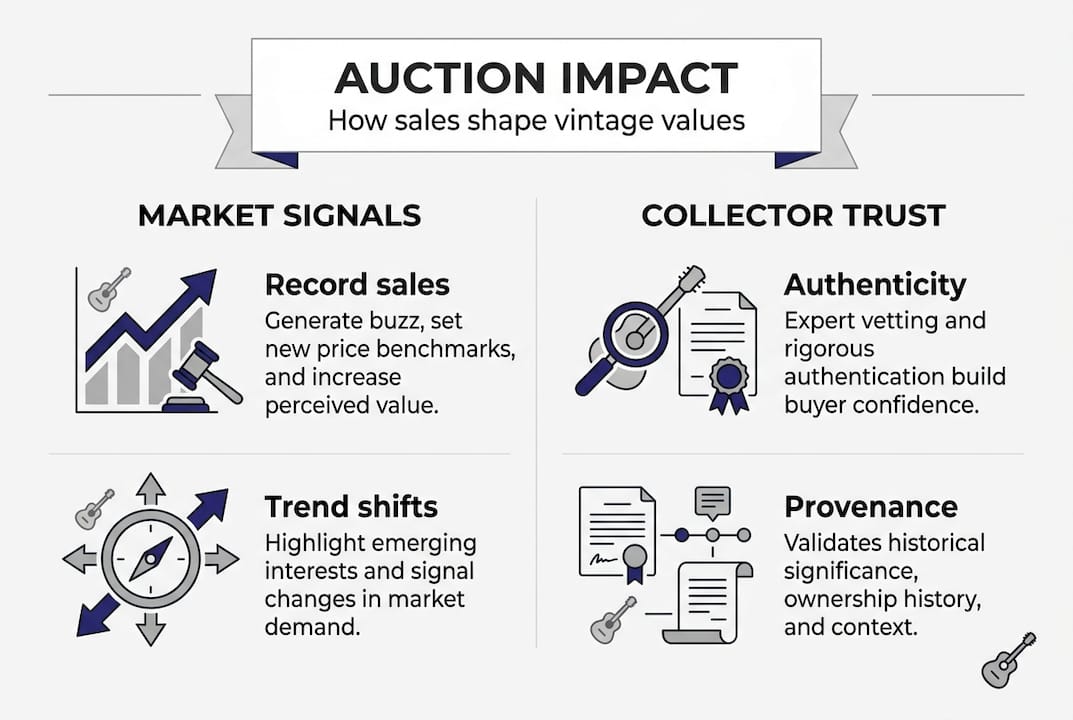
Market growth has accelerated post-pandemic, with record auction sales like the Gilmour Black Strat at $14.5M and Beck’s Oxblood Les Paul at £1.06M showing double-digit year-over-year rises in top-tier guitar values. Auction catalogs also shape taste. When a house dedicates a major sale to pre-war acoustics or early Fender electrics, it educates thousands of potential bidders about that category. Demand builds. Values follow.
For buyers trying to stay ahead of these trends, using a solid vintage guitar buying checklist helps you evaluate whether an instrument you’re eyeing is fairly priced given current auction benchmarks.
Competitive bidding also adds a layer of market transparency that private deals lack. When two informed bidders drive a price up to $200,000, that number is real. It reflects what the market, not one motivated seller, believes the instrument is worth.
Authentication, provenance, and the risks of buying outside auctions
Authentication is where auction houses earn their fees. The process is rigorous, and for good reason. A fake or mis-represented vintage guitar can cost a buyer tens of thousands of dollars and years of frustration.
Auction houses provide authentication, valuation, and global exposure that private transactions simply cannot match. Here’s what a standard auction authentication process looks like:
- Initial submission review — The house evaluates whether the instrument meets minimum standards for inclusion.
- Physical inspection — Specialists examine hardware, frets, finish, serial numbers, and structural integrity in person.
- Provenance research — Ownership history is traced through receipts, photographs, letters, and other documentation.
- Comparative analysis — The instrument is compared against known authentic examples to check for inconsistencies.
- Condition reporting — All findings are documented and shared with registered bidders before the sale.
Buying outside this process introduces serious risk. The private market is full of instruments with inflated claims and zero documentation. A guitar described as “original 1959 burst” by a private seller might be a later refinish with period-correct hardware swapped in. Without expert eyes and proper documentation, you may never know.
| Factor | Auction house | Private market |
|---|---|---|
| Authentication | Professional, documented | Buyer beware |
| Provenance | Verified chain of ownership | Unverifiable claims |
| Pricing transparency | Competitive, market-driven | Negotiated, often inflated |
| Dispute resolution | Formal process available | Limited recourse |
Pro Tip: Even when buying privately, always demand a full provenance guide equivalent from the seller. Receipts, photos with previous owners, and service records are not optional. They’re your only protection.
Learning how to evaluate a used guitar is also essential. Developing your own eye for red flags, like mismatched screws, refinished headstocks, or replaced tuners, means you enter any purchase with confidence, not just hope.
Participating in guitar auctions: what collectors and musicians need to know
Bidding in a guitar auction for the first time feels intimidating. It doesn’t have to be. With the right preparation, you can compete confidently whether you’re sitting in a saleroom in London or bidding online from your studio.
The vintage guitar auction market is growing fast. Post-pandemic growth and upcoming sales like Backstage Auctions’ 2026 events, estimated at $1.5M in total sales, show a market that rewards prepared buyers. Here’s how to get ready:
- Register early — Most houses require identity verification and a deposit before you can bid. Start the process weeks ahead.
- Set a hard budget — Decide your ceiling before the auction opens. Factor in buyer’s premium, which typically runs 20 to 25 percent above the hammer price.
- Study the catalog — Read every lot note. Look for condition flags, missing parts, and provenance gaps.
- Request additional documentation — Contact the specialist team directly. Ask for video walkthroughs, extra photographs, or condition clarifications.
- Attend previews — For in-person auctions, preview days let you play and inspect the instrument before bidding. This is invaluable.
- Bid with discipline — Set a walk-away number and honor it. Auction rooms are designed to create excitement. Stay rational.
Pro Tip: Building a relationship with an auction house specialist before you need to buy is one of the smartest moves a collector can make. These professionals often alert preferred clients to private sale opportunities, pre-catalog acquisitions, and upcoming consignments before they go public.
For remote bidding, knowing how to test vintage guitars through video and detailed imagery is a skill worth developing. Ask for the guitar to be filmed unplugged and plugged in, under different lighting, from multiple angles. Also, stay current with vintage guitar collecting tips so your knowledge base grows with the market.
The hidden power of auctions: More than just a sales venue
Here’s something most collecting guides miss: auction houses don’t just move inventory. They manufacture meaning. When Christie’s stages a collection around a legendary player, it creates a narrative that transforms a used instrument into a cultural artifact. The guitar doesn’t change. The story around it does.
That story-making function is genuinely powerful. It’s why collectors travel internationally to attend major sales. It’s why preview days feel more like museum events than shopping trips. Auctions build community around shared reverence for rare instruments, their makers, and the musicians who played them.
We’ve seen firsthand how these events inspire collectors to research deeper, play more seriously, and develop more nuanced taste. The competitive environment, the catalog essays, the specialist conversations — these all educate buyers in ways that browsing an online listing never will. Understanding why vintage guitars inspire collecting goes far beyond price. Auctions make that emotional and historical connection tangible.
The collector who attends even one major auction usually leaves changed. Not because they spent money, but because they saw what the market values most: authenticity, history, and an unbroken chain of story.
Find your next vintage guitar with expert support
If this guide has sharpened your eye for the vintage guitar market, you’re already thinking like a serious collector. Knowing how auction houses work, how values are set, and how to protect yourself is powerful knowledge.

At Vintage Guitar World, we curate a selection of rare, restored, and certified instruments with the same attention to provenance and quality that the best auction houses demand. Browse our inventory to explore instruments with full documentation and expert backing. Expand your knowledge through our guides on vintage guitar types, historical context, and market trends. When you’re ready to make a serious acquisition, our guitar appraisal guide gives you the framework to buy with total confidence.
Frequently asked questions
What is the benefit of buying a guitar at auction?
Auction houses provide authentication and global exposure that give buyers access to rare, historically verified instruments they simply cannot find through private sales or retail channels.
How do auction results affect the value of vintage guitars?
Record sales like the Gilmour Black Strat at $14.5M and Beck’s Oxblood Les Paul at £1.06M establish new price benchmarks that raise the perceived and insured value of similar models in private collections.
How do guitar auction houses verify authenticity?
Specialists physically inspect serial numbers, hardware, and finish, then research provenance and valuation through documented ownership records, issuing condition reports and certificates before any instrument goes to sale.
Can anyone participate in a guitar auction?
Most major auction houses welcome public registrations, though pre-approval, identity verification, and a deposit are typically required before you’re cleared to bid on high-value lots.