














TL;DR:
- Guitar action is the distance between strings and frets, typically measured at the 12th fret to influence playability. Proper adjustment involves balancing the truss rod, nut, and saddle to suit your playing style, environment, and guitar setup. Regularly checking and fine-tuning action enhances tone, comfort, and overall instrument performance.
Guitar action is defined as the distance between the bottom of a guitar string and the top of the frets, measured most commonly at the 12th fret. This single measurement shapes how easy the guitar feels to play, how much finger pressure you need, and how clearly each note rings out. Get it right, and the guitar feels like an extension of your hand. Get it wrong, and even a great instrument becomes a chore. Whether you play flamenco, blues, or fingerstyle, understanding string height is the first step toward a setup that actually works for you.
What is guitar action and how is it measured?
Guitar action, also called string height, is the gap between each string and the fretboard surface. Measuring action is done at the 12th fret using a ruler or a dedicated string action gauge, with the measurement taken from the top of the fret to the underside of the string.
The low E string and the high E string carry different standard measurements. Beginners typically benefit from action around 2.0mm on the low E and 1.5mm on the high E at the 12th fret. That range keeps fretting comfortable without creating excessive buzz. Advanced players often dial in tighter tolerances based on their technique.
Nut height is a separate but related measurement. To check it accurately, place a capo at the first fret and measure string height at the second fret. This isolates the nut from the equation and gives you a clean reading of neck relief.
Matching string height to fretboard radius is equally critical. An understring radius gauge confirms that string height stays consistent across all six strings, not just the outer two. Without this check, middle strings can sit too high or too low relative to the fretboard curve.
Standard action measurement ranges
| String | Low action | Medium action | High action |
|---|---|---|---|
| Low E (6th) | 1.5mm | 2.0mm | 2.5mm+ |
| High E (1st) | 1.0mm | 1.5mm | 2.0mm+ |
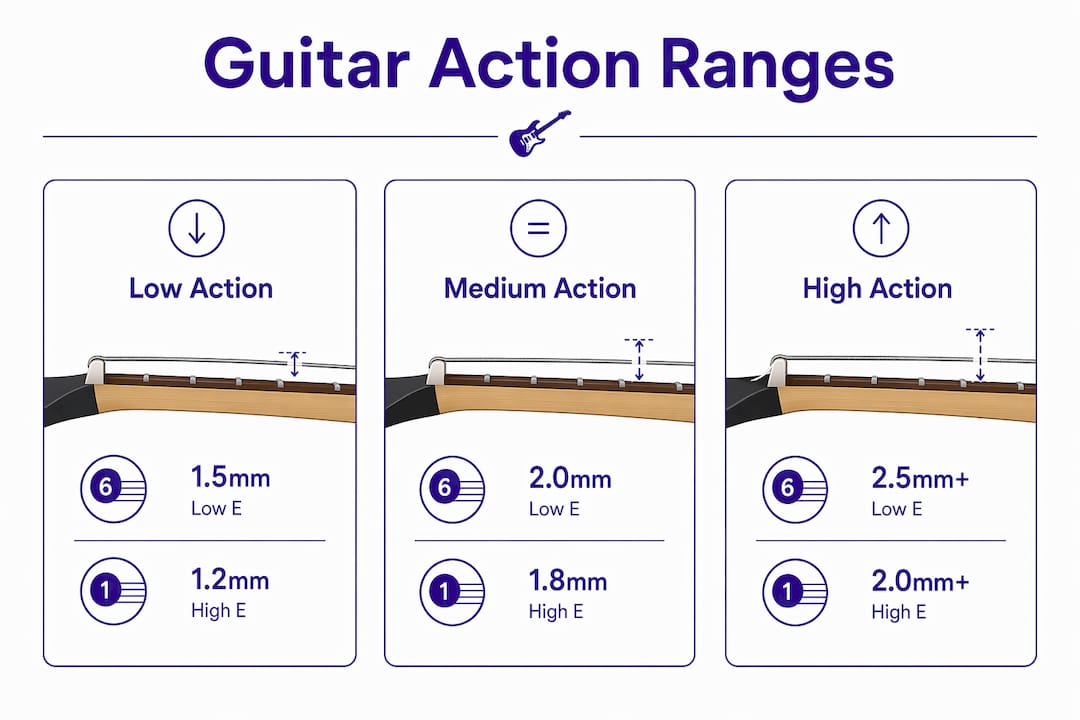
These ranges apply at the 12th fret and serve as starting points, not fixed rules. Your playing style determines where in that range you should land.
What factors influence guitar action?
Guitar action is not controlled by a single screw or adjustment. Luthiers confirm it is a holistic system involving the truss rod, nut, and bridge working together. Changing one without checking the others produces unpredictable results.
The truss rod runs inside the neck and controls neck relief, which is the slight forward bow in the neck. Tightening the truss rod) pulls the neck backward and lowers action at the middle frets. Loosening it adds relief and raises action in that zone. A slight forward bow is actually preferred by many luthiers because it gives vibrating strings room to move without buzzing.
The nut slot depth controls string height at the first few frets. Filing nut slots too deep causes open string buzz. Leaving them too high makes the first three frets feel stiff and out of tune. The bridge and saddle control action at the body end of the neck. Sanding or adjusting the saddle) raises or lowers string height across the upper frets.
Several other factors shift action over time:
- String gauge: Heavier strings exert more tension and can pull the neck into a forward bow, raising action.
- Tuning: Drop tunings reduce string tension, which can allow the neck to straighten and lower action.
- Humidity and temperature: Wood expands in humid conditions and contracts in dry ones. Climate changes can raise or lower action by half a millimeter without any human intervention.
- Playing style: Heavy pickers drive strings further from the fretboard during play, which means they need more clearance to avoid buzz.
Pro Tip: Check your guitar’s action at the start of each season. Wood movement from humidity shifts is one of the most common reasons a well-set guitar suddenly starts buzzing or feeling stiff.
What are the differences between high and low guitar action?
High action means the strings sit further from the fretboard. High action favors aggressive pickers and slide players because the extra clearance prevents buzz under heavy attack. The trade-off is that fretting requires more finger pressure, which causes fatigue during long sessions.
Low action places the strings closer to the frets. Low action enables faster fretting and lighter touch, which suits fingerstyle players and beginners building hand strength. The risk is fret buzz if the setup is not precise. A guitar with low action and a poorly cut nut or uneven frets will buzz constantly.
High vs. low action: who benefits from each?
| Action type | Best for | Main benefit | Main risk |
|---|---|---|---|
| High action | Slide, blues, heavy picking | No buzz under hard attack | Finger fatigue, slower fretting |
| Low action | Fingerstyle, fast playing, beginners | Easy fretting, light touch | Fret buzz, choked notes |
| Medium action | All-around players | Balance of comfort and clarity | Requires precise setup |
The sweet spot for most players sits in the medium range. Playing style dictates the exact preference: heavy pickers need higher clearance, while fingerstyle players tolerate and often prefer lower string height. Signs that action is poorly set include persistent buzzing on specific frets, notes that choke out when bent, and visible stiffness when pressing strings near the nut.
How can you adjust guitar action safely?
Adjusting string height follows a logical sequence. Start with neck relief before touching the nut or bridge. A poorly adjusted truss rod makes every other measurement meaningless.
- Check neck relief. Capo the first fret and fret the last fret with your picking hand. Press the string at the 7th or 8th fret with your other hand. The gap between the string and the fret should be roughly the thickness of a business card. More gap means too much relief; no gap means the neck is back-bowed.
- Adjust the truss rod. Turn the truss rod nut clockwise to reduce relief (straighten the neck) and counterclockwise to add relief. Make quarter-turn adjustments only, then wait several minutes for the wood to settle before measuring again.
- File nut slots if needed. Use nut files matched to each string’s gauge. File slowly and test frequently. Removing too much material ruins the nut and requires replacement.
- Adjust saddle or bridge height. On acoustic guitars, sand the saddle bottom to lower action. On electric guitars, use the saddle height screws to raise or lower individual strings.
- Check intonation. After any action change, verify intonation accuracy by comparing the open string pitch to the fretted 12th fret pitch. They should match. If the 12th fret note is sharp, move the saddle back. If it is flat, move it forward.
- Play test the result. Run through your normal playing patterns at full speed and full dynamics. Buzz that only appears during hard strumming may be acceptable. Buzz on light fingerpicking is not.
Pro Tip: Never force a truss rod adjustment. If the rod feels stiff or won’t turn, stop and take the guitar to a qualified luthier. A snapped truss rod is an expensive repair that a few extra minutes of patience could have prevented.
How does guitar action affect playability and tone?
String height directly controls how much finger force you need to fret a note cleanly. High action increases the distance your fingertip must travel and the pressure required to make contact with the fret. Over a two-hour practice session, that extra effort adds up as hand fatigue.
Action also shapes tone. Strings set further from the fretboard vibrate more freely, which produces more sustain and a fuller, rounder sound. This is why many flamenco players use a specific action setup that balances low enough action for speed with enough clearance to avoid buzz during percussive rasgueado strokes. Blues players often prefer higher action because it adds grit and sustain to bent notes.
For beginners, the priority is comfort. A guitar with action that is too high discourages practice and slows progress. A well-set guitar removes one barrier between the player and the music. Intermediate and advanced players can afford to experiment because they have the technique to compensate for minor setup imperfections.
Action is personal, shaped by hand size, finger strength, and playing style. Universal numbers are a starting point, not a destination.
Key Takeaways
Guitar action is the single most influential setup variable for playability, and getting it right requires adjusting the truss rod, nut, and bridge as a coordinated system, not in isolation.
| Point | Details |
|---|---|
| Action defined | String height measured at the 12th fret, typically 1.5mm–2.5mm depending on string and style. |
| Measurement tools | Use a ruler or string action gauge at the 12th fret; use a capo at the first fret to isolate nut height. |
| Three-part system | Truss rod, nut slots, and saddle height all control action and must be adjusted together. |
| High vs. low trade-off | High action suits aggressive pickers; low action suits fingerstyle players and beginners with precise setups. |
| Recheck seasonally | Humidity and temperature shift wood and alter action, requiring periodic readjustment throughout the year. |
What I’ve learned from years of handling vintage guitars
Most players who come to Vintage-guitar-world chasing the lowest possible action are solving the wrong problem. The best setup finds a balance between comfort and clear tone, not the minimum string height the guitar can physically tolerate.
The mistake I see most often is treating action as a single number to hit. A player reads that 1.5mm on the high E is “correct” and files the nut down until they get there, ignoring the fact that their neck has too much relief or their frets are uneven. The number means nothing without the full setup behind it.
Feel tests matter more than measurements. After any adjustment, play the guitar the way you actually play it. If your picking hand hits hard, strum hard during the test. If you bend strings constantly, bend during the test. The guitar has to perform under your real conditions, not ideal ones.
Environmental effects catch players off guard every year. A guitar that played perfectly in summer can feel stiff and high in a dry winter. Checking action twice a year, once in a humid season and once in a dry one, keeps the setup dialed in without major intervention.
— Vintage
Vintage-guitar-world: guitars built to play as well as they look
Every guitar at Vintage-guitar-world is evaluated for playability before it reaches a buyer. Setup quality, including string height, neck relief, and intonation, is part of how we assess and describe every instrument.

If you want to understand what makes a vintage instrument worth owning, the types of vintage guitars page covers the full range of acoustic, classical, flamenco, and electric options in our catalog, with historical context and feature breakdowns for each category. For players who want to go deeper on setup before buying, the guitar setup and playability guide walks through how different playing styles interact with action, neck profile, and string choice. A guitar that fits your hands and your style is worth far more than one that simply looks good on a wall.
FAQ
What is guitar action measured in?
Guitar action is measured in millimeters at the 12th fret, from the top of the fret to the underside of the string. Common ranges run from 1.5mm to 2.5mm depending on the string and playing style.
How do I know if my guitar action is too high?
The clearest sign is that fretting chords near the nut feels stiff or causes notes to play sharp. Finger fatigue during normal practice sessions is another reliable indicator.
Can I adjust guitar action at home?
Saddle height and truss rod adjustments are manageable at home with the right tools and patience. Nut slot filing carries more risk and is best left to a luthier if you have not done it before.
Does guitar action affect tone?
Higher action allows strings to vibrate more freely, which increases sustain and fullness. Lower action produces a tighter, faster response but can reduce sustain if strings choke against the frets.
How often should I check my guitar’s action?
Check action at least twice a year, ideally at the start of a humid season and again when the air turns dry. Climate shifts cause wood movement that alters string height without any adjustment on your part.