


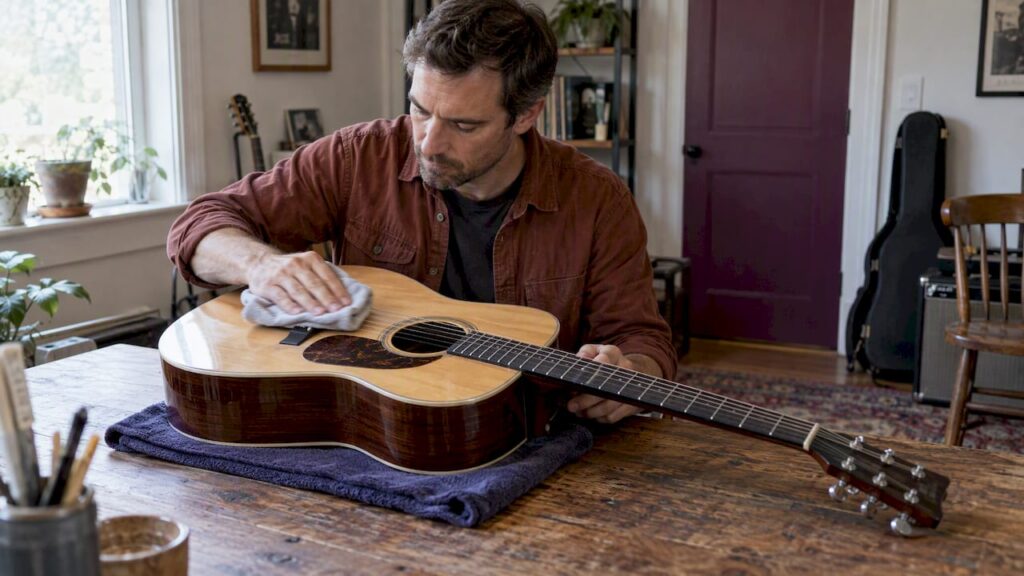

Preparing a guitar for sale comes down to six jobs: leave the instrument in an honest, stable condition, document everything about it, price it from real sales, photograph it truthfully, write the legal wording for a private sale, and plan how it will be handed over. Done in that order, a sale takes days instead of weeks, and you are far less likely to argue with the buyer afterward. This guide is written for sellers in Germany, and it matters most if your guitar is older, handmade or valuable.
TL;DR
- Clean gently and stop there: fresh strings and a wiped-down body help, but on a vintage instrument, repairs and polishing can cost you value.
- Write down model, year, serial number, repairs, replaced parts, accessories and every flaw before you write the ad.
- Price from what comparable guitars actually sold for, not from what other sellers ask.
- In Germany, a private seller can exclude the statutory warranty, but only by saying so clearly.
- Pack the guitar in its hard case inside a padded outer box, insure it and keep proof of dispatch.
Table of Contents
- Decide first: sell as it is, or put money into it?
- Step 1: Clean and check the guitar without causing damage
- Step 2: Document the guitar completely
- Step 3: Find a realistic price
- Step 4: Photograph the guitar truthfully
- Step 5: Write the description
- Step 6: Get the legal wording right for a private sale in Germany
- Step 7: Choose how to sell
- Step 8: Handle test-play visits and handover safely
- Step 9: Pack and ship the guitar
- Our perspective: sell the story, not just the specs
- When it makes sense to ask us
- Final checklist before you list
- FAQ
- Sources
Decide first: sell as it is, or put money into it?
Before you touch a cloth or a screwdriver, decide how far you will go. The answer depends on the age and type of the instrument.
Newer production guitars (say, a mid-range acoustic or a modern electric) often sell better after a basic service. A guitar that needs less work to become playable is more attractive to buyers, and Guitar World’s advice on selling online makes the same point: buyers may pay more when little work is needed. A fresh set of strings, a cleaned fretboard and a small setup adjustment are cheap compared to the impression they make.
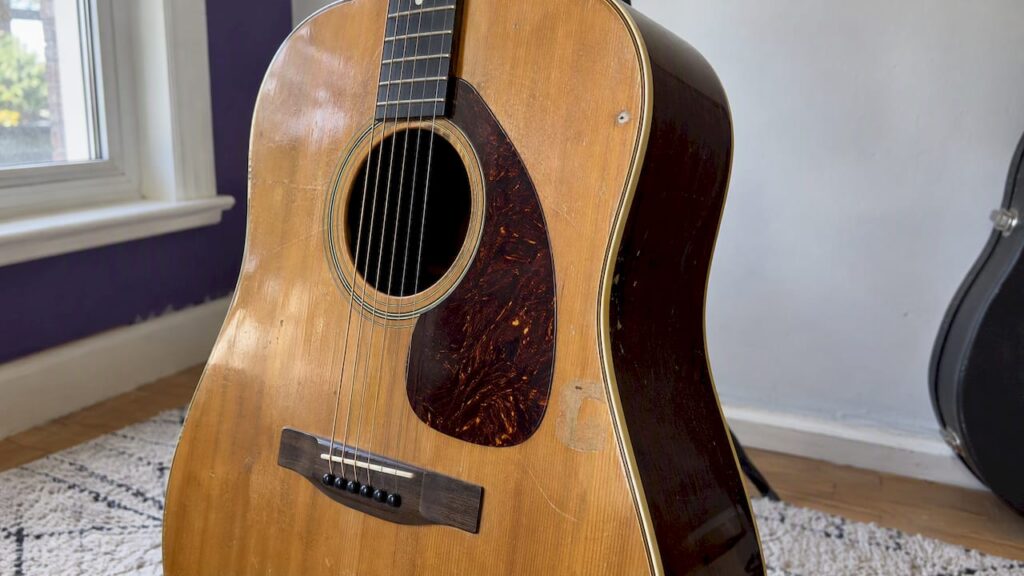
Vintage and collectible guitars follow the opposite rule. Original finish, original frets, original tuners and even honest wear are part of the value. A refinish, a refret or a swapped bridge can remove a large share of what a collector would pay. If you are unsure, read our guide on restoring versus preserving original condition before anyone touches the instrument, and see why original versus replacement parts matter so much to German collectors.
A useful rule: fix what makes the guitar unsafe or unplayable, leave what makes it old.
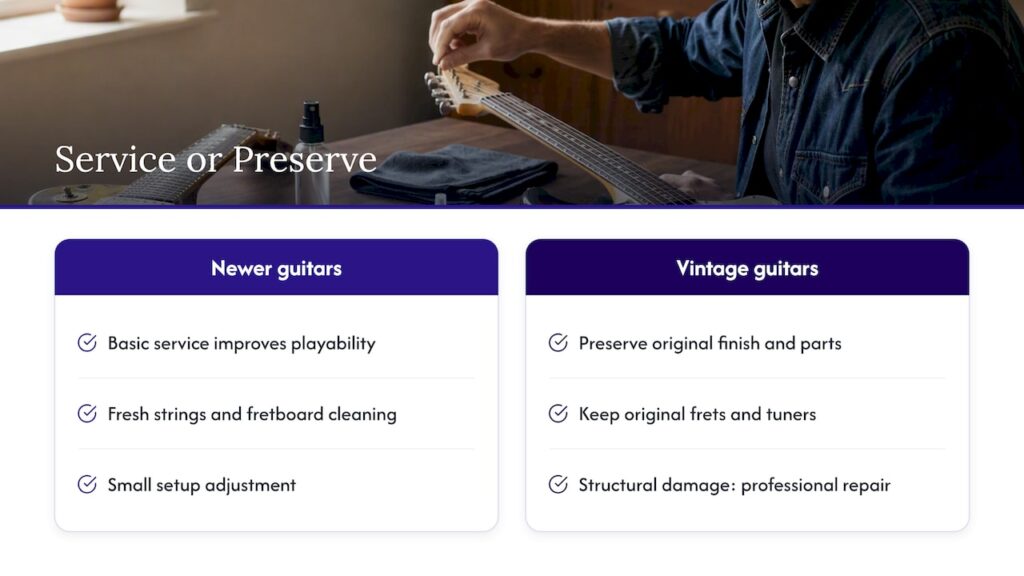
Structural damage is the exception. A small crack in the top or a loose brace will worry any buyer, and a clean, professional repair usually reads better than an open crack. Our luthier notes on how repaired cracks affect value explain what a good repair looks like and why it should be disclosed.
Step 1: Clean and check the guitar without causing damage
The goal is a guitar that looks cared for, not a guitar that looks new. Work slowly and use the mildest method that works.
What you can safely do yourself
- Fit new strings. Fresh strings are the cheapest way to make a guitar sound alive in a video or at a test. Change them one at a time so the neck tension stays steady.
- Wipe the body with a dry or barely damp, soft microfiber cloth. Remove fingerprints, dust and rosin from the top and under the strings.
- Clean the fretboard lightly. On unfinished rosewood or ebony, a small amount of a suitable fretboard conditioner is enough. Never soak the wood.
- Wipe hardware (tuners, bridge, pickup covers) with a dry cloth. Skip metal polish on old plating, since it can wear it off.
- Check function. Turn every pot, flip every switch, plug in the guitar and listen for crackle. On acoustics, tap around the top and listen for buzzes that point to loose bracing or a lifting bridge.
What to leave alone
Avoid household cleaners, solvents and abrasive polish, especially on nitrocellulose lacquer and old shellac, which react badly to many products. Do not tighten or adjust truss rods, shave nut slots or level frets unless you know exactly what you are doing. Manufacturers’ own manuals say the same thing: adjustments that require special skills belong with a dealer or a professional luthier. If the neck relief is off, the action is high or the intonation is wrong, a setup by a luthier is usually worth the fee on a modern guitar, and on a vintage one it should be discussed with a specialist first.
Store it properly until it sells
Once the guitar is ready, keep it in its case or gig bag in a dry, safe place rather than leaving it on a stand in a sunny room or playing it daily. This prevents knocks, detuning and new marks between your photos and the day the buyer arrives. wert-experte.com gives the same storage advice for the time before a sale.
Step 2: Document the guitar completely
A complete record does three things: it makes your ad believable, it speeds up questions, and it protects you if the buyer claims later that you hid something. Write the facts down before you draft the ad.
| What to record | Why it matters |
|---|---|
| Manufacturer, model, year | Buyers search by these terms; a wrong year hurts credibility |
| Serial number and where it is stamped or printed | Lets serious buyers verify the instrument |
| Finish: original, retouched or refinished | One of the largest value factors on vintage guitars |
| Repairs and who did them | Cracks, neck resets, refrets and rewiring all count |
| Replaced parts | Tuners, pickups, bridge, pots, nut, pickguard |
| Condition of wear parts | Frets, nut, saddle, tuners, electronics |
| Last service date | Shows the guitar was maintained |
| Accessories | Original case, strap, tools, manuals, hang tags, receipts |
| Known defects and what does not work | Saves arguments later |
The checklist of a classified-ad template from zweito.de asks for the same items: model, year or serial number, wear-part condition, last service, included accessories, and a plain statement of what does not work.
Protected woods and papers
If an older guitar may contain protected wood such as Rio rosewood (Dalbergia nigra), say so in the ad and state whether you have papers. Do not guess. If you are not sure whether the fretboard or back is Rio, our article on verifying Rio rosewood and the legal documentation in Germany walks through what to check before you list. A missing or unclear paper trail can complicate a sale, especially for buyers abroad.
Provenance and certification
For collectible instruments, provenance (previous owners, concert use, original sales receipts, old photos) can support the price. A written expert assessment adds weight when the guitar is rare or expensive. See our overview of the role of certification in guitar collecting to judge whether it is worth it for your instrument.
Step 3: Find a realistic price
Overpricing leaves a listing sitting for months; underpricing gives money away. Estimate the value before you list.
- Identify the exact variant. A model name is not enough. Year, finish, country of manufacture and originality can move a price by hundreds or thousands of euros.
- Compare sold prices, not asking prices. Asking prices show what sellers hope for. Completed sales show what buyers paid. This is the standard advice of valuation guides such as wasistdaswert.de.
- Adjust for condition. Compare your guitar honestly with the examples: finish checks, fret wear, repairs, replaced parts, case included or not.
- Set a price and a floor. Know the lowest figure you would accept so you do not give in to a quick lowball.
- Get an expert opinion when value is uncertain. For a rare or high-value guitar, an independent valuation is cheaper than a wrong price.
Our team provides certificates and written valuations for exactly this situation, and the price of that service is quoted individually rather than published.
Step 4: Photograph the guitar truthfully
Photos set the price in the buyer’s mind before they read a word. A modern smartphone is enough if you use daylight, a plain background and a tuned, clean guitar.
The shots every listing needs
- Full front and full back
- Side view and the profile of the body
- Headstock front and back, showing the logo and tuners
- Neck from several angles, plus the heel and the neck joint
- The fretboard, close up, with frets visible
- Bridge, saddle and pickups or soundhole
- Electronics and control cavity on electrics
- Serial number, label or stamp
- The case, inside and out
- Every flaw, close up, with a coin or ruler for scale
Light and background
Use soft, indirect daylight near a window, with no flash. Glossy lacquer reflects everything, so stand slightly off-axis to avoid a bright hot spot. Choose a plain wall or sheet as a backdrop. Wood grain and finish color should look as they do in person, so do not apply filters.
Show the flaws
Photographing dings, scratches and repairs seems counterintuitive, but it pays. Buyers who see the problems in advance rarely negotiate over them later, and it makes the rest of your photos believable. We cover this in more depth in our guide to photos for a guitar sale.
Step 5: Write the description
A good description is short, factual and in the same order every time. A reader should find the key facts within ten seconds.
- Headline: brand, model, year, finish. Nothing else.
- Condition summary: one or two plain sentences, such as playable and original apart from the listed changes.
- Specifications: body wood, neck, fretboard, pickups or bracing, scale length, nut width if you know it.
- History: one owner or several, how it was used, any repairs.
- Flaws and defects: list everything, including what does not work.
- Included items: case, papers, accessories.
- Handover: pickup, test play or shipping, and who pays what.
- Legal wording: the warranty exclusion, covered next.
Avoid vague superlatives and pure sales language. Words such as mint or perfect invite disputes. Describe, and let the photos prove it.
Step 6: Get the legal wording right for a private sale in Germany
This is the part many sellers skip, and the one that can cause the most trouble.
According to the Verbraucherzentrale, private sellers can exclude the statutory two-year warranty, but only if they state the exclusion clearly. A line buried in a long text or implied by the word used is not a safe way to do this. The same page points out that a seller who repeatedly uses the same exclusion wording should formulate it carefully, because it can be treated as general terms and conditions (AGB), which brings stricter rules.
A typical private-sale notice states that the sale is private, that warranty and returns are excluded, and that the item is sold as described. The magazine GITARRE & BASS publishes a sample disclaimer for private guitar sales that excludes warranty and withdrawal. Two cautions apply:
- An exclusion does not protect you if you knowingly hide a defect. Disclose everything you know.
- If you sell regularly or as a business, different rules apply. Ask a lawyer or a consumer-law advice center if you are unsure whether you count as a private seller.
Keep a copy of the ad, the messages and a simple written receipt signed by both sides: names, addresses, guitar, serial number, price, date and the exclusion wording.
Step 7: Choose how to sell
You have three realistic routes, and they suit different guitars.
| Route | Best for | Trade-off |
|---|---|---|
| Private sale through classifieds or a local ad | Everyday guitars up to a moderate value | Time, time-wasters, you carry the risk and the handling |
| Sale to a dealer | Fast, simple exit | Price is lower, since the dealer must resell at a margin |
| Commission sale through a specialist | Rare, vintage or high-value instruments | A commission fee, but the specialist handles pricing, buyers and testing |
If your guitar is collectible, a commission sale often earns more net than a private sale because it reaches serious buyers. We offer commission sales, test-play appointments and valuations for vintage and handmade guitars; get in touch and we will tell you whether your instrument is a fit.
Step 8: Handle test-play visits and handover safely
Most problems happen at the handover. A few habits remove most of the risk.
- Meet in a public or well-lit place, or at home with another person present. Never leave a buyer alone with the guitar.
- Keep the guitar tuned and ready, with a short list of its quirks so you can point them out.
- Do not accept test-play without ID or supervision for valuable instruments.
- Take cash in a safe way or confirm that a bank transfer has arrived before handing over the guitar. Be wary of overpayment stories, fake payment confirmations and buyers who insist on couriers they arrange themselves.
- Write and sign a receipt, as described above.
Our own approach to appointments is the mirror image of this: we ask buyers to bring a written confirmation, photo ID and their own testing gear. We describe it in how to prepare for a test-play appointment.
Step 9: Pack and ship the guitar
If the buyer lives elsewhere, shipping is where a good sale can turn into an expensive claim.
Packing
- Loosen the strings slightly to reduce tension. Do not detune fully on a vintage instrument without advice, as sudden changes can stress old necks.
- Pad the headstock and the space around the neck inside a hard case, so nothing can shift.
- Put the closed hard case into a sturdy, padded outer cardboard box to survive drops, as the sample listing guidance from zweito.de also recommends.
- Insure the parcel and send the buyer the tracking number.
Our step-by-step guides on packing a guitar safely and the vintage guitar shipping workflow show each stage with the materials we use.
Who bears the risk?
According to the Verbraucherzentrale page cited above, in a private-to-private sale the shipping risk generally passes to the buyer once the package is handed to the carrier. That makes proof of dispatch important: keep the acceptance receipt from the parcel shop or carrier. Even so, an insured shipment with careful packing is the better protection for both sides, because a damaged guitar leads to a dispute whoever is legally right.
Our perspective: sell the story, not just the specs
We handle vintage and handmade guitars every day, and the same pattern repeats. The guitars that sell well are rarely the ones that look the newest. They are the ones where the seller knew what the instrument was, said it plainly and left it intact.
Three things we see most often:
- Over-restoration. A well-meant refinish or a modern part on an old guitar turns a collectible into a player’s instrument, and the price follows. If you are unsure, ask first.
- Missing paper trails. Receipts, case candy, old photos and a clear statement on woods like Rio rosewood make serious buyers relax.
- Vague condition reports. Buyers forgive wear. They do not forgive surprises.
Our team evaluates every instrument before it goes online, and we test it with the same standard we ask of sellers: describe what is there, show what is there. If you prepare your guitar that way, you will be selling to the right buyer at the right price.
— Vintage
When it makes sense to ask us
If you own a guitar that is rare, handmade, old, or simply too valuable to risk on a stranger’s lowball offer, we can help at several points: a written valuation or certificate, advice on whether to restore, a commission sale, or a test-play appointment at our shop. You can see what we currently offer on the Vintage Guitar World homepage, or read about restoration costs and options if you are weighing a repair before a sale.
Final checklist before you list
- Strings fresh, body wiped, nothing polished that should stay original
- Everything works, or the defect is written down
- Model, year and serial number confirmed
- Repairs, replaced parts and accessories listed
- Protected woods and papers clarified
- Price based on sold examples, with a floor
- Photos taken in daylight, including every flaw
- Warranty exclusion written clearly, receipt prepared
- Handover plan and packing materials ready
FAQ
Should I restring and clean my guitar before selling?
Yes, in most cases. New strings and a gentle wipe-down make the guitar look cared for and play better. On a vintage guitar, stop there: do not polish the finish, replace parts or have it refinished without advice, since originality is a large part of the value.
Should I repair my guitar before I sell it?
Repair what affects safety and playability, such as a loose brace or a lifting bridge, and have a luthier do it. On newer guitars, small repairs can raise the price. On vintage guitars, talk to a specialist first, because changes can lower the value.
Can I exclude the warranty when I sell privately in Germany?
Yes. According to the Verbraucherzentrale, private sellers can exclude the statutory two-year warranty if they state the exclusion clearly. It does not cover defects you knowingly hide, so list every flaw you know about.
How do I find out what my guitar is worth?
Compare prices that identical or very similar guitars actually sold for, then adjust for condition, originality and included accessories. Asking prices on their own can be misleading. For rare or high-value instruments, a professional valuation is a sensible investment.
How should I ship a guitar to the buyer?
Loosen the strings slightly, pad the headstock inside a hard case and put the case into a sturdy outer box. Insure the parcel, send the tracking number and keep your proof of dispatch.
Sources
- Virtuelle Schnäppchenjagd: Regeln für Online-Auktionen, Verbraucherzentrale
- Was ist beim Verkaufen der Gitarre zu beachten?, GITARRE & BASS
- Selling your guitar online: 5 handy tips and scams to avoid, Guitar World
- Anzeigen-Vorlage Musikinstrument, zweito.de
- Gitarre verkaufen: Preise, Tipps & Wege 2026, wasistdaswert.de
- Gitarre verkaufen – Tipps für einen reibungslosen Ablauf, wert-experte.com