












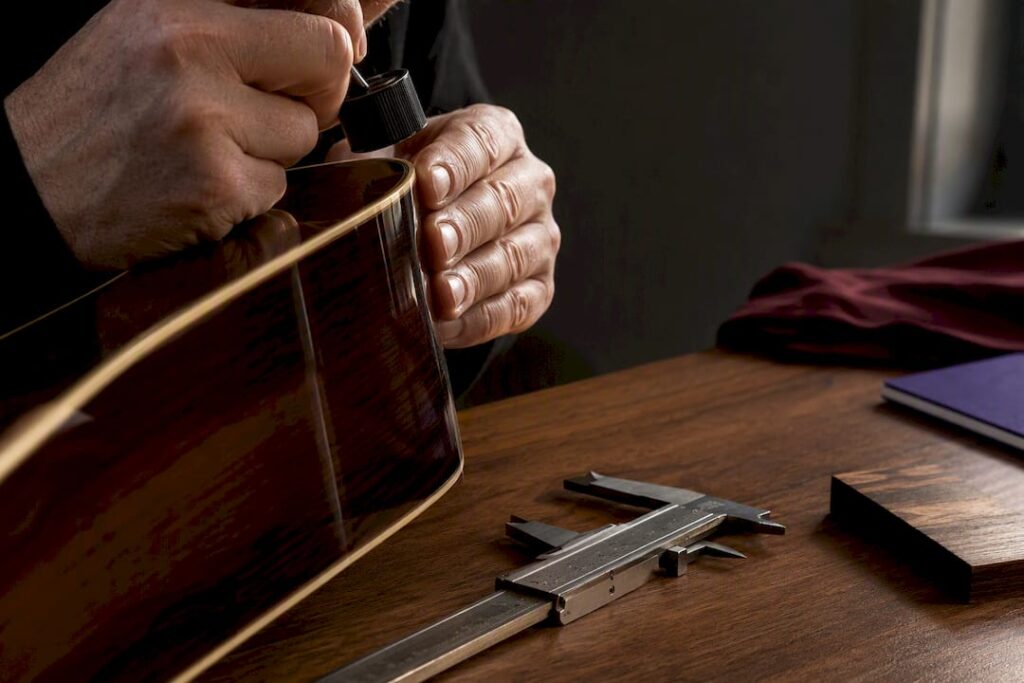

Yes, you can have your guitar professionally authenticated and issued a formal appraisal, called a Gutachten, that documents authenticity, condition, provenance, and market value. This kind of certificate is the document insurers, buyers, and estate lawyers actually trust. It’s mainly used for insurance coverage, resale, or settling an inheritance, and it has nothing to do with a musician’s performance diploma, which is a completely separate credential covered below.
TL;DR:
- Proper certification for high-value guitars involves detailed reports that include identification, condition, provenance, and market valuation based on comparable sales.
- For instruments worth six figures or with disputed histories, forensic testing using advanced techniques can confirm originality and significantly increase report credibility.
- Inexpensive estimates or lower-value guitars generally only require remote photo reviews from experienced appraisers or luthiers, with in-person or lab testing reserved for high-stakes cases.
- To obtain a certificate, owners should gather documentation, select an appropriate provider, and understand how the final report will be used for insurance, sales, or legal purposes.
- Skipping forensic analysis risks undervaluing or misrepresenting a vintage guitar, potentially leading to costly resale or insurance issues later.
Table of Contents
- What Does It Mean to Certify a Guitar?
- Who Actually Issues These Certificates?
- What Goes Into a Certificate, and How Do You Read One?
- How to Get Your Guitar Certified, Step by Step
- How Vintage-guitar-world Handles Authentication and Valuation
- When Forensic Testing Actually Pays Off
- Book a Guitar Appraisal or Testing Appointment
- Sources
- FAQ
What Does It Mean to Certify a Guitar?
When people search for how to get a guitar certified, they’re usually picturing two different things without realizing it. An instrument certificate, or Gutachten, is a written report that identifies your guitar, documents its condition and originality, traces its ownership history where possible, and states a market value. It exists for practical reasons: insuring the instrument at replacement value, proving what you’re selling, or settling an estate.
That’s a completely different animal from a musician’s performance qualification. Exams like ABRSM’s guitar practical grades or Trinity College London certifications assess how well a person plays. They say nothing about whether the instrument itself is a genuine 1959 Les Paul or a well-made copy. Confusing the two wastes time and, worse, sometimes money, if someone books a performance assessment thinking it will authenticate their guitar.
A certificate matters most in these situations:
- Insuring a high-value instrument at its true replacement cost
- Selling or consigning a rare or vintage guitar
- Settling an estate where instruments need a documented value
- Crossing borders with an instrument that may contain protected wood species
Who Actually Issues These Certificates?
Choosing the right provider depends on what you need proven and how much is riding on the answer.
- Independent certified appraisers and specialist instrument appraisal services focus on market valuation and provenance research. They compare your guitar against sales records, auction results, and comparable instruments to arrive at a defensible number, which is exactly what an insurer or estate attorney wants to see.
- Experienced luthiers and restorers bring hands-on inspection skills. They can tell you whether a bridge, tuners, or finish are original or replaced, which matters enormously for value, since a refinished vintage guitar can lose a large share of its worth compared to an all-original example.
- Forensic analysis labs step in when the stakes or the doubts are high. Their tools, including 3D scanning, spectroscopy, and radiography, can settle disputes that visual inspection alone cannot resolve.
- Notaries come into play when a legal attestation or signature legalization is required, typically for estate transfers or cross-border legal matters rather than the appraisal itself.
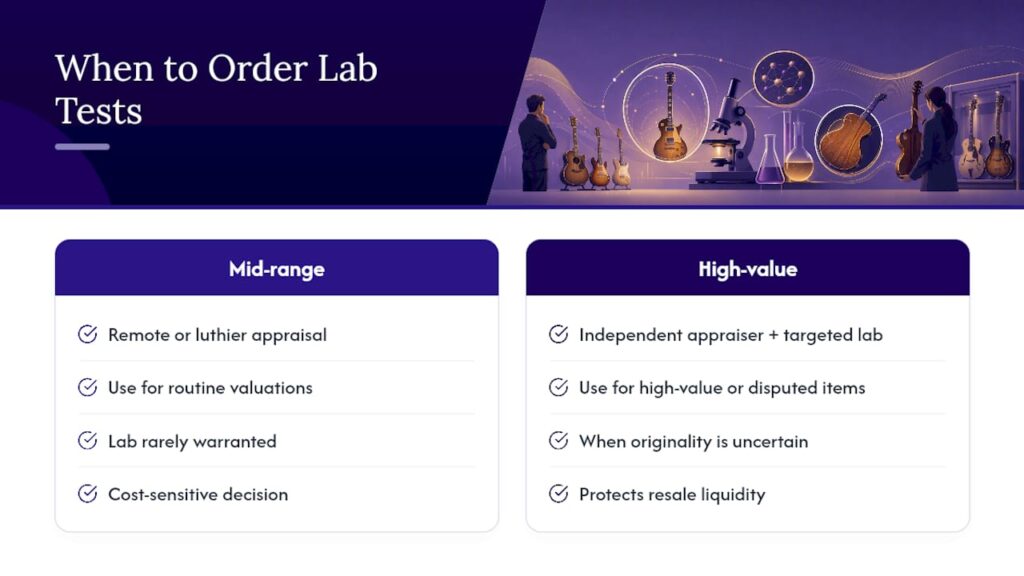
For a mid-range instrument with no red flags, a luthier or independent appraiser is usually enough. For anything six figures or with a disputed history, that’s when forensic testing earns its cost.
What Goes Into a Certificate, and How Do You Read One?
A properly written Gutachten isn’t a one-page letter. It’s a structured document, and knowing what belongs in it helps you spot a thin, low-value report versus one that will actually hold up with an insurer or a skeptical buyer.
A solid report includes:
- Full identification: model, serial number, year estimate, and specifications
- Detailed photos of the body, headstock, hardware, and any damage or repairs
- A condition assessment noting wear, cracks, refinishing, or replaced parts
- Provenance notes, meaning any documented ownership history
- A clear valuation statement with the methodology behind the number
Pro Tip: A report that cites comparable sales, states the appraiser’s credentials, and dates every finding is worth far more than one that just declares a number with no supporting logic behind it.
For instruments where authenticity is genuinely in question, forensic reports add another layer: material analysis that dates a finish, cavity trace evidence showing whether electronics were ever swapped, and dimensional matching against known original specifications. Cavity chemistry and micro layer analysis can reveal a refinish job that would fool almost anyone by eye alone. Labs also detect period correct finishes and hidden cavity remnants that counterfeiters struggle to replicate convincingly, which is precisely why serious collectors pay for this level of scrutiny on instruments where real money is at stake.
How to Get Your Guitar Certified, Step by Step
Getting a guitar certified doesn’t have to be a mystery. Here’s the practical sequence that keeps the process fast and the report useful.
- Gather your documentation first. Photograph the full body, headstock, serial number, neck joint, and any case candy: original receipts, prior repair invoices, or old appraisals. Note anything you know about the guitar’s history, even secondhand details from a previous owner.
- Vet the provider before booking. Ask what methods they use, whether they can show a sample report, how the instrument is insured during transit, and what turnaround to expect. A provider who can’t produce a sample report is a red flag.
- Pick the right inspection route. Remote review from high resolution photos works for straightforward, lower-value instruments. High-value or potentially altered guitars usually need an in-person inspection, and disputed or historically significant pieces may call for full lab analysis. Remote reviews can turn around in days; in-person inspections typically take one to two weeks; forensic testing can run several weeks depending on lab backlog.
- Understand what drives cost. Basic appraisals sit at the lower end of the price scale, full valuations with provenance research cost more, and forensic testing is the most expensive tier because of the equipment and specialist time involved. Age, rarity, and how much documentation you can supply upfront all affect the final price.
- Use the finished report. File it with your insurer for accurate coverage, attach it to a sale listing to justify your asking price, or, if the guitar contains protected woods like Brazilian rosewood, check whether you need CITES paperwork through an authority such as the Bundesamt für Naturschutz before selling or traveling internationally with the instrument.
Before you start any of this, our guitar appraisal checklist walks through exactly what to photograph and note down.
How Vintage-guitar-world Handles Authentication and Valuation
Expert evaluation, in-person testing appointments, and valuation and certification services are offered based on this process. Instead of guessing whether a listing photo tells the whole story, you can book an appointment, have the instrument inspected hands-on, and walk away with documentation that covers identification, condition, and market value.
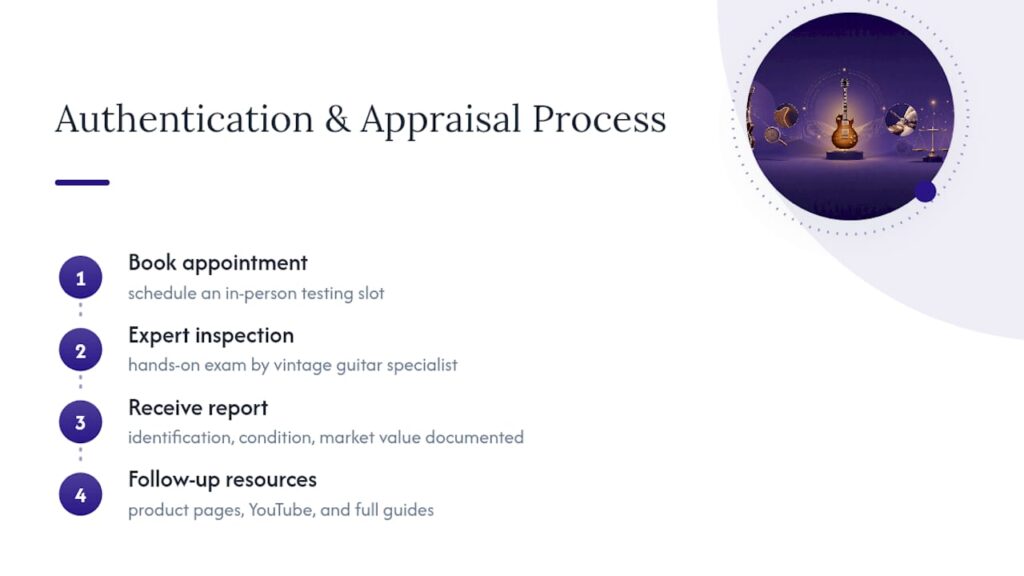
The process runs the way it should: you book a testing appointment, the instrument gets inspected by someone who handles vintage and handcrafted guitars regularly, and you receive a report you can actually use with an insurer or a buyer. Our guide to authenticating vintage guitars covers what that inspection looks for in detail, from hardware originality to finish consistency.
Beyond the appraisal itself, the website maintains detailed product pages with historical context on the instruments it presents, plus a YouTube channel covering craftsmanship and instrument history. If you want a fuller breakdown of how the appraisal process works before booking, our guitar appraisal guide for collectors is a good next stop.
— Vintage
When Forensic Testing Actually Pays Off
Forensic testing earns its cost in narrow, specific situations. If an instrument is worth enough that a wrong valuation would sting, or if there’s genuine uncertainty about originality, that’s when lab work stops being optional. Visual inspection alone, no matter how experienced the eye, can miss a finish that was reapplied decades ago or electronics that were swapped and re-aged to look period correct.
The confidence a lab-backed report provides protects resale liquidity down the line, since a buyer or auction house trusts objective evidence far more than a seller’s word. A sensible rule: use remote or luthier-based appraisals for mid-range instruments, and reserve independent appraisers plus targeted lab testing for anything high-value, disputed, or historically significant. Skipping that step on a six-figure guitar to save a few hundred dollars is the kind of shortcut that costs collectors real money later.
Book a Guitar Appraisal or Testing Appointment
Vintage-guitar-world is set up specifically for owners who want a real, usable Gutachten rather than a guess dressed up as an opinion. Whether you’re insuring a vintage acoustic, preparing to sell a handcrafted classical guitar, or settling an estate, our expert evaluation and testing appointments give you documentation that actually holds up.

To get started, book a testing appointment through the service and bring whatever documentation you already have: photos, receipts, prior repair records, anything with a date on it. Before your appointment, run through our guitar appraisal checklist so the inspection moves faster, and don’t hesitate to ask about sample reports and transit insurance if you’re shipping the instrument to us. If you’re still exploring what makes an instrument worth certifying in the first place, our page on types of vintage guitars is worth a look before you book.
Sources
- Is Authenticating Vintage Guitars in 2026 – Premier Guitar
- Gutachten – Gitarrenkontor
- ABRSM guitar practical grades
FAQ
How Do I Get a Guitar Professionally Certified?
You book an appraisal with an independent appraiser, experienced luthier, or, for high-stakes cases, a forensic lab, then supply photos, serial numbers, and any existing paperwork so the provider can inspect, document, and value the instrument.
How Can I Determine the Value of My Guitar?
A formal appraisal documents identity, condition, provenance, and market value by comparing your instrument against sales records and comparable guitars, which is far more reliable than online price guessing.
Is a Guitar Certificate the Same as a Musician’s Performance Certificate?
No. A guitar certificate, or Gutachten, authenticates and values the instrument, while performance exams like ABRSM or Trinity assess a player’s skill and have nothing to do with the guitar itself.
Do I Need Special Paperwork to Travel With a Vintage Guitar?
If your guitar contains protected wood species, you may need CITES documentation from an authority like the Bundesamt für Naturschutz before crossing borders, in addition to your standard appraisal.
How Long Does a Guitar Appraisal Take?
A remote review based on photos can take just days, an in-person inspection usually runs one to two weeks, and forensic lab testing can take several weeks depending on the lab’s workload.