


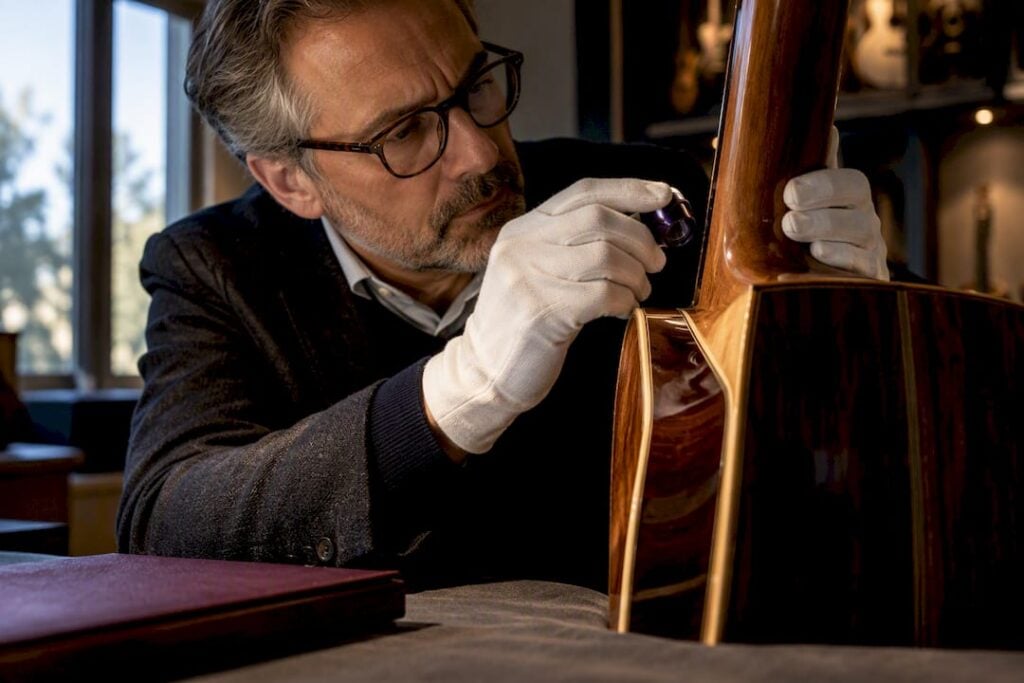

Yes: if your guitar’s value or how you use it exceeds what a Hausrat policy pays out, you need dedicated instrument insurance with an agreed value and a formal appraisal. A 1962 Stratocaster in a display case, a touring dreadnought, or a Flamenco guitar loaned for a recording session all fall outside standard household coverage. The fix is straightforward: get the instrument valued, then match that number to a specialist policy before anything goes wrong.
TL;DR:
- Standard household insurance typically caps guitar coverage at around 20% of the total insured value and pays out based on depreciation, risking underinsurance for valuable collections.
- Dedicated instrument insurance provides an agreed value based on a professional appraisal, ensuring a fixed payout that reflects the item’s market worth in case of total loss.
- Most specialist policies include worldwide transit coverage and all-risk protection, covering theft, damage, and loss during transport or outside the home.
- Proper documentation, including a recent formal valuation and photos, is essential for a smooth claim process and to avoid underinsurance or disputes.
- Cost usually ranges from 0.8% to 1.5% of the agreed value annually, influenced by coverage scope, use, number of instruments, and deductible levels.
Table of Contents
- When a Standard Hausrat Policy Is (Not) Enough for Vintage Guitars
- How Specialist Instrument Insurance Actually Works
- Typical Coverages and the Exclusions That Catch Collectors Off Guard
- Pricing and Cost Drivers: What Collectors Actually Pay
- Getting Appraisals and Building a Claims-Ready File
- The Checklist to Run Past Any Insurer or Broker
- Preparing the Paperwork Insurers Actually Ask For
- What Collectors Get Wrong About Insuring Their Guitars
- Get a Valuation Before You Insure
- Sources
- FAQ
When a Standard Hausrat Policy Is (Not) Enough for Vintage Guitars
Household insurance covers fire, burglary, and storm damage inside your home, and it treats your guitars as “valuables” alongside jewelry and electronics. That category usually gets capped at around 20% of your total sum insured — fine for a single instrument worth a few hundred euros, disastrous for a collection worth tens of thousands.
Hausrat also pays time value (Zeitwert), not agreed value. An insurer estimates depreciation on your 1970s Martin the same way it would a ten-year-old sofa, which almost never matches what the guitar would fetch at auction. Underinsurance compounds the problem: if your policy’s sum insured hasn’t kept pace with your collection’s growth, payouts get reduced proportionally across the board.
Common gaps show up in specific situations:
- A guitar stolen from a car or hotel room during a gig, outside the home
- An instrument damaged in transit to a repair shop or another city
- Professional or commercial use, which many household policies exclude outright
- Loaning an instrument to another musician or a museum exhibit
How Specialist Instrument Insurance Actually Works
Dedicated policies solve the valuation problem by fixing a vereinbarter Wert, or agreed value, before any loss occurs. You and the insurer settle on a figure based on a professional appraisal or comparable sale prices, and that number becomes the payout on a total loss. There’s no argument later about depreciation or “what it’s really worth now” — the agreed-value approach removes that dispute entirely.
Collectors with more than one instrument choose between two structures:
- Scheduled coverage — each guitar listed individually with its own agreed value, ideal for pieces above roughly €5,000
- Blanket coverage — a total collection limit with a per-item cap, cheaper for smaller-value instruments you don’t want to itemize one by one
Most specialist products also include Allgefahrendeckung (all-risk cover) and worldwide transit protection, meaning the guitar is insured wherever it travels, not just inside your front door. German providers built around this model, such as SINFONIMA-style instrument concepts, typically bundle theft, accidental damage, and cross-border transport into one policy rather than forcing you to bolt on separate riders.
Pro Tip: Request the agreed value in writing as a policy endorsement, not just a verbal confirmation from your broker — insurers occasionally dispute figures that weren’t formally attached to the contract.
If you’re scheduling a guitar bought years ago, revisit its market position first. Our guide on insuring a vintage guitar at market value walks through why current value, not what you originally paid, should anchor the number you submit.
Typical Coverages and the Exclusions That Catch Collectors Off Guard
A well-built collector policy insures against a specific, known set of perils. Understanding what’s excluded matters just as much as knowing what’s covered.
- Covered as standard: theft, fire, water damage, accidental drops, transport damage, vandalism, and often “mysterious disappearance” (loss with no clear cause).
- Proberaum clause: rehearsal-space storage is frequently excluded or capped separately, since shared band rooms carry higher theft risk. Check this line item specifically.
- Unattended instrument exclusion: leaving a guitar in an unlocked car or an unsupervised venue often voids a claim regardless of how it was covered otherwise.
- Pre-existing damage: cracks, prior repairs, or structural issues noted before the policy started are typically excluded from future claims on the same defect.
- Wear and climate exclusions: gradual humidity damage, fret wear, and finish checking from age are treated as maintenance issues, not insurable losses.
- Security obligations: many policies require secure storage (locked cases, alarmed premises) as a condition of coverage, and failing to meet them can reduce a payout.
The AVB Musikinstrumente model wording used across German instrument policies spells out these obligations and exclusions in detail, and it’s worth reading even if your specific insurer uses their own variant. On repairs, ask whether you can choose your own restorer or whether the insurer mandates an approved repair network — this affects both settlement speed and whether original parts get preserved.
Pricing and Cost Drivers: What Collectors Actually Pay

Premiums for specialist instrument policies in Germany generally run 0.8% to 1.5% of the agreed value per year. Entry-level tariffs for lower-value instruments can start around €4.69 per month, though that figure climbs quickly once agreed value, worldwide cover, and professional use enter the picture.
Cost drivers include:
- The agreed value itself (the largest single factor)
- Worldwide or touring coverage versus home-only protection
- Professional versus hobbyist use
- Number of scheduled instruments and your chosen deductible
A €10,000 instrument with home-only cover and a modest deductible might land near the lower end of that percentage range annually, while a €50,000 archtop with worldwide touring cover and a low deductible sits closer to the upper end. Raising your deductible from, say, €150 to €500 typically shaves a noticeable amount off the annual premium, since you’re absorbing more of the small, frequent claims yourself.
Getting Appraisals and Building a Claims-Ready File
Insurers accept several forms of valuation, but not all carry equal weight. A formal Wertgutachten from a qualified appraiser carries the most authority, followed by dealer comparables, recent auction results for similar instruments, and certified purchase invoices.
- Commission a written appraisal that documents condition, provenance, and comparable market sales.
- Photograph the instrument in high resolution from multiple angles, including the serial number and any label or stamp.
- Keep restoration and repair records separate from the instrument itself, ideally digitized and backed up.
- Refresh the appraisal every few years, since vintage guitar values shift with market demand and your original figure can quickly fall behind.
Insurers typically ask for this exact documentation when a claim is filed, so proving pre-loss condition with dated photos and a provenance note is what separates a fast payout from a drawn-out dispute. Our piece on commissioning a formal appraisal covers exactly what German insurers expect to see in that report.
Pro Tip: Store your documentation folder somewhere other than the case pocket or the room where the guitar lives — if there’s a fire or flood, you don’t want to lose the proof alongside the instrument.
The Checklist to Run Past Any Insurer or Broker
Before signing anything, work through this list on a call or in writing with the insurer or broker:
- Does the policy offer agreed-value scheduling, or only time-value payouts?
- Is worldwide and transit coverage included, or is it a separate add-on?
- Does the proberaum clause exclude rehearsal-space storage, or only limit it?
- Can you choose your own restorer, or must repairs go through an approved network?
- What appraisal formats does the insurer accept — Wertgutachten only, or also dealer comparables?
- What’s the deductible, and how does raising or lowering it change the premium?
- What’s the typical timeline from claim submission to payout?
If your collection spans multiple high-value instruments, or you tour internationally, a standalone product may not flex enough. That’s when private-client or specialist-broker programs that combine home, collections, and instrument cover under one umbrella tend to close gaps a single-item policy leaves open. Instruments function as both tools you use and assets you own, and coverage should follow both roles.
Preparing the Paperwork Insurers Actually Ask For
Getting a guitar formally valued, certified, and documented is most of the battle when it comes to securing agreed-value coverage. A written valuation records condition, provenance, and comparable sales in the exact format most German insurers request for scheduling. Certification of authenticity backs up serial numbers and build details, while a restoration report establishes what work has been done and when. In-person testing appointments let an appraiser examine the instrument directly rather than relying on photos alone.
Once you have these documents, the next move is simple: request the valuation, then forward it to your prospective insurer before finalizing any policy figure.
What Collectors Get Wrong About Insuring Their Guitars
The most common mistake is letting an appraisal go stale. A guitar bought for €8,000 a decade ago might be worth double that now, and an outdated agreed value means you’re underinsured without realizing it until a claim proves it.
The second mistake is documentation, or the lack of it. No serial number photo, no condition notes, no paper trail. The third is assuming Hausrat quietly covers touring, transport, or a loaned instrument. It doesn’t, and that assumption tends to surface at the worst possible moment.
— Vintage
Get a Valuation Before You Insure
Collectors need paperwork insurers actually want, not just a guitar to admire. A valuation and certification service can produce a formal, dated report covering provenance, condition, and comparable market value, exactly the documentation insurers typically ask for when scheduling an instrument at agreed value.

If a piece needs work before it goes on cover, a restoration service can document every repair so that history travels with the instrument rather than getting lost. Whether you’re insuring a guitar you already own or considering a new vintage acquisition for your collection, start by requesting a valuation so you have a defensible number before you call any insurer.
Sources
- Gitarre versichern — pricing and product concepts
- Musical instrument insurance: agreed value approaches
FAQ
Where can I get an old musical instrument appraised in Germany?
A formal Wertgutachten comes from an independent instrument appraiser or a specialist dealer with valuation experience, such as Vintage-guitar-world’s certification service. Dealer comparables and recent auction results can support the figure but carry less weight alone than a written expert report.
How much does instrument insurance cost?
Dedicated instrument policies in Germany typically run 0.8% to 1.5% of the agreed value per year, with entry-level tariffs starting around €4.69 monthly for lower-value instruments. Cost rises with worldwide cover, professional use, and lower deductibles.
Are musical instruments covered by household insurance?
Partially. Hausrat policies cover instruments at home against fire and theft, but valuables including guitars are often capped at around 20% of the total sum insured and paid at time value, not an agreed collector price.
Is instrument insurance worth it for collectors?
For any guitar above a few thousand euros, or one that travels or gets loaned out, yes. Standard household cover won’t match agreed value, won’t reliably follow the instrument outside the home, and caps valuables payouts well below what a serious collection is worth.