


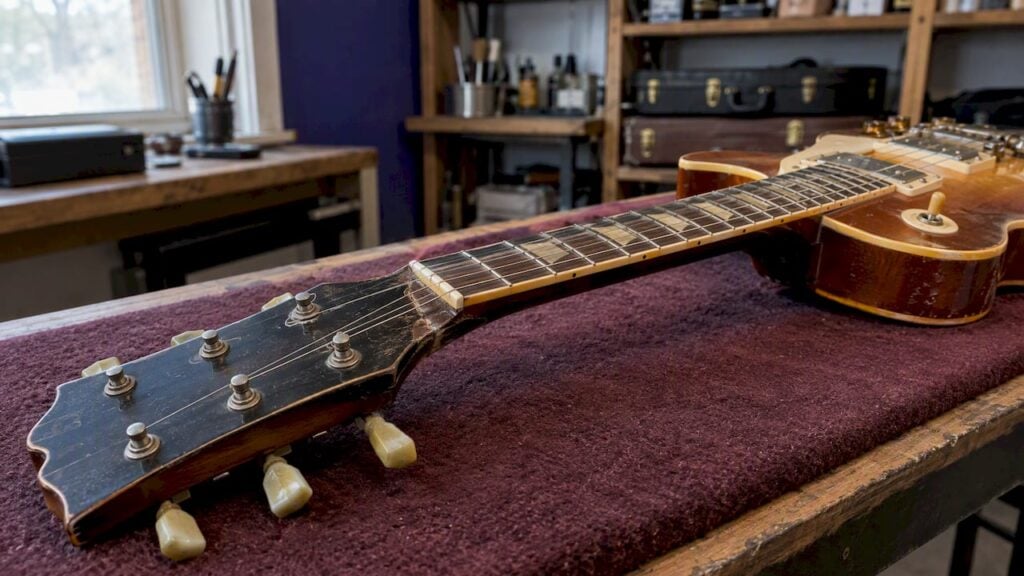

A broken and professionally repaired Gibson headstock lowers the value of the guitar, usually by a clearly noticeable margin, but not by the same amount every time. The discount depends on three things: how clean the break was, how well it was repaired, and how rare the guitar is. A 2016 Les Paul Tribute with a neat glue repair and a 1959 Les Paul with the same damage are two entirely different cases.
Below we explain why Gibsons break, what a discount looks like in practice, how to spot a repair, and how to decide whether to buy or sell a guitar with this history.
TL;DR
- A repaired headstock break typically lowers a Gibson’s market value. One often-repeated rule of thumb is a deduction of around one third, but that is a rough forum figure, not a fixed rate.
- The discount shrinks with a clean, well-documented, structurally reinforced repair, and grows with hidden, repeated or amateur repairs.
- Rare and collectible instruments lose far more in absolute terms, and for some collectors a break ends the investment case entirely.
- Breaks are less widespread than the internet suggests: Gibson’s own insurance data points to well under 1% of guitars.
- Before you buy or sell, get the repair inspected and the history written down. We offer valuation and certification for exactly this.
Table of Contents
- Why Gibson headstocks break in the first place
- What a headstock break does to a Gibson’s value
- Player’s guitar or collectible: two different markets
- How to recognize a repaired headstock
- What the repair itself costs
- Perspective: how we judge a Gibson with a repaired neck
- Selling a Gibson with a headstock repair
- Buying: when a repaired Gibson makes sense
- Preventing a break
- Frequently asked questions
- Sources
Why Gibson headstocks break in the first place
The discount makes more sense once you know the mechanism. According to Gibson’s own explanation in Guitar World, the breaks come from a combination of three factors: soft mahogany, a steep headstock angle, and a thin, weakened area of wood behind the nut where the truss rod cavity is routed. When a guitar falls, the force concentrates on that spot, and the neck snaps just behind the nut.
This is a design trade-off, not a manufacturing defect. The angled headstock keeps the strings firmly seated in the nut slots without string trees, and mahogany gives the guitar its tone and weight. The price is a weak point that a Fender-style straight headstock does not have in the same way.
How common is it really?
The same Guitar World interview puts the numbers in perspective. Gibson’s insurance data from the five years before 2025 suggests headstock breaks on privately insured guitars are around 0.2%, and the company estimates that fewer than 1% of all Gibsons ever made have had one. The impression that every second Les Paul has a repaired neck partly comes from the fact that this is a common repair job in workshops. Guitars that survive without a problem never show up in repair stories.
For you as a buyer this matters in one way: a clean, intact neck is the norm, and the market prices it that way. A guitar with a break history is the exception, so buyers ask for a discount.
What a headstock break does to a Gibson’s value
There is no official price table, and anyone who quotes you one exact percentage is guessing. What exists are rules of thumb and real negotiations.
In a German forum thread about a Les Paul Tribute with a headstock break after transport, the owner of a 2016 guitar bought for 875 € asked what loss in value to claim. One reply recalled that a well-repaired headstock break had been rated with a deduction of at least one third in the American Vintage Guitar Price Guide. Another reply pointed out that it depends heavily on how valuable the guitar is and how invisible the repair is. Both points are fair, and both match what we see.
Treat “one third” as a starting point for a conversation, not a formula. It was quoted from memory in a forum, and the market has moved since.
The factors that move the discount
| Factor | Smaller discount | Larger discount |
|---|---|---|
| Type of break | Clean, single break along the grain | Splintered, severed, missing wood |
| Repair method | Glue joint plus reinforcement (splines, backstrap, overlay) | Glue only, epoxy, soft dowels |
| Finish work | Touch-up, visible only under light | Full refinish of the headstock or neck |
| Documentation | Invoice, photos, named workshop | “It was always like this” |
| Number of repairs | One expert intervention | A repair on top of a repair |
| Model | Current production, mid-priced | Rare, early or collectible |
| Originality | Original parts and finish elsewhere | Already modified or refinished |
Why a second repair hurts more
The luthier Aaron Younce describes how cheap repairs often rely on materials that cannot cope with string tension: epoxy, or splines made of soft wood. Standard electric guitar strings pull with a force of roughly 130 lbs, and a weak repair eventually lets go. Redoing it can mean resetting the neck angle or carving out more original wood, which removes more of the instrument’s substance than one proper repair would have. So a guitar with one competent repair is a very different proposition from one that has failed twice.
Modern repair techniques can improve the neck
The same source explains that reinforcement such as carbon fiber splines or an added volute (a raised bump on the back of the headstock) can make the repaired area stronger than before. A volute mimics a feature Gibson itself used in the 1970s against this very problem. Technically, that is good news: a well-reinforced guitar is unlikely to break in the same place again. Commercially, it only softens the discount. Buyers who pay for originality still see a repaired neck, and a volute that was never on the original is a visible change.
Player’s guitar or collectible: two different markets
The answer to “what is it worth?” changes with who is buying.
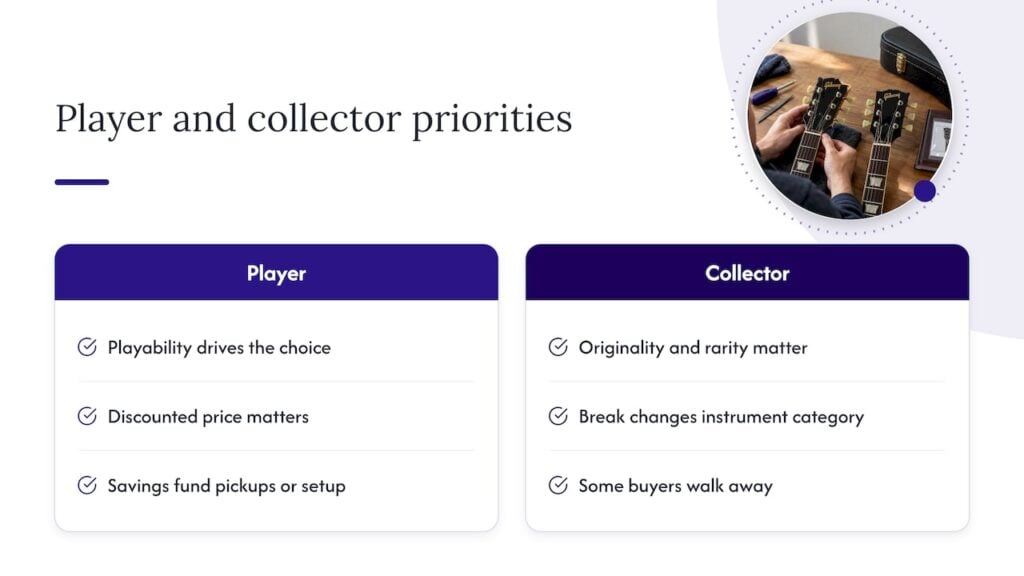
For players, a repaired Gibson can be a real bargain. If the repair is sound, the guitar sounds and plays like an unbroken one, and the discount is the whole point. Many musicians knowingly buy a repaired Les Paul or SG, because the money saved goes into better pickups or a proper setup. Listings that openly describe a professional repair, often with a clear price reduction, are a normal part of the used market.
For collectors, originality is the product. A break, even a flawless repair, interrupts the unbroken history of the instrument. For a rare vintage model the loss is not a third but can be far more, and in the top segment some buyers will simply walk away. That is why a collectible Gibson with a broken headstock must be valued by someone who knows the specific model and year, not by a rule of thumb.
If you are comparing the two worlds, our guide on vintage versus new guitars explains why originality weighs so heavily in the vintage segment.
How to recognize a repaired headstock
If you are about to buy a used Gibson, check the neck before you check the sound. Good repairs are hard to see, so look systematically:
- Look at the area just behind the nut under raking light from the side. Finish that is slightly too even, a different sheen, or a faint line across the neck is a warning sign.
- Check the back of the headstock for a ridge, a new bump, or an unusual overlay. A volute or backstrap is a clear sign of reinforcement.
- Look at the headstock veneer (the plate on the front). Cracks, lifting edges or a repainted logo can indicate that it was damaged and redone.
- Feel the transition between neck and headstock with your fingertips. A repair often shows up as a tiny step or ripple that your eyes miss.
- Check the tuners and the truss rod cover. Missing or mismatched parts sometimes mean a headstock was removed and refitted.
- Ask directly and ask for paperwork. A seller who knows of a repair has to tell you, and a documented repair is always worth more than a rumored one.
- Have it inspected if the price is high. A second pair of trained eyes costs little compared with a wrong decision on a four- or five-figure instrument.
A small overspray of the finish near the nut is not automatically a break repair, so avoid jumping to conclusions. What matters is the full picture: the finish, the wood grain across the join, and the seller’s story.
What the repair itself costs
Before you subtract an amount from the asking price, remember that two different numbers matter: the cost of repairing and the loss in resale value. They are not the same. A simple glue job on a mid-priced guitar can be done for a modest workshop fee, as the forum owner above learned when his technician estimated it from 60 €. But that fee tells you nothing about the value loss. The 875 € guitar and a 6,000 € guitar need roughly the same bench time, while the discount in euros differs enormously.
Workshop prices in Germany vary by region and by complexity. A clean break with no finish damage is the cheap end. A splintered break that needs reinforcement and refinishing sits at the expensive end, and it always has to be quoted after the guitar has been inspected. For the work we do on instruments, see our page on guitar restoration and its costs.
Perspective: how we judge a Gibson with a repaired neck
We handle vintage and collectible guitars every day, and a repaired headstock is one of the first things we look for in any instrument that comes through our hands. Our view is simple and consistent.
First, a repair is not a verdict. A properly done, reinforced and documented repair can leave a guitar perfectly playable, and we would rather see an honest repair than a hidden one. Concealment, not the break itself, is what destroys trust and value.
Second, the discount belongs to the buyer’s use. A player who wants a great-sounding Les Paul should treat a sound repair as a reason to negotiate. A collector should treat it as a change in the instrument’s category.
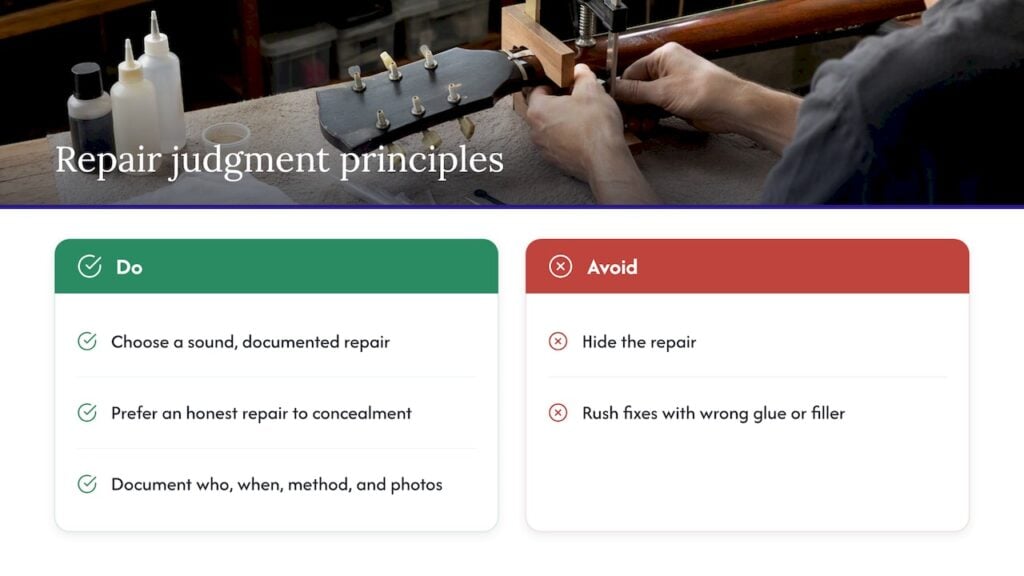
Third, do not repair what you do not need to repair in a hurry. A rushed fix with the wrong glue or filler can cost more value than the break itself. We cover the broader question of when to repair and when to preserve in our article on restoring or keeping the original condition.
Fourth, write everything down. Who repaired it, when, with which method, and photos before and after. That one sheet of paper often earns back a good part of the discount when you sell.
— Vintage
Selling a Gibson with a headstock repair
If you own one, you have three realistic options.
Sell it privately and disclose. State the break, the repair method and who did it, and add photos. Price it below a comparable intact guitar. This is quickest, but you carry the negotiation and any dispute afterwards. Concealing a repair can lead to claims against you, so always disclose it.
Keep it and play it. If the guitar is for you, the repair has already cost you the value. Playing it costs nothing more.
Have it valued first. If the guitar is rare, a written expert opinion helps you set a defensible price and gives buyers confidence. For collectible models, a wrong price in either direction is expensive.
Where we can help
Our services cover precisely these situations. We offer valuation and certification, commission sales and exclusive playing appointments for vintage and collectible instruments. Prices for these services are not published, so please get in touch with the details of your guitar. If your instrument needs work, our restoration service is the place to start. For a closer look at what a repaired break does to the price, you can also read our dedicated piece on the value of headstock crack repair.
Buying: when a repaired Gibson makes sense
A repaired Gibson can be a sensible purchase when the following are all true:
- The repair is documented, or an independent expert confirms it is structurally sound.
- The price reflects the break with a clear reduction against intact examples of the same model and year.
- You want to play the guitar, not hold it as an investment.
- The rest of the instrument is original and in good shape.
Walk away, or at least renegotiate hard, if the seller will not discuss the neck, if the repair looks like epoxy and filler with no reinforcement, or if there are signs of more than one repair. If you want a guitar with a clean history, browse our vintage guitars or our electric guitars, where each instrument comes with a detailed description.
Preventing a break
As the Guitar World interview notes, most breaks happen through falls, knocks and rough handling, so prevention is mostly about habits:
- Use a hard case or a well-padded gig bag for transport, and support the neck.
- Never lean a guitar against an amp or a wall without a stable stand. Use a stand with a neck yoke that holds the guitar securely.
- Put the guitar in its case, not on a seat, during breaks.
- Secure the guitar in the car and when shipping, with the headstock supported inside the case so it cannot move.
- Insure valuable instruments for transport and touring.
The forum case above, a break after transport, is a typical story. The guitar was fine until it was handled in a box.
Frequently asked questions
How much value does a Gibson lose after a headstock break?
There is no fixed rate. A frequently quoted rule of thumb from price guides is a deduction of about one third for a well-repaired break, but this figure is only a starting point. Rare vintage models can lose much more, and an invisible, documented repair on a standard model can lose less.
Is a repaired headstock worse than a new one?
Not necessarily in strength. A reinforced repair with splines or a volute can be stronger than the original neck. In market value, however, an unbroken original neck is still preferred, so the repaired guitar sells for less.
Do all Gibsons break at the headstock?
No. Gibson’s own insurance data suggests that only about 0.2% of privately insured guitars are affected over five years, and the company thinks that fewer than 1% of all Gibsons have ever had a break. The design has a weak spot, but most guitars never meet the conditions that break it.
Can I sell a Gibson with a repaired headstock?
Yes, as long as you disclose the repair honestly. Describe the break, the repair method and the workshop, add photos and price the guitar below intact comparables. For collectible instruments, a written valuation helps you defend the price.
Should I repair the break before selling?
If the break is fresh, a professional repair usually makes sense, because a guitar with an open break sells for far less than one with a clean fix. Choose a skilled workshop and keep the paperwork. For a rare instrument, have it valued before you decide, so you do not damage original substance.
Sources
- Gibson sets the record straight on headstock breaks, Guitar World
- Repairing a Broken Gibson Headstock and Adding a Volute
- Gibson Les Paul Tribute: Kopfplattenbruch nach Transport, Musiker-Board