













TL;DR:
- Proper flamenco guitar tuning involves controlled string stretching, selecting appropriate tension, and performing regular pre-performance checks to ensure pitch stability during demanding playing sessions. Using the right tools, matching string tension to the guitar’s build, and maintaining consistent environment conditions are essential for optimal response and tone. Developing a disciplined tuning routine and preparing the instrument well before performances prevents tuning issues and enhances overall musical expression.
The guitar tuning process for flamenco is defined as the systematic preparation of string tension, pitch calibration, and instrument setup required to achieve the tone, responsiveness, and stability that flamenco music demands. Unlike classical or acoustic guitar tuning, flamenco tuning involves specific string choices, controlled stretching techniques, and setup adjustments that directly affect percussive articulation, rasgueado clarity, and picado speed. Getting this process right separates a guitar that sings from one that fights you on stage. The tools you need include a chromatic clip-on tuner, high-tension or medium-tension nylon strings, a string winder, and wire cutters.
What tools do you need for tuning a flamenco guitar?
The right materials determine how well your tuning holds under the physical demands of flamenco playing. Choosing the wrong string type or tension category is the most common mistake players make before they even start tuning.
String types and tension categories:
- Nylon strings are the traditional choice for flamenco guitars. They produce warm, full tone and are available in low, medium, and high tension.
- Fluorocarbon strings offer brighter projection and faster attack. They hold pitch slightly better in humid conditions. You can compare nylon vs. fluorocarbon strings in detail to decide which suits your playing style.
- Low-tension strings feel easier to play but reduce volume and projection. They are not ideal for the percussive demands of flamenco.
- High-tension strings deliver more volume and sustain but require proper setup adjustments to avoid buzzing and action problems.
Tuning devices:
- A chromatic clip-on tuner like the Snark SN-5 or D’Addario NS Micro is the most reliable option for live and practice settings.
- Tuning apps like GuitarTuna work well for home practice but can struggle in noisy environments.
- A strobe tuner offers the highest accuracy and is worth using for recording sessions.
Other tools:
- A string winder speeds up string changes and reduces strain on tuning pegs.
- Wire cutters trim excess string length cleanly after installation.
- A soft cloth protects the soundboard during string changes.
Pro Tip: Match your string tension to your guitar’s build. Flamenco guitars built with lighter tops and lower bracing respond best to medium-tension strings. High-tension strings on a lightly built guitar can reduce volume and responsiveness rather than improve them.
How does the step-by-step flamenco tuning process work?
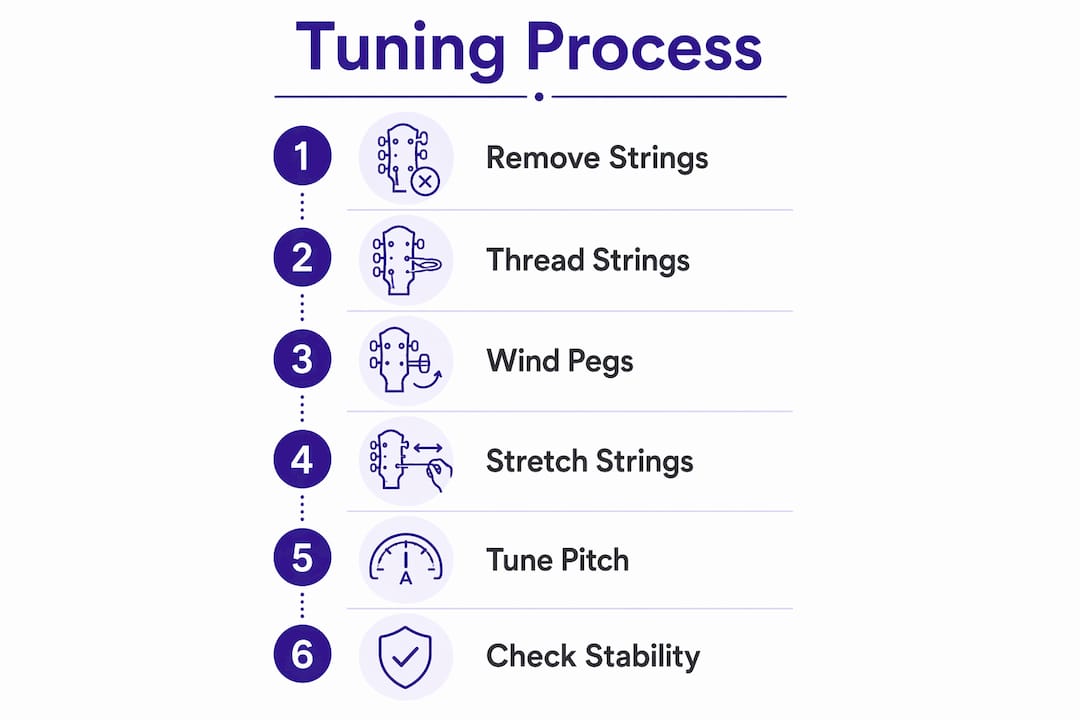
The full process covers string removal, installation, stretching, and final pitch calibration. Each step affects the next, so skipping any one of them costs you tuning stability.
Step 1: Remove old strings and clean the guitar
Loosen each string fully before cutting. Remove strings one at a time rather than all at once to avoid sudden tension release on the top. Once the strings are off, wipe down the fretboard with a dry cloth and inspect the nut slots and saddle for wear.
Step 2: Thread new strings through the bridge
Flamenco guitars use a tie-block bridge. Pass the string through the hole, loop it back over itself twice, and pull tight. A loose bridge knot is the most common cause of tuning failure in the first hour of playing.
Step 3: Wind strings onto the tuning pegs
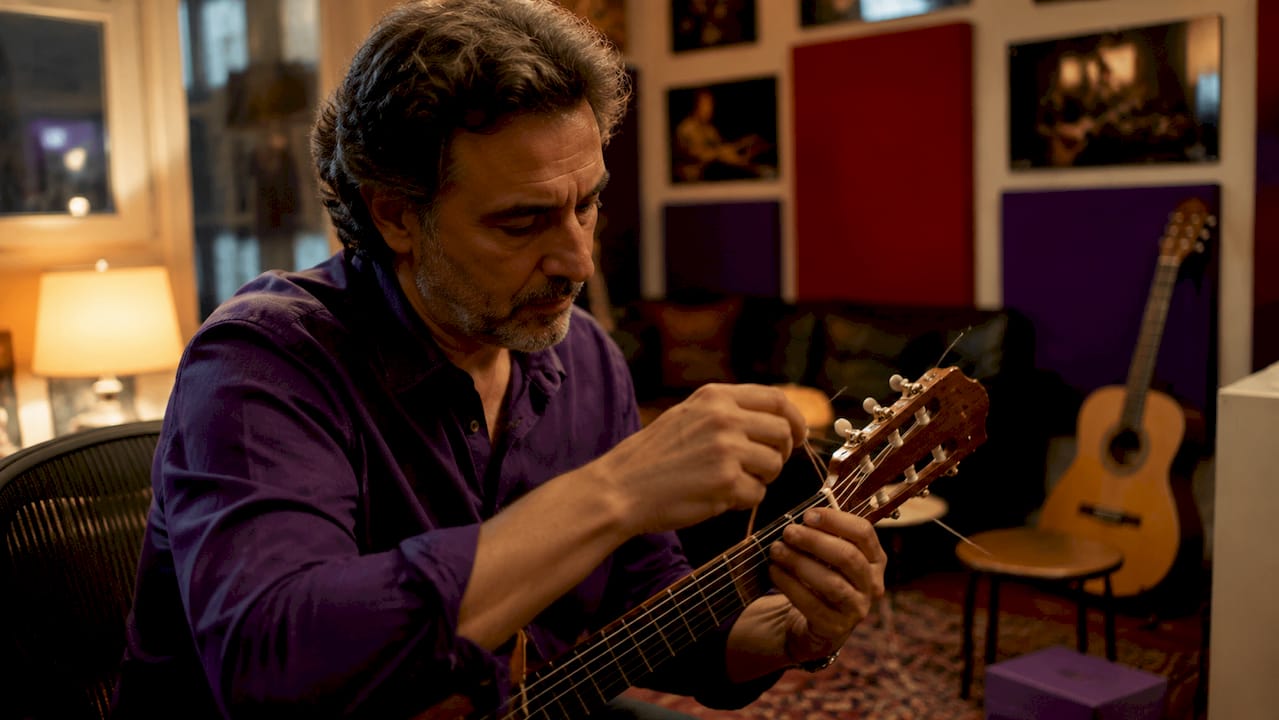
Leave enough slack for 2–3 winds around the peg. Wind downward so the string locks against itself. Fewer winds mean less material to stretch and faster tuning stability.
Step 4: Apply controlled stretching
Controlled stretching by gently pulling each string away from the fretboard multiple times stabilizes tuning faster without degrading the string. Apply approximately 3–4 pounds of lateral force three times in the first hour, tuning between each stretch. This technique is far more effective than the old trick of tuning a half-step high overnight. That method actually harms the elastic polymer in nylon strings and shortens their life.
Step 5: Tune to pitch using a chromatic tuner
Tune from the lowest string (E2) to the highest (E4). Always approach pitch from below. Tuning up to a note is more stable than tuning down to it.
Step 6: Check stability and repeat
New high-tension strings require 2–4 hours of break-in playing to reach stable pitch and tone. Aggressive playing during break-in causes uneven stretching and dead spots. Play lightly, retune every 15–20 minutes, and repeat the stretching cycle until the pitch holds.
| Stage | Action | Expected Outcome |
|---|---|---|
| Bridge threading | Double loop knot | Secure anchor, no slippage |
| Peg winding | 2–3 downward winds | Minimal stretch material |
| Controlled stretching | 3–4 lb force, 3 times | Faster pitch stability |
| Break-in playing | Light play for 2–4 hours | Even string response |
| Final tuning check | Chromatic tuner, tune up | Accurate, stable pitch |
Pro Tip: Change your strings 3–5 days before a recital or performance. This gives nylon strings enough time to settle fully while leaving room for final adjustments on the day of the show.
What is the best tuning for flamenco guitar?
Standard tuning (E A D G B E) is the foundation of virtually all flamenco playing. Most flamenco music is performed in standard tuning, with alternate tunings reserved for specific styles and compositions.
The most recognized alternate tuning in flamenco is Rondeña, which uses D A D F# B E. This tuning lowers the sixth and third strings and raises the fourth, creating an open resonance that suits the Rondeña palo specifically. It changes fingerings significantly and is not practical for general flamenco repertoire.
| Tuning | Pitches | Common Use |
|---|---|---|
| Standard | E A D G B E | All palos, everyday practice |
| Rondeña | D A D F# B E | Rondeña palo, specific compositions |
| Drop D | D A D G B E | Occasional use in modern flamenco fusion |
Tuning above A=440Hz is sometimes discussed for tonal brightness, but the trade-off is real. Higher pitch increases string tension beyond the guitar’s design tolerance. Flamenco guitars have lower tolerance for high string tension compared to classical guitars. Excessive tension reduces volume, responsiveness, and can cause higher action and buzzing. The standard A=440Hz reference pitch is the correct target for most flamenco players.
String tension also shapes technique directly. Medium-tension strings allow faster rasgueado because the strings rebound quickly. High-tension strings give more resistance, which can slow down rapid picado runs until your fingers adapt. Choosing tension is not just a tone decision. It is a technique decision.
How do you fix tuning instability on a flamenco guitar?
Tuning instability on a flamenco guitar usually has one of four causes: new strings still stretching, incorrect nut slot sizing, bridge knot failure, or environmental changes. Identifying the source quickly saves you from chasing a problem that has a simple fix.
Common causes and solutions:
- New strings still stretching: Repeat the controlled stretching cycle. Do not skip this step or rush it.
- Nut slot too narrow: When upgrading to high-tension strings, nut slots should be widened by 0.2–0.3 mm at the 12th fret, with saddle compensation. A slot that is too narrow pinches the string and causes it to snap back to pitch unevenly.
- Bridge knot slipping: Re-thread the string with a proper double loop. A single loop will not hold under flamenco’s percussive attack.
- Action too high or too low: Changing string tension changes the forces on the neck and saddle. If you switch tension categories, have a luthier check the action before your next performance.
Instrument preparation is as crucial as musical technique for flamenco guitarists. Overlooked setup reduces the response and decay that are central to flamenco expression. (Source)
Environmental changes such as temperature and humidity can rapidly affect flamenco guitar tuning during transport and performance. Use a rigid case and avoid leaving the guitar in a car or near heating vents. A 10-degree temperature swing is enough to pull your guitar noticeably out of pitch.
You can also review common guitar owner mistakes to catch setup errors that most players overlook until they cause real problems on stage.
How do you maintain tuning stability during performances?
Consistent tuning during a flamenco performance requires a structured routine, not just a quick check before you walk on stage. Proper action and tuning stability are foundational before you attempt advanced rasgueado and picado techniques. Shaky tuning undermines every technique built on top of it.
- Tune during warm-up, not just before. Your fingers and the strings both need time to reach playing temperature. Tune at the start of warm-up, then recheck at the end.
- Check tuning between pieces during a gig. Flamenco’s percussive golpe technique and heavy strumming pull strings sharp over time. A quick check between palos takes 30 seconds and prevents embarrassing drift.
- Replace strings on a schedule. Old strings lose brightness and elastic response, making tuning unstable and playing harder. For active performers, replace strings every 2–4 weeks. For regular practice players, once a month is a reasonable minimum.
- Store the guitar correctly. Keep it in a case with a humidity control pack when not in use. Consistent humidity prevents the wood from expanding and contracting, which shifts the neck angle and action over time.
Pro Tip: Lay the guitar flat in its case rather than standing it against a wall when storing it overnight before a performance. This reduces the chance of accidental knocks and keeps the neck under consistent, even pressure.
For a full preparation checklist before your next performance, the flamenco guitar preparation guide at Vintage-guitar-world covers every step from string installation to stage-ready setup.
Key takeaways
Proper flamenco guitar tuning requires controlled string stretching, correct tension selection, and consistent pre-performance checks to maintain pitch stability under demanding playing conditions.
| Point | Details |
|---|---|
| String tension matters | Match tension to your guitar’s build; high-tension strings on light tops reduce volume and response. |
| Controlled stretching is required | Apply lateral force 3 times in the first hour and tune between stretches to stabilize pitch faster. |
| Change strings before performances | Replace strings 3–5 days before a recital to allow full settling before the show. |
| Standard tuning is the default | E A D G B E covers virtually all flamenco palos; alternate tunings like Rondeña are style-specific. |
| Environment affects pitch | Use a rigid case and humidity control to protect tuning stability during transport and storage. |
What i’ve learned from years of watching flamenco guitars get tuned wrong
The most consistent mistake I see is players treating flamenco guitar tuning as an afterthought. They spend months on technique and minutes on setup. The result is a guitar that fights them every time they sit down to play.
String tension choice is where most players go wrong first. There is a widespread assumption that high-tension strings always sound better. They do not, especially on lighter flamenco builds. I have handled guitars that lost half their projection after a player switched to high-tension strings without adjusting the nut or saddle. The guitar went from alive to dull in one string change.
The controlled stretching method is not optional. It is the difference between a guitar that holds pitch through a full performance and one that drifts by the third piece. Players who skip it always pay for it on stage.
Developing a disciplined tuning routine is what separates prepared performers from reactive ones. Tune during warm-up. Check between pieces. Replace strings on a schedule. These habits take less time than fixing a tuning problem mid-performance. If you want to go deeper on finding the right instrument to support these habits, the vintage flamenco guitar selection at Vintage-guitar-world is worth exploring. A well-built guitar holds tuning better and rewards good preparation with better tone.
— Vintage
Find the right flamenco guitar and strings at Vintage-guitar-world
Getting your tuning process right starts with having the right instrument. A poorly built guitar will fight your setup work at every step.

Vintage-guitar-world carries a curated selection of handcrafted flamenco guitars built to the structural standards that make proper string tension and tuning stability achievable. Each instrument is evaluated for playability, action, and tonal response before it reaches you. Whether you are looking for a performance-ready flamenco guitar or want expert guidance on string selection and setup, Vintage-guitar-world offers the knowledge and inventory to match. Browse the full collection and find an instrument that supports your playing from the first string change onward.
FAQ
What is standard flamenco guitar tuning?
Standard flamenco guitar tuning is E A D G B E, identical to standard guitar tuning. Most flamenco palos and techniques are built around this reference, with A=440Hz as the standard pitch reference.
How long do new flamenco strings take to settle?
New high-tension flamenco strings require 2–4 hours of break-in playing to reach stable pitch. Controlled stretching during this period speeds up the process significantly.
What is rondeña tuning on a flamenco guitar?
Rondeña tuning uses D A D F# B E and is specific to the Rondeña palo. It changes the tonal character and fingerings considerably and is not used for general flamenco repertoire.
When should i change flamenco guitar strings?
Change strings 3–5 days before a performance to allow full settling. For regular players, replacing strings every 2–4 weeks maintains tone and tuning stability.
Can i use high-tension strings on any flamenco guitar?
No. Flamenco guitars have lower structural tolerance for high tension than classical guitars. Switching to high-tension strings without nut slot and saddle adjustments causes buzzing, higher action, and reduced volume.